








How GCCs are powering AI-native customer service

How GCCs are powering AI-native customer service

Discover why GCC-led Centers of Excellence are becoming important to scaling AI-native customer service transformation.


In brief

  • Up to 40%–50% of customer service interactions have self-service potential but realizing that value requires the right operating model.
  • GCC-led Centers of Excellence help enterprises scale AI-native customer service through centralized ownership, governance and execution.
  • India combines deep AI talent, a growing innovation ecosystem, and a 3x–5x cost advantage to support AI-native customer service operations.

Customer service complexity is growing faster than most operating models can keep up. Demand for personalized, seamless customer service experiences across channels is putting pressure on organizations, along with managing growing interaction volumes, always-on global operations and increasingly stringent regulatory requirements. This combination of scale and complexity is driving enterprises to rethink how customer service is organized and delivered, accelerating the shift toward AI-led customer experience and broader customer experience transformation initiatives.

EY Competency Connect - Smarter talent decisions, powered by AI

Competency Connect is an AI-powered, end-to-end assessment platform by EY, designed to redefine how organizations measure capability and potential.

Know more

This complexity compounds when service delivery is fragmented across markets. Different regions often solve the same problems differently. As a result, organizations struggle to deliver consistency, efficiency and intelligence at scale. Companies that address these challenges can transform customer service from a transactional support function into a strategic driver of brand perception, customer retention and loyalty.


Multinational firms have responded by centralizing customer operations, which can help standardize processes across markets. India has become the natural home for this, already running the largest share of centralized global service delivery for multinational enterprises. But centralizing delivery is only the first step. The real question is whether that operating model captures AI's full value or is it simply running AI on the same fragmented structure it was meant to fix. Increasingly, leading Global Capability Centers (GCCs) are emerging as the preferred platform for scaling AI customer experience transformation and enterprise-wide customer operating model redesign.

ey-how-gccs-are-powering-ai-native-customer-service-chapter-1
1

Chapter 1

From automation to autonomous value creation

Customer service is shifting from AI-assisted automation to AI-led journeys where agents, AI systems and enterprise workflows work together.

Today, Agentic AI in customer service moves beyond automation and personalization to autonomous value creation, enabling AI-driven customer journeys, where AI agents understand intent, collaborate with humans, and take actions across the front, middle, and back office to drive cost efficiency, satisfaction and revenue growth together.

This value shows up across two tiers. The first is mass automation: call summarization, after-call work, and next-best-action recommendations. Industry estimates suggest 40%–50% of call types have self-service potential through chatbots or Intelligent Virtual Assistants (IVAs), while AI can automate ~20%–30% of agent workload, freeing human agents for empathy and complex problem-solving[1]. The second is high-leverage autonomy, where AI agents reason across touchpoints in real time, detecting a service lapse, prioritizing it by customer value and triggering a retention offer.

Capturing either tier at scale is an operating model problem, not just a technology one. Sustained value creation requires a clear AI customer service strategy, robust operating governance and enterprise ownership of the underlying Agentic AI operating model. Whether Agentic AI becomes a point solution or a genuine strategic capability comes down to how well a company solves that ownership question.

Why capturing AI value requires a GCC-led CoE

EY Customer Service and Sales Acceleration Suite: AI-driven customer excellence

Our AI-powered platform unifies fragmented customer processes into a single intelligent flow, learning from your knowledge base and operating within your current tech stack.

Know more

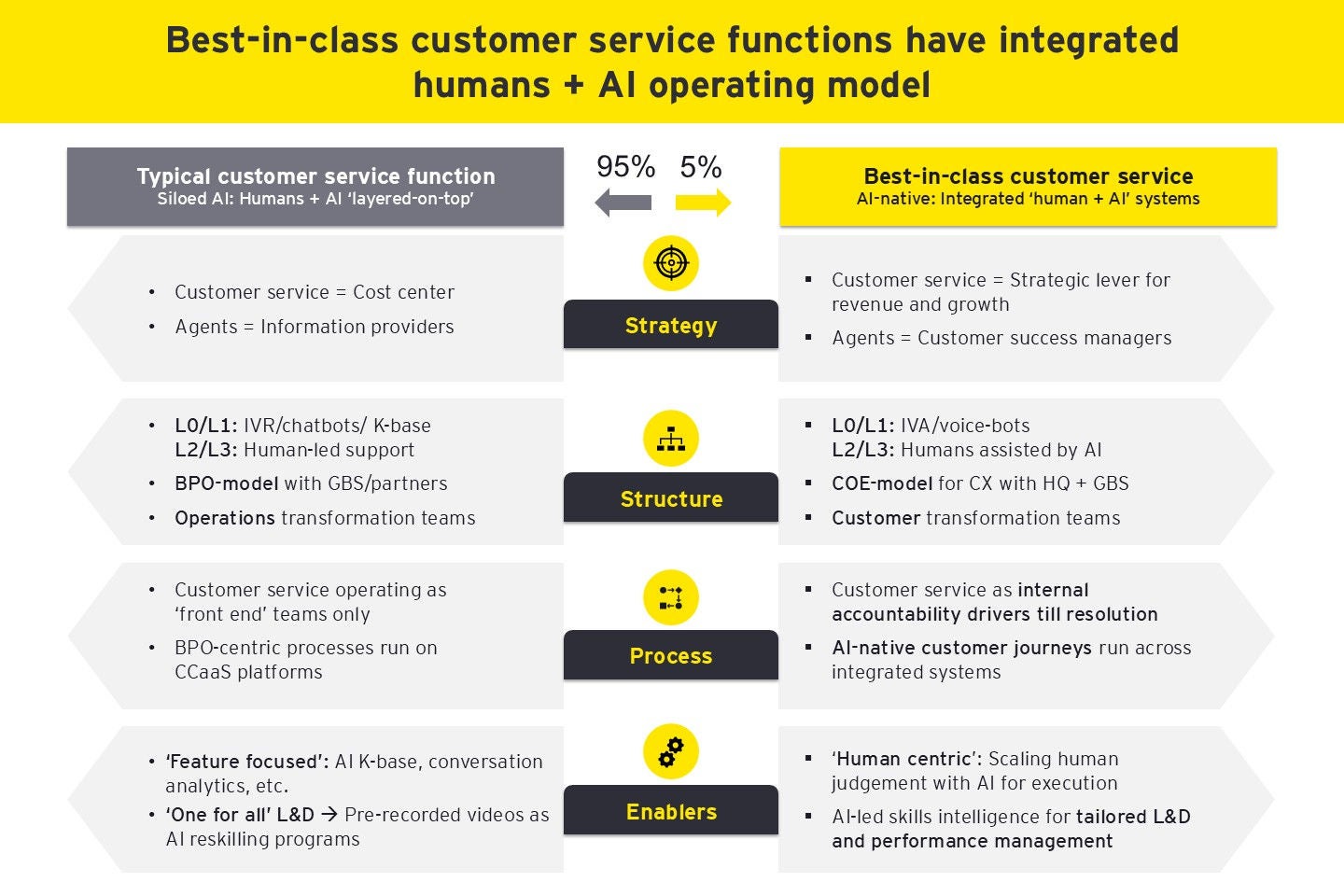
Most firms today still run a layered model: customer service agents function as information providers, with L0 queries (fully self-serve, no human involvement) and L1 queries (routine issues resolved through basic guided support) going to Interactive Voice Response (IVR) systems and static knowledge bases, while AI sits on top as an add-on rather than a core part of delivery. This problem is often amplified in business process outsourcing (BPO) outsourced service models, where contracts with third parties are structured around interaction volume, capacity and service-level agreement (SLA) compliance, creating limited incentives for transforming customer journeys through automation and AI. This widens the gap for owning and advancing AI capability, as there is limited accountability for how AI is designed, scaled, or improved over time. As a result, many organizations struggle to move beyond isolated AI deployments to achieve meaningful customer service transformation or long-term AI-enabled service delivery.


Best-in-class firms operate differently. They route ownership of AI-native customer experience transformation through a GCC-based Center of Excellence (CoE): customer service agents act as customer success managers, L0/L1 queries run through IVA voice bots and L2/L3 (more complex or sensitive cases requiring human judgment) issues go to humans working alongside AI. The CoE provides the global framework to design, deploy and govern AI-native customer journeys end-to-end, and scale them consistently across markets.

Figure: Evolution of customer service operating models from traditional to AI-native
Evolution of customer service operating models from traditional to AI-native-1

This structural shift makes AI’s value sustainable rather than incremental. Firms running the CoE-led model retain customers, grow revenue, and compound institutional knowledge over time because of the centralized ownership model to build AI-native customer journeys. India's Global Capability Centers provide a vantage point to build these CoE models and centrally govern them to unlock the full potential of Agentic AI.


ey-how-gccs-are-powering-ai-native-customer-service-chapter-2
2

Chapter 2

Why India's talent, ecosystem and costs suit AI-native CX CoEs

India combines AI-native CX talent, a growing enterprise technology ecosystem and cost efficiency to drive GCC-led CX transformation.

Building and governing the CoE model at scale requires a specific combination of resources, and India offers three structural advantages that few markets can match.

  • Talent: India has close to 6,00,000 AI-native CX professionals, representing 16% of the global pool and the second-largest concentration after the US, with the talent base projected to grow 2x by 20272. An EY survey found that 84% of employees are ready to embrace Agentic AI in their roles3, becoming a key enabler of enterprise AI adoption.
  • Ecosystem: More than 500 AI-led CX platform companies operate from India, and enterprises are setting up Agentic AI labs across BFSI, healthcare and retail, with 83% of GCCs investing in GenAI and 58% in Agentic AI systems4.
  • Cost: India operates at roughly 3x–5x lower cost than other regions, letting Global Capability Centers scale efficiently while advancing toward higher-value AI work.

How AI-native CX architecture, CoE ownership and enterprise integration work together

Talent, ecosystem and cost base can only translate into consistent service if the CoE owns how AI solutions connect into enterprise systems day to day. GCC CoEs integrate AI with CRM, ticketing and service platforms, maintaining knowledge governance centrally, creating a unified customer view that drives faster resolution compared to deployments where each market runs its own disconnected AI layer. This same principle of dedicated ownership plays out differently by sector, but with the same underlying logic: in retail, CoEs own the knowledge base and global operations workflows behind order and delivery queries; in manufacturing, they design triage logic and analytics that surface complaint patterns early; in technology product support, they build knowledge bases for L1 resolution and govern continuous improvement; and in healthcare and other services, they run patient-centric workflows, escalating appropriately while preserving empathy. In every case, it is the CoE’s consolidated ownership, which is not a specific tool or workflow, that makes the AI-native model consistent at scale.

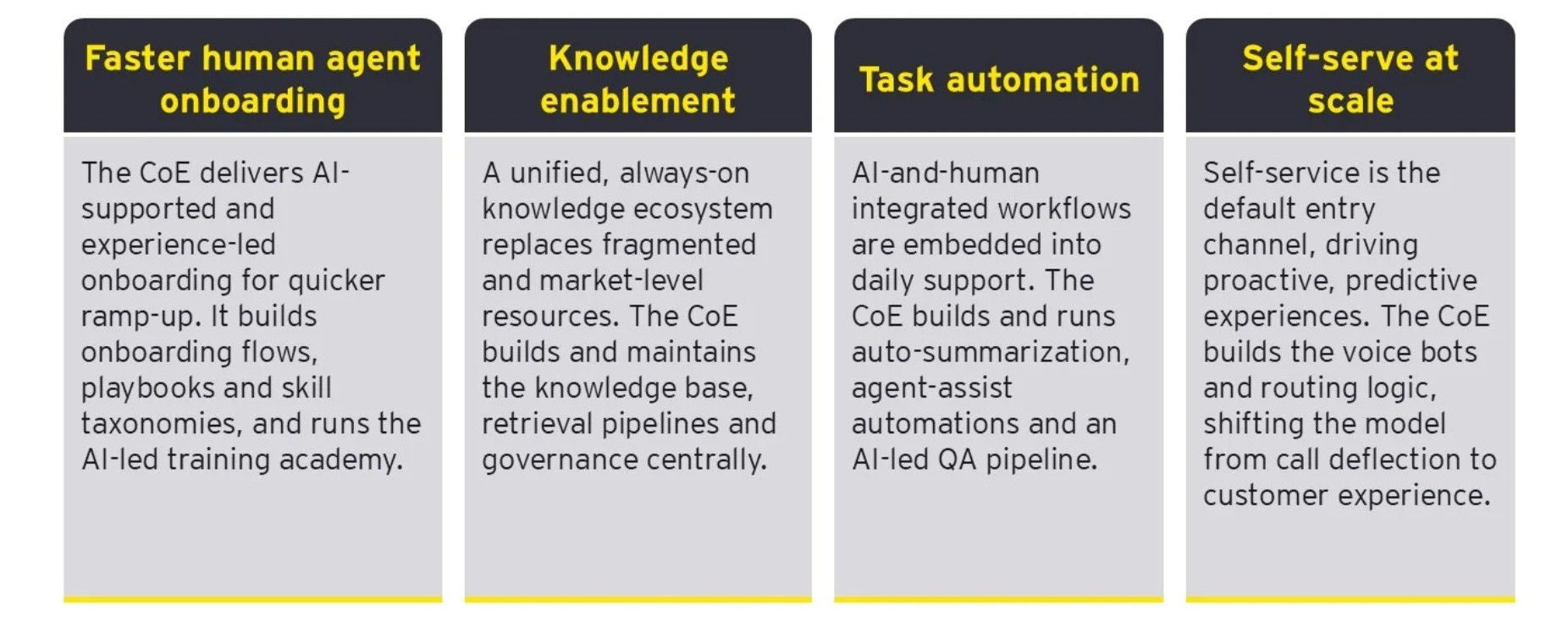
This model is already in place. For instance, a leading tech conglomerate with more than 35,0005 customer service agents transformed its operating model by positioning its India-based CX CoE as the capability hub for AI-native service, rather than running AI through scattered local initiatives. The CoE took ownership across four areas:

Evolution of customer service operating models from traditional to AI-native-2

The value delivered reflects what CoE ownership makes possible: collaboration efficiency improved as agent-to-agent coordination time fell roughly 13% indicating faster access to information, chat case-handling time dropped up to roughly 16% translating into quicker resolution per customer interaction, and automated processing reduced manual work by roughly 80% in select use cases, freeing customer service agents for high-value, complex problem-solving.5

What CXOs should do next

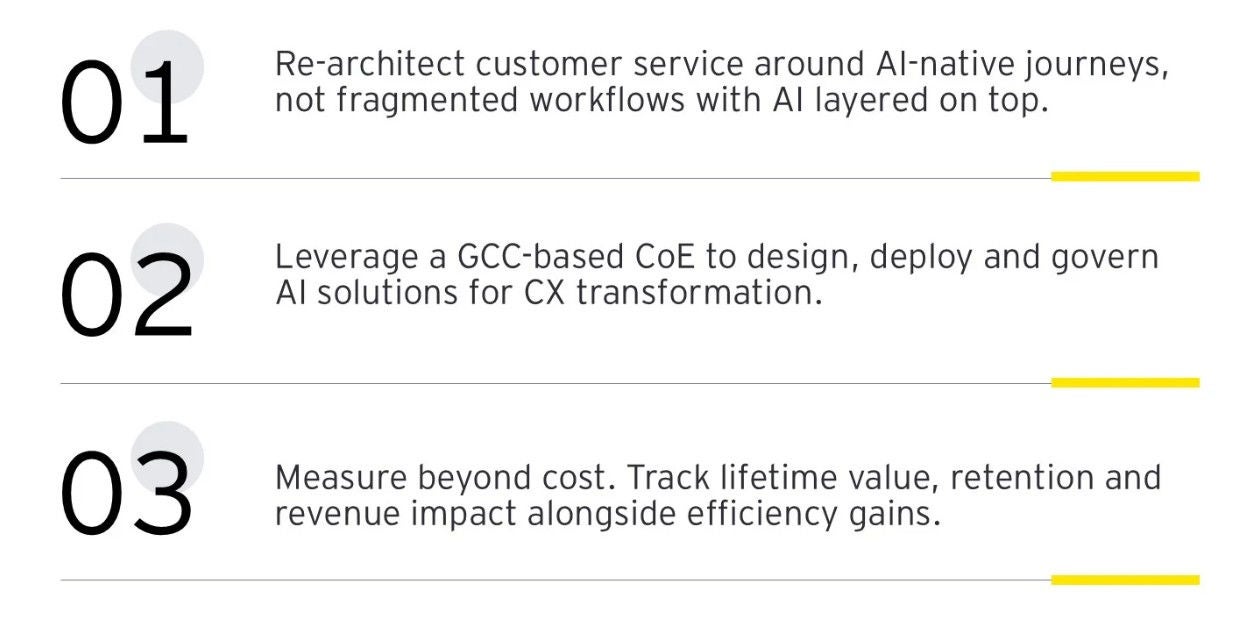
The next step for CXOs is to make three shifts in leadership approach:

Evolution of customer service operating models from traditional to AI-native-3

AI Academy
Empowering GenAI training and talent transformation

AI Academy enables enterprises to scale AI training and upskill their workforce, equipping employees to adapt and innovate in the GenAI era.

Know more

Organizations that embrace a GCC-led customer transformation agenda will be better positioned to scale AI-powered contact center operations, modernize customer engagement, and create an AI-native customer operations capability built for long-term growth. The future belongs to enterprises that treat AI not as a standalone technology initiative, but as a catalyst for digital customer service transformation and broader AI-led business transformation.


Acting on these shifts separates transformation leaders from firms that stall at cost savings alone. The winners move beyond legacy BPO models, built on interaction volume, capacity and SLA compliance, toward AI-native Global Capability Center models built on outcomes and continuous value creation. India’s Global Capability Centers bring talent, ecosystem, and scale to build and operate these CoEs, making them the operating core of next-generation customer service — not replacing people with AI, but combining human expertise with AI to deliver measurable business outcomes.

Learn more about GCC-powered customer experience transformation


Summary

Customer service is moving beyond AI automation to AI-led experiences. GCC-led Centers of Excellence can help organizations scale AI, redesign customer operations and deliver consistent, high-value customer experiences, with India emerging as a leading hub due to its talent, ecosystem and cost base.

Related articles

Why GCC operating models offer a new competitive advantage

GCCs are shifting from cost centers to strategic hubs, with evolving operating models to drive business transformation.

How a strong trade credit policy drives business growth and liquidity

Read how a strong trade credit policy with GCC support enhances growth, protects liquidity and improves risk management through structured controls and analytics.

How are Agentic AI GCCs shaping enterprise operating models

Learn how agentic AI is redefining Global Capability Centers as enterprise intelligence hubs, shifting from cost efficiency to AI-first autonomous models.


About this article