









EY refers to the global organization, and may refer to one or more, of the member firms of Ernst & Young Global Limited, each of which is a separate legal entity. Ernst & Young Global Limited, a UK company limited by guarantee, does not provide services to clients.
How EY can help
-
EY and SAP create a future where responsible AI solutions solve complex challenges through people-centered collaboration and intelligent data capabilities.
Read more
Enterprise resource planning (ERP) redesigns typically prompt the reimagining of a company’s business. These redesigns can drive significant changes across front-, mid-, and back-office functions. These changes enhance data visibility, analytics, security, compliance and M&A readiness while accelerating innovation.
Front-office improvements may include optimized order-to-cash processes and personalized customer interactions through real-time data access. In supply chain and manufacturing, enhancements can involve better demand planning, automated warehouse processes and real-time inventory visibility. Back-office transformations often lead to faster financial closes and centralized financial data management.
This front-to-back-office scope leads to several unique challenges:
- Broader and deeper cross-functional involvement: while other transformations may focus on a single function, SAP S/4HANA transformations often touch multiple end-to-end processes and teams, also impacting edge systems and tools. This emphasizes the importance of radical collaboration. It often means a broader-reaching change impact. The wider organization must be brought along and engaged in the change journey.
- Rapid, strategic decision-making on future business design: depending on its scope, the SAP S/4HANA transformation could require business and functional leaders to make cross-functional decisions. Enterprise business process owners (EBPOs) or global process owners (GPOs) may need to decide in real time about future operating model and functions’ processes, policies and ways of working. Engaged C-suite and empowered leaders are essential to keep momentum and avoid constant escalation to executive leadership.
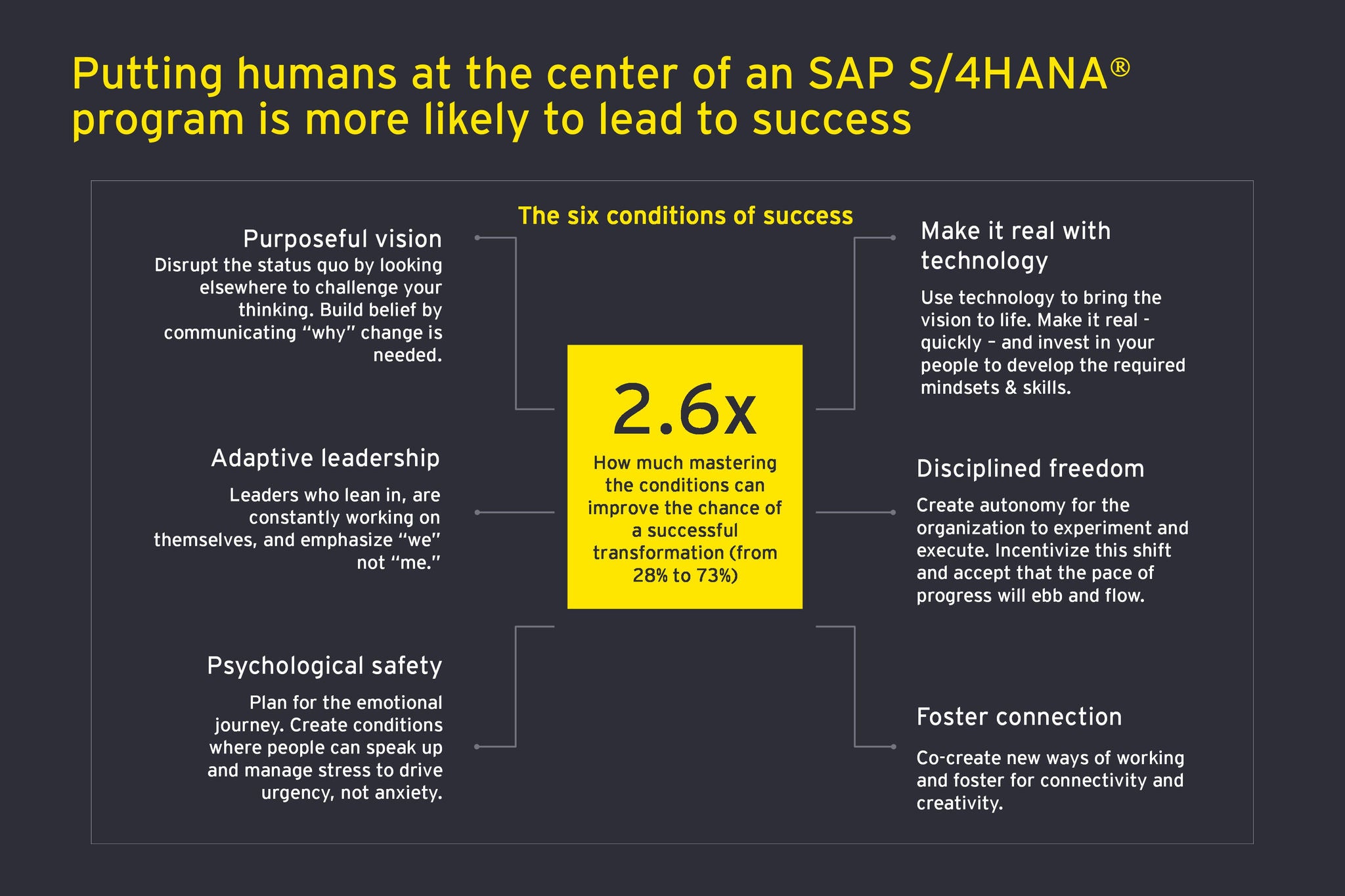
- Misconception as IT projects: the above dynamics clearly illustrate that treating these programs as purely technical ones can delay meaningful business input. End-to-end process alignment, cross-functional decision-making and business-driven governance are most critical. As Vaidy Subramanian, CDIO at Daikin North America, puts it, “Technology doesn’t transform the business; people do.” Organizations must treat this type of transformation not just as a technology initiative, but as a truly business-driven and human-led one, embedding empathy, leadership, trust and collaboration into every phase of the journey.