









Woman seeing outside

How to increase SAP S/4HANA® transformation success: the human factor

Unique complexities mean that SAP S/4HANA transformation success hinges on adaptive leadership, trust and empowered teams.


In brief

  • Despite a 67% failure rate in transformations, success hinges on human behaviors and leadership — not just strategy and data.
  • Interviews with 15 transformation leaders revealed that adaptive leadership, psychological safety and disciplined freedom are pivotal for SAP S/4HANA success.
  • Treating SAP S/4HANA programs as business-driven transformations — rather than IT projects — empowers teams, accelerates decision-making and fosters trust.

In a world of constant disruption, organizations are still grappling with high failure rates in their quest for transformational change. Comprehensive research by EYGS LLP and the University of Oxford’s Saïd Business School suggested a 67% failure rate for transformations. However, the research also revealed a startling insight. Success isn’t driven by data and strategy alone. Human behaviors and the conditions that influence them play a pivotal role.

The research explores human factors influencing the success and value derived from a SAP S/4HANA transformation program. With the looming 2027 end-of-maintenance deadline for SAP ERP Central Component (ECC), the stakes have never been higher.

Given the large and complex nature of these programs, it is hypothesized that some human conditions are more critical for success than others.

From April through September 2025, we conducted interviews with 15 transformation leaders and practitioners, representing national and global organizations across six sectors with annual revenues ranging from US$2.5b to over US$100b, to gather their insights on the challenges of S/4HANA modernization programs. These discussions helped identify compelling use cases.

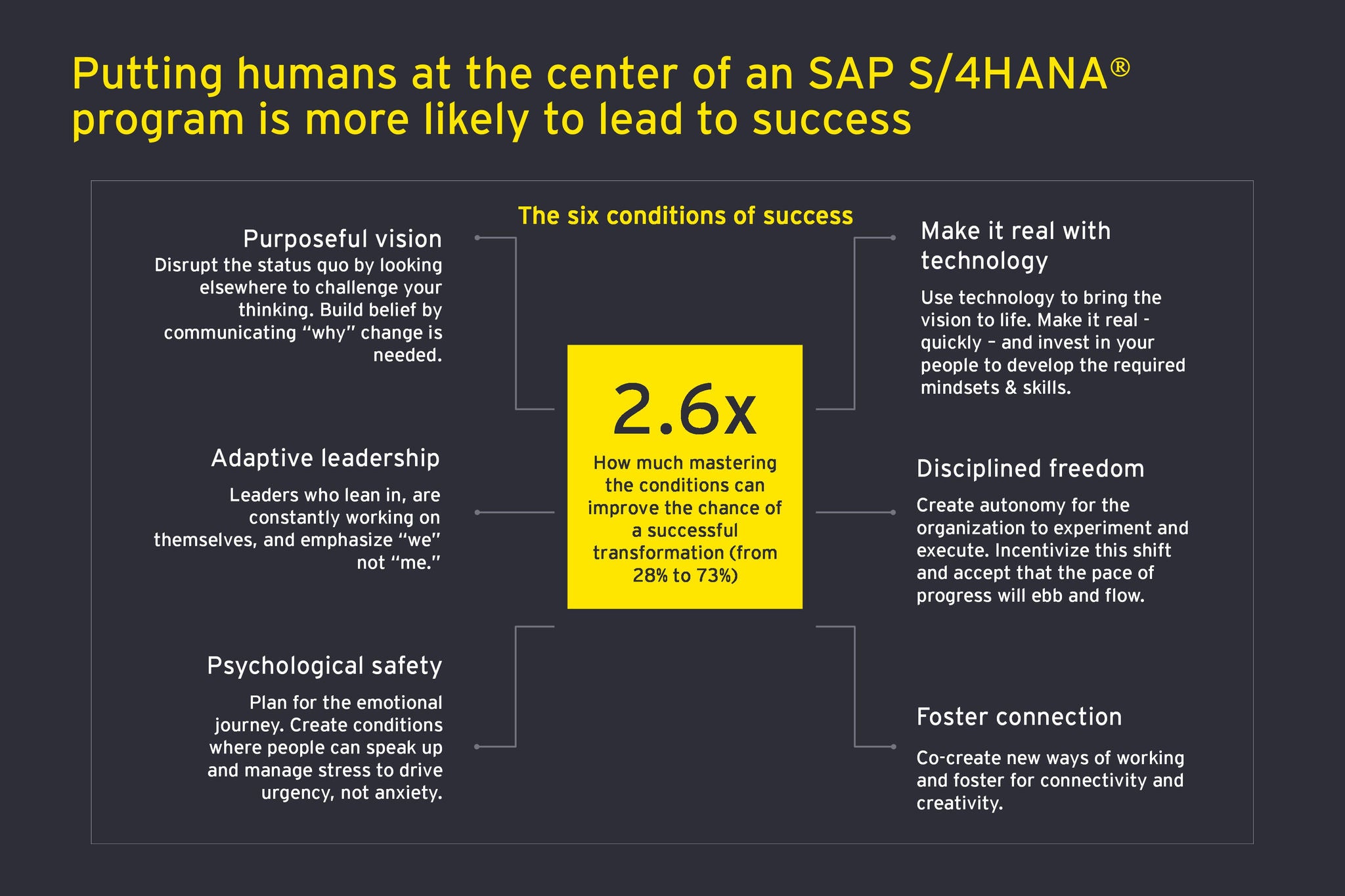
They also provided the context to prioritize the six key conditions for successful transformations identified in the research collaboration between EY and Oxford. 

Shot of a businessman working late in an office
1

Chapter 1

What makes SAP S/4HANA transformations uniquely challenging

SAP S/4HANA transformations are broad, cross-functional efforts that require technological, business and organizational change.

Enterprise resource planning (ERP) redesigns typically prompt the reimagining of a company’s business. These redesigns can drive significant changes across front-, mid-, and back-office functions. These changes enhance data visibility, analytics, security, compliance and M&A readiness while accelerating innovation.


Front-office improvements may include optimized order-to-cash processes and personalized customer interactions through real-time data access. In supply chain and manufacturing, enhancements can involve better demand planning, automated warehouse processes and real-time inventory visibility. Back-office transformations often lead to faster financial closes and centralized financial data management.


This front-to-back-office scope leads to several unique challenges:

  • Broader and deeper cross-functional involvement: while other transformations may focus on a single function, SAP S/4HANA transformations often touch multiple end-to-end processes and teams, also impacting edge systems and tools. This emphasizes the importance of radical collaboration. It often means a broader-reaching change impact. The wider organization must be brought along and engaged in the change journey. 
  • Rapid, strategic decision-making on future business design: depending on its scope, the SAP S/4HANA transformation could require business and functional leaders to make cross-functional decisions. Enterprise business process owners (EBPOs) or global process owners (GPOs) may need to decide in real time about future operating model and functions’ processes, policies and ways of working. Engaged C-suite and empowered leaders are essential to keep momentum and avoid constant escalation to executive leadership. 
  • Misconception as IT projects: the above dynamics clearly illustrate that treating these programs as purely technical ones can delay meaningful business input. End-to-end process alignment, cross-functional decision-making and business-driven governance are most critical. As Vaidy Subramanian, CDIO at Daikin North America, puts it, “Technology doesn’t transform the business; people do.” Organizations must treat this type of transformation not just as a technology initiative, but as a truly business-driven and human-led one, embedding empathy, leadership, trust and collaboration into every phase of the journey.
Senior businesswoman presenting project on digital tablet to colleague in conference room
2

Chapter 2

Human-centric transformation in action

Fifteen transformation leaders explain how they approached human-centric transformation.

The first phase of the joint EY-Oxford University research uncovered factors critical to successful transformations: a people-centered approach, based on establishing six key conditions of human behavior. 

sucess

While all six matter, our interviewees consistently pointed to three of these conditions as crucial to the success of SAP S/4HANA transformations. They are:

1. Adaptive leadership
2. Psychological safety
3. Disciplined freedom

Diving more deeply into each, we can see how the organizations we interviewed addressed them effectively.

Adaptive leadership: orchestrating complexity with clarity

SAP S/4HANA transformations are not just IT upgrades — they are business reinventions. Leaders must simultaneously orchestrate business redesign, technical enablement and organizational change. They must do all this within ambitious timelines. Traditional product-, geo-, and function-oriented organizations don’t have an end-to-end process orientation. This new “flying formation” can be a significant shift for many companies.

Picking the right program leaders is crucial. Executive sponsors, overall business and tech leads with day-to-day responsibility, and the transformation’s global and enterprise business process owners (GPOs and EBPOs) – all require a unique combination of both technical and “Emotional Quotient” (EQ) skills to be successful. GPOs in particular need to be simultaneously fluent across process, solution design, people management and value realization (via LinkedIn).

 “Balancing capacity of these roles – full vs part-time allocation – is critical to get right from the beginning. These types of transformations are notoriously understaffed and dedicating critical roles like GPOs and EBPOs can prevent issues early on,” says Nicole Licciardi, Change Experience Officer at Mars.

Licciardi also emphasized the importance of dedicating full-time resources to key roles. Part-time allocations could lead to misalignment and delays.

These types of transformations are notoriously understaffed and dedicating critical roles like GPOs and EBPOs can prevent issues early on.

It’s critical to keep executives and business leaders, who are not involved in the day to day, close to the program so that they can help the team navigate turning points when needed - an engaged leader is a useful leader. Mars embedded human-centric leadership training early in its transformation. Its EOS transformation business leader at Royal Canin sponsored it. Executives were challenged to reflect on their own growth areas across six transformation conditions. As a result, program advocacy, leader engagement and role modeling kicked into high gear right from the start.

“You know that we nailed our humans-at-heart value when leaders are asking what we are doing for our people,” Licciardi recalled, referencing a moment when her organization’s president inquired about the program’s employee wellness strategy.

Engaged leaders at all levels of the organization and a program with the complexity of a multiyear SAP S/4HANA transformation are key to navigating “turning points” — those inevitable hiccups along the way when a sense of progress becomes stagnation and momentum stalls. Examples of common inflection points include:

  • End of explore/design phase, when gaps and customizations exceed the budget
  • Build phase, when detailed design activities are disrupted by new SAP ® module releases
  • Go/no-go decisions near deployment

Effective program leaders not only manage through these but also anticipate them:

  •  Include contingency timelines and budgets (OpEx/CapEx) in plans and the business case.
  •  Use “discuss-then-decide” mechanisms to balance inclusion with swift decision-making.
  •  Call strategic timeouts to realign on purpose and guiding principles, identify issues and address root causes with a timely action plan.

One transformation leader we interviewed, from an organization with many legacy acquisitions, paused early in the explore phase when silos threatened to derail timelines, budgets and engagement. The team decided to embed dedicated change resources into workstreams to provide clarity; align GPOs, business and IT leads, and requirements-gathering stakeholders; and reinforce shared understanding and focus through consistent messaging.

Psychological safety: listening and recognizing to build trust

Team emotions are often a leading indicator for transformation health, even before issues show up in traditional KPIs. Leaders who listen at scale and act on feedback create cultures where people feel safe to speak up. These leaders are much better at getting ahead of challenges.

Leadership can demonstrate responsiveness, reinforce a culture of trust and maintain program momentum through active listening. Some effective practices include:

  • Running regular, anonymous pulse surveys or pulse checks to detect early signs of team sentiment deterioration
  • Rapidly deploying targeted interventions by quickly analyzing these insights, identifying the true root causes, and turning them into actionable improvements

Purposeful recognition reinforces positive behaviors, promotes continuous improvement, strengthens morale and encourages ongoing engagement.

  • Formalize financial incentives in the cost case, tied to both team and individual milestones, to encourage teamwork and ownership.
  • Visibly recognize individuals and teams in real time for impactful contributions.

In one case, a change leader proactively flagged a communications gap that could have derailed alignment across teams. Leadership publicly recognized their insight in an all-hands meeting, modeling and encouraging this type of proactive engagement. As a result, overlooked issues were reduced.

Disciplined freedom: empowering teams within guardrails

SAP S/4HANA programs are inherently complex because they simultaneously reimagine end-to-end business processes, adopt standard SAP software and scale globally across business units. Without clear decision authority and aligned governance, escalation paralysis among workstream leads and IT counterparts can stall progress velocity and design integrity, causing ripple effects across interconnected functions.

Effective governance provides the guardrails for timely, informed decisions and smooth escalation to the executive level. A robust structure should include clear roles, escalation thresholds and cadences that enable collaboration and maintain program velocity. Key elements include:

  • Specialized decision forums to address different decision types:
    • Solution Integration for cross-E2E process design and reviews.
    • Design Authority Board (DAB) to manage RICEFWFs counts, limit customizations and adhere to Clean Core principles.
    • Change Control Board (CCB) for KDDs and governance of scope, budget, timeline, or value changes.
    • Executive SteerCo for critical risk and issue resolution.
  • Defining responsibilities within each forum (e.g., chair, coordinator, facilitator) and setting expectations for required inputs and outputs. This ensures productive meetings and enhances post-meeting alignment.
  • For example, before a CCB convenes, preparing a KDD document outlining the problem statement, rationale, trade-offs, implications for value, cost and timeline, along with the team’s recommendation. Similarly, for DAB reviews, request teams to provide the business value, regulatory considerations, level of effort, and technical complexity up front to enable evaluation based on a standard set of criteria.
  • Adjusting governance periodically by assessing what’s working and what’s not.

Governance only works when teams feel safe to use it. Effective leaders normalize early risk identification, escalation and resolution as a routine matter.

“I’d weigh potential for failure, and if the risk was low, I'd let my teams make the decision even though I sometimes didn't fully agree,” says Vaidy Subramanian, Chief Digital and Information Officer at Daikin North America. “This fostered our empowerment culture. Over time, my teams understood I wouldn't make decisions for them, but that I trusted them.”

I’d weigh potential for failure and if the risk was low, I'd let my teams make the decision even though I sometimes didn't fully agree. This fostered our empowerment culture. Over time, my teams understood I wouldn't make decisions for them, but that I trusted them.

Leaders can’t underestimate the diversity of starting points across teams and the effort required to build a common knowledge base. Teams tasked with designing the future state must not only challenge the current state but also rethink future processes — which often requires upskilling them. Providing just-in-time, basic training ahead of each major program phase can help, such as:

  • SAP S/4HANA 101 sessions ahead of the kickoff
  • PMO playbooks as a reference guide for governance and structure
  • Phase-specific workshops to align objectives, timelines and roles

E2E process teams should think beyond compliance and efficiency toward value creation and user centricity. ERP modernization programs often aim for becoming “easier to work with” and “easier to work for” as goals. To achieve this:

  • Use prework such as persona definitions, day-in-the-life scenarios and experience maps to highlight friction points and moments that matter.
  • Offer training on innovation and future-back thinking to arm teams with design skills to reimagine and humanize change.
  • Embed external subject-matter resources (SMRs) where an outside-in perspective and industry-leading practices are essential.
A man sits outside on a rooftop terrace and uses a laptop
3

Chapter 3

Leveraging AI: a human-centric perspective

Transformation leaders are using AI to improve the six enabling conditions for successful transformation journeys.

No discussion of technology-inspired transformation today can ignore the role of artificial intelligence (AI). In SAP S/4HANA programs — where complexity, speed and human-centricity intersect — AI is emerging as a catalyst for efficiency and insight. It isn’t just automating change; it is reshaping how teams design, govern and sustain transformation.

Our research shows how organizations are using AI to strengthen the six enabling conditions for successful transformation journeys. Key applications include:

Accelerating impact analysis: AI tools can analyze business process documents and meeting notes to quickly generate initial assessments of change impacts across workstreams.

Enhancing engagement: Tools such as the EY Transformation Experience Platform integrate AI to streamline end-user interaction. Capabilities include content intelligence that promotes frequently accessed or highly rated content to the program site homepage, enhanced AI site search and chatbot, a workforce communications writing assistant and engaging, on-demand training videos featuring AI-generated avatars.

Real-time governance insights: AI-powered analytics, integrated into program delivery tools and management dashboards, help continuously monitor participation trends, sentiment shifts and behavioral changes. These analytics can flag disengagement patterns in real time, enabling leaders to respond proactively.

Conclusion

SAP S/4HANA transformations re-architect end-to-end processes, demand timely cross-functional decisions and bring together diverse teams. Success depends on more than effectively wielding technology — it requires a human-focused, experience-led mindset to keep teams aligned, informed and confident.

When leaders model clarity and curiosity, when teams are heard at scale and when workstream leads are empowered to decide within clear guardrails, momentum holds and design integrity strengthens.

Eight questions to ask yourself:

1. Is your transformation narrative compelling enough to galvanize the organization?

2. How openly do leaders acknowledge the emotional impact of transformation challenges — and are plans in place for inevitable turning points?

3. Are leaders open to transforming themselves? Do they know what one thing might move the needle, and are they upskilling?

4. How well do teams collaborate across the organizational ecosystem and are incentives in place to reward this?

5. Can you hear the voices that are not typically heard?

6. What prevents you from transferring more accountability and authority downward — and what is that costing you?

7. How do you respond to missteps? What cultural messages do those reactions send?

8. Are you clear on the critical skills and mindset shifts for your employees to thrive in the future?

SAP S/4HANA® and SAP S/4HANA® Cloud are registered trademarks of SAP SE® or its affiliates in Germany and in other countries.

Summary 

Organizations face a 67% failure rate in transformation programs, and SAP S/4HANA initiatives are no exception. Success hinges not just on technology but on human factors — adaptive leadership, psychological safety and disciplined freedom. With the 2027 ECC deadline looming, EY research and interviews with global leaders reveal why these conditions matter and how they shape outcomes for complex, cross-functional transformations.

The author would like to thank Jennifer Maddox, Jay Schumacher, Debbie Rapoport, Shreya Rai, Michelle Oden, Tigran Atayan, Jen Czupek, Mario Capece, Joy Bell, Ryan Thompson, Paul Bierbusse, Kim Turner, Rory Jackson, Keith VanWarren, Dasha Kholodenko, Kosheelia Chetty, and Sarah Thurin from the EY organization for their contributions to this article.

Related articles

Can AI advance toward value if workforce tensions linger?

AI success needs tech and talent to turn adoption into transformational impact, the EY 2025 Work Reimagined survey shows. Learn more.

How can the moments that threaten your transformation define its success?

Leaders that put humans at the center to navigate turning points are 12 times more likely to significantly improve transformation performance. Learn More.

How do you harness the power of people to double transformation success?

Read about how EY and the University of Oxford explored the emotional cost of failed transformations and what it takes to get them right.

    About this article