






AI work colleagues having an impromptu meeting

How to shape the future of AI in consumer products

Companies should embrace a spectrum of AI scenarios to drive innovation, efficiency and resilience in an uncertain landscape.

In brief

  • Consumer products companies must prepare for a range of AI scenarios by proactively planning and adapting their strategies to potential outcomes.
  • Organizations should assess current capabilities, build foundational readiness and implement AI initiatives that deliver measurable results.
  • By leveraging autonomous systems, companies can enhance operational efficiency and consumer experiences.

The tech world, and therefore the business world at large, is abuzz at the prospect of artificial general intelligence (AGI), the point at which a machine can think at the level of the smartest human in any conceivable task. This could happen in five years, three or maybe tomorrow — if it hasn’t already happened. Another possibility: It might never happen at all. In fact, the concept behind AGI has existed since the 1950s, and many predictions of computer superintelligence were never realized.


Rather than betting on a single outcome, consumer products companies must prepare for a range — from heyday to doomsday. To stay ahead, executives must imagine the unimaginable: innovation at the speed of consumer demand alongside environmental challenges, mass unemployment alongside explosive growth and even the persistence of today’s status quo. We could be entering an era of agentic automation in shopping and service or facing a hype cycle that underdelivers.


Since generative AI (GenAI) captured the public’s attention in 2023, consumer products (CP) companies have launched a wave of pilots. Many have struggled to scale due to complexity. By late 2024, 54% of executives across industries admitted they were falling short as artificial intelligence (AI) leaders, according to the EY AI Pulse Survey. With tight margins and limited capital, consumer products companies face a clear challenge: move beyond experimentation, identify high-impact opportunities and deliver measurable results.


Rethinking the future is fundamental. And to help you, EY has defined four future scenarios (via ey.com US) intended to raise questions that can ultimately guide strategy, to determine where companies are now, where they want to go and how to move forward with growth, efficiency or resilience.

Production of colorful gummies on the industrial conveyor
1

Chapter 1

The four futures of AI in consumer products

By analyzing emerging signals and trends, we’ve developed four future scenarios for how AI could reshape the business landscape by 2030.

Today’s business landscape is marked by rapid shifts, unpredictability, and deep interconnections. EY defines this world as NAVI — characterized by nonlinearity, acceleration, volatility and interconnectedness. Changes on the horizon range from steady evolution to transformative change, and from a cautious recalibration to a concentration of market power. This is not merely a thought experiment; companies that translate AI’s abstract potential into tangible products, business models and operational methods will emerge as leaders.

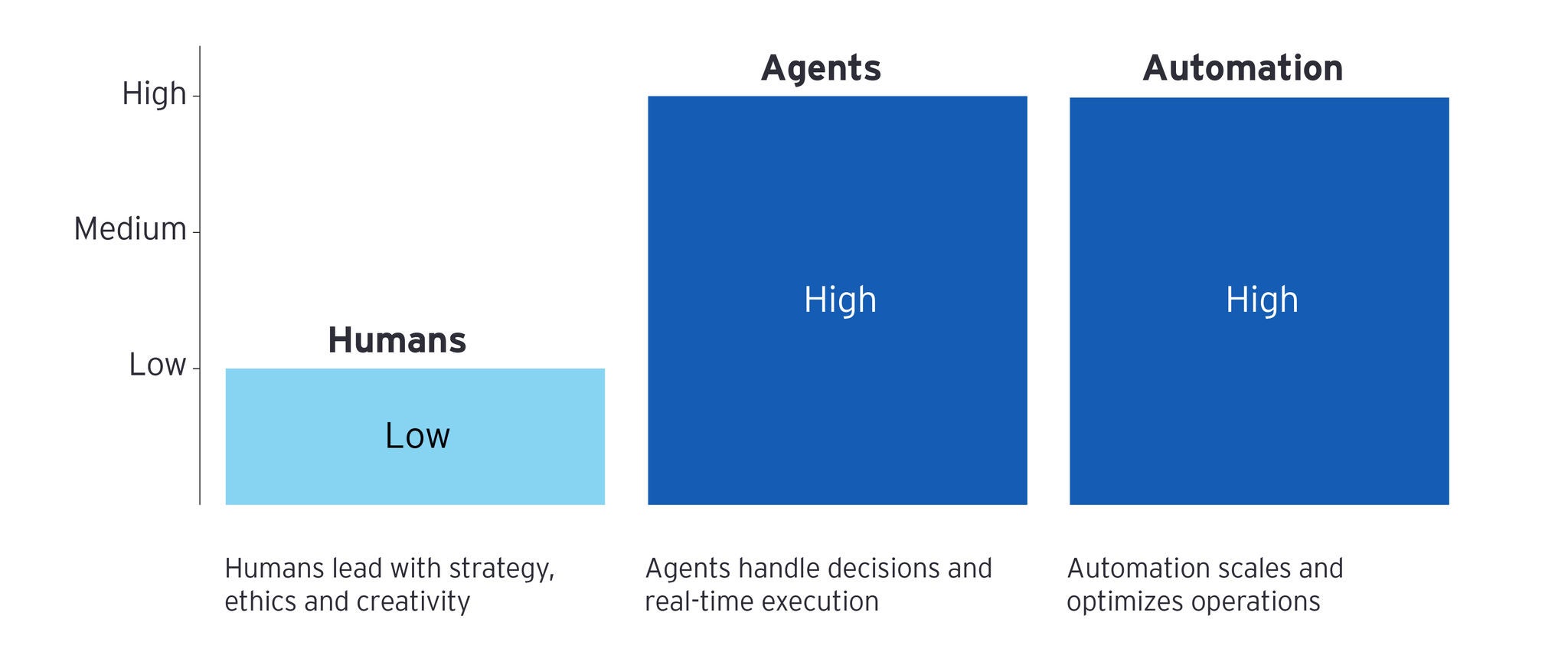
Future #1: Transform

By 2030 — AI is transforming business

In this scenario, the widespread adoption of advanced reasoning and agentic AI systems creates unprecedented opportunities for business innovation and value creation (via EY.com US). By 2030, enterprise-grade AI platforms have become robust, trustworthy and widely accessible, massively augmenting human capabilities and automating even complex workflows and activities across multiple domains. Democratizing AI enables organizations to completely reimagine how they work, creating lightweight and remarkably efficient organizational structures that enable human creativity and strategic thinking to be unleashed while unlocking latent market demand.

What it means for CP companies: Here, AI shatters the hype and reinvents society as a whole: how we live, how we work and how we shop. Agentic systems anticipate consumer needs, design products around them and run operations end to end. Consumers expect seamless, predictive experiences — and brands that cannot deliver disappear. The winners are those bold enough to rebuild their entire value chain around AI, re-engineering how products are made, moved, marketed and sold.

Key takeaway: AI becomes the operating system of the business where humans steer and AI drives.

Human to agent to automation ratio:

Human to agents to automation ratio - chart 1

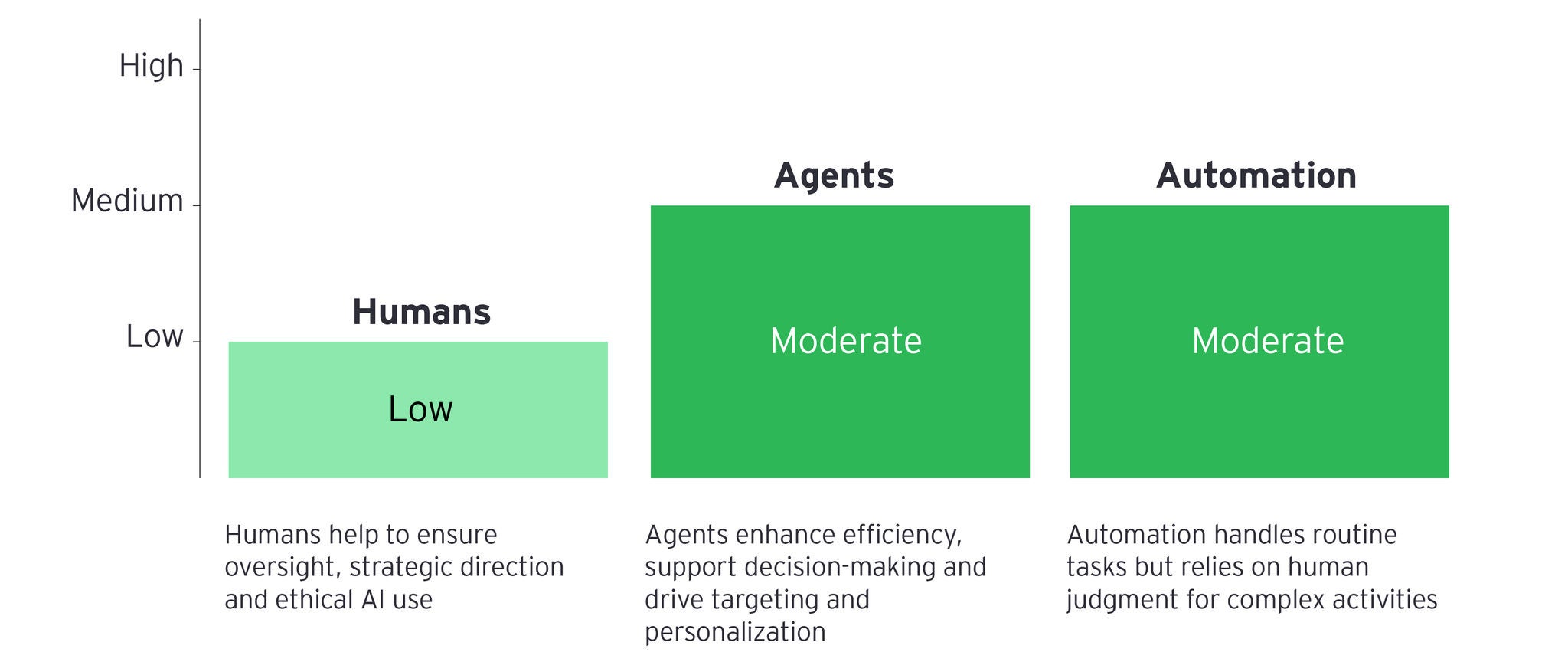
Future #2: Growth

By 2030 — AI is driving growth

In this future, AI capabilities advance steadily along current trajectories, driven by incremental improvements rather than major breakthroughs. Efforts to regulate the technology are outweighed by productivity gains from humans leveraging AI. By 2030, domain-specific AI agents have achieved remarkable proficiency in operational functions across finance, HR, legal and other business areas. This evolution enables new organizational models featuring highly automated back offices and AI-augmented front offices, delivering significant productivity gains and cost efficiencies.

What it means for CP companies: AI delivers — not explosively, but reliably. Agents drive greater productivity by autonomously handling routine tasks so that operations are scaled cost-effectively, while humans shift to higher-value roles in strategy and creativity. Consumers enjoy smarter personalization. The winners are companies that scale AI across the value chain from sourcing to service while still strategically leveraging the best of what humans can offer.

Key takeaway: AI augments work without replacing it and humans shift up the value chain.

Human to agent to automation ratio: 

Human to agents to automation ratio - chart 2

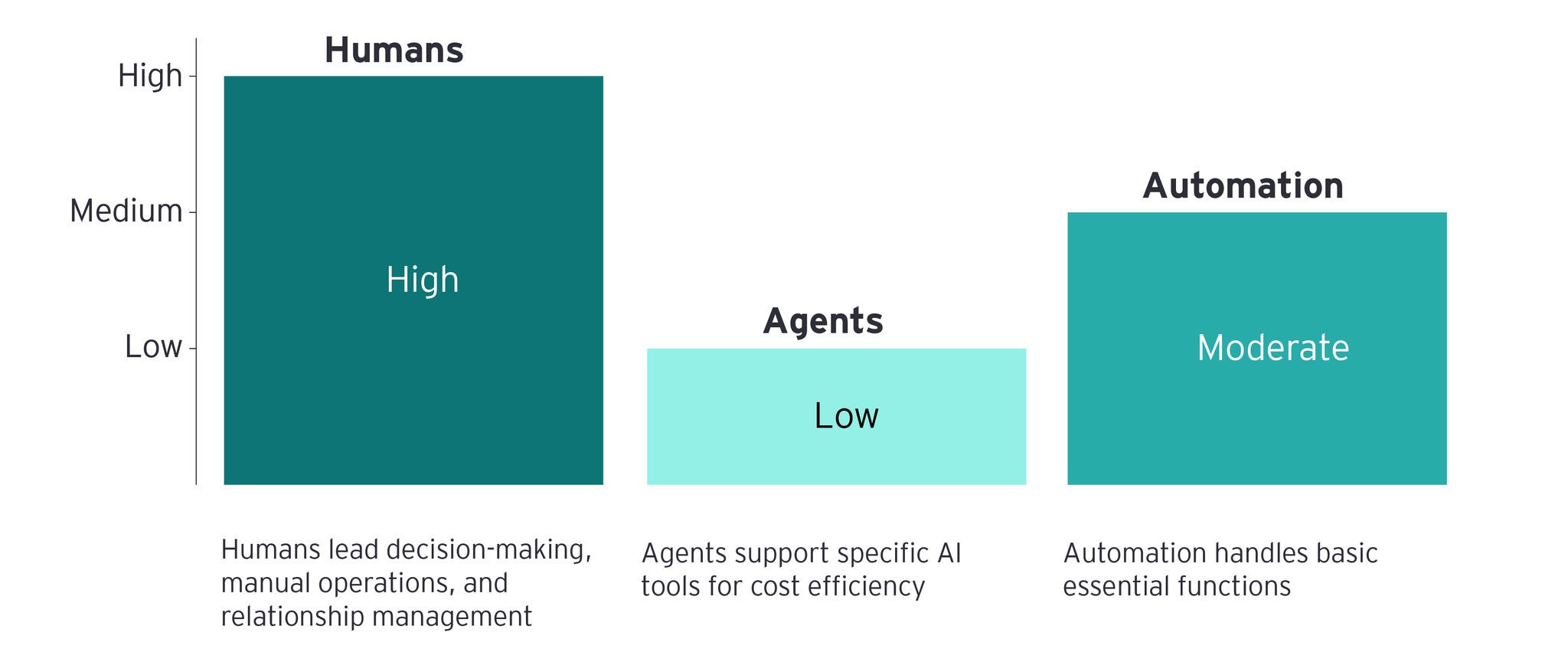
Future #3: Constraint

By 2030 — AI is under close scrutiny

In this future of AI, adoption of the technology faces significant recalibration following a series of high-profile setbacks. By 2030, incidents such as AI trading system malfunctions impacting market stability, persistent errors in AI-powered financial reporting and medical AI misdiagnoses have led to new liability issues. Meanwhile, AI content generation has proved less commercially viable than anticipated. These challenges prompt a measured reassessment of AI regulation and AI implementation across markets.

What it means for CP companies: AI stalls as energy demands spike and regulations strangle progress. Returns on investment underwhelm and progress slows to a crawl. Consumers grow skeptical of the mechanical sameness of AI, and luxury goods boast “Not Made by AI” labels. The winners are brands that double down on human creativity and trust, optimizing traditional value chains while signaling authenticity at every touchpoint.

Key takeaway: AI underdelivers and humans remain central to value creation.

Human to agent to automation ratio: 

Human to agents to automation ratio - chart 3

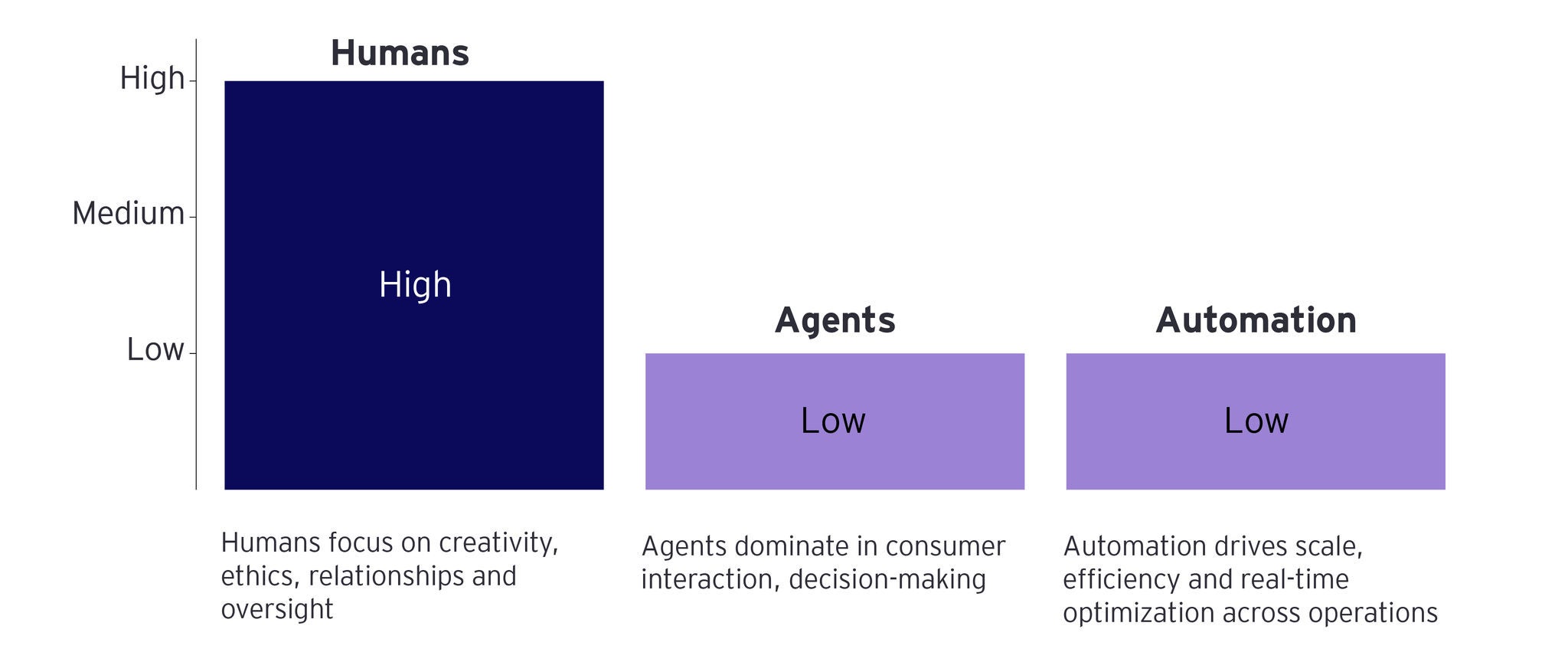
Future #4: Collapse

By 2030 — AI reshapes market dynamics

In this future of AI, a major technological breakthrough leads to extreme market concentration in AI capabilities. By 2030, a single entity achieves significant advantages in AI, creating powerful network effects that reshape market dynamics across all knowledge-based sectors of the economy.

What it means for CP companies: AI promised transformation but delivered exclusion. A handful of mega corporations control its benefits while for most, AI simply does not work. Models are inaccessible, data is locked, and talent is out of reach. Innovation has stalled. The majority are left with hype and no results. AI has not democratized progress; it has concentrated it.

Key takeaway: AI promised scale, but it scaled back.

Human to agent to automation ratio: 

Human to agents to automation ratio - chart 4

Shaping the future — the CP strategic response

We’ve considered the impact of AI across the CP value chain and have defined possible strategic responses demanded by each of the four futures. Every CP company is different, but as a thought starter to bring this to life, we’ve explored options for a beverage company with an online presence:


Inspector with digital tablet and worker pouring caramel in cake factory
2

Chapter 2

The reality for consumer products companies: steps to take

To navigate the uncertainty of the four futures, consumer products companies must build agility, resilience and strategic foresight.

Rather than waiting for clarity, leaders should act now, anchoring their AI strategy in a structured, scenario-based approach that supports long-term value creation.

We recommend a six-step process:


1. Envision

Begin with scenario planning. Use the four futures to explore how AI could reshape your business and define your ambition across multiple possible outcomes. This step aligns leadership around a shared vision and prepares the organization for a range of futures from transformation to constraint.

2. Assess

Evaluate your value chain and data readiness. Identify where AI can unlock value — whether in supply chain, marketing or customer service — and assess the maturity of your data, systems and governance. This ensures your ambition is grounded in operational reality.

3. Foundation

Before deploying AI, build the right foundation. This includes establishing cross-functional AI teams, investing in upskilling and ensuring your tech stack and data infrastructure can support scalable AI. Without this groundwork, even the best use cases may stall.

4. Activate

Launch high-impact use cases using reusable assets. Focus on quick wins that align with your vision and demonstrate tangible value. You do not need perfect data to start, but it must be relevant and sufficient to support early success.

5. Accelerate

Prove value and build momentum. Develop reusable models, pipelines and governance structures that can be applied across use cases. Establish clear KPIs like customer satisfaction or operational efficiency to track progress and guide reinvestment.

6. Implement, monitor and scale

Embed AI into workflows and operating models. Use strong governance and risk management practices to ensure responsible scaling. Monitor performance, adapt to market signals and continuously evolve your AI strategy as the future unfolds.

Conclusion: from possibility to preparedness

The future of AI in consumer products is not a single destination — it is a spectrum of possibilities. Whether we are heading toward transformation, growth, constraint or collapse, the companies that lead will be those that prepare for all four.

By envisioning multiple futures, building foundational readiness and scaling responsibly, organizations can move from abstract potential to concrete action. The six-step process outlined above provides a structured path forward, one that balances ambition with operational reality.

To guide this journey, leaders should ask:
  • How can AI amplify and drive the most business value across our value chain?
  • What gaps exist in our data, talent and technology foundations and how do we close them?
  • How should we evolve our core systems, including ERP and global business services, to scale AI effectively?
  • How can AI enable smarter, more personalized consumer experiences?
  • What governance and risk frameworks are needed to ensure responsible implementation?

The future may be uncertain, but the opportunity to shape it is very real. The companies that act now — guided by foresight and grounded in strategy — will be the ones shaping what comes next. 

Summary

Facing so many potential futures with AI, consumer products companies need to adopt a structured approach to AI strategy that fosters adaptability and long-term value.

Related content

EY State of Consumer Products 2025 report

Download the 2025 EY State of CP report and learn how CPG companies can reclaim their relevance.

    About this article

    Authors