


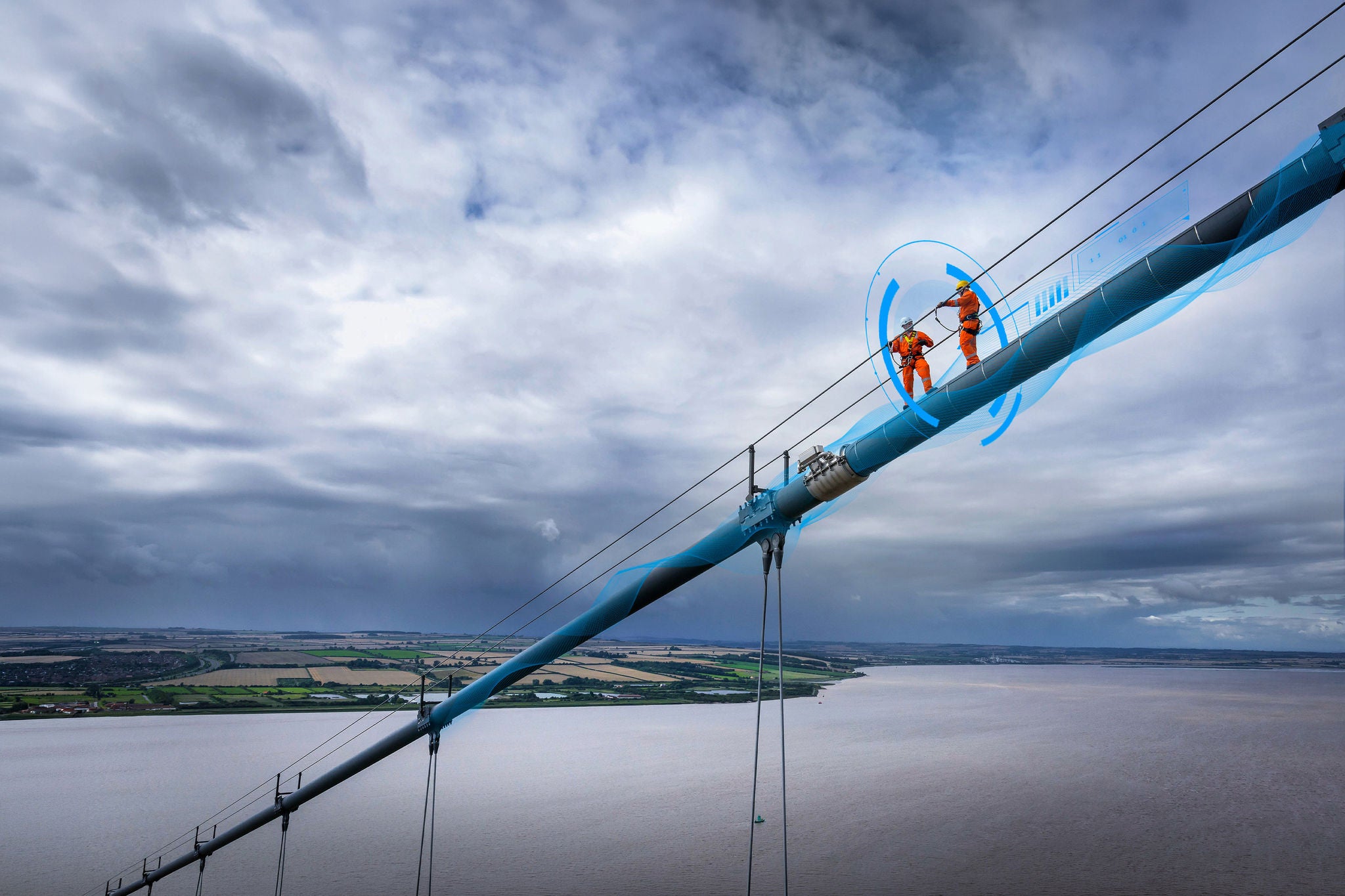





The Humber Bridge, UK was built in 1981 and at the time was the worlds largest single-span suspension bridge

How agentic AI can create an intelligence layer for infrastructure

Related topics

Agentic AI enables an intelligence layer that connects siloed data, delivers better decision-ready insights and improves human judgment.


In brief

  • The infrastructure sector has seen significant digital innovation in recent years, but efficiency improvements have failed to transcend the wider ecosystem.
  • Agentic AI could transform infrastructure with an intelligence layer by enabling disparate systems to connect and deliver broader insights.
  • Agentic AI combined with greater human judgment has the potential to expedite infrastructure delivery. The winners are those that help to define it.

Recent years have seen a huge amount of technological innovation throughout infrastructure. Now bristling with digital applications at every stage of their lifecycle, new systems are designed to help stakeholders better monitor and manage these assets. However, the ongoing digitalization of infrastructure has failed to translate to overall greater efficiency for this sector.

The truth is these gains do not compound. A myriad of different digital tools, which all work fine in isolation, are unable to talk with one another. Each new sensor, scheduling engine and computer vision system adds data to an environment already saturated with it.

As such, productivity flatlines or even stalls. This surplus of domain-specific data is often not communicated through to the right stakeholders, which undermines the oversight of major projects. Friction between silos can add up, with statistics painting a sobering picture.

Industry benchmarks from the Construction Industry Institute indicate that rework alone consumes up to 15% of total cost on a typical project1 — rework that could have been avoided with better coordination of information. Applied to the global infrastructure pipeline, with annual investment approaching US$7 trillion by 2030,2 the addressable value loss sits in the hundreds of billions each year. The cause is usually the same: failures at the interfaces between functions, organizations and systems.

A driving theme for much of infrastructure’s digitalization has been to break down silos, with the aim of allowing each tool to work together harmoniously. However, silos can exist for good reasons; they often protect intellectual property, clarify professional accountability and reflect commercial and organizational barriers. To break these down just isn’t realistic. In a sector of such scale and complexity, the challenge is not to erase silos, but to coordinate more effectively across them.

This is where agentic AI comes in. A new EY report, The intelligence layer: how agentic AI can connect the infrastructure industry,” explores how agentic AI can delve into the silos, connect data points in meaningful ways to support better decision-making and improve human judgment.

 Queensferry Crossing Bridge at sunset
1

Chapter 1

Agentic AI - the opportunity

Agentic AI creates an “intelligence layer” that connects data sitting in silos and improves human judgment.

Imagine an infrastructure system where leaders can see the implications of change as they emerge: where owners understand portfolio effects earlier, operators can trace asset performance across the lifecycle, and investors, regulators and delivery teams act with a fuller view of risk, consequence and opportunity. In such a system, intelligence does not stall at the boundaries between planning, funding, design, delivery and operations. It moves across them.

This matters because infrastructure is becoming harder to govern through human coordination alone. Data volumes are rising, interdependencies are multiplying and the consequences of decisions are increasingly felt across commercial, technical, operational and public domains at once.

But agentic AI makes a different future possible: not by removing the systems, functions or organizational boundaries on which infrastructure depends, but by creating an intelligence layer above them that can reconcile fragmented information and deliver decision-ready intelligence to the people responsible for judgment and decision. At a system level, that could mean earlier visibility of risk, faster and better-informed decisions, stronger capital discipline, more resilient operations and less value lost in the gaps between organizations, functions and lifecycle stages.

What is agentic AI? It is essentially a goal-directed system in which various specialist AI agents reason with one another from multiple sources. This is not automation, as that refers to technology being programmed to continue working away on pre-defined tasks. Nor is this about data standardization or overhauling entire tech stacks.

Instead, agentic AI strengthens the infrastructure ecosystem with an “intelligence layer.” This consists of numerous specialist AI agents that reach down into each silo, extract the required data and transport it to the correct users. For example, scheduling AI agents will recalibrate the critical path and consider what will lead to delays and the ramifications of these. Safety AI agents will evaluate risks and provide mitigation measures. Cost AI agents will continually monitor progress and delays, aligning these with the financial bottom line. All of these, and more, will feed into an orchestration AI agent that will coordinate between them. Silos do not need to be broken down.

Crucially, agentic AI is designed for the benefit of human end users. The intelligence layer brings organization to the masses of data in a typical infrastructure project, with decision packages and priorities generated to support key stakeholders. This allows the consequences of delays and other issues to be immediately identified and solutions generated. Then humans use orchestration AI agents to work through a project to successful completion. 

Instead, agentic AI strengthens the infrastructure ecosystem with an “intelligence layer.” This consists of numerous specialist AI agents that reach down into each silo, extract the required data and transport it to the correct users.

Aerial view of the airport in twilight
2

Chapter 2

Creating infrastructure’s agentic AI-enabled future

Actions the sector needs to take for agentic AI to become reality.

For agentic AI to thrive, agents must be able to reason across organizational boundaries and across multiple information sources that were originally designed to remain separate. This places an onus on having the right enabling governance in place.

To be successful, agentic AI governance frameworks need to get five things right: accountability and legal liability, transparency and explainability, data sovereignty and commercial confidentiality, human oversight and competence, and systemic resilience.

These are all multi-faceted areas and speak to the high standards that organizations must meet to allow this technology to flourish.

However, the intelligence layer does not require an immediate overhaul of the operating model to begin creating value. Given agentic AI sits across various projects, programs and portfolios, it will reflect the level of quality and governance it works with.

The case for the intelligence layer is strategic, but the response must be practical. For most organizations, the question is not whether to jump immediately to full agentic coordination, but how to take the next steps in a way that creates value, builds trust and strengthens readiness over time. 

The organizations that capture the greatest value from agentic AI will not be those that treat it as a perpetual series of disconnected pilots but those that set a clear ambition for how intelligence should operate across the business over time, and align investment, governance and technology choices behind it.
 

As such, effective integration will come through different stages. The maturity model demonstrates this across three stages: connected insight, followed by coordinated intelligence, before resulting in adaptive intelligence. In tandem to these steps, the AI agents involved will inform, then recommend, then act with approval, before acting as human audits.


In the spirit of connectivity, there are also cross-industry actions to pursue. These apply to all stakeholder groups and, together, provide a practical agenda for moving from interest in agentic AI to implementation:

  • Set a clear long-term ambition
  • Make new systems agent-ready by design
  • Treat data as a strategic asset
  • Deploy over existing workflows
  • Invest in semantic interoperability
  • Build governance in parallel
  • Invest in professional capability

These actions should be followed by all stakeholders, regardless of role or seniority.

The case for the intelligence layer is strategic, but the response must be practical. For most organizations, the question is not whether to jump immediately to full agentic coordination, but how to take the next steps in a way that creates value, builds trust and strengthens readiness over time.

In addition, different stakeholder groups must take responsibility for their own role to create the conditions for agentic coordination to deliver value safely and at scale:

  • Government and regulators: Develop sector-specific guidance for AI-assisted decision-making in safety-critical infrastructure applications
  • Asset owners and investors: Pilot the intelligence layer on a defined area with measurable success criteria
  • Designers and consultants: Structure design data for agent access alongside human consumption
  • Contractors and delivery organizations: Deploy agents over existing scheduling, cost and progress systems at Stage 1
  • Operators: Define structured handover requirements that preserve lifecycle information in queryable form
  • Technology providers: Build to open standards, particularly OpenUSD and IFC. Invest in semantic mediation capability
  • Education and research institutions: Integrate agentic AI governance into engineering and construction management programs

For leaders, the immediate priority is not to solve everything at once. It is to identify the highest-friction coordination problem, prove value in that domain and build outward from there. But that near-term pragmatism should sit within a clearer long-term ambition: to make systems, data and decision processes increasingly ready for an agentic future by design. That is how the intelligence layer will move from concept to operating reality, and from isolated use cases to durable advantage.

The question now is not whether this change will arrive. It is whether leaders and their organizations will shape it or adapt to it. Those that wait for the complete picture will find it has been drawn by others.


Summary

While the infrastructure sector has seen significant digital innovation in recent years, the efficiency needed hasn’t been achieved. The ability of agentic AI to provide an intelligence layer that connects data in silos and arms decision-makers with greater insights offers a new approach to accelerate infrastructure delivery. The question now is whether organizations will shape it or adapt to it.

Related content

How Agentic AI can transform enterprise operations through co-innovation

In this episode of the EY Microsoft Tech Directions podcast, explore how Agentic AI is transforming enterprise operations through the power of co-innovation.

31m 33s

How Mott MacDonald is building confidence through responsible AI

Explore how EY teams helped a global firm establish and accelerate AI governance to enable them to transform responsibly and ethically.

How artificial intelligence can unlock a new future for infrastructure

To unlock the value of AI and truly transform the infrastructure sector, it must adopt a new mindset, skillset, toolset. Find out how in EY’s new report.

    About this article

    Authors