



EY refers to the global organization, and may refer to one or more, of the member firms of Ernst & Young Global Limited, each of which is a separate legal entity. Ernst & Young Global Limited, a UK company limited by guarantee, does not provide services to clients.
Recent Searches
Portugal | Fiscal measures provided in State Budget Law for 2025
- Portugal's State Budget Law for 2025 has been approved, and the nominal corporate income tax rate and autonomous tax rates are reduced.
- The notional interest tax deduction has been increased under the Incentive for Capitalization of Companies (ICE) regime.
- Invoices provided in portable document format (PDF) will be considered equivalent to electronic invoices until 31 December 2025.
Executive summary
The 2025 State Budget Law, adopted on 31 December 2024 under Law No. 45-A/2024, adopts a rather conservative approach, balancing fiscal consolidation with economic growth and social protection. Regarding Corporate Income Tax (IRC), the most emblematic measure reduces the nominal rate by one percentage point. However, the Government's legislative authorization to review the application of the reduced 6% Value Added Tax (VAT) rate on construction or rehabilitation works was rejected, frustrating the sector's expectations of promoting a potential solution to the housing crisis. In terms of personal income tax (IRS), some of the measures include the reinforcement of the "IRS Jovem" (Special Personal Income Tax [IRS] for Youth), the update of IRS brackets, and the exemption of IRS and Social Security on productivity bonuses.
Essentially, the 2025 State Budget Law reflects the measures presented in the State Budget Proposal, discussed and approved in the Parliament in November 2024.
This Alert highlights changes in the new law with regard to the following areas:
- Corporate Income Tax
- Personal Income Tax
- Social Security
- Excise Duties
- Municipal Property Tax
- Stamp Duty
- Tax benefits
- Fees and other levies
- Tax litigation
Corporate Income Tax (CIT)
Expenses related to employee wellbeing
The Portuguese State Budget Law for 2025 establishes that expenses incurred with health and wellness insurance contracts are accounted in 120% for tax purposes when determining the taxable income of a corporate taxpayer.
Nominal CIT rate
The nominal CIT rate is reduced from 21% to 20%. For taxable entities engaged primarily in economic activities of an agricultural, commercial or industrial nature, classified as small or medium-sized enterprises (SMEs) or small/medium capitalization companies (Small Mid Cap), as defined in the annex to Decree-Law no. 372/2007 of 6 November 2007, the applicable CIT rate for the first €50,000 of taxable income is 16% (previously 17%). Any taxable income exceeding this amount is subject to a CIT rate of 20%. For entities with headquarters or effective management in Portuguese territory that do not engage primarily in commercial, industrial or agricultural activities, the applicable CIT rate is 20% (previously 21%).
These changes are applicable to fiscal years (FYs) starting in or after 1 January 2025.
Autonomous taxation
Budget Law for 2025 provides for the reduction of autonomous taxation rates levied on costs incurred or borne on certain vehicles by corporate taxpayers that do not benefit from a subjective exemption and that carry out a commercial, industrial or agricultural main activity, as follows:
- 8% (previously 8.5%) in the case of vehicles with an acquisition cost of less than €37,500 (previously €27,500)
- 25% (previously 25.5%) in the case of vehicles with an acquisition cost equal to or greater than €37,500 (previously €27,500) and less than €45,000 (previously €35,000)
- 32% (previously 32.5%) in the case of vehicles with an acquisition cost equal to or greater than €45,000 (previously €35,000)
Costs related to shows offered domestically or abroad to customers, suppliers or any other persons or entities are no longer considered as expenses incurred with a representation purpose, hence are no longer subject to autonomous taxation at a 10% rate.
The 10-percentage point increase in autonomous tax rates for non-CIT-exempt commercial, industrial or agricultural taxpayers, generally triggered when the entity (or the tax group to which it belongs) computes a tax loss, does not apply in the 2025 FY if:
- The taxpayer: (i) had a taxable profit in at least one of the three previous FYs and (ii) timely complied with the reporting obligations provided for in articles 120 (submission of the CIT return) and article 121 (submission of the annual declaration of accounting and tax information) foreseen in the CIT Code in the two previous FYs.
- The increase corresponds to the FY of commencement of activity or to one of the two following FYs.
This provision was incorporated within an exceptional framework of the Portuguese State Budget Law for 2023, applicable to the FY s 2022 and 2023. It did not apply to the FY 2024 but was reinstated for FY 2025.
Personal Income Tax (PIT)
Meal allowance
The Portuguese State Budget Law for 2025 updated the legal limit for the exclusion of taxation on meal allowances provided through meal vouchers. The exempt amount will increase from 60% to 70% for PIT and Social Security purposes. Consequently, the exempt amount will now be €10.20 starting in 2025 (previously €9.60).
Reinvestment relief on capital gains from the sale of real estate
The Portuguese State Budget Law for 2025 now requires that the reinvestment of the net sales value of property (i.e., after deduction of the amortization of the mortgage loan) into Pan-European Individual Savings Products shall occur within six months from the date of the sale of the property (previously this deadline was applicable to life insurance financial contracts, open pension funds and to the public capitalization regime).
Special PIT regime for Youth
The Portuguese State Budget Law for 2025 introduces significant changes to the special PIT regime for the Youth.
Eligibility for this regime will no longer be contingent upon the completion of academic studies, thereby allowing all individuals up to 35 years of age to take advantage of this regime. This regime shall now be applicable for the first 10 years (previously 5 years) of earning income from categories A (employment) or B (business/professional), provided that the taxpayers are not classified as dependents for PIT purposes. The exemption on income will be applied as follows:
Year |
Exemption percentage |
|---|---|
|
1st year |
100% |
|
2nd to 4th year |
75% |
|
5th to 7th year |
50% |
|
8th to 10th year |
25% |
The exemption will always have an annual cap of 55 times the value of the Social Support Index (IAS) (€28,737.50, considering the IAS in force for 2025).
The Portuguese State Budget Law for 2025 stipulates that this regime will not be applicable to taxpayers who (i) benefit or have benefited from the non-habitual resident regime, (ii) benefit or have benefited from the tax incentive for scientific research and innovation, (iii) have opted for taxation under the former-residents tax regime, or (iv) do not have their tax situation regularized.
As per a transitional provision, individuals who have not yet completed 10 years since they began earning income from categories A or B and have not yet reached 35 years old may still benefit from the regime.
They can enjoy this regime for the remaining period (the years during which they were considered dependents shall not be counted for this purpose).
Specific deduction for employment income
In accordance with the Portuguese State Budget Law for 2025, this specific deduction will be fixed at 8.54 times the value of the IAS (€4,462.15, considering the IAS for 2025), thereby revoking the recent amendment, which stated that it would be updated annually based on the IAS update rate.
Specific deduction for pension income
The Portuguese State Budget Law for 2025 introduces changes to the specific deduction applicable to pension income, aligning it with the deduction provided for employment income.
Consequently, the specific deduction for this category of income will now be equivalent to 8.54 times the value of the IAS (€4,462.15, considering the IAS for 2025).
Change in the taxable income thresholds for each PIT bracket
The Portuguese State Budget Law for 2025 adjusts the taxable income thresholds by 4.62%, exceeding the inflation rate forecasted for 2025, while maintaining the current tax rates as stipulated by Law no. 33/2024, dated 7 August 2024.
Taxable amount |
Normal tax rate |
|---|---|
|
Up to €8,059 |
13.00% |
|
Over €8,059 up to €12,160 |
16.50% |
|
Over €12,160 up to €17,233 |
22.00% |
|
Over €17,233 up to €22,306 |
25.00% |
|
Over €22,306 up to €28,400 |
32.00% |
|
Over €28,400 up to €41,629 |
35.50% |
|
Over €41,629 up to €44,987 |
43.50% |
|
Over €44,987 up to €83,696 |
45.00% |
|
Over €83,696 |
48.00% |
Minimum subsistence threshold
The reference value for the minimum subsistence threshold has been revised to be the greater of €12,180 or the following formula: 1.5 x 14 x the IAS (€10,972.50, considering the IAS in force for 2025). This adjustment is a result of the updated minimum monthly wage, which has increased from €820 to €870.
Overtime work
The Portuguese State Budget Law for 2025 introduced adjustments in terms of withholding tax applicable to income earned from overtime work.
A 50% reduction in the autonomous PIT withholding tax rate on overtime work is now in force, effectively revoking the previous 50% reduction that was only applicable upon the 101st hour onward, inclusive.
Furthermore, the exemption limit, corresponding to the value of the minimum monthly wage, applicable to employment income resulting from overtime work earned by nonresident taxpayers, will now apply to income obtained in the first 100 hours of overtime work provided. Previously, this limit was only applicable to the first 50 hours, with a withholding tax rate of 25% levied to the amount exceeding that volume of hours.
Autonomous taxation on representation expenses and vehicles
Regarding the application of autonomous taxation, the Portuguese State Budget Law for 2025 maintains the rate of 10% on deductible expenses related to representation expenses and passenger or mixed vehicles. The change corresponds to an increase in the acquisition value of these vehicles from €20,000 to €30,000. If the vehicle has an acquisition value equal to or greater than €30,000, the autonomous taxation rate remains at 20%.
It should be noted that, for autonomous taxation purposes, expenses related to shows are now excluded from the concept of representation expenses.
Reduction of the withholding tax rate applicable to category B income
The Portuguese State Budget Law for 2025 reduces from 25% to 23% the withholding tax rate applicable to category B income that results from professional activities specifically listed in the table referred to in article 151 of the PIT Code.
Payments on account
In specific situations, self-employed individuals may be required to make advance payments, which serve as a prepayment of the tax amount due at the final settlement when submitting their PIT return.
Therefore, to determine the amount of tax to be paid in advance as a prepayment, the Portuguese State Budget Law for 2025 stipulates that it shall correspond to 65% of the calculated amount (previously 76.50%), according to the formula indicated below:
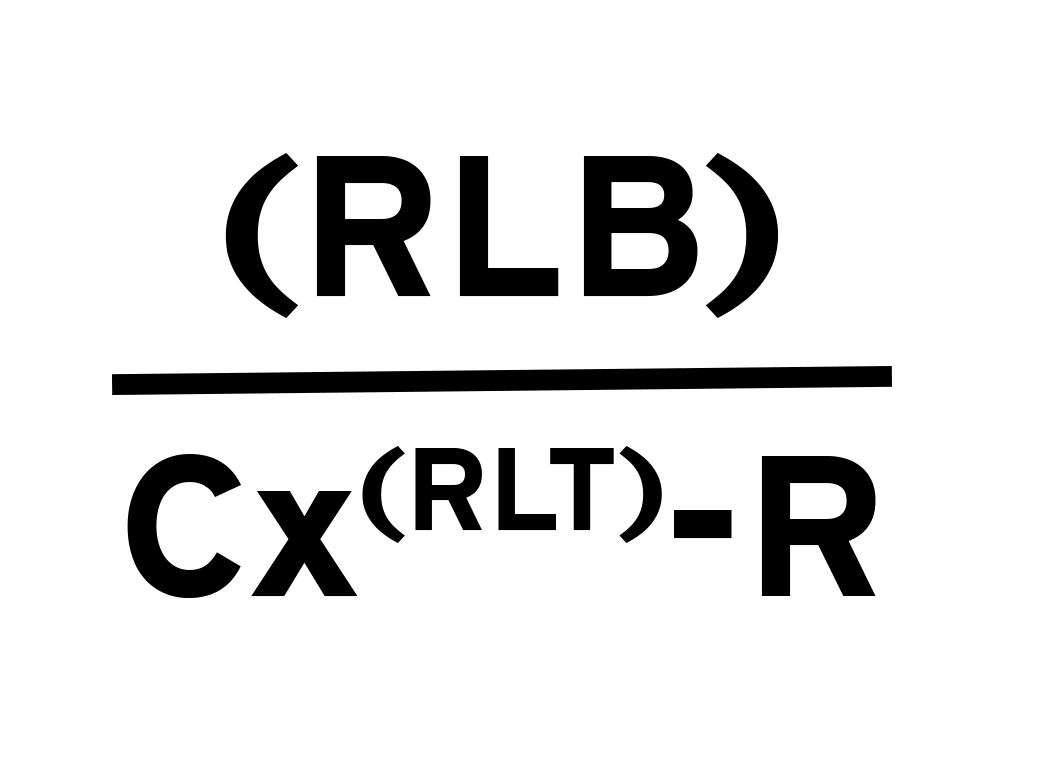
- C = Tax from the penultimate year, net of the deductions referred to in paragraph 1 of article 78.º, except for the deduction provided for in subparagraph i)
- R = Total withholding taxes levied in the penultimate year on income from category B; RLB = Positive net income from category B in the penultimate year
- RLT = Total net income in the penultimate year
Exemption from PIT and Social Security on productivity bonuses, performance bonuses, profit-sharing and balance sheet bonuses
Portuguese State Budget Law for 2025 provides for an exemption from PIT and Social Security for productivity bonuses, performance bonuses, profit-sharing and balance sheet bonuses, which are awarded voluntarily and on a non-regular basis. The PIT exemption is applicable up to a limit of 6% of the employee's annual base salary, based on the criteria for applying the tax incentive for salary increases foreseen in article 19(B) of the Portuguese Tax Incentives Statute.
According to the Portuguese State Budget Law for 2025, withholding tax should be levied on amounts paid as productivity bonuses, performance bonuses, profit-sharing and balance sheet bonuses at a rate corresponding to the monthly employment remuneration for the month in which those amounts are paid or made available. Indeed, the PIT exemption will only apply on an annual basis.
These amounts are also excluded from the Social Security contribution base, which is already the practice in several cases.
Social Security
Electronic Communication for Social Security purposes
The Portuguese State Budget Law for 2025 mandates that interactions between Social Security and other stakeholders, including beneficiaries and applicants for European funds, will primarily be conducted electronically. This initiative aims to streamline and modernize the notification process.
To achieve this, whenever individual taxpayers or other entities request assistance or clarifications through "Segurança Social Direta," the Social Security Services are allowed to communicate via the electronic system, including disseminating decisions. Corporate entities will receive notifications exclusively through the Social Security electronic notification system. This allows the General Directorate of Local Municipalities to send electronic notifications to local sector entities within their functions without needing prior consent.
Information exchange and data protection
The Portuguese State Budget Law for 2025 states that Social Security Authorities can obtain information electronically from entities such as the Portuguese Tax Authorities (PTA), the Institute of Registries and Notaries, I.P., and the Portuguese National Bank, to administer benefits and prevent fraud. The following information is specified to be provided:
- Categories of income
- Reported values
- Tax situation
- Composition of the household
- Tax records information
- Exercise of parental authority
- Identification of the head of the deceased beneficiary's household
- Existence of immovable and movable property subject to registration.
Nonetheless, the safeguarding of personal data is imperative in all information exchange processes. These activities will be regulated by specific protocols designed to enhance risk management.
Extraordinary pension update
In 2025, the Government will proceed with an extraordinary update of pensions, effective from 1 January 2025, as follows:
- An increase of 1.25 percentage points will apply to the regular annual pension update rate, to be carried out in January 2025.
- This applies to disability, old-age and survivor pensions granted by the Social Security and retirement, pension and survivor pensions under the convergent social protection scheme, granted by CGA, IP, amounting to up to three times the IAS (i.e., €1,567.50, considering the IAS in force for 2025).
Extraordinary pension supplement
In 2025, the Government will implement an extraordinary pension supplement payment, contingent upon the progression of budget execution and corresponding trends in revenue and expenditure.
Value Added Tax
Following the discussion and final approval of the State Budget Law Proposal for 2025, the following provisions related to VAT have been maintained and/or added to the final version of the Portuguese State Budget Law for 2025:
Confirmation of the extension of the VAT exemption applicable to the sale of fertilizers, soil improvers and products that fall under the category of feed for animals intended for human consumption
The Portuguese State Budget Law for 2025 foresees an extension until 31 December 2025 of the VAT exemption applicable to the sale of the following:
- Fertilizers and soil improvers
- Products that fall under the concept of animal feed, regardless of the breed or purpose of the animals during their lifetime, provided the animals are intended for human consumption.
Confirmation of the equivalence of PDF invoices to electronic invoices until 31 December 2025
The Portuguese State Budget Law for 2025 extends the equivalence of invoices in PDF format to electronic invoices until 31 December 2025 for all purposes provided for in tax legislation.
Confirmation of the extension of the total or partial VAT refund
The Portuguese State Budget Law for 2025 establishes the extension of the total or partial refund of the amount equivalent to VAT to the Regional Civil Protection Service, IP-RAM, and to the Regional Civil Protection and Firefighters Service of Azores, as well as to the entities holding forest fire brigades, which are part of the Integrated Rural Fire Management System (Sistema de Gestão Integrada de Fogos Rurais), when they are unable to exercise the right to deduct VAT, in respect of movable equipment directly intended for the pursuit of their respective purposes, including the services necessary for the equipment's conservation, repair and maintenance.
Extension of the right to deduct VAT on expenses incurred with bicycles (velocípedes), with or without a motor
The Portuguese State Budget Law for 2025 establishes that the exclusion of the right to deduct VAT incurred on expenses related to the acquisition, manufacture or import, leasing, use, transformation, and repair does not apply to bicycles (velocípedes), with or without a motor.
The Portuguese State Budget for 2025 gives an interpretive nature to the new wording of article 21 (1) of the VAT Code, which identifies the derogations to the right to deduct VAT.
Extension of reduced VAT rate
The Portuguese State Budget Law for 2025 foresees the extension of the scope of two items in List I annexed to the Portuguese VAT Code:
- Item 2.10: extension of the reduced rate to utensils and other equipment exclusively or primarily intended for rescue operations, acquired by the following entities: Regional Civil Protection Service, IP-RAM, Regional Civil Protection and Firefighters Service of Azores, municipalities and intermunicipal entities
- Item 2.32: extension of the reduced rate to bullfighting shows
Reduced VAT rate — addition of item 1.14 to List I annexed to the Portuguese VAT Code
The Portuguese State Budget Law for 2025 includes the addition of item 1.14 to List I annexed to the Portuguese VAT Code, which provides for the application of the reduced VAT rate to food products intended for infants and young children, including formulas, as well as foods for special medical purposes and total diet replacements for weight control, in accordance with Regulation (EU) no. 609/2013 of the European Parliament and of the Council, of 12 June 2013.
Excise Duties (IEC)
The Portuguese State Budget Law for 2025 does not establish any general increase of the current rates already in place in terms of Excise Duties (IECs).
Excise duty on alcohol, alcoholic beverages and beverages containing added sugar or other sweetening matter (IABA)
The Portuguese State Budget Law for 2025 provides for the extension until 31 December 2025, of the application of 25% of the current standard rate, specifically applicable as for liqueurs and "crème de," as well as, for distilled spirits and fruit brandies, in accordance with and under the characteristics foreseen by the Regulation of the European Parliament and of the Council (EC) no. 110/2008, of 15 January 2008, provided they are exclusively made from arbutus berries (Arbutus unedo), produced and distilled within specific municipalities, such as Albufeira (freguesia de Paderne), Alcoutim, Alijó, Aljezur, Almodôvar, Alvaiázere, Ansião, Arganil, Barrancos, Castanheira de Pera, Castelo Branco, Castro Marim, Covilhã, Faro (freguesias de Santa Bárbara de Nexe e União das Freguesias de Conceição e Estoi), Ferreira do Zêzere, Figueiró dos Vinhos, Fundão, Góis, Lagos (freguesias de Odiáxere e União das Freguesias de Bensafrim e Barão de São J oão), Loulé (freguesias de Alte, Ameixial, Boliqueime, Salir, São Clemente e São Sebastião e União das Freguesias de Querença, Tôr e Benafim), Lousã, Mação, Mértola, Miranda do Corvo, Monchique, Moura, Odemira, Oleiros, Ourique, Pampilhosa da Serra, Pedrógão Grande, Penacova, Penamacor, Penela, Portalegre, Portel, Portimão (freguesias de Mexilhoeira Grande e Portimão), Proença-a-Nova, São Brás de Alportel, Sardoal, Seia, Sertã, Silves, Tavira (freguesias de Cachopo, Santa Catarina da Fonte do Bispo, União das Freguesias de Tavira (Santa Maria e Santiago) e União das Freguesias de Conceição e Cabanas de Tavira), Vila de Rei, Vila do Bispo e Vila Velha de Ródão.
Excise duty on tobacco (IST)
The Portuguese State Budget Law for 2025 foresees changes in the taxation of cigarettes by eliminating, for the purposes of calculating the total minimum reference tax, in place for each year, the references to the national average taxation and to the European average taxation.
The Portuguese State Budget Law for 2025 also revokes the method for IST calculation currently applicable to the cigarettes resulting from the "weighted average taxation by the introductions for consumption of the Member States of the European Union."
Thus, the Portuguese Budget Law for 2025 foresees that the total minimum reference tax on cigarettes, in force by each year, shall be the sum resulting from the product of the tobacco tax rates (specific and ad valorem elements) and from the Value Added Tax (VAT) to the cigarettes national weighted average price.
The Portuguese State Budget Law for 2025 also determines the application to cigarettes of a 50% minimum taxation rate as applicable to cigars sold at the weighted average price of cigarettes.
Excise duty on Petroleum and Energy Products (ISPE)
The Portuguese State Budget Law for 2025 maintains the gradual elimination of harmful exemptions for petroleum and energy products classified under combined nomenclature codes (NC) codes 2710 19 62 up to 2710 19 67, and NC 2710 20 32 and NC 2710 20 38, used within the production of electricity, electricity and heat (cogeneration), or city gas on Portugal mainland, taxing them at a rate corresponding to 100% of the ISPE rate and with a rate corresponding to 100% of the carbon dioxide (CO2) emissions surcharge.
During 2025, products classified under NC codes 2707 99 99 (new), NC 2710 19 43 to 2710 19 48, NC 2710 20 11 to 2710 20 19, NC 2710 19 62 to 2710 19 67, NC 2710 20 32, and 2710 20 38, consumed in the Autonomous Regions of the Azores and Autonomous Regions of Madeira, used in the production of electricity, electricity and heat (cogeneration), or city gas by entities whose main activity is these activities, will be taxed at a rate corresponding to 100% (previously 75%) of the ISPE rate and a rate corresponding to 100% (previously 75%) of the CO2 emissions surcharge when used and consumed on Portugal mainland.
Products classified under NC code 2711, used in the production of electricity, electricity and heat (cogeneration), or city gas by entities whose main activity is these activities, except those used in the autonomous regions, will continue to be taxed at a rate corresponding to 50% of the ISPE rate and a rate corresponding to 50% of the CO2 emissions surcharge.
The Portuguese State Budget Law for 2025 also establishes that during 2025, energy products classified under NC codes 2701, 2702, 2704, 2713, and 2711 12 11, and fuel oil with a sulfur content equal to or less than 0.5%, classified under NC codes 2710 19 62 and NC 2710 19 66, used in installations subject to an energy consumption rationalization agreement (ARCE), will be taxed at a rate corresponding to 100% (previously 65% of the CO2 emissions surcharge).
The Portuguese State Budget Law for 2025 determines that all energy products covered by the elimination rule used in installations covered by the European Emissions Trading Scheme (CELE), including those covered by the Optional Exclusion provided for in CELE, are not subject to the CO2 emissions surcharge.
Furthermore, the Portuguese State Budget Law for 2025 establishes that the taxation rates percentages provided do not apply to biofuels, biomethane, green hydrogen and other renewable gases that can benefit from an ISPE tax exemption.
On a transitory basis, the Portuguese State Budget Law for 2025 provides that, during 2025, colored and marked diesel can still be consumed by vehicles used by forestry sapper teams that are part of the Integrated Rural Fire Management System, in accordance with the formalities and procedures applicable to the recognition and control of the benefit, as defined by a decree issued by the members of the government responsible for finance, internal administration, forests and energy.
Vehicle Tax (ISV)
The Portuguese State Budget Law for 2025 introduces the application of a 25% rate at the level of intermediate rates already applicable to passenger vehicles registered in another EU Member State of the European Union (EU) (between 1 January 2015 and 31 December 2020), equipped with plug-in hybrid engines, whose battery can be charged through an electrical grid connection and has a minimum electric mode range of 25 kilometers.
Regarding used vehicles with definitive community registrations assigned by other EU Member States, the Portuguese State Budget Law for 2025 eliminates, for the calculation of the ISV due, by reference to Table D, in the displacement and environmental components, the criteria of the remaining average useful life of the vehicles.
The Portuguese State Budget Law for 2025 also provides for the elimination of the payment of a prior fee (as defined by Government Order) to be borne by taxable persons who believe that the amount of tax assessed in respect of used vehicles exceeds the amount of ISV applicable, calculated by applying the current calculation formula, maintaining the need to apply to the director of customs for the new and amended calculation formula to be applied to the taxation of that same vehicle.
According to the Portuguese State Budget Law for 2025, the aforementioned calculation formula applicable to the taxation of these vehicles for settlement has been changed: ISV = (V/VR) x Y + (1-U/UR) x C.
Support for farmers, aquaculture producers and fishers
The increase applicable to subsidies for the use of colored and marked diesel by small farmers, holders or family farming status, with an annual consumption of up to 2,000 liters of €0.06 per liter of that fuel used in the respective activity, to be granted by the Government area of agriculture and food, remains in force for 2025.
With the Portuguese State Budget Law for 2025, the subsidy referred to in the previous paragraph will continue to be increased by €0.04 per liter for small farmers with family farming status.
Also in this context, a subsidy will continue to be granted in 2025 to small-scale and coastal fishermen, small-scale aquaculture producers and seal salt extraction companies, who are thus entitled to the following subsidies:
- A subsidy on the number of liters of petrol consumed in their activity, equivalent to that resulting from the reduction in the rate applicable to diesel consumed in fishing activities
- A subsidy on liquified petroleum gas (LPG) consumed in the respective activity, equivalent to that resulting from the reduction in the rate applicable to diesel consumed in fishing activities
The criteria for identifying beneficiaries, determining the amount according to the number of tides and fuel consumption and the procedures for granting subsidies are defined by decree of the members of the government responsible for finance and agriculture and food.
Vehicle Circulation Tax (IUC)
The Portuguese State Budget Law for 2025 does not establish any general increase in terms of the IUC rates.
The new law provides for the maintenance of the additional IUC for diesel vehicles falling under categories A and B, during 2025.
Real Estate Transfer Tax (RETT)
Update of the brackets of RETT rates
The Portuguese State Budget Law for 2025 revises the brackets of the taxable basis over which RETT is levied upon the acquisition of an urban property or an autonomous fraction of an urban property allocated exclusively for own and permanent residence, corresponding to an update of 2.3%, as follows:
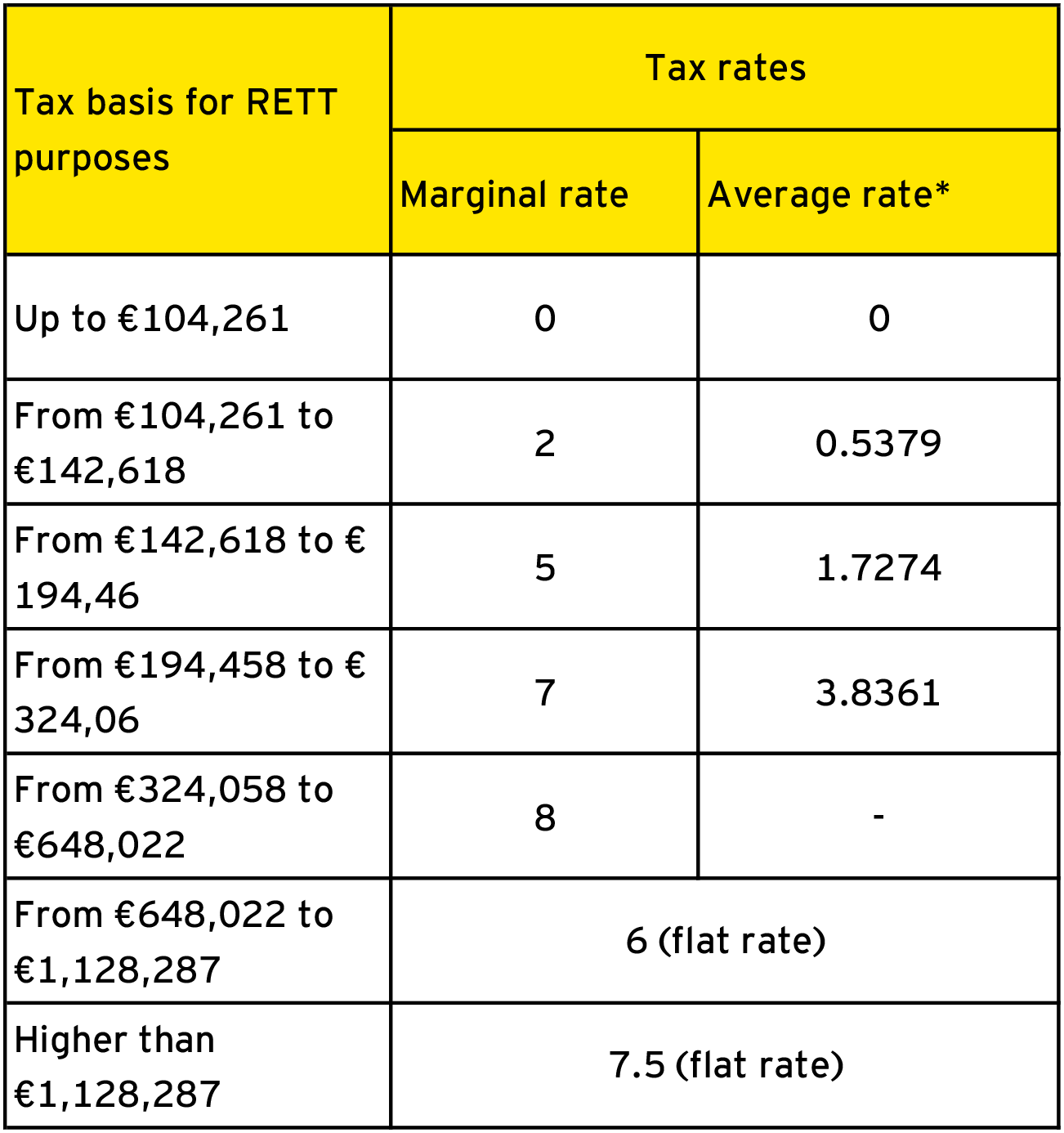
*At the upper limit of the bracket
The Portuguese State Budget Law for 2025 also revises, to the same extent (i.e., by 2.3%), the brackets of the taxable basis over which RETT is levied for the acquisition of an urban property or an autonomous fraction of an urban property allocated exclusively for own and permanent residence, when acquired by taxpayers aged 35 or less and meeting the remaining conditions necessary for the exemption applicable to the acquisition of properties by young people up to that age, as follows:
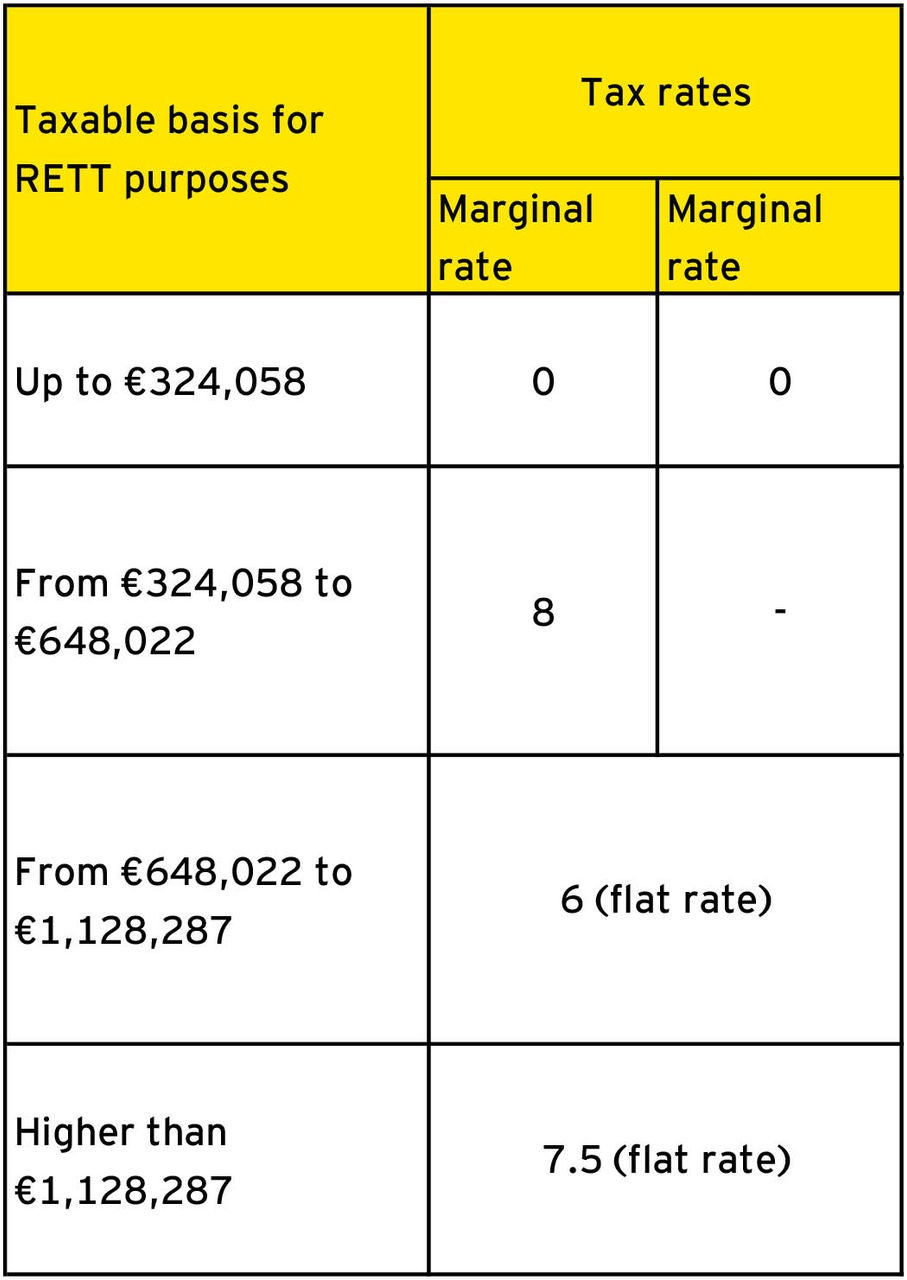
*At the upper limit of the bracket
Additionally, the Portuguese State Budget Law for 2025 revises, to the same extent (i.e., by 2.3%), the brackets on which the RETT is levied in the context of the acquisition of an urban property or an autonomous fraction of an urban property allocated exclusively to residential purposes but not covered by the aforementioned situations (i.e., not allocated to own and permanent residence), to the following amounts:

*At the upper limit of the bracket
Incentive for the consolidation of rural properties
The Portuguese State Budget Law for 2025 extends the applicability of exemptions from RETT, Stamp Duty and registration fees for the year 2025. These exemptions apply to the transfer of properties necessary for the consolidation of contiguous or adjoining rural properties under the same ownership, regardless of the economic use of the properties.
The applicability of the aforementioned exemptions is contingent upon the submission of documentation demonstrating that: (i) the applicant holds ownership of the rural properties subject to consolidation, and (ii) the properties in question are either contiguous or adjoining.
Municipal Property Tax (MPT)
The PTA are required to publish on their website, by February 2025, the list of municipalities that have extended the MPT exemption for urban properties with a property tax value not exceeding €125,000. This exemption applies exclusively to properties intended for the primary residence of the taxpayer or their household, as specified in article 46 no. 5 of the Statute of Tax Benefits and article 51 of Law no. 56/2023, dated 6 October 2023.
Stamp Duty
Extension of the Stamp Duty exemption on the renegotiation of housing credit
The Portuguese State Budget Law for 2025 extends the exemption from Stamp Duty on housing credit renegotiation operations. Consequently, housing credit restructuring operations that include the extension of loan terms or debt refinancing will continue to benefit from this exemption.
Temporary fixation of the installment of credit contracts for the acquisition or construction of permanent own housing
The Portuguese State Budget Law for 2025 extends the Stamp Duty exemption on the use of credit, under the terms of item 17.1 of the general table of the Stamp Duty Code, which is due by virtue of the operations of temporary fixation of the installment and capitalization of deferred amounts in the loan value under the Decree-Law that establishes the measure of temporary fixation of the installment of credit contracts for the acquisition or construction of permanent own housing and reinforces the extraordinary measures and supports within the scope of housing credits.
Tax benefits
Disclosure of tax expenditure
The scope of the annual quantitative report to be prepared by the Government, as outlined in article 15-A (1) of the Statute of Tax Benefits (STB), has been expanded to encompass not only tax benefits but also any tax expenditures. In this context, tax expenditure refers to any fiscal outlay arising from legal and regulatory provisions or practices that result in a reduction or deferral of the tax liability for a specific group of taxpayers compared to the standard tax regime.
The wording of article 15-A (2) and (3) of the STB remains unchanged, maintaining the obligations for the Government to submit the relevant report to the Assembly of the Republic during the first half of the year following the one to which it pertains and for the Tax Authorities to disclose, by the end of September each year, the CIT taxpayers who utilized tax benefits, specifying the type and amount of the benefit used.
Tax incentive for salary increase
The Portuguese State Budget Law for 2025 modified article 19-B of the STB, which defines the tax incentive for salary increases. It specifies that the expenses related to salary increases for workers with an indefinite-term employment contract will be considered at 200% of their respective amount (previously 150%), accounted for as an exercise expense. This benefit is now subject to the following conditions:
- An increase in the company's average annual base salary, by reference to the end of the previous year, of at least 4.7%
- An increase in the annual base salary of employees who earn an amount equal to or less than the company's average annual base salary at the end of the previous year, of at least 4.7%
Contrary to what was previously foreseen, the Portuguese State Budget Law for 2025 maintains the eligibility condition of not increasing the salary range of workers compared to the previous year.
Additionally, the Portuguese State Budget Law for 2025 simplifies the scope of the benefit to workers covered by a collective labor regulation instrument concluded or updated less than three years ago, thus replacing the concept of "dynamic collective labor regulation instrument."
Similarly, the Portuguese State Budget Law for 2025 refers to articles 2 and 258 of the Labor Code, for the concepts of "Collective labor regulation instrument" and "Base salary," respectively.
This benefit is now limited to five times the guaranteed minimum monthly salary (previously four times), excluding charges resulting from the update of this value.
Capital contributions in cash
With respect to the existing tax incentive, PIT taxpayers who contribute cash capital to companies in which they hold shares can deduct up to 20% of these contributions from the gross amount of profits distributed by these companies or, in the event of the disposal of the shareholding, from the balance determined between capital gains and losses from that operation, the Portuguese State Budget Law for 2025 removes the requirement that such a company be in the situation provided for in article 35 of the Commercial Companies Code (loss of half of the share capital).
The Portuguese State Budget Law for 2025 states that this deduction will not apply to contributions made to entities regulated by the Portuguese National Bank or the Insurance and Pension Funds Supervisory Authority, as well as to branches in Portugal of credit institutions, other financial institutions, or insurance companies.
Tax regime for the Incentive for Capitalization of Companies (ICE)
The Portuguese State Budget Law for 2025 revises the tax framework for the notional interest tax deduction under the Incentive for Capitalization of Companies, originally established in 2023 and subsequently amended in 2024.
Under the terms of this amendment, the difference between the rate applicable to most companies and the rate applicable to micro, small or medium-sized enterprises or small-medium capitalization companies (Small Mid Cap) is eliminated. Thus, the amount to be deducted under ICE, for all companies that meet the respective requirements, corresponds to the application of the 12-month Euribor rate, corresponding to the average of the taxation period, calculated based on the last day of each month, added to a spread of two percentage points, to the amount of eligible net equity increases.
The Portuguese State Budget Law for 2025 stipulates that the aforementioned deduction will be increased by 50% in 2025, while retaining the limits of €4m or 30% of the result before depreciations, amortizations, net financing expenses, and taxes, as specified in article 67 of the CIT Code. It is also noted that the Portuguese State Budget Law for 2024 anticipated an increase of this incentive by 30% in 2025, reflecting an adjustment in the applicable increase.
No modifications are suggested concerning the concepts and application requirements of this regime.
Regime applicable to entities licensed in the Madeira Free Trade Zone from January 1,2015
The Portuguese State Budget Law for 2025 extends the 5% CIT rate to entities licensed in the Madeira Free Trade Zone from 1 January 2025 to 31 December 2026. Previously, this rate applied only to licenses issued between 1 January 2015 and 31 December 2024. This rate remains valid until 31 December 2028.
Please note that all other requirements and conditions outlined in article 36 of the EBF remain unchanged, with only Paragraph 7 of the same article being adjusted accordingly.
Extension of tax benefits
The Portuguese State Budget Law for 2025 extends the tax benefits related to the following until December 31, 2025:
- Deductions under social impact bond partnerships
- Forestry activity tax incentives
- Forest management entities and forest management units
- Electro-solar or exclusively electric vessels
The purpose of this extension is to assess the tax benefits under consideration within the context of the tax benefits evaluation scheduled for 2025. The Portuguese State Budget Law for 2025 extends the extraordinary support regime for agricultural production costs until 31 December 2025.
Fees and other levies (contributions)
The Portuguese State Budget Law for 2025 includes the continuation of (i) the contribution on the banking sector, (ii) the solidarity surcharge on the banking sector, (iii) the extraordinary contribution on the pharmaceutical industry, (iv) the extraordinary contribution on suppliers to the National Healthcare System (NHS) of medical devices, and (v) the extraordinary contribution on the energy sector (ECES). It clarifies that references to the years 2015 and 2017 are to be understood as references to the FY 2025.
Similar to the previous year, the Portuguese State Budget Law for 2025 does not update the monthly values of the audiovisual contribution.
Tax litigation
Social Security assets and credits
The Portuguese State Budget Law for 2025 allows for the cancellation of social security credits and debits that are no longer justified, insufficiently documented, or deemed irrecoverable due to the lack of seizable assets from the debtor. This may also apply to debts related to contributions, installments, or rents that are 20 years old or more, or 10 years old or more with a low value (less than €50).
Contributory transparency measures related to the relationship with Social Security
The Portuguese State Budget Law for 2025 foresees the possibility of disclosing the list of debtors to social security remains, under the same terms already provided for taxpayers with tax debts. For this purpose, the Social Security and the PTA may exchange information between each other, particularly regarding the amounts of social benefits paid (including pensions, scholarships, or rent subsidies), the income declared in annexes A, B, C, D, J and SS of the Personal Income Tax Return, or the amounts of income from sales of goods and products and the services provided relevant to determining the contributory obligation of contracting entities. On the other hand, the need for coordinated positions between the PTA and the Ministry of Labor, Solidarity and Social Security regarding the debts of legal entities subject to Corporate Income Tax that are in economic difficulty is reinforced once again.
Preemption right of municipalities in the sale of seized properties in tax execution procedures
The municipalities preemption right in the purchase and sale or lieu in payment of seized properties in tax execution procedures, located in the respective municipality, has been guaranteed, which will be ranked immediately next to the preemption right of the landowner.
Transparency of judicial decisions
As part of the Anti-Corruption Agenda, it is anticipated that by 2025, all decisions issued by first instance courts will be published anonymously. Additionally, a single case law database will be created to make these decisions available to the public in an anonymous manner.
Implications
The now-approved State Budget Law provides certain tax relief measures for companies and private individuals, while also aiming to help taxable entities reducing their business costs. Multinational enterprises doing business in Portugal should review the changes that could affect them and contact their tax advisors to answer questions and provide relevant assistance.
For additional information concerning this Alert, please contact:
Ernst & Young, S.A.,
- Pedro Fugas, Country Tax Leader
- Alexandra Nunes, Global Compliance & Reporting
- Amilcar Nunes, Indirect Tax Services
- Anabela Silva, People Advisory Services Tax
- António Neves, International Tax & Transaction Services
- Bruna Melo, International Tax & Transaction Services
- Carla I Baltazar, Managed Services Leader
- Francisco Hamilton Pereira, Quantitative Services
- Helder Matias, International Tax & Transaction Services
- Ines Cabral, Financial Services
- Jaime Rocha, International Tax & Transaction Services
- João Gregório, Global Compliance & Reporting
- João Nóbrega, Law Managing Partner
- Luis Marques, International Tax & Transaction Services
- Luís Sousa, Transfer Pricing
- Paulo Mendonca, Transfer Pricing
- Pedro Paiva, International Tax & Transaction Services
- Ricardo Correia, Tax Technology & Transformation |
- Rui Carvalho, Global Compliance & Reporting
- Rui Henriques, Global Compliance & Reporting
- Sara Reis, Law
Published by NTD’s Tax Technical Knowledge Services group; Carolyn Wright, legal editor
For a full listing of contacts and email addresses, please click on the Tax News Update: Global Edition (GTNU) version of this Alert.