
































































EY refers to the global organization, and may refer to one or more, of the member firms of Ernst & Young Global Limited, each of which is a separate legal entity. Ernst & Young Global Limited, a UK company limited by guarantee, does not provide services to clients.
Recent Searches
India Economic Pulse
India Economic Pulse analyzes high-frequency economic indicators and policy developments to help businesses understand economic trends and the government's policy direction.
Join the conversation
We are pleased to share the September 2026 edition of the EY India Economic Pulse, which examines India's economic performance amid continued geopolitical uncertainty, evolving global financial conditions and shifting trade dynamics. As part of Indian economy analysis, the report highlights resilience in the face of external headwinds, supported by strong domestic consumption in India, robust investment activity, healthy tax collections and sustained policy support. It also assesses developments across growth, inflation, trade, public finances, capital flows, commodity markets, Indian financial markets and key sectoral indicators shaping India's outlook for FY27.
Key highlights from this edition include:
- Growth outlook: India's economy grew by 7.8% in Q1 FY27, supported by broad-based growth in consumption, investment and exports. Gross Value Added (GVA) expanded by 8.2%, driven by strong performance across manufacturing, construction and services sectors. The report notes that India's economic fundamentals remain strong enough to support growth of nearly 7% in FY27.
- Consumption and demand trends: Domestic demand remained buoyant across both rural and urban markets. Consumer credit increased by 16.2%, passenger vehicle registrations increased 25.1%, tractor registrations rose 22.3% and two-wheeler registrations grew 21.4%, reflecting sustained consumer confidence.
- Investment and capital expenditure: Investment activity continues to strengthen, with Gross Fixed Capital Formation growing 12% in Q1 FY27, outpacing GDP growth. Industrial credit growth reached a decadal high of 20%, while cement and steel production increased by 9.9% and 4.6%, respectively, indicating strong momentum in infrastructure and real estate investment.
- External sector dynamics: While gross FDI inflows rose 15% to US$30.7 billion in April-June FY27 and remittances increased significantly, India's merchandise trade deficit widened amid higher imports, particularly in electronics and energy products. The report highlights the importance of strengthening domestic manufacturing capabilities and leveraging recently concluded FTAs to support export growth in India.
- Fiscal and tax performance: Public finances remained resilient despite reductions in fuel-related duties. Gross tax revenues increased by 11.4% during April-July FY27, supported by strong growth in corporate and personal income taxes. Capital expenditure rose by nearly 30%, while the fiscal deficit in India remained lower than for the corresponding period last year, reflecting improved revenue performance and prudent fiscal management.
- Inflation and commodity trends: CPI inflation in India remained contained within the RBI's target range at 4.5% in July 2026, although WPI inflation remained elevated at 9.8% due to higher energy-related input costs. Commodity markets experienced volatility, with crude oil prices rising amid renewed geopolitical tensions and agricultural commodity prices requiring close monitoring for potential food inflation risks.
- Financial markets and external stability: Foreign exchange reserves in India reached a record high of US$729.3 billion, supported by foreign currency non-resident account (FCNR) inflows and improving capital flows. The Rupee stabilized in recent months, while equity markets recovered as FPI sentiment strengthened and domestic institutional investments remained robust.
Going forward, India's economic outlook will depend on the evolution of geopolitical developments, energy market stability, global financial conditions, and the effectiveness of ongoing policy measures aimed at strengthening domestic manufacturing and investment. While external risks remain, India's growth story continues to be supported by resilient domestic demand, a strong investment cycle, accelerating formalization and digitalization of the economy, robust tax collections and sustained public infrastructure spending. Continued policy focus on competitiveness, technology adoption and economic resilience will be critical to sustaining India’s economic growth in FY27 and beyond.
Please find below the complete report for a deeper analysis.
Our latest thinking
21st Annual EY India Tax Workshop 2026
Register for India Tax Workshop 2026. Learn more about the tax function.
Jaipur, IN
New Provident Fund Scheme and Amnesty 2026: Key changes and practical implications
In this webcast, panelists discuss the new PF Scheme and Amnesty 2026, key employer impacts and compliance steps.
GST at 9: The journey so far and the road ahead
Explore how GST has transformed India's tax ecosystem, improved compliance and shaped the next phase of tax reforms and growth.
20m
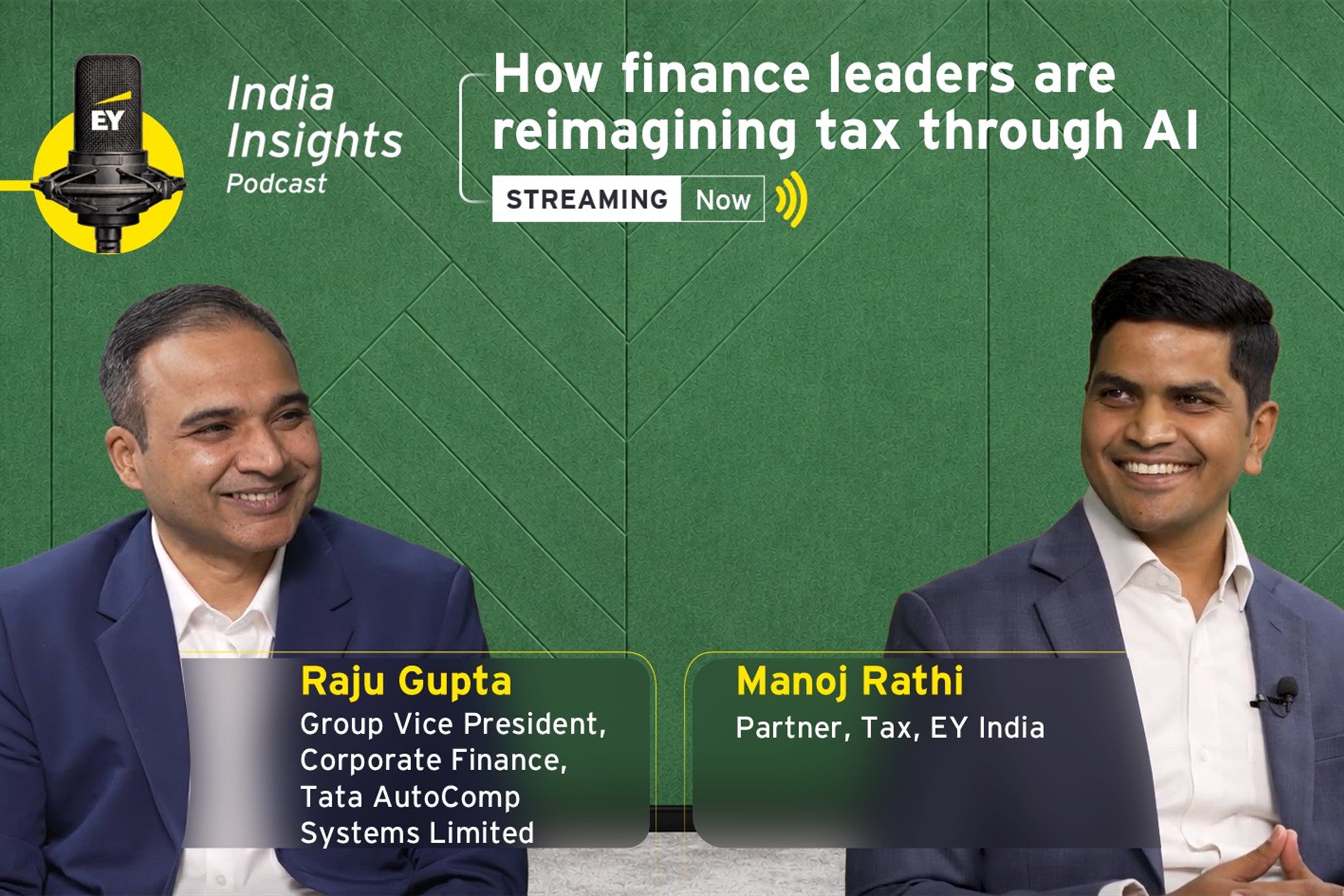
How finance leaders are reimagining tax through AI
Discover how organizations use AI to transform tax functions while managing risk. Unlock insights to drive efficiency, scale impact and maximize ROI.
16m 59s
How PLI is helping Indian brands go global
Join our latest conversation on how PLI-backed Indian manufacturers are translating policy support into global ambition, scale and sustained growth.
25m 37s
Preserving India’s long-term growth amid evolving economic clouds
OECD 2025 projects India to become the leading economy in a selected feasible scenario, surpassing the US by 2045 and China by 2063 in PPP terms.
Why recent macro fiscal shifts call for a reassessment of FC16 projections
New GDP data, GST changes and global uncertainty call for a reassessment of FC16 projections and fiscal sustainability in India.
Affordable household insecticides critical for vector‑borne diseases
Reducing GST on household insecticides to 5% can boost affordability and play a vital role in preventing vector-borne diseases in India.
GoI-state fiscal transfers: The next five years
The 16th Finance Commission report analyzes tax devolution, grant discontinuation and fiscal transfer shifts impacting the finances of states and Center.
The future of Global Capability Centers in India: Policy shifts
India’s GCC sector is benefitting from tax reforms, safe harbour rules, GST clarity and incentives driving growth, innovation and global competitiveness.
18m 3s
Tax compliance reimagined: AI, data integrity and intelligent reporting
Tax compliance is evolving toward intelligence embedded in operations, leveraging AI and data for real-time insights and regulatory trust.
How AI-led compliance can power India’s export boom
India’s expanding FTA network supports AI-enabled trade automation, helping businesses manage compliance, unlock FTA benefits and scale cross-border operations.
FY27 Budget: Downward expenditure adjustments and slowing fiscal consolidation
FY26 tax reforms reduce revenues by INR1.925 lakh crore; FY27 sees slower fiscal consolidation, lower state transfers and subdued nominal GDP growth.
Budget 2026: Highlights for NRIs on investment, property, disclosures
Listen to our latest podcast analyzing Union Budget 2026 updates for NRIs, including TCS on remittances, PAN-based TDS for property sales, investment limits and foreign asset disclosures.
6m 15s
Budget 2026 on TDS, TCS, LRS and transition to the New Income Tax Act
Listen to our podcast about Union Budget 2026 direct tax announcements, covering TDS and TCS changes, LRS updates, compliance simplification and the new Income Tax Act.
7m 2s
Budget 2026: Tax proposals and opportunities in India data centers
Listen to our podcast about Budget 2026 tax proposals for India data centers, exploring the tax holiday till 2047, Safe Harbor margins, PE clarity and cloud investment opportunities.
12m 52s
Strengthening Maharashtra’s industrial ecosystem through targeted incentives
Listen to our podcast about Maharashtra’s Industries, Investments & Services Policy 2025, covering SGST reimbursement, MSME and service sector incentives, and growth drivers.
9m 44s
Union Budget 2026-27 highlights
Get the latest insights on the Union Budget 2026-27, including tax updates, policy changes and sector-wise impacts. Explore insights and analysis from EY India on budget reforms and growth.
FY27 Budget outlook: Sustaining growth while negotiating global headwinds
Read about FY27 Budget Outlook for India, highlighting growth prospects with FY26 real and nominal GDP projected at 7.4% and 8.0%, fiscal consolidation targets, potential deficit reduction and expenditure priorities.
With robust economic growth, what are the Union Budget 2026 prospects?
India’s FY26 outlook shows strong 8% growth, low inflation and fiscal pressures, with GST revenues, capex momentum and consolidation shaping the economic path.
How GIFT City can transform business opportunities in India
Explore business opportunities in GIFT City IFSC with HSBC & EY’s report, covering regulatory, tax, and sector-specific insights for investors.
Center of gravity of world economy shifting towards the EMDEs
EMDEs will form 61% of global GDP in 2025, with India contributing 17.5% to global growth. Innovation is key to India’s rise beyond middle-income status.
India’s growth pulse: First quarter FY26 GDP, GST 2.0 and trade risks
EY India podcast explores India’s 7.8% GDP growth, GST 2.0 reforms, and trade diversification shaping Q1 FY26.
24m 17s
India’s steady progress in poverty reduction
India’s poverty headcount ratio has fallen to 1% in 2025, showing dramatic progress in eliminating extreme poverty across rural and urban areas.
India’s trade with US and China: Performance and potential
Read the comprehensive analysis on performance and potential of India's trade relationships with the US and China, highlighting key trends and opportunities.
Navigating international tax compliance for Indian multinationals
Read how EY helps Indian multinationals with global tax complexity transfer pricing, BEPS 2.0, permanent establishments and technology-enabled compliance.
Where India stands in the group of five largest economies
India is set to become the world’s 3rd-largest economy, potentially surpassing the US in PPP by 2038, despite US tariffs and global trade uncertainties.
Aligning India’s defense spending to the Viksit Bharat vision
Listen to our podcast on why India’s defence spend dropped from 2.9% to 1.9% of GDP (FY26 BE) & how a non-lapsable fund could realign to Viksit Bharat goals.
16m 20s
BRICS+ 2025 growth and trade promoting initiatives
BRICS+ drives global shift with rising trade, GDP share, and local currency payments—advancing multilateralism and sustainable growth across 19 nations.
Understanding India’s Employment-Linked Incentive (ELI) Schemes
Explore India’s new employment-linked incentive schemes and their impact on hiring, compliance, and cost benefits for employers and employees.
6m 20s
Understanding minimum disclosure requirements for related party transactions
In this webcast, our panel of EY experts shares insights on the recent SEBI circular and its impact on related party transaction (RPT) disclosure requirements and industry standards.
Decoding the new Employment Linked Incentive (ELI) Schemes
In this webcast, panelists discussed the new Employment Linked Incentive (ELI) Schemes, benefits available to employers and employees and action planning for employers.
Budgeting for defence expenditure
India's defence needs a 3% GDP benchmark to ensure modernisation, steady funding, and Aatmanirbhar growth amid fiscal constraints and global challenges.
Getting India future-ready: Role of rare earth elements
Rare earth elements are key to India's future. EY explores the role of rare earth metals, minerals & elements technology in mining industry to drive growth.
Sailing through global tariff headwinds
Discover how India can navigate global tariff challenges, sustain 6.5% GDP growth in FY26, and leverage fiscal reforms, AI, and trade agreements for stability.
As Trump tariffs reshape global trade, India must adapt fast
Amid global trade shifts from US reciprocal tariffs, India must diversify exports, address trade imbalances, and boost manufacturing competitiveness.
How Should India Prioritize Fiscal Health—Deficit Control or Debt Reduction?
Explore fiscal health priorities: fiscal deficit or debt-GDP ratio. Understand India's fiscal reforms, debt trends, and sustainable fiscal deficit strategies. Find out more.
Why India should focus on health and education to achieve Viksit Bharat status
Prioritizing health and education is key to harnessing India's demographic dividend. Enhanced spending on these sectors fosters growth, employment, and productivity. Learn more.
FY26 Union Budget: Diversifies stimuli and rethinks fiscal consolidation
FY26 Union Budget shifts focus to consumption with INR1 lakh crore tax relief for households, INR1.5 lakh crore in interest-free loans, and INR4.3 lakh crore in grants.
Budget 2025: Insights on macro-fiscal implications
Uncover FY26's macro-economic outlook, tax reforms, and policy impacts on India's growth in our post-Budget 2025 podcast. Will GDP exceed 7%? Listen in.
18m 54s
Why Budget 2025 should focus on restoring India’s capex growth momentum
India's FY25 GDP growth forecast at 6.4%, with fiscal deficit to improve to 4.4% in FY26 and a 20% capital expenditure hike. Learn more.
Budget 2025: Insights on expectations for the manufacturing sector
Explore Union Budget 2025 with Ajit Krishnan, EY India Tax Partner, discussing manufacturing growth, tax incentives, MSME support and sustainability goals.
11m 55s
Budget 2025: Macroeconomic expectations and policy priorities for FY26
Explore Union Budget 2526 insights with Dr. D.K. Srivastava as he analyzes India's fiscal strategies, tax reforms, and infrastructure priorities. Tune in now!
9m 15s
How LT Foods achieved 2x revenue growth with digital supply chain transformation
LT Foods elevates supply chain transformation and doubles revenue with EY's Asterisk platform, enhancing agility and service in the food market.
Recasting fiscal responsibility framework: Roadmap to achieve Viksit Bharat
Discover India's new fiscal framework for Viksit Bharat: aiming for 30% debt, 3% deficit norms, and zero revenue deficit to ensure economic stability.
How India can frame its fiscal architecture to realize Viksit Bharat
Discover the roadmap to Viksit Bharat. Learn about the necessary government size, tax reforms, and fiscal discipline to achieve India's development goals.
BRICS+ to pave the way for a multipolar currency era
BRICS+ group's rising trade share challenges G7 dominance. Explore the shift towards a multipolar economic system and implications for global currencies.
Can BRICS+ play a key role in shaping future global economic policy
Explore the impact of G7 and BRICS+ on global economics, their power balance, and cooperation in shaping the world's financial future.
Interim Budget 2024: impact on individuals and India Inc.
Explore EY's deep dive into the Interim Budget 2024's impact on individuals and India Inc. Boost your financial literacy. Tune in now!
9m 56s
Understanding AI – How it is changing the world of taxes
Rahul Patni & Divyesh Lapsiwala discuss GenAI's future in tax, its role in enhancing productivity, and evolving tax professions. Tune in now!
14m 22s
Budget 2024: Charting the course for India's growth story
Join us for our Budget webcast on 'Charting the course for India's growth story,' scheduled for 1 February 2024, at 5:00 p.m.
Interim Budget 2024: impact on the macroeconomics of Indian economy
Explore EY's analysis of the Interim Budget 2024's impact on India's economy. Dive deep into macroeconomics! Listen now!
8m 39s
Incentive insights: Decoding state incentives in Gujarat
Learn how to decode state incentives in Gujarat with EY's podcast. Unearth new insights & strategies. Listen today!
9m 51s
Budgeting for balancing growth and fiscal discipline
Discover how FY25 Interim budget has struck a fine balance between sustaining growth and achieving fiscal consolidation. Learn more.
Interim Budget 2024: tax navigation, BEPS 2.0 and energy transition
Navigate tax, BEPS 2 and energy transition with EY's analysis on Interim Budget 2024. Enhance your understanding. Listen now!
10m 38s
How FY25 Budget can tackle fiscal imbalances and signal sustainability
Explore EY Economy Watch on how the FY25 budget can tackle fiscal imbalances, sustain economic growth, and foster enduring macroeconomic stability.
16th Finance Commission: The benefits of brevity in Terms of Reference
The Terms of Reference (ToR) of the 16th Finance Commission provide it flexibility to define the scope of its work, approach and methodology. Learn more.
Incentive insights: State incentives for the tourism sector
Know about state incentives boosting India's tourism sector with EY. Decode complex strategies with ease. Start listening now!
8m 52s
How India’s FY25 interim budget could prepare ground for the main budget
Discover the groundwork laid by India's FY25 interim budget, shaping expectations for the main budget. Key insights on economic strategies and policies.
Incentive insights: Maharashtra IT/ITES Policy and its impact on investment
In this podcast, Bhavesh Thakkar, Partner at EY India's Tax and Regulatory Services shares insights on the policy's coverage, eligibility criteria for incentives, and its unique approach toward incentivizing investments in emerging technologies.
12m 9s
Reaping the demographic dividend
Learn how the size and age of India's workforce will significantly impact its economic growth in the coming years, highlighting theIndian demographic dividend.
Fiscal consolidation in India: charting a credible glide path
How a reduced fiscal deficit will help India make more investable resources available for the private sector? Learn more about fiscal consolidation in India.
How Budget 2023 has increased the attractiveness for IFSC, GIFT IFSC
Discover how GIFT (IFSC is expected to play a pivotal role in India’s growth journey. Learn more about Tax Incentives for IFSC Unit - GIFT IFSC
Union Budget 2023: strict clauses continue to challenge charitable institutions
EY highlights the amendment in charitable trust. Learn more about the Charitable trust amendment in budget 2023.
EY highlights how Budget 2023 attempts to make the new concessional tax regime more attractive. Learn more about the new and old tax regimes.
How amendments in angel tax will impact companies
In Budget 2023, the scope of angel tax expanded, to cover foreign funding. Learn more about the amendments in angel tax.
Sunset clauses in India are truly setting
Sunset clauses are commonly used in India's tax and fiscal laws, such as tax holidays and exchange control regulations. Learn more about their implications.
How India can fill the credit gap to fuel economic growth
Discover how debt has played a crucial role in driving economic growth. Learn more about credit gaps in India.
Digitalizing India: a force to reckon with
Learn how digitization in India & its adoption by people, provides India with a unique competitive advantage for growing business along with reducing cost.
How India is emerging as the world’s technology and services hub
Discover how India can become a technology hub in the world. Learn more about it in the latest report India@100.
Frequently Asked Questions (FAQs)
The team
Direct to your inbox
Stay up to date with our Editor's picks newsletter