






Colorful lights form a spiral shape that leads into darkness.

How CFOs are addressing AI economics, risk and governance

Related topics

CFOs are uniquely positioned to balance AI investments, expectations and governance — while transforming finance itself.


In brief
  • AI creates value in forecasting, pricing, accounting and compliance, but scalable gains require stronger data, redesigned processes and change management.
  • CFOs are seeking greater visibility into AI costs while matching the right tools to the right use cases.
  • Risk-based governance and workforce development are critical to enabling innovation while preserving human judgment and accountability.

CFOs are seeing the AI conversation evolve from driving adoption to balancing cost, value, governance and transformation. Positioned at the intersection of investment, accountability and execution, they are playing a central role in scaling AI responsibly across the enterprise.

The dramatic potential of AI was very apparent among the 16 CFOs from some of the largest companies in the world who gathered for two roundtables hosted by the EY Center for Executive Leadership. “We had a salesperson who is a math major build a way to automate the quoting process,” one executive said. “She went to the IT organization; they took it, enhanced it and scaled it. In less than six weeks we’ve got thousands of quotes going out.”

Even as they navigate questions of cost and risk, CFOs shared tangible examples of how AI is already creating value across the enterprise and within the finance function:


  • Price efficiency. “We have the luxury of scan data at the national level but we’ve gone down to the customer level now,” one attendee said. “The optimization against that has been significant. That’s been a five-year journey with our own data and training the AI behind that.”
  • Regulatory reviews. “With the FTC, we have website compliance,” a CFO of a healthcare company said. “A marketing person created a website review that’s cutting down exposure.”
  • Financial planning and analysis. “The opportunity is taking the rest of data on the commercial side and manufacturing to connect all the dots for more different analytics and real-time forecasting,” one participant said. “It’s taking information from the external market and communicating info to manufacturing to optimize schedules and costs.”
  • Accounting automation through solutions such as BlackLine, including manual journal entries, with a human in the loop. Contract intelligence also plays a role. “We’re a big investor, and with debt agreements or things like that we’ll use AI to read the documents and help with the accounting,” a CFO of a life insurer added.

Realizing those benefits at scale requires greater discipline around processes, data, investment and governance.


AI cost and overall economics: applying greater discipline to cost and value

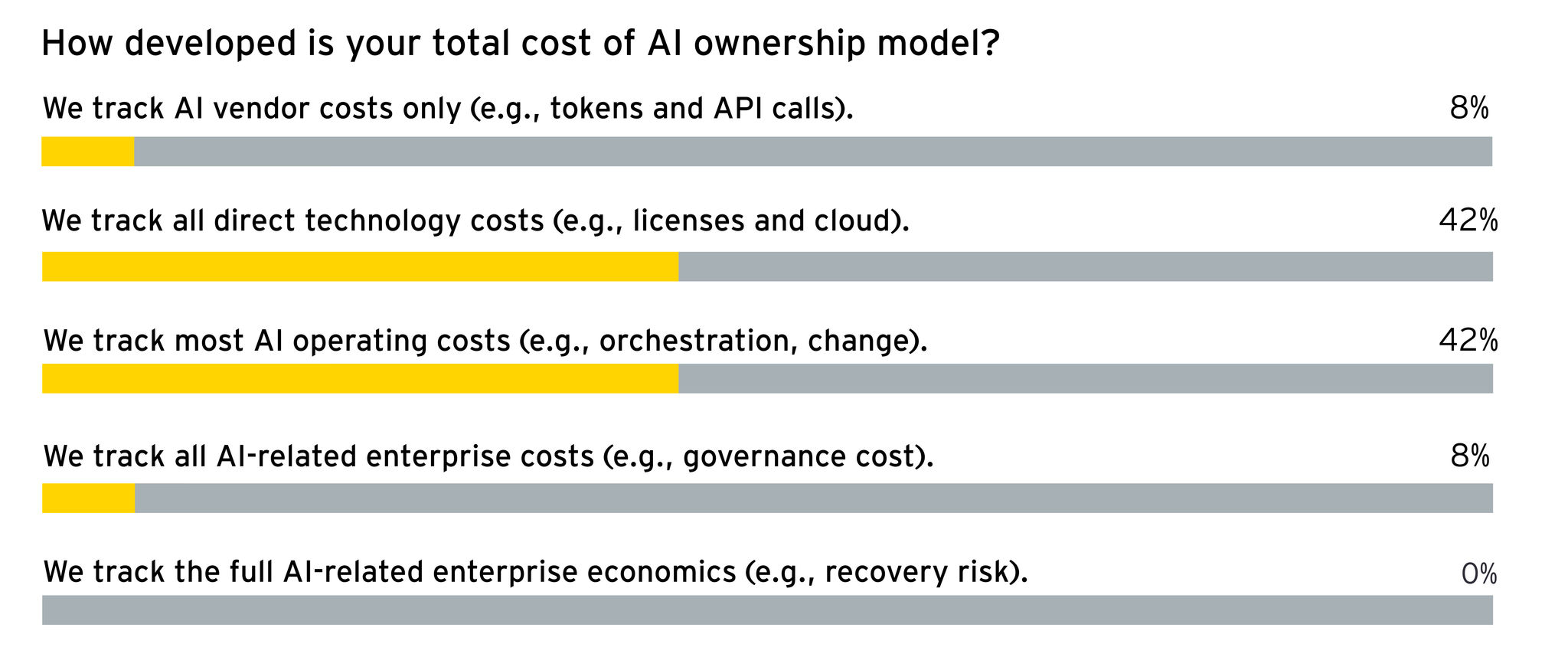
Many CFOs are developing a solid foundation for measuring comprehensive AI cost, with half of the group already factoring in most AI operating costs, including orchestration, change management and the run-rate cost of agents, while the other half currently limit their measures to direct technology costs such as tokens, licenses and cloud expenses.

how developed is your total cost of AI chart

A tech CFO said his company was seeing tremendous benefits relative to the cost but only after a great deal of work. “Our OpEx has gone down in dollar terms for the past four years in a row, and it’s at the most efficient in the history of the company,” he said. “But we spent three years pulling apart every workflow and process in the company. Over our history, we’ve bolted on ERPs, empowered different geographies to build their own tools, lots of acquisitions — you wake up and your data doesn’t talk to each other. Putting AI on that will produce benefits but not long-term scale. In our journey, 75% of the effort hasn’t been AI: it’s been process management. Some people try to shortcut the first piece of that.”

As organizations move from experimentation to scaled deployment, CFOs are beginning to apply the same capital allocation discipline to AI that they apply elsewhere in the business. Rather than defaulting to the most powerful model, many participants described a growing focus on matching the right tool to the right use case while balancing capability, cost and business value.

CFOs who were feeling more confident about cost credited their more flexible approaches that avoided locking the company into a single model or provider. One participant compared it to choosing between a standard ride and a premium ride service: Both get you to the same destination, but at very different price points.

“We went through all of our finance areas, and 80% to 90% of tasks don’t need to be at the frontier levels,” one leader said. “We’re at such a point where we’re doing a lot of experimenting, but we’re not committing to any frontier model,” another added. Many recognized that certain tasks worked better with certain models but that the models themselves changed so often that it was a struggle to look toward the future with certainty.

“Customized harnesses help us route to the right model — that’s the leading thinking without creating an expectation that everyday users will have the right knowledge necessary to help balance effectiveness and cost,” said Traci Gusher, EY Americas AI and Data Leader. “But small language models can be deployed on your local infrastructure or even your laptop and trained on your data, without paying token costs. It’s good where there is proprietary information that is highly tailored to you. The tradeoff is that if you need deep research that isn’t in your information, then you need a large model for that intelligence. The thinking is that we have to be hybrid.”

A tech company CFO found success by having a dedicated AI leader in each function, like supply chain and sales, who determines who can access which type of LLM and the token budget. “If I’m giving anyone AI capability, it’s understood that a multiplicity of productivity with a better cost outcome is needed,” he said. “We didn’t provide any new dollars for AI costs. They have to be self-funded and then some. You have to prove you’re using it productively.” Another had a dedicated AI team of under six people. “They have the three-part agenda: awareness, change management, and working with functions by wave to get a business case with costs tracked and the engineers deployed,” she said.

Nonetheless, CFOs widely understood that the benefits of AI often did not easily correlate with a certain dollar amount. “Listen, if you told me that I could take the budget up 25% but increased productivity 10x, I’d take that,” one said. Another CFO added: “Investors sometimes just want to see expenses going down. It’s taken a while to get everyone to understand that it’s more about expanding gross than anything.”

Recommended actions

  • Understand that small language and open-weight models are cheaper and may be more than adequate for a task.
  • Incorporate AI expenses into business cases from the outset, establish hurdles to clear for expected returns, and recognize that value may appear through revenue growth, speed or capacity rather than just lower costs.
  • Monitor usage at the individual, function and business unit levels and create metrics around how to distinguish productive adoption from experimentation that creates little value. For transparency, assign the costs to the functions and use cases generating them.
  • For a bigger impact, redesign selected processes end to end, strengthen the underlying data and context, and pair business-led ideas with technology expertise that can industrialize and scale them.

AI governance and risk: building confidence to innovate

One CFO in consumer goods noted that his company’s products could cause injury if a customer service chatbot made incorrect recommendations. “That would expose us to legal action,” he said. But there was a solution. “We put checks and balances in; if the usage has a certain level of risk, our chatbots will respond so that they have everything documented, like the source. Two or three years ago we had been using publicly available agents and getting all kinds of wrong answers. It put us in a conservative posture right out of the gate.”

Enabling innovation was clearly on the minds of CFOs, half of whom said that it required the most attention among all aspects of AI governance in their organizations. “Where we’re starting to see leading practice evolve to is governance as an accelerant to innovation,” said Richard Jackson, EY Global Assurance AI Leader. “It’s like having good brakes on a car: they give you the confidence to go faster. For a lot of organizations, they’re in the mode of how to slow down and not break things. They’ve over-pivoted to that.”

Even so, the reality of regulatory compliance could not be ignored. “People can sneak things through easier with AI,” one CFO lamented. “We can’t let the models make decisions and then throw our hands up,” another CFO in financial services noted.

That tension was evident in the inaugural Ernst & Young LLP AI Risk and Governance Survey of more than 200 US senior AI decision-makers at large publicly traded companies. Nearly all respondents (98%) report that their organizations have formal AI governance policies in place. Yet 69% are concerned that their organization lacks the internal expertise needed to keep evolving its AI governance controls effectively, and about half (47%) say their organization has previously bypassed its AI governance process for urgent deployments. “The underlying theme is how to make the governance something that works designed at the front end,” Jackson said.

For CFOs, accountability ultimately extends beyond controls and technology to the people responsible for evaluating AI-generated outputs. All of this heightens the need for human skills in a way that is perfectly understandable yet somewhat paradoxical. “The grunt work is done with your agent and then the judgment call is with the person,” one CFO noted. “We’re dialing up to get AI fluent and interact with the agents and write your code, so we’re indexing on talent the other way: judgment is heightened.”

CFOs then sounded an alarm that one leader aptly summarized: “If all the activities are replaced by AI, then how do we enable teams to grow the critical thinking and judgment they’ll need when the transaction is done by the agent?”

In the EY audit practice, which has used an apprenticeship model in its audit practice for over a hundred years, that question is acute, Jackson said. The internship program is no longer six weeks over the summer; now, a residency program employs recruits through the last three years of their college career, with simulated training and experiences to hone professional skepticism. “Over those years, we’ll start bringing them in to do the activities that will be displaced by AI, like cash confirmations,” he said. “The tech shows us that we can move them aggressively through new roles and responsibilities, instead of the defined time cadence.”

Recommended actions

  • Strive for governance as an enabling capability to accelerate safely, not just to slam on the brakes. It can contain the potential impact of experimentation, identify successful patterns early and create a clear path for converting promising ideas into secure, enterprise-grade solutions.
  • Establish a risk-based governance model that applies controls according to the potential impact of each AI use case rather than governing every experiment in the same way.
  • Embrace multidisciplinary governance, bringing together finance, technology, enterprise risk, legal and business owners through established strategy, investment and technology risk forums, while giving employees controlled environments in which to develop low-risk ideas.
  • Rethink learning programs to sharpen professional judgment on a compressed timetable, like by using gamification.

Summary

CFOs are moving beyond AI adoption to confront its costs, uncertain returns and growing risks. Roundtable participants cited gains in forecasting, pricing, accounting and regulatory compliance, but emphasized that scalable value requires process redesign, strong data and disciplined cost tracking. Many favor hybrid architectures that match tasks with appropriately sized models. At the same time, risk-based governance should enable innovation while maintaining human oversight, regulatory compliance and accountability. As AI automates routine work, companies must also accelerate workforce development to preserve the judgment and critical-thinking skills future leaders will need.

About this article

Related articles

How CFOs can accelerate value creation: five lessons in leadership, metrics and talent

CFOs can accelerate value creation by strengthening leadership, redefining metrics, embracing technology and building future-ready talent.

Scaling AI in the finance function: six leading practices for CFOs

Six practices to help CFOs move beyond pilots and scale AI through stronger data, governance and talent strategies.

Juan Uro + 1

CFO Matters

CFO publication to deliver research-backed, high-quality insights that speak directly to the CFO agenda.