Office concept: meeting of business partners in a conference room to discuss new contracts

Merger Monthly series

US M&A activity insights: September 2026


Mid-market dealmaking kept activity moving.


In brief
  • Life sciences, media and entertainment, and insurance posted the strongest growth in deal value.
  • M&A activity remains supported by corporate confidence, strategic demand for scale and continued AI investment.
  • The M&A outlook is positive, but high borrowing costs, inflation and valuation gaps may keep dealmaking uneven.

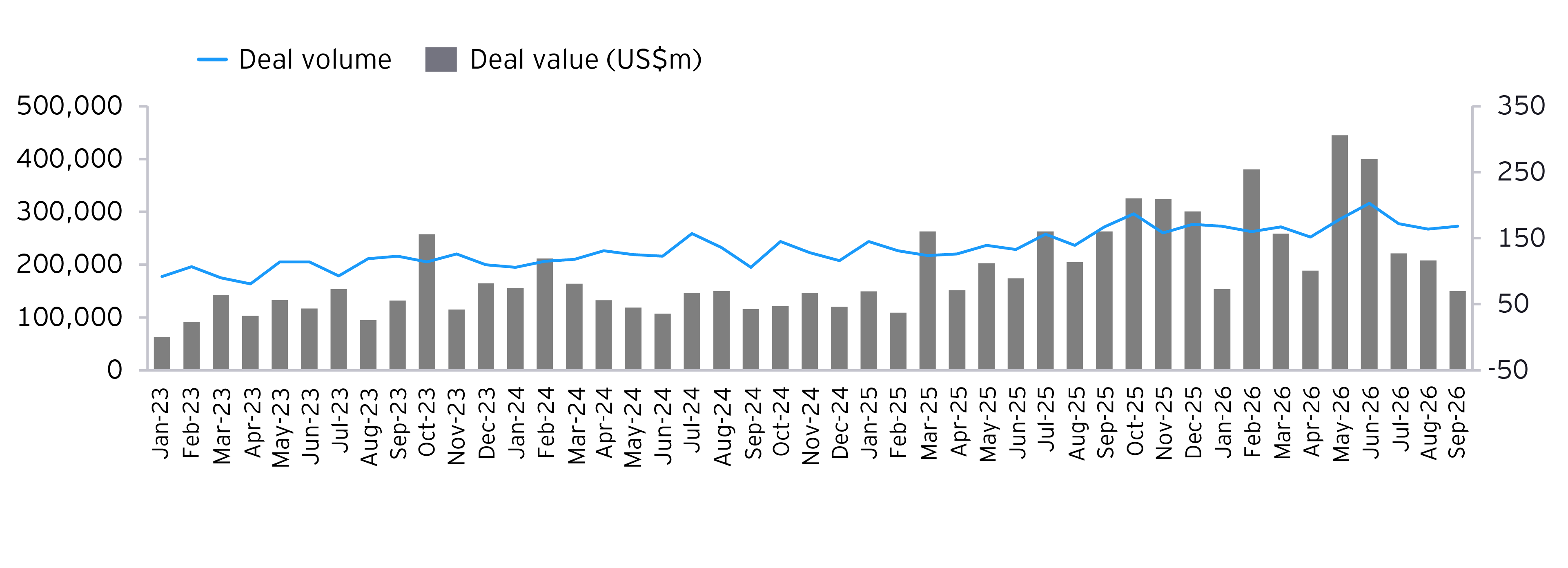
US merger and acquisition (M&A) volume increased 9% from July through September 2026, as mid-market deals supported activity, with megadeals losing momentum.1 Deal value for transactions of US$100 million or more declined 21% year over year (YoY). Megadeal (transactions above $5 billion) value and volume fell 50% and 21%, respectively, as borrowing costs, valuation pressures and macroeconomic uncertainty increased buyer selectivity. Against this backdrop, capital is increasingly being directed toward transactions with a clear strategic rationale, differentiated capabilities and identifiable value-creation pathways.

Against this mixed dealmaking backdrop, resilient economic growth could support acquisition appetite, even as inflation and financing constraints limit larger transactions. According to EY-Parthenon Chief Economist Gregory Daco, the US economy is expected to remain resilient, supported by robust consumer spending and sustained AI-led business investment. Growth could approach 2.5% in 2026, despite trade, geopolitical, energy and labor-related headwinds. The outlook remains uneven, with spending concentrated among higher-income households and corporate margins outperforming household income growth. Inflation is expected to stay above the Federal Reserve’s target, supporting a cautious monetary policy stance.

Monthly M&A trend (2023 onward)

Deal value (US$100m+), deal volume (US$100m+)

Monthly M&A trends chart - september

Enhancing portfolio resilience via diversification and strategic focus

Recent transactions reflect efforts to reshape portfolios through a combination of diversification, capability expansion and greater strategic focus. Acquirers are broadening exposure across complementary products, services and end markets to reduce concentration risk and create more balanced growth profiles, while some transactions facilitate clearer prioritization of core business areas. Rather than pursuing scale alone, buyers are using M&A as a deliberate lever to reshape portfolios, acquire critical capabilities and strengthen long-term competitive positioning.

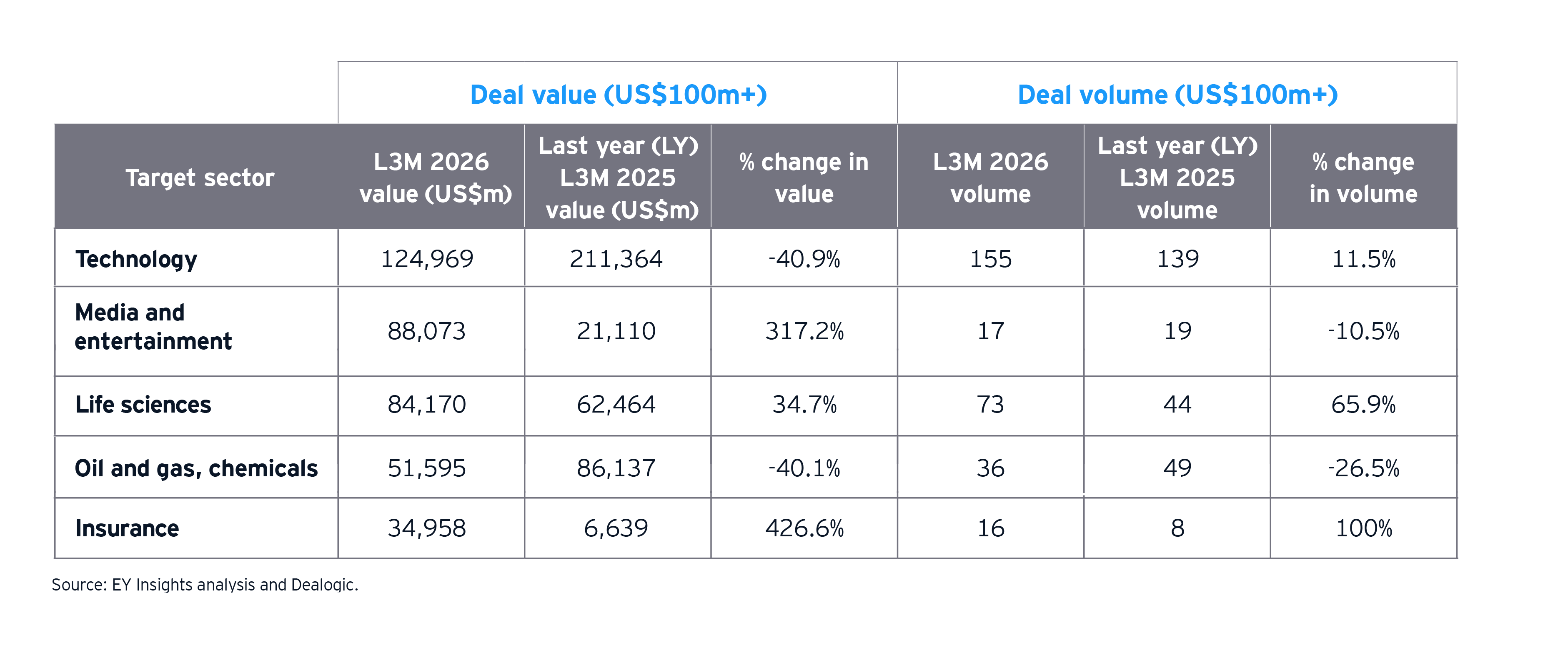
US sector breakdown for top deals (US$100m+)

Sectors that fueled deal activity in Jul-Sep 2026 (last three months (L3M)

US sector breakdown for top deals - jul-sep 2026

Sector highlights

M&A activity from July through September showed divergent trends across sectors:

Technology

Deal value declined 41% while volume increased 12%, indicating that activity shifted toward smaller transactions. Activity focused on AI platforms, data infrastructure, specialized computing and power-conversion capabilities supporting high-density data centers. Buyers targeted differentiated technology, research talent and scalable infrastructure to accelerate enterprise AI deployment, expand ecosystem reach and strengthen integrated digital offerings.

Media and entertainment


Deal value surged 317% as volume declined 10%, concentrating growth in fewer, larger transactions. Activity centered on premium sports franchises, live entertainment venues and scaled media platforms with strong brands and engaged audiences. Buyers pursued geographic expansion, broader reach and integrated ecosystems to drive commercial growth and diversify revenue.


Life sciences


M&A strengthened, with deal value increasing 35% and volume rising 66%, indicating growth was driven by a larger number of smaller transactions. Activity focused on pipeline expansion, therapeutic diversification and integrated diagnostic and manufacturing capabilities. Buyers prioritized differentiated late-stage assets and novel treatment platforms across oncology, immunology and rare diseases.


Oil and gas, chemicals


M&A activity, slowed with deal value declining 40% and volume falling 27%, reflecting more selective capital deployment. Activity pointed to consolidation and vertical integration across midstream infrastructure, alongside investment in energy infrastructure supporting data centers and AI workloads. Buyers pursued greater processing and transportation capacity, integrated operating footprints and contracted cash flows to capture synergies and build scale.


Insurance


M&A surged, with deal value increasing 427% and volume rising 100%, indicating deal volume and volume rose sharply amplified by larger transactions. Activity centered on consolidation across insurance distribution, specialty risk and regional underwriting platforms, alongside technology-led modernization. Buyers pursued greater market reach, portfolio diversification and vertical integration while targeting AI-enabled advisory, underwriting and workflow capabilities to enhance operating efficiency.


"The insurance M&A market has continued to strengthen, as we are starting to see the return of some of the larger deals we expected in the second half of the year. The largest US financial services deal this year has been in insurance brokerage and was driven by a take-private with an AI transformation focus. Competitive pressure is also a big driver, with buyers asking what they need to do to keep up. While deal size and scale matters, investors are really looking for capability, whether that's distribution, a specialty or underwriting expertise they don't already have," said Jeremy Spier, EY-Parthenon Americas Insurance Sector Leader.

Looking ahead

For the remainder of 2026, M&A activity is expected to remain supported by improving corporate confidence, strategic demand for scale and capabilities, and continued investment in technology and infrastructure. Companies are likely to use acquisitions to accelerate revenue growth; acquire critical capabilities, technology and talent; strengthen supply chains; and expand into attractive markets. AI-related investment should remain a key driver of activity, not only within technology but also across data centers, power infrastructure, healthcare and industrial automation.

While the outlook remains constructive, dealmaking momentum may remain uneven as geopolitical uncertainty, with elevated borrowing costs and persistent inflation that continues to weigh on boardroom decision-making and financing conditions. Megadeals may continue where there is strong strategic conviction, particularly in the technology sector, as well as energy and power, although higher yields could result in greater volatility by making valuations and financing more challenging.

Middle-market activity is expected to remain relatively resilient as investors continue to pursue attractive valuation opportunities and operational value creation. At the same time, competition for high-quality assets, modest revenue growth and valuation gaps may continue to extend diligence and negotiation timelines. Private equity activity is likely to remain disciplined because higher borrowing costs will continue to constrain leverage, while exit markets recover gradually. Successful dealmaking will increasingly depend on strategic clarity, disciplined pricing, rigorous diligence and early integration planning.


Summary

From July through September 2026, US M&A activity increased by volume but declined by value as mid-market deals offset softer megadeals. Sector performance varied, with technology favoring smaller transactions while media, life sciences and insurance posted strong gains. Buyers pursued capabilities, diversification and scale, particularly in AI and infrastructure. The M&A market outlook remains constructive, supported by corporate confidence, though inflation, borrowing costs, valuation gaps and geopolitical uncertainty may keep momentum uneven.

Explore recent editions


US M&A Insights
August 2026


US M&A Insights
July 2026


US M&A Insights
June 2026


About this article

Authors


Contact our M&A advisory team
Get in touch to learn how EY can help with your M&A strategy. 

Related articles

How can CEOs turn AI productivity gains into lasting value?

Learn why CEOs are investing in AI, talent and portfolio transformation to convert productivity gains into growth and long-term value.

Private Equity Pulse: key takeaways from Q2 2026

The PE Pulse is a quarterly report that provides data and insights on private equity market activity and trends. Read the latest report.

EY-Parthenon forecasts resilient 8% growth in US dealmaking in 2026 despite geopolitical and economic headwinds

The EY-Parthenon Deal Barometer projects 8% growth in US M&A 2026 deal volumes. Get the latest M&A outlook on US deals, mergers and acquisitions, and dealmaking trends.

Macro Bites: PE deals increase as valuation gaps shrink, dry powder available

Private equity leaders should invest in AI, prepare for exits, and engage stakeholders to seize new market opportunities. Watch more on Macro Bites.