AI Machine Learning Business Internet Technology

Neurosymbolic AI: A strategy for growth, not just a product

Neurosymbolic AI is a fundamental shift in growth strategy, helping CEOs see around the corner to find opportunities their competitors don’t see.


In brief
  • Neurosymbolic AI can help companies transform their commercial model by identifying hidden growth opportunities.
  • It can help companies develop tailored strategies for forecasting, pricing, new products, M&A and more.
  • EY Growth Platforms is working with companies across industries to harness the power of neurosymbolic AI.

How can CEOs find the exponential growth opportunities that their competitors don’t see in a world where hundreds of millions of data points can send mixed signals? And how can they develop the strategy to scale these opportunities at hyper speed? Neurosymbolic AI (NSAI) can be that game changer. However, most executives today are not aware of Neuro-symbolic AI (NSAI) as an emerging AI technology, nor of the role that it came to play in growth. Those that do hear about NSAI may easily mischaracterize it as another technology initiative. This is a categorical mistake. NSAI is not about phasing in a new tool; it is about transforming the commercial model. NSAI provides a strategic lens that reshapes how enterprises perceive, unlock and sustain growth.

Here, we introduce a structured approach to NSAI as a growth strategy:

  1. Applying the NSAI lens to stratify and uncover hidden concentrations of value
  2. Creating foundational workflows that embed causality into enterprise operations and drive core growth
  3. Unlocking adjacent growth through new venture workflows that scale beyond the core

Defining NSAI

NSAI fuses statistical AI (pattern recognition) with symbolic AI (logic, rules, and causal structures). The outcome is predictive, auditable, adaptive and scalable reasoning that not only forecasts outcomes, but also explains why and prescribes how to act.

Where NSAI is on the horizon


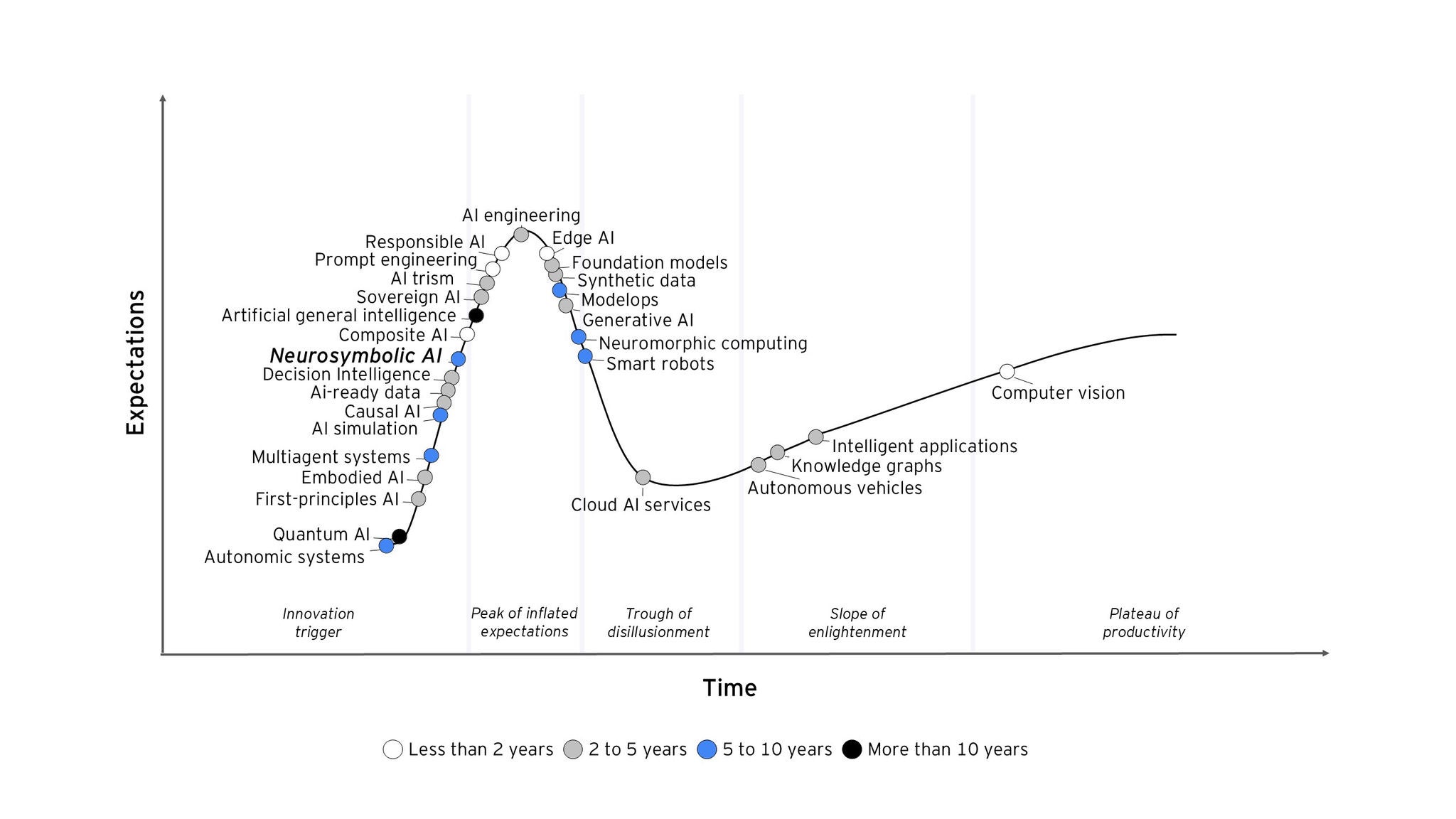
Most industry observers, including Gartner, place NSAI on a 2–5-year horizon before broad enterprise adoption (Figure 1). This creates a strategic gap, and a rare opportunity. While most organizations will wait for maturity, the EY team is already moving.


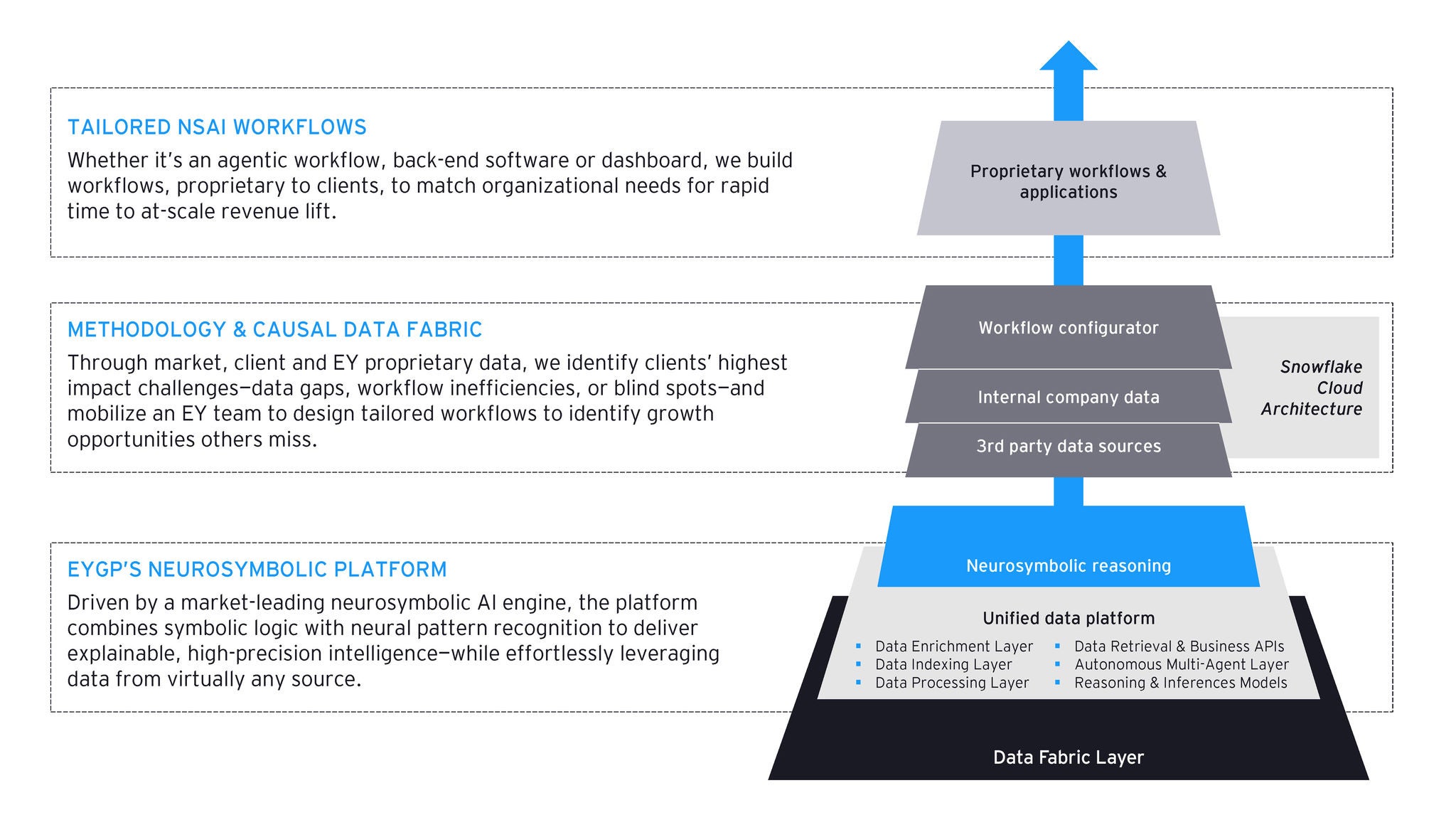
Through EY Growth Platforms (EYGP) and an exclusive licensing agreement with Growth Protocol, we have already built the only enterprise-grade NSAI platform in the market today. Our platform uniquely integrates real-time public data with proprietary client and third-party sources, within the client environment, delivering tailored insights with highest granularity. This fusion of data unlocks differentiated opportunities and empowers leading enterprises to seize first-mover advantage: not just testing NSAI but deploying it to shape markets (Figure 2). By operationalizing NSAI ahead of the curve, these enterprises don’t just participate in the future of AI, they define it, capturing disproportionate growth opportunities that late adopters will miss.


Figure 1: Gartner Hype Cycle for AI, June 2024

Source: Gartner Hype Cycle for AI, June 2024


Figure 2: EYGP’s Neurosymbolic platform


Workflows: strategic engines of value transformation

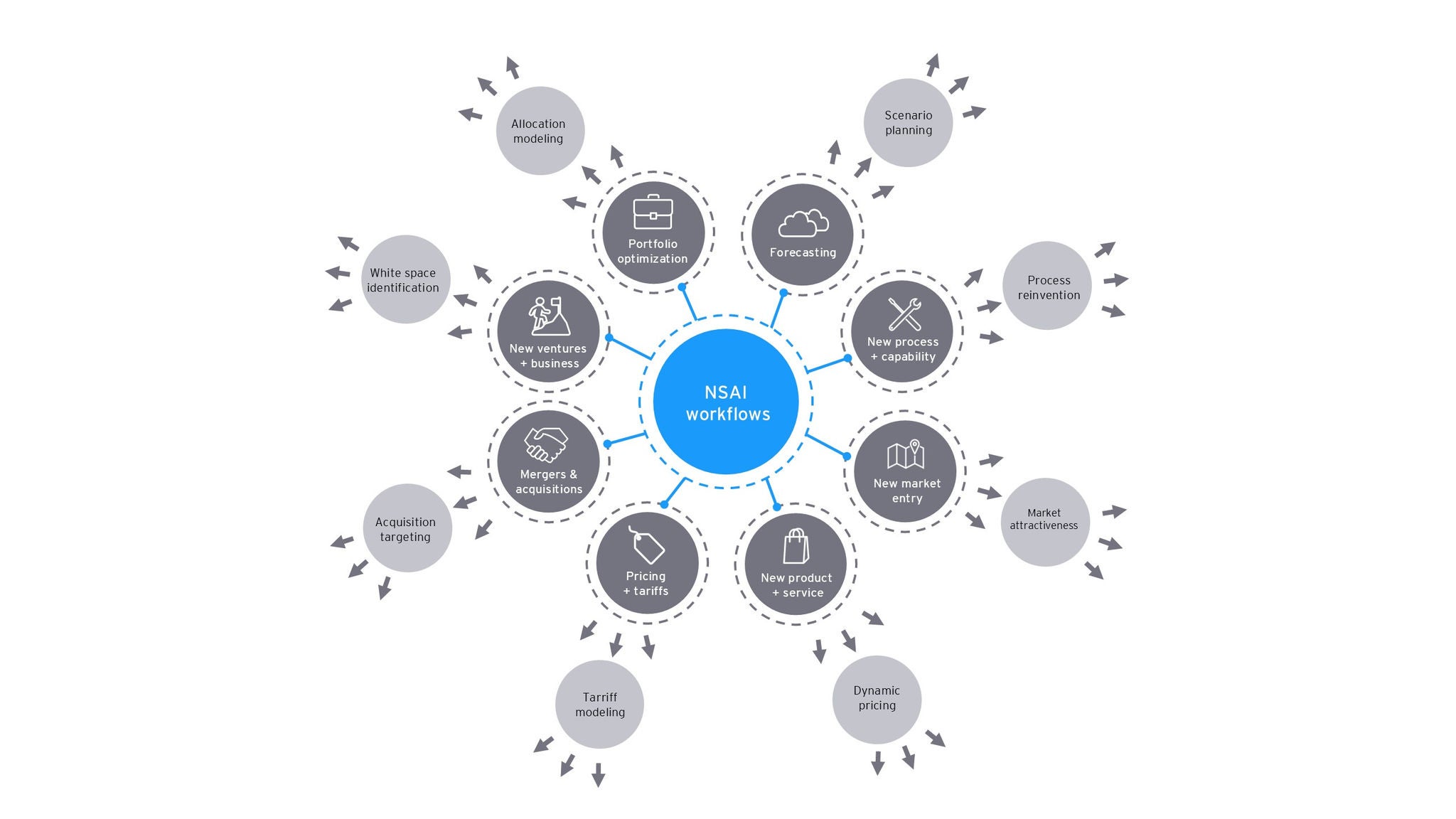
Workflows are key. In NSAI, a workflow is a proprietary application purpose-built to unlock enterprise growth by being activated across all components of the commercial model, or more simply, the levers a company uses to make money. These include forecasting, pricing and tariffs, new products and services, market entry, M&A, new ventures, and portfolio optimization. A workflow is not automation or campaign optimization, it’s a strategic engine that integrates data, causal reasoning and execution to drive value creation at a structural level. Here, we focus on two or three of these areas to illustrate how NSAI can drive transformation and unlock value.

Unlike traditional process improvements, NSAI workflows target hidden concentrations of value others cannot see, map the causal dynamics behind them, and design interventions that shift value into higher-return flows. Because these workflows are auditable and continuously adaptive, they not only capture value once, but sustain and compound it over time (Figure 3).

The outcome is not incremental efficiency, but a step-change in enterprise performance, redefining pricing power, margin profile, risk resilience and growth trajectories. These shifts directly translate into material changes in market capitalization and enterprise value potential.

NSAI brings growth strategy from static research to dynamic execution. Custom workflows embedded in an enterprise environment continuously identify and surface real-time opportunities for profitable growth. This redefines strategy as a living system, where workflows act as strategic engines of value transformation, reshaping how enterprises compete, scale and lead their industries.

Figure 3: Enterprise workflows: foundational and nested


Why NSAI is a strategic shift

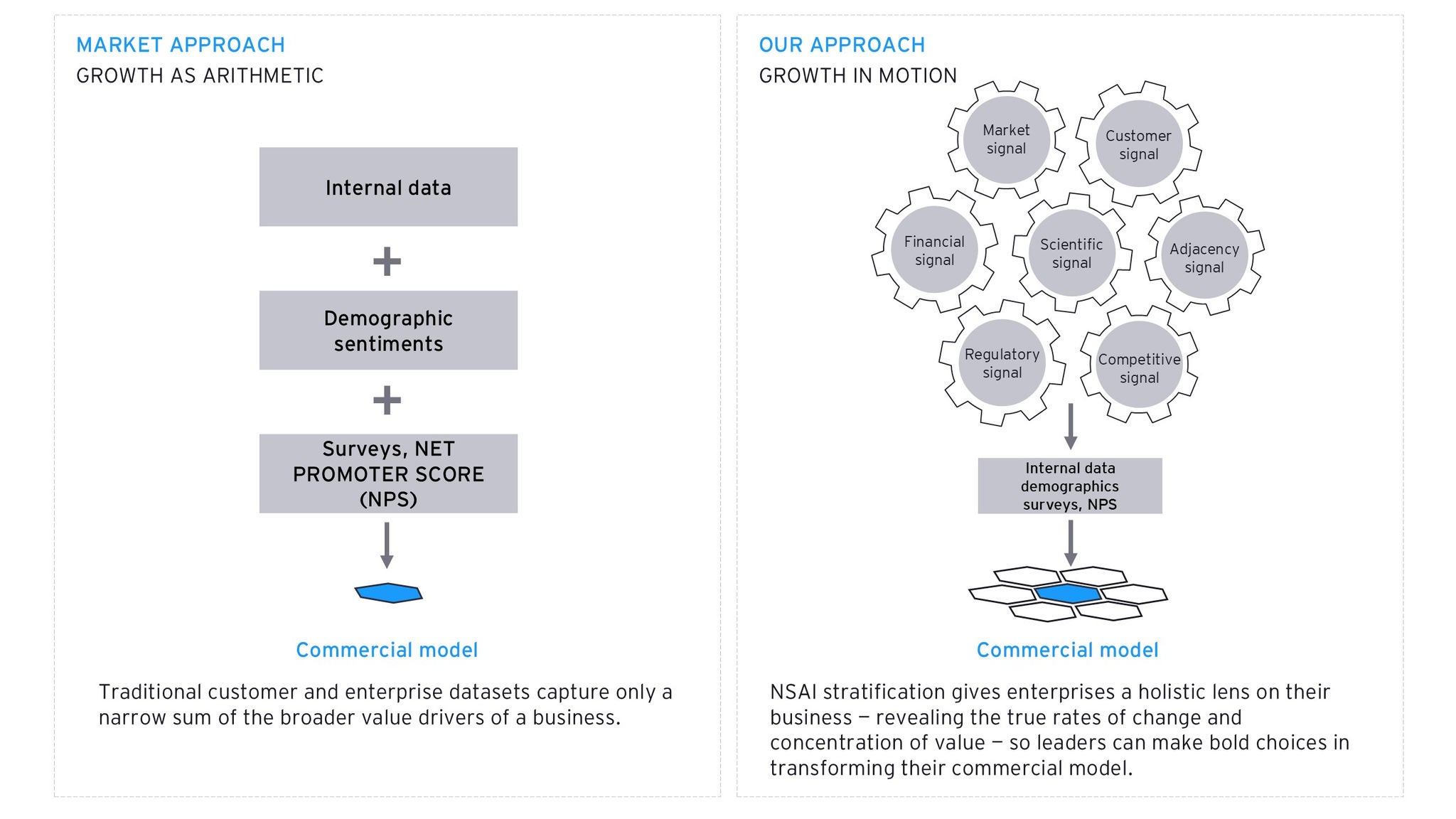
Traditional growth is treated like arithmetic, with incremental gains. NSAI reframes growth as calculus: flows, compounding effects and first-mover advantage. It changes problem statements, elevates thinking and transforms execution (Figure 4).

Figure 4: The NSAI growth difference


How stratification changes the growth equation

To help identify those growth opportunities, NSAI enables stratification of an enterprise’s commercial model. To do this, NSAI fuses vast external data signals, such as demographics, competitor pricing, online activity and supply chain costs, with internal business inputs. This approach uncovers hidden value flows within the organization, revealing which segments contribute most to revenue and which may erode profitability. By identifying these dynamics, NSAI enables businesses to design adaptive workflows, continually updating strategies to maximize growth. This kind of stratification is what helps clients rapidly assess where NSAI can deliver the highest ROI. While NSAI can touch every part of the commercial model, the point where value is unlocked is different for every enterprise. Stratification is how we find it.

NSAI in action

EYGP is currently working with a select group of leading-edge clients to define how NSAI can accelerate growth and transform their commercial models. The following case studies reflect real-time engagements and represent just a fraction of the broader applications underway, highlighting the rare window of opportunity for early movers to differentiate.

Case study 1: Global OEM insurance — foundational workflow for core value

A global OEM (Original Equipment Manufacturer) sought to enter the insurance space to bundle risk coverage with equipment sales. Their ambition was to create a recurring revenue stream to offset cyclicality in equipment sales.

Without NSAI (Traditional build): The manufacturer would rely on actuarial modeling and fragmented dealer systems. Time-to-value was 2–3 years, with high vendor costs, fragmented customer experience, and the risk of replication by InsurTechs and traditional insurers.

Result: Recurring revenue of approximately $60M with limited scale.

With NSAI + EYGP (Accelerated differentiation): Insurance is being reframed as a data-driven ecosystem play and is expected to launch in less than 12 months with auditable NSAI underwriting. EYGP brought dealer, fleet and risk data together. Predictive repair improved claims and service pull-through. Dealers are becoming risk advisors with real-time dashboards. Proprietary operational data + NSAI decisioning will create high barriers to entry among competitors.

Expected impact: A line-of-sight to $1b+ total shareholder return impact. Higher margins from bundled value and premium pricing. Insurance transformed into a strategic growth engine, resilient to cyclicality.


Case study 2: Enterprise SaaS platform — unlocking adjacent growth

A SaaS provider in enterprise risk insights was positioned as a cost-savings tool. Its differentiation was at risk as Enterprise Resource Planning (ERP) and Business Intelligence (BI) vendors advanced. Leadership saw the need to reposition beyond efficiency.

Without NSAI (Current state): Value centered on efficiency such as accounts payable optimization and procurement savings. The SaaS provider’s differentiation was at risk of being commoditized. Onboarding required manual mapping, and the market was limited to construction with modest expansion. They risked being perceived as just another analytics tool.

With NSAI + EYGP (Future state): The provider will be repositioned as the first NSAI-enabled enterprise growth operating system. Value will shift from efficiency to growth and resilience. Causal reasoning will provide explanations, not just predictions. Automated ingestion will cut onboarding from months to weeks. Playbooks will expand into multiple industries, enhancing pricing, supply chain redesign, divestitures and venture creation. Continuous causal learning will create defensibility.

Expected impact: Their platform will transform into a category-defining growth operating system and expand their TAM, move beyond efficiency to strategic growth enablement, and position as the first NSAI-powered platform for resilience.

To capture this value, it’s about more than just the technology. It’s knowing where and how to apply it. EYGP’s integration within the broader EY ecosystem gives clients not only access to NSAI, but also the functional expertise needed to execute on these workflows. Whether it's pricing, supply chain, or new ventures, our teams help clients rapidly assess where NSAI can deliver the highest ROI and stand-up workflows that drive measurable impact.

The choice for leaders

The decision in front of executives today is not about which AI product to buy or which incremental digital initiative to fund. It is far more fundamental: Will you continue to operate in arithmetic, or will you move into calculus?

Through the lens of NSAI, we have shown:

  • How stratification exposes hidden concentrations of value and enables leaders to see what others cannot.
  • How foundational workflows transform the core, embedding causal reasoning into pricing, forecasting, insurance, and supply chain execution.
  • How adjacent growth opportunities can be unlocked through new venture workflows that reposition entire platforms and create new categories.

Most organizations are 2–5 years away from being able to do this at scale. The EY team, through EY Growth Platforms with a license for Growth Protocol, has built the only enterprise-grade NSAI platform capable of delivering these insights and workflows today. That creates an unprecedented opening: for the first movers who adopt NSAI now, the prize is not incremental efficiency, but market leadership.

This is not a race to adopt another tool; it is a race to own the commercial model of the future. Companies that act first will not just participate in the next wave of AI — they will set the terms of competition, reshape industries, and capture growth opportunities that others will only see in hindsight.

For leaders willing to seize this moment, NSAI offers more than technology. It offers a strategy, a lens, and a platform for transformation. The opportunity is nothing less than redefining how your enterprise makes money, and in doing so, shaping the markets in which you compete.

Summary 

Neurosymbolic AI transforms the commercial model of companies, uncovering hidden value by integrating data, causal reasoning, and execution. This creates a sustained competitive advantage, empowering businesses to redefine growth, future-proof revenue, and launch innovative ventures across industries.

Morgan Cole, EY-Parthenon, EY Growth Platforms Chief of Staff, contributed to this article.

About this article

Authors