





EY refers to the global organization, and may refer to one or more, of the member firms of Ernst & Young Global Limited, each of which is a separate legal entity. Ernst & Young Global Limited, a UK company limited by guarantee, does not provide services to clients.
How EY can help
-
Helping top leaders to achieve peak performance, professionally and personally, by providing insights and networking opportunities.
Read more -
ey.ai The Reimagination Engine helps organizations to scale AI across the enterprise, delivering trusted intelligence, connected capabilities and real business value.
Read more
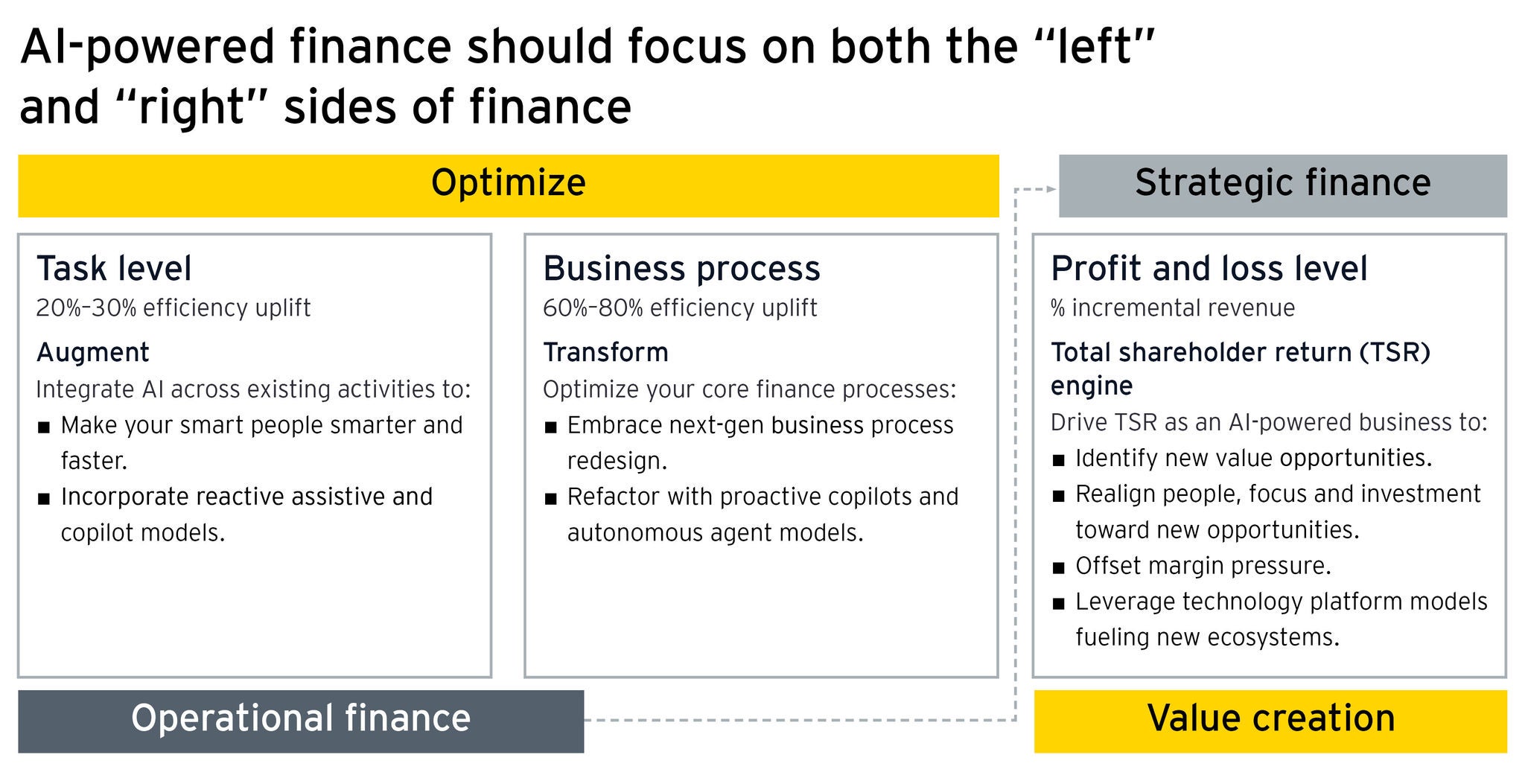
When we consider the future of finance, it is often helpful to consider it through two distinct lenses: operational finance and strategic finance.
On the left, operational finance acts as the “machine,” handling tasks like closing the books, processing journal entries, managing cash applications and producing month-end analyses. On the right, strategic finance focuses on driving and enhancing business performance, leveraging insights to shape the organization’s future. The left side focuses on efficiency and control, the right on strategy and value creation.
Left-side disruption: Agentic AI is making rapid inroads into operational finance. Accounts receivable and accounts payable agentic solutions offer efficiency improvements far beyond traditional labor arbitrage. Agentic AI can now “touchlessly” produce month-end analysis, create reports and narratives, and automatically reflect changing economics into new, accurate forecasts and scenarios. Work that took weeks can be performed in minutes with little to no human effort. This rapid digitization of accounting work enables a pivot in purpose toward smaller data-enabled and value-focused organizations.
Right-side value: This is where we see the most significant opportunity, driven by functional reimagination that allows finance to switch focus to growing and delivering enterprise value. As we consider analytics maturity, most CFOs would assess their organizations to be somewhere between descriptive and diagnostic. Predictive analytics (forecasting) leveraging AI fused with existing data has become a mature capability, and the technology is now enabling both prescriptive and autonomous analytics offering radically improved capabilities, insight and value.
Consider a forward-thinking Fortune 100 company that successfully implemented broad AI/ML forecasting in 2018. The CFO also led a significant shift in resource allocation to focus the business on growing total shareholder returns (TSR). Over 10 years, this company’s relative TSR has improved from third-quartile to top-quartile, and on same sales and revenues its market cap is over $160b higher as a consequence of this finance-created and -led program. This program depended on finance to provide new market and competitive insights that were executed through incentive systems, strategic planning processes and annual operating plans. At first, the insights were primarily manual and required a heavy lift to support the changes. Today, this work can largely be digitized with significant improvements in quality and agility.
The “aha” moment: This example illustrates the conundrum: Should CFOs focus on driving efficiency on the left or value on the right? The reality is that most finance functions typically cost 1% of sales, and the benefits from a cost reduction program in a Fortune 100 company would likely be measured in tens of millions. However, improving TSR could easily yield tens of billions.
Our view is that CFOs should create balanced transformations including both left and right. The costs of building new strategic finance capabilities can be offset by cost reduction delivered by the reimagination of operational finance. CFOs should have solid expectations that their organizations drive significant enterprise value far beyond the constraints of their functional costs, including improved price realization, increased product and service competitiveness and, importantly, smarter resource allocation.
Starting the journey
Reimagination is a challenge for finance employees and leaders. We have been training our teams to repeat the same process every month without deviation. It’s not surprising that when we ask our teams to go “crazy” and reimagine finance, the result is blank stares. Reimagination requires a thoughtful and focused approach.
Successful transformations require a believable vision of the future with a granular roadmap to get there, and most importantly, the genuine engagement and support of the organization. EY data shows that almost half of finance employees directly link transformation to job risk, creating inertia that demands robust change management.i This is further amplified by the competing initiatives facing cross-functional and business unit leaders, along with the real risk of “transformation fatigue.”
In the next edition of CFO Matters, we will explore the practical steps a CFO can take to navigate this maze of work reimagination, new operating models, new talent needs and the necessary change management needed to build a strategic finance function that is a true competitive advantage.