




Futuristic blue neural network. Abstract science fiction concept. 3D rendering with DOF

How CFOs plan to leverage AI for growth and productivity in 2026

Related topics

During recent EY-hosted roundtables, CFOs explored the challenges and opportunities of integrating AI in finance as they prepare for 2026.


In brief
  • CFOs acknowledge that while they are in the early stages of AI adoption, there is a collective urgency to leverage AI for growth and productivity.
  • The successful integration of AI hinges on effective data management and a willingness to reimagine processes.
  • As the talent landscape evolves, CFOs should consider adapting their hiring strategies to focus on analytics and digital skills.

As CFOs look toward 2026, accelerating artificial intelligence (AI) across finance and the broader enterprise to drive growth and productivity will remain a key priority. Through a series of roundtables with CFOs of leading companies hosted by the EY Center for Executive Leadership in December 2025, AI’s implications loomed large on the agenda, forcing executives to reconsider technology platforms, data architecture, process reinvention and workforce transformation.

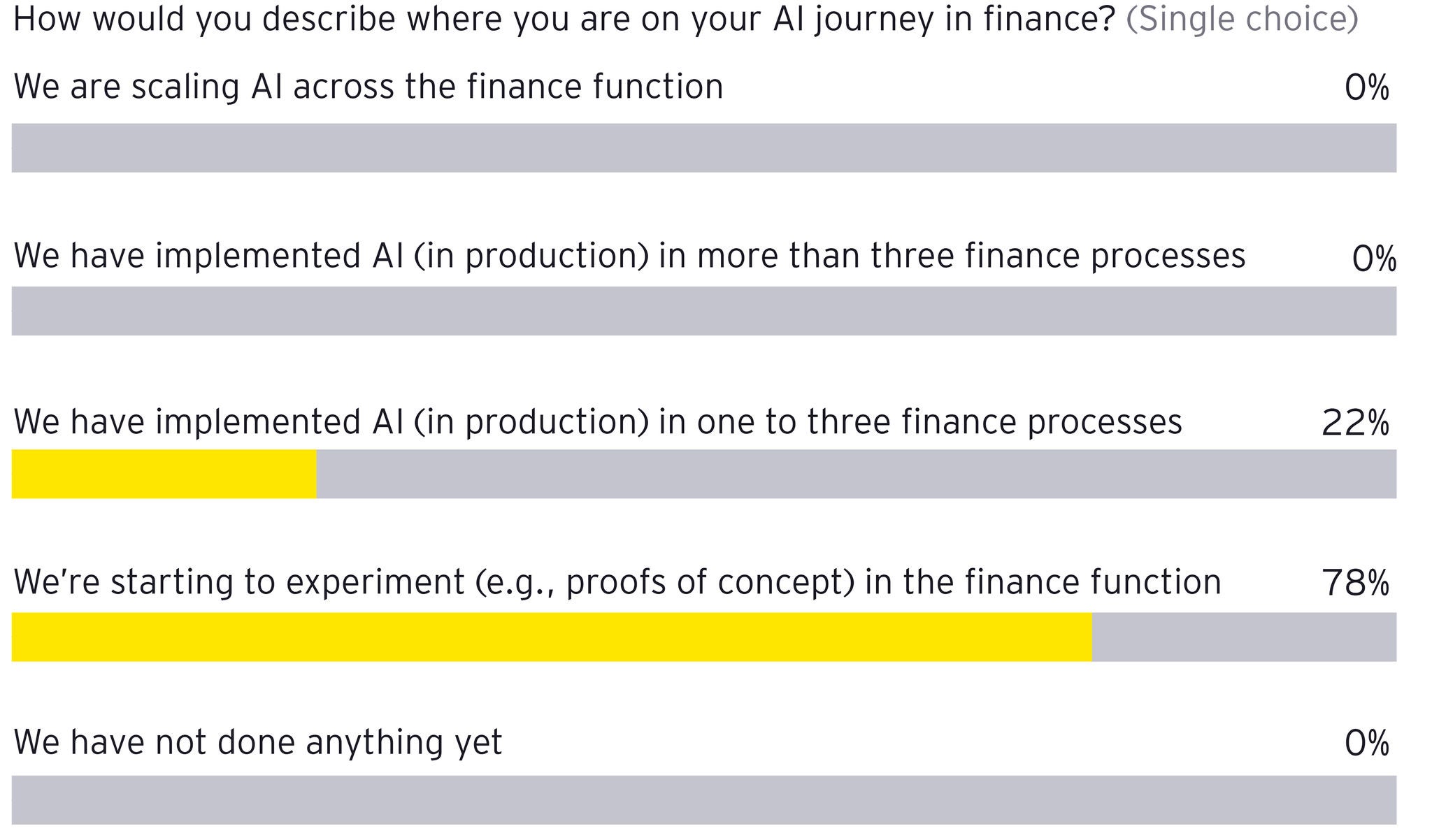
Most CFOs feel they are in the early stages of AI adoption, with experimentation focused on targeted use cases rather than broad transformation. There is a shared sentiment of being behind, yet most organizations are progressing at a similar pace. “I’d be surprised if anyone in finance is mature in AI — we’re a cautious group,” one CFO shared. While the technology has proved itself in procurement, internal audit, investor relations and the operations side, many feel that AI lacks a proven business case in finance. “You can spend $1 million or $2 million for proper AI but you save $100,000,” one executive said.


Nevertheless, CFOs shared strong proof-of-concept projects. One example: “We’ve built a proof-of-concept in finance, a language-model-based trained database on our travel expenses,” one CFO said. “That was to show the function that if you’ve done that, you can ask questions of the data without writing technical templates and queries.” And in shared services: “We have an agentic use case with collection, like past due for some companies. Coming up with an AI tool that can generate emails and follow up.”

ey-ai-finance-journey

Based on their experiments with agentic AI, these CFOs are likely further along than they may realize, using AI in accounts payable, contract validation and internal chatbots, while making tentative inroads into forecasting. “We say it takes a quarter to forecast a quarter,” a CFO said. “We’re in the early stages of coming up with a machine learning tool that won’t be perfect but will save hours over time.”

For another leader, a “man vs. machine” competition on revenue forecast is under way: “One of our finance team members owns a trend forecasting process that is largely manual with Excel spreadsheets. He’s been accurate. We decided to take that and see how to use AI to facilitate it. We’ve been running the two in parallel.”

Such efforts point to potentially new mechanisms for deploying capital effectively, with greater foresight. CFOs know what the drivers of shareholder return are and how, through finance, you can inject AI more transformationally.

1

Chapter 1

Technology: deciding what to bolt on or what to build up

Build vs. buy is a complex equation for CFOs, who are approaching AI inquisitively but cautiously in finance.

Several CFOs mentioned recent enterprise resource planning (ERP) transformations that have positioned them for success with AI, but the build-vs.-buy paradigm for new capabilities remains prominent. “I’m trying to weigh how much we build a solution or use the usual major platform vendors and just leverage something we can bolt on from them,” one participant said. But another CFO lamented: “A lot of what we see from vendors, when you talk about their AI offerings, it’s RPA 2.0.” Internal, secure LLMs were seen as useful but lacking compared with the native AI on existing software.

A critical consideration in technology architecture is how to marry internal and external data to drive the value from AI. Traci Gusher, EY Americas AI and Data Leader, shared: “One of the things we know about financial forecasting and machine learning is that your internal data is valuable, but external data supercharges accuracy in a forecast. In the architecture and AI models, you can get into a costly situation when you’re bringing all that external data into your ERP environment. There are new alliances that give you the opportunity to mirror your data into solutions without cloud egress charges.”

Action item: Explore new solutions that make it easier to house data, especially from external sources, for forecasting.

Data: what makes or breaks AI for the entire organization

Scenario planning and other enterprise-wide efforts rely on data that’s housed in finance. “You need to drive cost-efficiency, but don’t throw transactions over the fence,” urged Deirdre Ryan, EY Global Finance Transformation Leader. “They are where we capture data, and that’s where we can drive consistency and drive value and compliance.” Gusher tells clients that, for every dollar spent on AI, plan to spend 20 on data: “Without it, you’ll end up in your never-ending cycle of trying to figure out why your AI isn’t delivering value.”

Although CFOs are understandably wary about “owning” responsibility for data, they are in the best position to drive value and help enable data as a function. One participant said that IT reported to the CFO at his company: “The data lead is organizing our thinking in terms of data products, and staffing with people who know how to do this is critical.”

Action items: Strive to enable data as an enterprise-wide function, and encourage close collaboration between IT and finance in your organizational chart.

2

Chapter 2

Process: It’s time for reimagination, not just optimization

How would you work in finance equipped with AI if you started from a clean sheet of paper?

Use-case-specific approaches are yielding building blocks but no transformative value across the enterprise yet, CFOs say, because AI is being shoehorned into old ways of working. And tech leaders often have better insights into reimagining processes than those who are closest to them.

“We’ve taken our old processes from the old ERP and put them in a new system,” one CFO admitted. “We didn’t want to throw everything in the air at the same time. But we’re going back to redesign from the ground up. We’re going back to basics: what we need to do, not what the software can do. … We hear people say, ‘But two individuals aren’t checking it like before.’ Convincing people that AI is a better control than a human has gone a long way.”

Action items: Take the time to reimagine how you work and what you can achieve with AI, uniting subject-matter leaders with tech specialists, rather than sprinkling in technology.

3

Chapter 3

People: The talent equation has changed — or is being broken

The fear factor among employees is limiting adoption as CFOs try to set expectations on how productivity gains affect decision-making.

CFOs will be keen to channel productivity gains into either investment for functions or headcount reductions. “We’re trying to stay flat on the workforce year over year,” one attendee said. “And as we grow as a company, we don’t want to add resources in finance or shared services. But it’s definitely a big question for us, particularly because of the amount of investment of what IT wants to make.”

Another executive noted that AI was helping them improve work-life balance and make time for more employee training. But the fear factor weighs heavily on the minds of employees. “Adoption is a challenge because people think: ‘If I simplify these mundane tasks, then does that remove jobs?’ At the corporate level, we’re saying that it won’t.”

Within finance, AI-driven transformation is reshaping finance talent models, with a shift toward hiring for analytics, business acumen and digital skills. Because needed skills are changing, many junior roles where young talent should grow could be axed, even though they’re the most suited for the AI age. “During our layoffs, we didn’t change our new university hiring, but what we need out of university is very different,” a CFO said. Ryan urged CFOs to “borrow” talent through gig marketplaces and alumni networks.

Action items: Leverage rotational programs and rethink roles from across the hierarchy. Assess how to gain a balance of tech skills and technical skills and how to spread them.

4

Chapter 4

Economy: 2026 likely to resemble 2025 in many ways

In what feels like a transformative time, CFOs were largely feeling neutral about what to expect in 2026, while supply shocks and volatility persist.

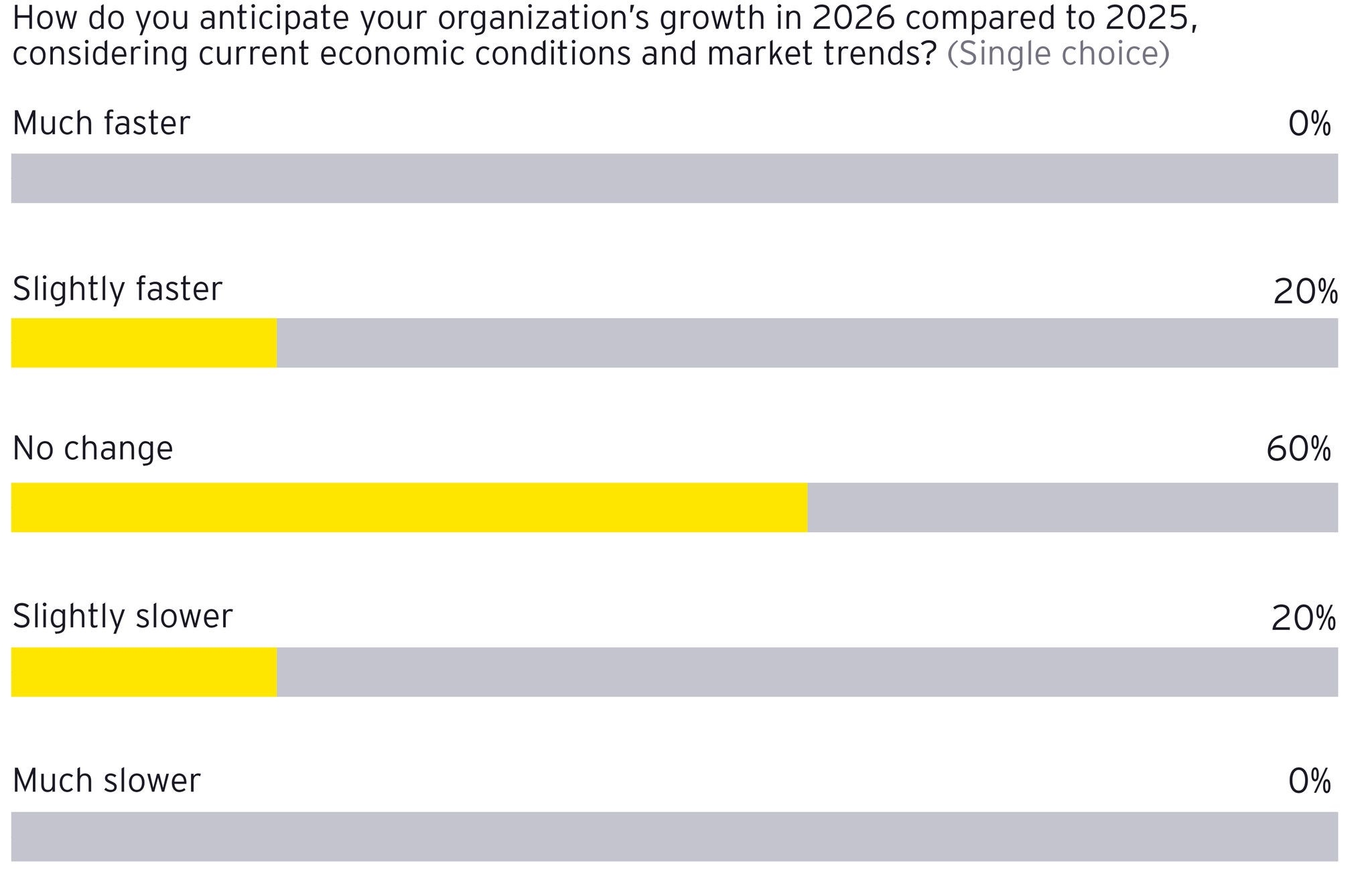
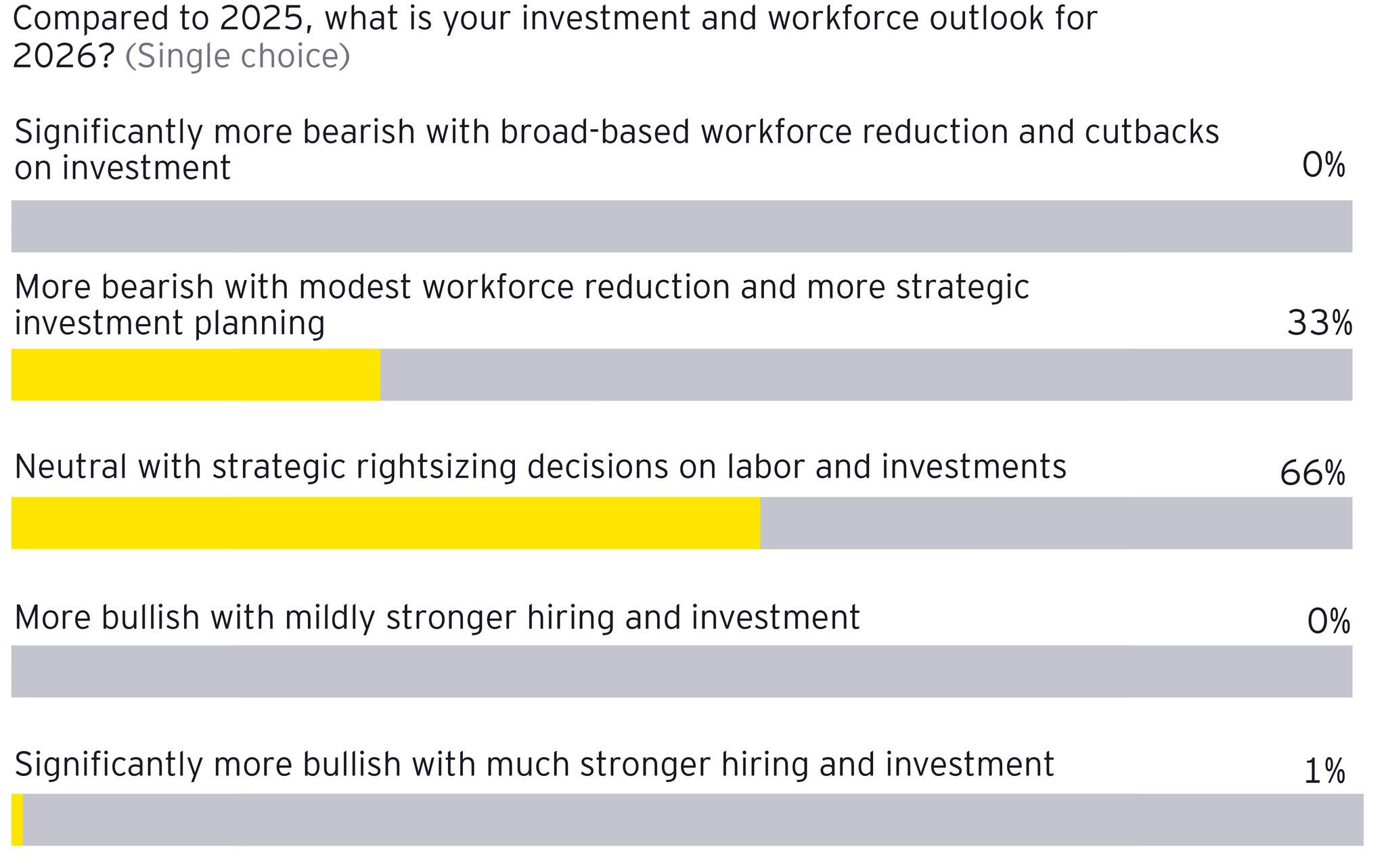
Looking toward 2026, CFOs were mostly not expecting much change in growth and were feeling neutral about their investment and workforce plans. Slightly more foresaw growth in costs but slower than revenue, while many expected costs to fall.

ey-ai-finance-how-do-you-anticipate

ey-investments

Greg Daco, EY-Parthenon Chief Economist, noted that the global economy has been resilient in the face of supply shocks, whether it’s the cost of trade (a negative) or the adoption of AI (a positive), which still remains low. He predicted a growth rate of 3.3% in 2026, up modestly from 3.1% in 2025, while noting three themes for CFOs to track:

  • A lot of market volatility exists in finance markets, with long-term interest rates that are still high.
  • Governments are balancing populist desires for greater spending with the need to remain competitive in key industries such as manufacturing. Debt levels are elevated, and the interest burden on that is rising.
  • The global population is rapidly aging, and birth rates are lowering across the world, limiting the potential for growth and strengthening the need for productivity through AI and automation.

Summary 

In recent roundtables hosted by the EY Center for Executive Leadership, CFOs from leading companies discussed the critical role of AI in shaping the future of finance as they look toward 2026. While many CFOs recognize that they are still in the early stages of AI adoption, there is a shared commitment to harnessing its potential to drive growth and productivity.

About this article