A technology leader using a laptop inside a modern data warehouse

Three foundational elements of successful securitization platforms


Peter O'Connell, Courtney Lazzari and Melissa DiDio also contributed to this article.

Securitization platforms that integrate people, processes and technology enable firms to navigate complexities and drive sustainable growth.


In brief
  • In an evolving financial market, robust securitization platforms streamline processes, enhance transparency and empower organizations to maximize asset value.
  • Building effective securitization platforms requires a mix of skilled teams, efficient processes and advanced technology to navigate regulatory complexities.

Introduction

Securitization has long been a vital mechanism for balance sheet, risk and liquidity management as well as a source of revenue. Pooling contractual debts and payment obligations — such as loans and leases — and converting them into tradable securities, not only grants issuers access to capital but also provides investors with a diversified asset portfolio. However, the complexities of securitization necessitate a robust infrastructure to establish efficiency, compliance and transparency. This is where an effective securitization platform becomes essential.

A dynamic securitization platform streamlines the process by automating workflows, facilitating regulatory compliance reporting and offering clear visibility for issuers, investors and regulators. These platforms form the backbone of successful securitization efforts.


The effectiveness of a securitization platform relies on three critical elements: people, processes and technology. Skilled teams with expertise in finance, technology and compliance are crucial for driving platform design and operations. Efficient processes and workflows are necessary for managing data governance and reporting throughout the securitization lifecycle. Finally, scalable and secure technology systems are vital for automating and integrating complex tasks, establishing seamless execution at every stage of the securitization process.


Development


A securitization platform can take different forms, reflecting the strategic choices organizations face at each step of its development. Building such a platform involves evaluating build vs. buy vs. outsource decisions for components like technology infrastructure, data management systems and compliance tools. The platform can be compartmentalized across different entities — such as internal teams, third-party vendors or hybrid partnerships — allowing for flexibility where different models may align better with an organization’s core competencies, such as in-house expertise in risk management vs. outsourcing specialized tech development. This decision-making process should occur before embarking on a full build-out to optimize resources and outcomes; for those with existing platforms, it presents an opportunity to reassess and pivot toward more efficient configurations.

As the financial landscape evolves — with potential shifts in market structures, entity roles and traditional exit strategies for asset originators — the need for a robust securitization platform has never been more pressing. Adaptable platforms empower issuers to expand their capabilities, navigate emerging dynamics and pursue innovative pathways for liquidity, risk management and financial gain.

In this context, whether organizations are building a new securitization platform or modernizing an existing one, they require a strong infrastructure to promote efficiency, compliance and transparency. By leveraging collective knowledge and experience, organizations can confidently navigate the complexities of the securitization lifecycle and position themselves for long-term success.

This article explores the foundational elements that underpin successful securitization efforts, emphasizing the strategic advantages these platforms provide. Financial executives, risk managers and decision-makers must understand how an effective securitization platform can boost operational efficiency and foster sustainable growth. Read on to discover how to leverage these insights for your organization’s success.

1

Chapter 1

The securitization lifecycle: key phases and challenges

A firm grasp of the securitization lifecycle phases is essential for organizations to effectively navigate the complexities and challenges impacting their operations.

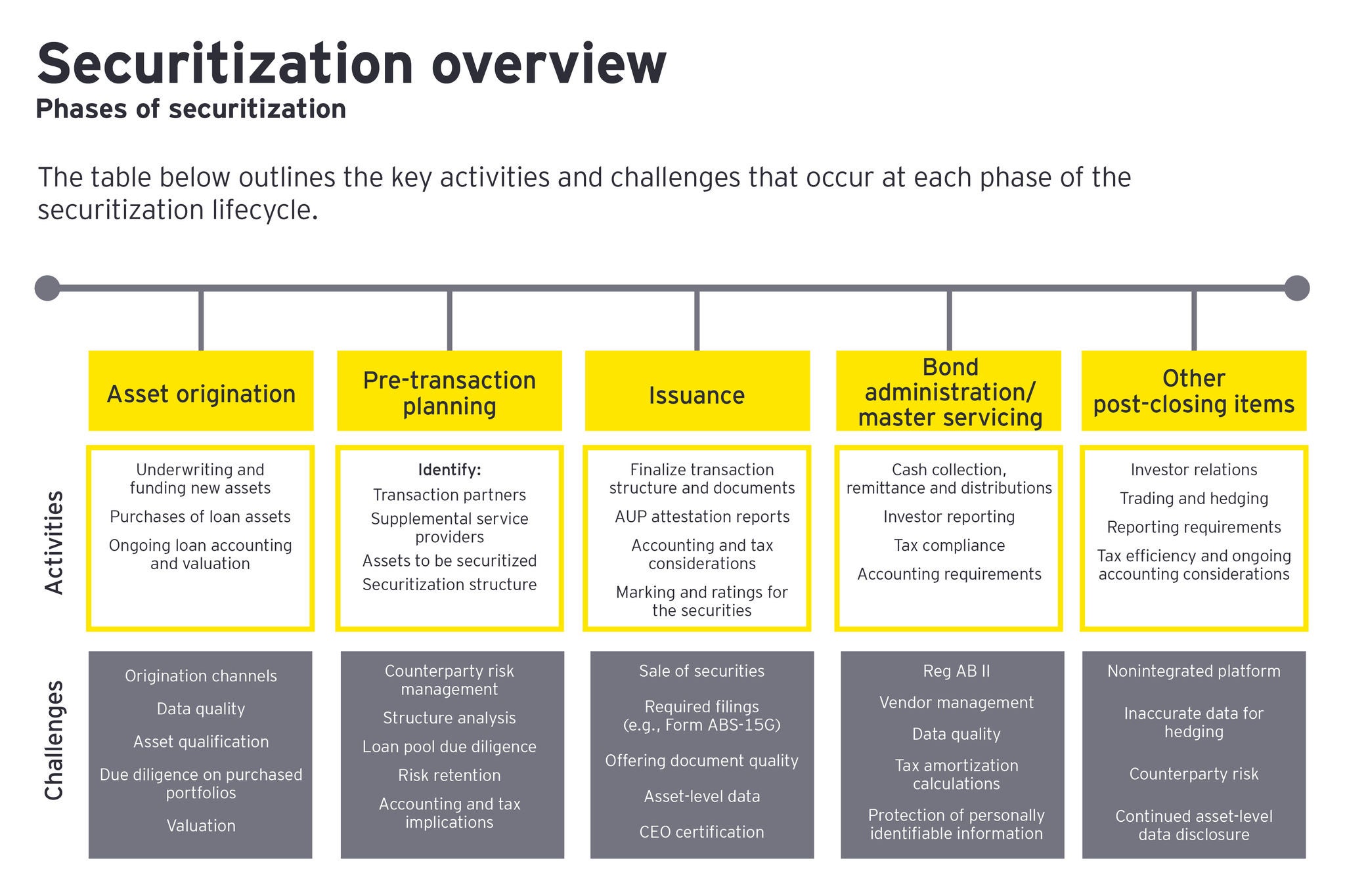
It is crucial to understand the securitization lifecycle, which consists of several key phases, each composed of specific activities and corresponding challenges that impact people, processes and technology. A comprehensive grasp of these phases is vital for organizations aiming to effectively navigate the intricacies of securitization.

1. Asset origination

The lifecycle begins with asset origination, where organizations focus on underwriting and funding new assets, purchasing loan portfolios, and maintaining ongoing loan accounting and valuation. This phase is filled with challenges, including managing diverse origination channels, verifying data quality, qualifying assets, conducting due diligence on potential portfolio purchases and accurately valuing assets.

2. Pre-transaction planning

Following asset origination, the pre-transaction planning phase involves identifying transaction partners and supplemental service providers, as well as conducting market analysis, engaging in investor outreach, determining which assets to securitize and selecting the appropriate securitization structure. Key challenges in this phase include managing counterparty risk, optimizing the transaction structure, continuing the due diligence process, adhering to risk retention requirements, and addressing accounting and tax implications.

3. Issuance

The issuance phase is where the transaction structure and related documents are finalized. This includes obtaining accountant agreed-upon procedures reports, finalizing accounting and tax positions, securing ratings for the securities, and potentially furnishing required information to the SEC EDGAR site (i.e., SEC Form 15-G). Challenges in this phase involve successfully selling securities, meeting required filings, confirming the quality of offering documents, managing asset-level data and obtaining CEO certification.

4. Bond administration and master servicing

Once securities are issued, the focus shifts to bond administration and master servicing. This phase entails cash collection, remittance and distributions, alongside investor reporting and compliance. Organizations must navigate challenges such as implementing compliance processes and effective vendor management, maintaining data quality, performing tax amortization calculations, and safeguarding personally identifiable information.

5. Other post-closing items

Finally, the post-closing phase encompasses investor relations, trading and hedging activities, and ongoing reporting requirements. Organizations must also consider tax compliance, reporting and continued accounting obligations. Challenges in this phase can arise from nonintegrated platforms, inaccurate data for hedging, counterparty risk and the need for ongoing asset-level data disclosure.

Each phase of the securitization lifecycle presents distinct activities and challenges that organizations must adeptly manage to achieve successful outcomes. By understanding and addressing the complexities of each phase, organizations can enhance their operational efficiency and drive sustainable growth.

ey-securitization-overview-graphic1


2

Chapter 2

Meeting stakeholder needs

Building or modernizing a securitization platform is a strategic initiative that meets diverse stakeholder needs while enhancing efficiency, transparency and compliance.

Building or modernizing an existing securitization platform is not merely a technical endeavor; it is a strategic initiative that addresses the diverse needs of various stakeholders. By prioritizing efficiency, transparency, compliance and innovation, organizations can create a robust ecosystem that fosters trust, enhances market participation and drives growth in the securitization market.

For issuers, the focus is on efficient structuring and issuance. They require a platform that simplifies the creation of securities, enabling quick and effective access to capital. This efficiency accelerates the issuance process and enhances the overall value proposition for issuers, allowing them to respond swiftly to market demands.

Investors, in contrast, prioritize transparent data and reporting. In an environment where trust is paramount, investors need assurance that the information they receive is accurate and comprehensive. A well-designed securitization platform provides the necessary transparency, empowering investors to make informed decisions based on reliable data. This transparency fosters confidence in the market, encouraging greater participation and investment.

Regulators also play a critical role in the securitization ecosystem, demanding compliance and auditability. A robust securitization platform must incorporate features that facilitate adherence to regulatory requirements, confirming that all transactions are traceable and verifiable. By integrating compliance measures into the platform, organizations can mitigate risks and avoid potential pitfalls associated with regulatory scrutiny.

Servicers, responsible for managing the ongoing administration of securitized assets, benefit from streamlined management tools that enhance operational efficiency. A comprehensive platform equips servicers with the resources needed to monitor performance, manage cash flows and address any issues that may arise. By providing effective tools, organizations can confirm that the entire securitization process runs smoothly, from issuance to ongoing management.

3

Chapter 3

Critical elements of effective securitization platforms

A successful securitization platform requires a balanced integration of technology, data management and compliance, supported by strategic collaboration to thrive in a dynamic market.

Process optimization

To effectively support these stakeholder needs, process optimization is of principal concern. A well-defined process framework is essential for the seamless operation of a securitization platform. This involves implementing standardized procedures that facilitate efficient asset origination, rigorous risk assessment and meticulous servicing. Streamlining these processes enhances transparency and accountability, ultimately fostering investor confidence.

Leading practices dictate that firms leverage data analytics and automation to optimize workflows, reducing operational bottlenecks and improving responsiveness to market dynamics. In an environment where speed and accuracy are critical, the ability to adapt processes in real time can provide a significant competitive advantage.

Strategic collaboration and key considerations

Strategic collaboration is crucial in building a successful securitization platform. Cross-functional teams that integrate finance, technology, compliance and risk management are essential for aligning the platform’s objectives with broader business goals. By fostering a culture of collaboration, organizations can harness diverse perspectives and experience, driving innovation and enhancing decision-making. Additionally, forging strong partnerships with external stakeholders, including regulatory bodies and industry professionals, provides valuable insights and aids compliance with evolving standards.

Multidisciplinary teams

Transitioning from collaboration to execution, organizations must adopt a comprehensive strategy that encompasses talent, processes and technology. Central to this effort is the recruitment of skilled professionals. Building multidisciplinary teams with experience in structured finance, technology, risk management and regulatory compliance is crucial for the effective design and operation of these platforms. However, attracting and retaining individuals with specialized securitization knowledge remains a significant challenge. This, coupled with capacity constraints, leads many organizations to outsource certain components of their platform to subject-matter professionals and specialists.

Technology and data management

The technological framework supporting the securitization platform is equally vital. Organizations require scalable and secure systems capable of managing transactions while seamlessly integrating with existing infrastructure. Prioritizing modularity in system design is a leading practice that facilitates future technological advancements. Yet, the challenge lies in adapting to rapid innovations while maintaining system reliability.

Data management is another critical factor influencing the success of securitization platforms. Standardized asset-level data, rating agency documentation and governing documents are essential components that must be meticulously addressed. Establishing robust data governance from the outset is vital for embedding accuracy and reliability. However, managing diverse, real-time data can be complex. Streamlining data management processes, particularly during key phases such as asset origination and pre-transaction, is crucial for operational efficiency.

Navigating the regulatory landscape

Governance, risk management and controls are also integral for maintaining the platform’s integrity. Organizations must implement oversight mechanisms, risk assessment tools and compliance controls to navigate the regulatory landscape effectively. Developing adaptable frameworks that can respond to external changes enhances resilience against various risks, including cyber threats, regulatory changes and market volatility.

Finally, accounting and reporting, along with tax considerations, are essential elements that require careful attention to provide regulatory compliance and operational success. Compliance with GAAP/IFRS standards, accurate reporting, valuations and meeting regulatory requirements are fundamental needs that must be prioritized. Aligning reporting practices with stakeholder expectations helps establish clarity and transparency. Navigating the complexities of accounting standards poses challenges, while integrating jurisdiction-specific tax compliance and efficiency into platform design is crucial, particularly during issuance and administration.

Conclusion

Building a successful securitization platform or modernizing an existing one requires a careful balance of technology, data management, governance, accounting and tax compliance within a regulated environment. A holistic approach that integrates these elements — anchored in strategic collaboration — is essential for thriving in today’s dynamic market. By leveraging the foundational components of skilled personnel, streamlined processes and robust technology, organizations can confidently navigate the complexities of securitization and position themselves for success.


4

Chapter 4

Case study

This case study highlights the challenges that can arise from faulty securitization platforms.


Case study: Generalized example of issues from faulty securitization platforms

  • In various instances across the financial sector, suboptimal securitization platforms — characterized by inadequate data validation, fragmented reporting workflows and insufficient compliance controls — have led to significant operational and regulatory challenges.
  • For example, when platforms fail to accurately track and disclose asset performance metrics, such as loan delinquency rates in asset-backed securities deals, issuers may inadvertently provide misleading information to investors.
  • This can result in regulatory investigations, substantial monetary penalties and erosion of market confidence, ultimately increasing funding costs and limiting future access to capital markets.
  • Such platforms often exacerbate risks during volatile periods, where manual processes or outdated systems delay error detection, leading to amplified financial consequences and the need for costly remediation efforts.

Summary 

To build or modernize a successful securitization platform, organizations must balance technology, data management, governance and compliance. A holistic approach that integrates these elements, supported by strategic collaboration, is crucial for success. By leveraging skilled personnel and streamlined processes, firms can effectively navigate the complexities of securitization and enhance their competitive edge.

About this article

Related articles

Through an auditor’s lens: structured products valuation

Explore the auditor’s approach to structured finance product valuation, detailed in the EY insights that follow.