Freelancer typing on laptop on cliff at sea coast background

What if your workforce could scale without hiring?

Agentic AI-first strategies can scale global business services, delivering cost savings and efficiency to consumer leaders.


In brief
  • The consumer products (CP) industry is at a pivotal juncture, facing a myriad of challenges that threaten to disrupt traditional business models.
  • CP companies have an opportunity to leap forward with an AI-first model where humans shift into roles as orchestrators and strategic decision-makers.
  • Leaders can reimagine their value chains and improve productivity, all while maintaining the flexibility to scale operations in response to market demands.


Embracing an agentic AI–first strategy in global business services: a path forward for the consumer products industry

What if your workforce could scale without hiring?


What if every employee had a team of artificial intelligence (AI) agents multiplying their impact?


These aren’t hypothetical questions. They’re the new strategic imperative for leaders in the consumer products (CP) industry.


By reimagining global business services (GBS) with agentic AI, leading CP companies are cutting costs by 20% to 30%, boosting efficiency by up to 50% and driving 10% to 15% profit growth while scaling innovation and decision-making without adding to their headcount.

The  CP industry stands at a pivotal moment. Rising operational costs, shifting consumer expectations, intensifying competition and supply chain volatility are disrupting traditional business models. To stay competitive, CP companies must embrace technologies like AI, particularly in GBS, where AI can drive cost efficiency, service quality and enterprise agility.

The consumer products (CP) industry is at a pivotal juncture, facing myriad challenges that threaten to disrupt traditional business models. From rising operational costs and shifting consumer preferences to increased competition and supply chain complexities, CP companies must adapt to survive. This makes now the right time to focus on technologies like artificial intelligence (AI), particularly in global business services (GBS), where it can drive improvements in cost, quality and competitiveness. CP leaders can deliver cost savings, quality improvements, operational efficiencies, and multiply the impact of each employee in both the back and front office operations by reinventing how GBS services are delivered using agentic AI. As illustrated in our first article in a series on agentic AI in CP, leveraging agentic AI can streamline operations, enhance customer experiences and ultimately drive profitability. In this second article, we explore the key topics surrounding the implementation of an agentic AI–first strategy in GBS and offer actionable recommendations for industry leaders.

Reinventing the operating model

While agentic AI and generative AI promise to make dramatic improvements to productivity and workflows for knowledge workers and back-office functions like invoicing, payroll and benefits management, purely iterative approaches to individual workflows can only take companies so far. Organizations often make enormous efforts to understand the current state of a business process and then re-engineering a people-centric approach to adjusting the workflow, optimizing the process and tackling one-off opportunities for improvement. This approach moves the ball forward and yields short-term gains but often creates a patchwork of new solutions that further entrench both data and workflow silos. What’s needed is an approach that both accelerates cost takeout and maximizes workforce investments.

Instead, CP companies have an opportunity to leap forward with a unified, AI-first model where agents handle requests, collaborate with other agents, and humans shift into roles as orchestrators and strategic decision-makers. This isn’t about removing humans but rather elevating them. Human involvement becomes purposeful, arriving at the right moment with the right context to drive the impact.

Take for example a typical invoicing process for a large CP firm. Manual processes such as invoice capture, validation, exception handling and functions handled by Enterprise Resource Planning (ERP) platforms could each be improved individually through automation and by providing workers with new tools to improve the workflow and reduce human errors.

Building a new operating model with an enterprise AI system, Retrieval-augmented Generation (RAG) pipeline and large language model can shift most of this work from humans to AI agents. Beyond efficiencies and the reduction of human errors, this approach can have profound implications on labor cost structures, data insights and the speed of execution.

Benefits and impacts of an AI-first model in GBS

By moving to a fully automated agentic model, CP companies can optimize costs, reimagine their value chains and improve productivity, all while maintaining the flexibility to scale operations in response to market demands.

How to get there

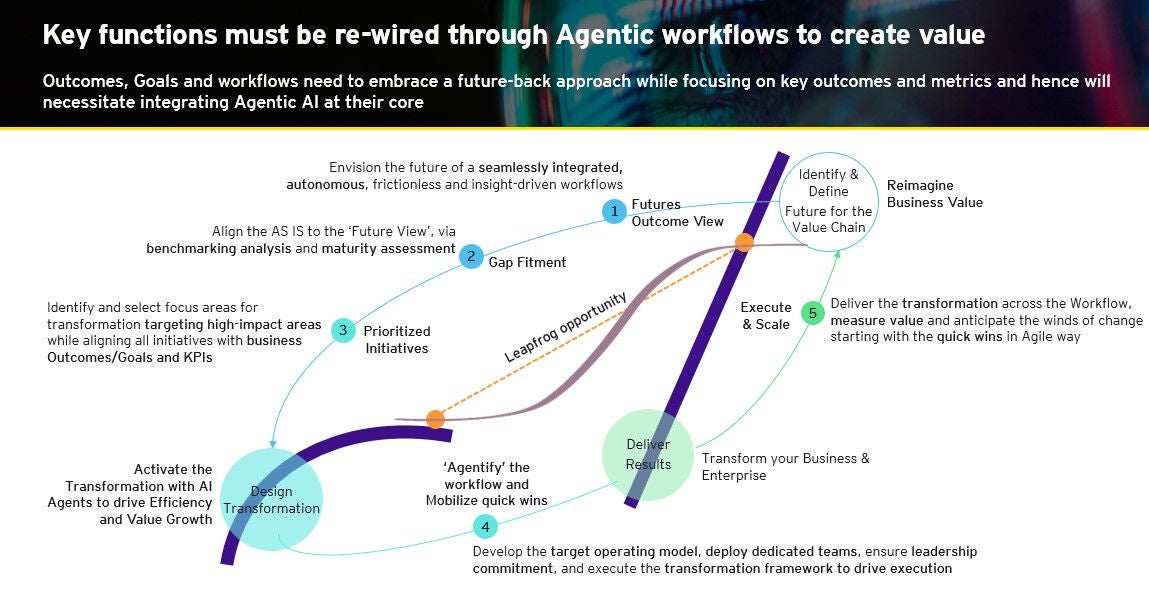
Agentic AI isn’t about incremental change or improvement. It’s about leapfrogging the natural course of advancement, and it requires a fundamental rewiring of workflows to create value. The opportunity exists only when companies are willing to engage in reimagining all business processes and functions. This future-back approach must focus on the key outcomes and metrics to align new workflows. The process to achieve this change can be broken down into the following five key steps:

Agentic workflows

Conclusion

The CP industry is facing unprecedented challenges, but by embracing an AI-first strategy in GBS, organizations can position themselves for success.

This transformation isn’t just about technology. It’s about redefining how value is created across the enterprise.

Agentic AI enables people to do more of what only people can do: innovate, strategize and lead. By shifting the focus from task execution to purposeful orchestration, organizations can unlock a new level of workforce potential.

To realize this vision, CP companies must invest in:

With a vision and future-back mindset, industry leaders can turn GBS from a cost center into a growth engine — one that scales the impact, not just output.

Summary 

For leaders in the consumer products industry, embracing an agentic AI-first strategy in global business services (GBS) is crucial for navigating unprecedented challenges. By leveraging AI, companies can significantly reduce costs, enhance efficiency, and drive profitable growth without increasing headcount. This transformation enables teams to reimagine workflows, automate repetitive tasks, and empower the workforce to focus on strategic decision-making.

About this article

Related articles

The future of autonomous systems: agentic AI in consumer products

Discover how agentic artificial intelligence is revolutionizing the consumer products sector by enhancing customer experiences and optimizing operations.

How GenAI changes the way CPG and retail operate — and consumers too

As generative AI for business takes-off so do generative AI business use cases for retail and CPG. But GenAI will change consumer behavior too. Learn more.