


Real-Time Server Performance in Modern Data Centers

Two builds, one clock: how data center time-to-power may reshape E&C

Related topics

Data center construction in the US can finish years before power arrives. Boards should measure that exposure now.


In brief
  • For Engineering & Construction (E&C) firms, a completed private-side asset can sit idle for years, earning nothing until it is connected to power.
  • Federal reform of large-load interconnection is under way. The power plant queue is the closest proxy for data centers, with a 2025 median wait over 5 years.
  • Integrators can't control utility timing, so contracts should cap the delay risk they take on. Boards should measure power-linked backlog and stage investment.

In late 2025, a roughly 430,000-square-foot data center in Santa Clara, California, stood complete but empty, awaiting the remaining power for its full 48 MW of critical IT load. Separately, the local utility said a broader system upgrade of about $450 million, serving that campus and other customers, was scheduled for completion in 2028.[1]


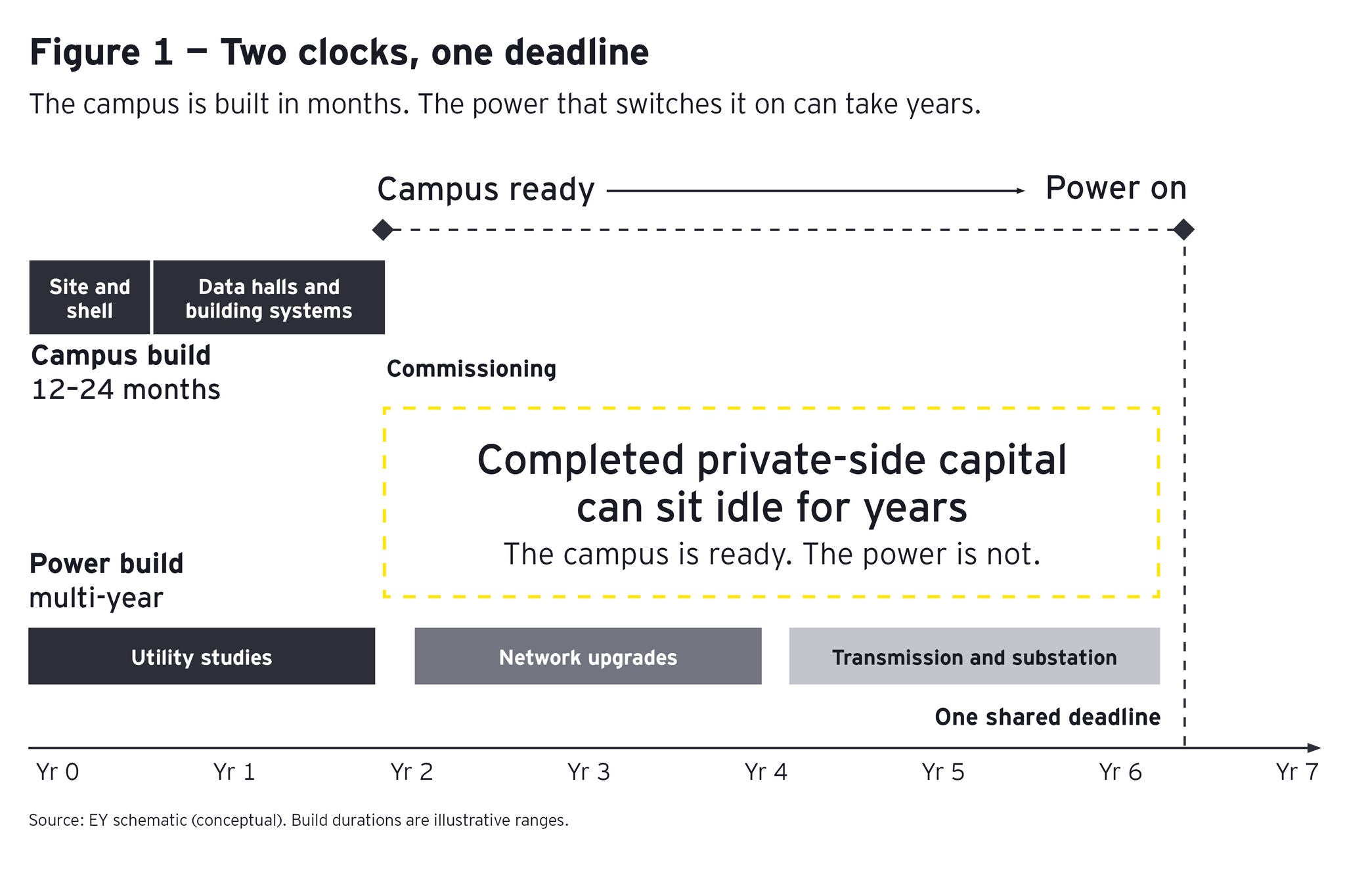
The building was completed. The grid capacity behind it was years away. The campus build is the private side of the project; the power build is everything needed to energize the campus. The two are often contracted and procured separately, so the interface between them absorbs delay that no single party fully controls.

Timeline showing a 12–24 month campus build versus a multi-year power build, leaving a completed campus idle until power is available

See the four interface failure points, the boundaries of contractual control, where each delivery model is strongest, and the delivery-certainty dashboard in the full point of view.

Why data center time-to-power is now an E&C problem

In the EY current-trajectory model, US electricity demand rises about 12% from 2026 to 2030 and a further 14% from 2030 to 2035, with data centers accounting for about 49% of that later increase.[2] In one stylized model of a fully grid-connected 1 GW facility with roughly $38 billion in up-front capital, the owner’s own substation works account for less than 0.5% of the total. The date the facility is energized sets when anything it is built to hold can start earning.[3]

Project owners carry most of this schedule exposure today. Contractors absorb a growing share of it; in backlog work they may have to resequence or hold open until someone else’s power date arrives.

The grid development clock

Load interconnection is the process of connecting a large electricity consumer, such as a data center campus, to the grid. Generation interconnection is the parallel process for connecting new supply. Load interconnection has historically been a state and local matter, so there is no long-running national data set comparable to the generation queue. Federal rulemaking on the question began in October 2025, after the Secretary of Energy directed the Federal Energy Regulatory Commission (FERC) to consider an advance notice of proposed rulemaking on large-load interconnection.[4] On a separate track in June 2026, FERC issued show cause orders directing the six regional grid operators it regulates to justify or reform their large-load rules across five reform categories, one of which is transparency into transmission upgrade costs.[5] Until those proceedings conclude, generation queues remain the closest published proxy. In regions where duration data are available, Lawrence Berkeley National Laboratory reports that the median project reaching commercial operation in 2025 took more than five years from interconnection request to operation.[6]

This is no longer only a utility problem.

The divergence between the two builds is increasingly relevant to the engineering and construction backlog.

Who owns the seam between the two builds?

Neither side of that seam can manage it alone, which is what makes the resulting delay expensive. That work is rarely contracted as an accountable, risk-bearing scope. Call the party that takes on this work a two-build integrator: a firm or consortium that sits between the campus build and the power build and takes contractual ownership of that interface. It can own everything on the private side, up to and including private generation. It cannot own the utility's timeline. That is the line between the delays an integrator can price and the ones that must remain relief events.

FERC is pressing a related question about who pays. In the same June 2026 orders, it asked each region to justify or add a pro forma cost recovery agreement for large loads. Such an agreement would assign the cost of a network upgrade to the customer taking service on behalf of the load that triggers the upgrade.[5] As that cost exposure becomes more defined, owners have more reason to push schedule risk downstream.

We see three models forming. Some contractors are adding power-side capability. Energy developers are leading where generation is the scarce asset, while large buyers are seeking control through co-located generation and long-term offtake. None of the three is settled practice. Few public examples show any of them working repeatedly at scale, and we found no like-for-like premium for integrated delivery in the public pricing reviewed for this analysis.

Boards must decide how far to move on the integrator role, and when. Our full point of view sets out where each delivery model is strongest, the boundaries of contractual control and how to tell a real risk-transfer premium from scarcity pricing.

Our view is that measuring this exposure is already justified. Investing in a risk-bearing capability is a bet the evidence does not yet support.

Three questions for the board agenda

In a delivery-constrained market, a growing backlog is a risk indicator. Boards should be able to answer:

  • How much of our backlog depends on a power date we do not control?
  • Who owns the interface on our largest programs?
  • Where in our contracts is energization accountability priced?

When private-side construction finishes before firm power arrives, capital is tied up and carrying costs accrue. Buyers may increasingly reward firms that can measure that exposure, price it, staff the integrator role and carry a bounded share of the schedule risk. E&C boards can start measuring before the rest of that is settled.


Mohit Ahuja and Gautam S Rashingkar contributed to this report and article.

Summary 

A data center asset can reach construction completion years before power arrives. Engineering and construction firms increasingly hold delayed work in their backlogs. A two-build integrator role is emerging at the seam between the campus and power builds. The first board task is measurement. Quantify how much backlog is contingent on a utility energization date, and name an owner for that interface.

About this article

Authors

Related articles

How to power data center growth without overloading the grid

How demand response and flexible operations can manage peak constraints and accelerate data center growth. Read more.

Why data strategy and technology alignment matter on capital projects

Explore the importance of data strategy and technology alignment in capital projects. Discover insights for effective digital transformation.