Young business people and designers.They working on new project.Startup concept.

Merger Monthly series

US M&A activity insights: November 2025

US M&A activity in November saw a dip but megadeals fueled robust annual gains.


In brief
  • The US M&A market is set for growth in 2026, boosted by a stable economy, expected rate cuts and the push to adopt AI.
  • The technology, healthcare and consumer sectors led year-over-year growth, with significant contributions from private equity.
  • US GDP is projected to grow 1.9% in 2026, limited by tariffs and immigration but helped by artificial intelligence (AI), fiscal support and deregulatory trends.

November recorded the second-highest US aggregate deal value in 2025, as rate cuts and strategic goals such as technology adoption and operational efficiency, drove M&A activity.

US M&A deal value demonstrated impressive year-over year (YoY) growth, with aggregate deal value increasing by 93% for transactions exceeding US$100m and by 112.6% for those over US$1b. Dealmaking activity was primarily driven by recent Federal Reserve cuts that lowered borrowing costs and strategic goals such as technology adoption and operational efficiency.

Receive our monthly M&A activity insights as soon as they’re released

A serious businessman standing in front of the corporation and checking data on a smart phone.

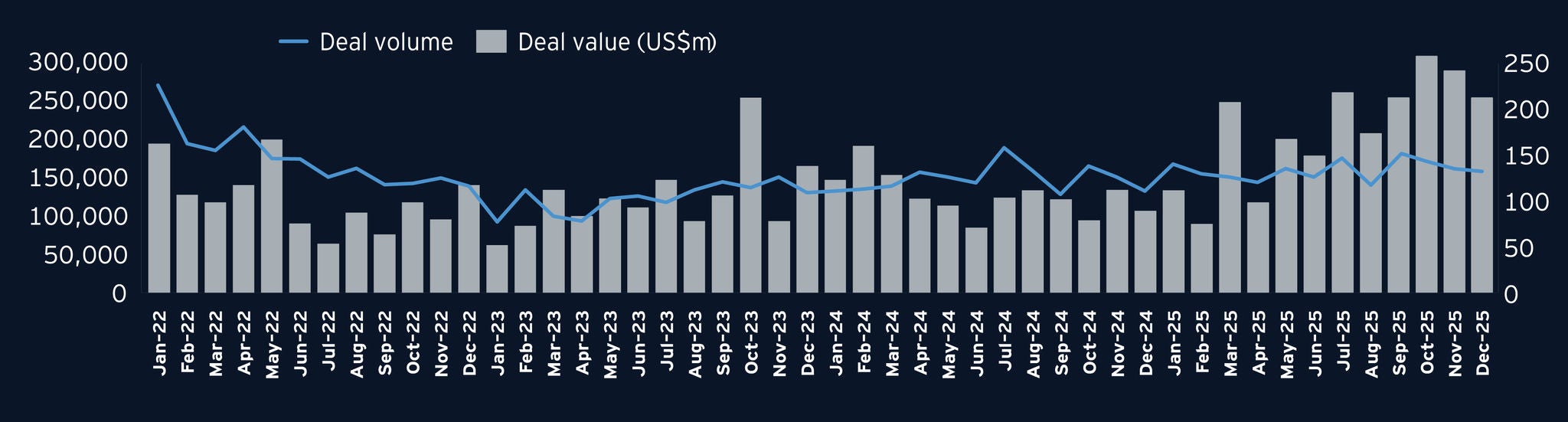
The deal value also showed impressive year-over-year (YoY) growth for the year-to-date (YTD) period from January to November, with the aggregate deal value increasing by 50.3% and deal volume growing by 10.7% for transactions exceeding US$100m.

Monthly M&A trends (2022 onwards)

Deal value (US$100m+); Deal volume (US$100m+)

ey-monthly-m&a_trends_chart-November

Source: EY Insights analysis and Dealogic


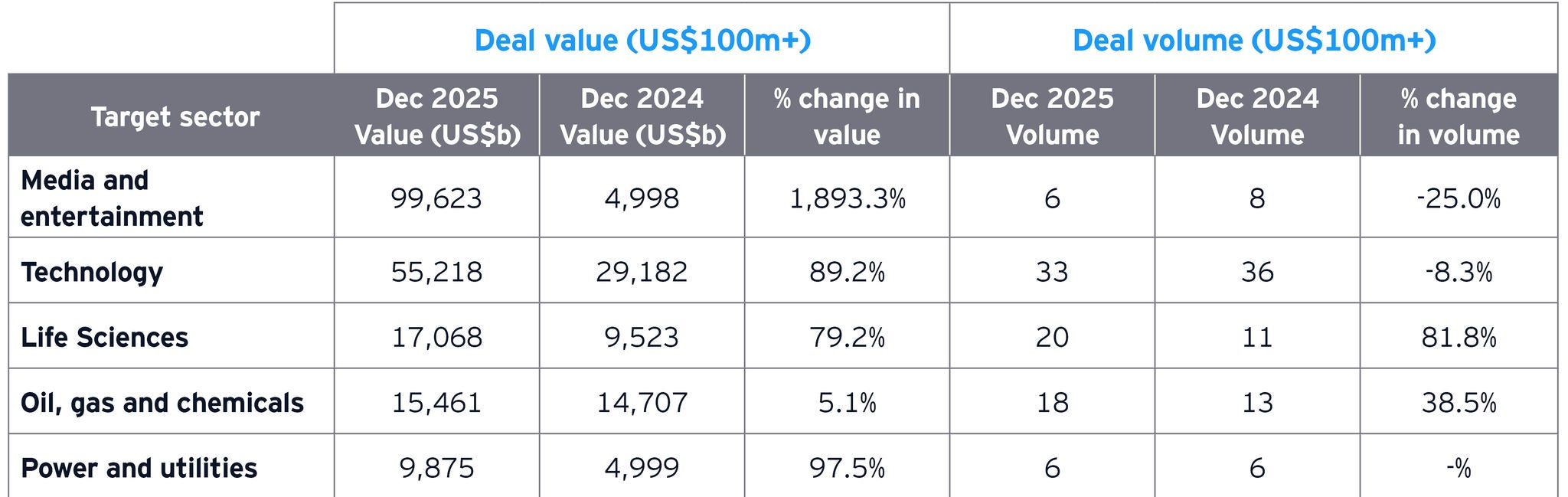
US sector breakdown for top deals (US$100m+) – November 2025

Sectors that fueled this month’s deal activity

US sector breakdown for top deals sep chart

Source: EY Insights analysis and Dealogic


Sector highlights

M&A activity in November reveals a number of high-value transactions across sectors:

Technology

Technology deals above US$100m amounted to about US$63b across 39 transactions, centered on AI platforms, developer tools, cybersecurity and digital infrastructure assets. Private equity (PE) investment appetite remained strong and strategic buyers doubled down on AI-native capabilities, cloud-scaled architectures and data-centric software. Key drivers included accelerating enterprise demand for automation, tightening security requirements and continued consolidation in high-growth AI and analytics segments.

Consumer products and retail

Consumer products and retail M&A reflected moderate deal activity but a sharp spike in total deal value (up by over 900% YoY) due to one large acquisition valued at US$51.4b. Strategic buyers focused on consolidating core brands, expanding category adjacencies and strengthening premium personal care and beverage portfolios while financial sponsors remained active in carve-outs and emerging lifestyle brands.

Oil, gas and chemicals

The sector registered steady deal value while deal volume experienced a decline of 6.3% YoY. M&A activity was dominated by strategic buyers and infrastructure investors consolidating shale positions, securing advantaged midstream capacity and reshaping portfolios toward high-margin basins. Private capital remained active in midstream carve-outs, underscoring sustained confidence in long-term cash-flow visibility across North American energy infrastructure.

Healthcare

A large M&A deal valued at US$25.7b led to a 150% YoY jump in deal value in the healthcare sector. Deal activity was tilted toward diagnostic platforms, imaging software and care delivery assets. Investor interest remained robust in tech-enabled wellness and data-centric health models. Key drivers included the push for integrated diagnostics, rising demand for scalable imaging solutions and continued consolidation in nursing and long-term care as providers seek operational resilience and stable cash-flow visibility.

Life sciences

Life sciences deal value decreased by about 15% YoY and total deal volume declined by about 45%. Most transactions reflected targeted pipeline expansion in oncology, infectious disease and cell therapy. Investor participation in neurotechnology and surgical innovation indicated sustained capital rotation into differentiated, IP-rich platforms.

PE holds ground with higher deal value despite volume decline

PE activity reflected a mixed trend. PE’s share of overall US deal volume edged up marginally to 28.5%, marking a 1% month-over-month (MoM) increase, while its share of deal value dropped sharply from 40.7% to 23.2%, signalling cautious capital deployment. Despite a MoM drop in high value deals (i.e., deals valued over $1B+), PE sponsors remained active in strategic sectors such as healthcare, technology, energy and select industrial assets. The focus leaned toward platform investments and sectoral diversification, including balancing large-scale healthcare plays, selective bets in industrial products and upstream and midstream energy assets.

Expanding market presence through scale-building acquisitions

Dealmaking highlighted how companies are strengthening their position in core markets by acquiring closely aligned businesses. This approach allows firms to broaden their customer reach, reinforce distribution channels and gain operational efficiencies that come from larger scale.

Beyond efficiency, expanding within the same market segment supports long-term strategic positioning. Larger platforms can invest more confidently in innovation, withstand market volatility and negotiate from a position of strength. As markets mature and organic growth moderates, scale-building acquisitions offer a faster route to enhance competitiveness, accelerate revenue synergies and safeguard leadership positions.

Looking ahead

The US M&A market is positioned for a robust expansion into 2026, transitioning from a period of recovery to one of resilient growth. Dealmakers anticipate a healthy deal pipeline across sectors including technology, healthcare, industrials and financials. This positive trajectory is underpinned by a stabilizing macroeconomic environment, anticipated interest rate cuts and the strategic imperative for corporations to integrate AI capabilities.

This comes as EY-Parthenon economists expect US GDP to increase 1.9% in 2026 after a 2.0% expected increase in 2025 — constrained by tariffs and tighter immigration but supported by ongoing AI investment, a modest fiscal impulse in early 2026 and some deregulatory momentum.

On December 10, the Federal Reserve cut rates by 25 basis points, its third reduction in 2025. Projections suggest one more cut in 2026, indicating a cautious approach amid economic strain. However, divisions within the committee reveal uncertainty about future rate movements.

The resolution of the US government shutdown on November 12 removed a significant layer of macroeconomic uncertainty. However, the temporary funding resolution through January 30, 2026 offers only short-term stability, leaving significant uncertainty for the year ahead around regulatory delays and economic data gaps that might complicate due diligence.

Companies that prioritize acquiring AI-driven capabilities and talent they cannot build internally, while achieving integration readiness, robust diligence and agile portfolio reshaping, will likely be well positioned to capture emerging opportunities.

Summary 

In November 2025, M&A activity in the US saw the second-highest aggregate deal value, driven by Federal Reserve rate cuts, tech adoption and operational efficiency. Technology, healthcare and consumer sectors led YoY growth, with significant contributions from PE. The robust M&A dealmaking signals continued market expansion into 2026 as companies pursue scale-building acquisitions and AI integration to strengthen strategic positions amid a stabilizing economic outlook.

Karan Chowdhary, Assistant Director, and Runjhun Anurag, Supervising Associate, from Ernst & Young LLP (India) contributed to this article.

Explore recent editions


US M&A Insights
November 2025


US M&A Insights
September 2025


US M&A Insights
August 2025


About this article

Authors


Contact our M&A advisory team
Get in touch to learn how EY can help with your M&A strategy. 

Related articles

Macro Bites: PE deals increase as valuation gaps shrink, dry powder available

Private equity leaders should invest in AI, prepare for exits, and engage stakeholders to seize new market opportunities. Watch more on Macro Bites.

M&A outlook: stronger US deal market in 2026 despite mixed economic signals

The EY-Parthenon Deal Barometer, informed by our US economic outlook, predicts robust US deal volume growth through 2026.

Private Equity Pulse: key takeaways from Q3 2025

Private equity exits reach a three-year high as firms seize opportunities to turn strategic value creation into realized returns.

Does today’s disruption provide the blueprint for tomorrow’s growth?

EY-Parthenon CEO Survey September 2025 reveals how leaders build confidence, resilience, and growth strategies amid disruption and transformation.