






Big City Modern Office at Night

Organizations evolved series

How real estate tax and finance operating models are shifting

Strategic transformation in tax and finance is key for real estate firms to lead in a competitive market.

The first installment in a series on organizational shifts within the commercial real estate industry.


In brief
  • Insights from the EY Tax and Finance Operations survey reveal compliance and transparency are critical for building stakeholder trust in evolving regulations.
  • Embracing artificial intelligence (AI) is no longer optional as it is essential for transforming tax and finance functions and driving efficiency.
  • Attracting diverse talent is growing in importance with the future of tax becoming increasingly reliant on innovative workforce strategies and flexibility.

Today’s business environment is increasingly global, costly and complex. According to the EY Tax and Finance Operations survey (TFO survey), which includes responses from 150 executives primarily consisting of chief financial officers (CFOs) and vice presidents of tax from real estate, hospitality and construction companies, in response to a highly dynamic market, 54% of leading real estate players are evolving their operating models in an effort to become more agile, insight-driven and efficient organizations.

of leading Real Estate players are evolving their operating models.

One area of significant transformation is tax and finance functions. Real estate firms are reassessing their priorities and approaches to address complex challenges.


However, a lack of budget for critical investments in technology, talent acquisition and training present a significant challenge for 37% of tax executives, highlighting the growing difficulties within tax operations. As regulations evolve and global tax complexities increase, the urgency for transformation intensifies. In this context, artificial intelligence (AI) emerges as a vital tool, with 88% of executives optimistic about its potential to enhance tax and finance functions.


As executives deal with budget constraints, talent attraction/retention issues and the complexities of global tax compliance, the integration of technology, especially AI, is becoming a game changer for driving efficiency and effectiveness. While there were initial hesitations about adopting AI, the survey reports that more executives are starting to see its potential to revolutionize data acquisition, compliance and analytics.


Additionally, the push for diverse talent and innovative operating models is changing how companies think about their workforce strategies. As real estate sector organizations work to adapt to new legislation and transparency requirements, the need for a proactive and agile tax and finance function is becoming increasingly important.


This transformation is not just a reaction to external pressures; it is a strategic move that can position the sector for sustainable growth and success in a competitive landscape.


With this foundation in mind, let’s explore the key priorities, challenges and technological advancements that are shaping the future of tax and finance in the real estate sector.


Top priorities for real estate tax functions

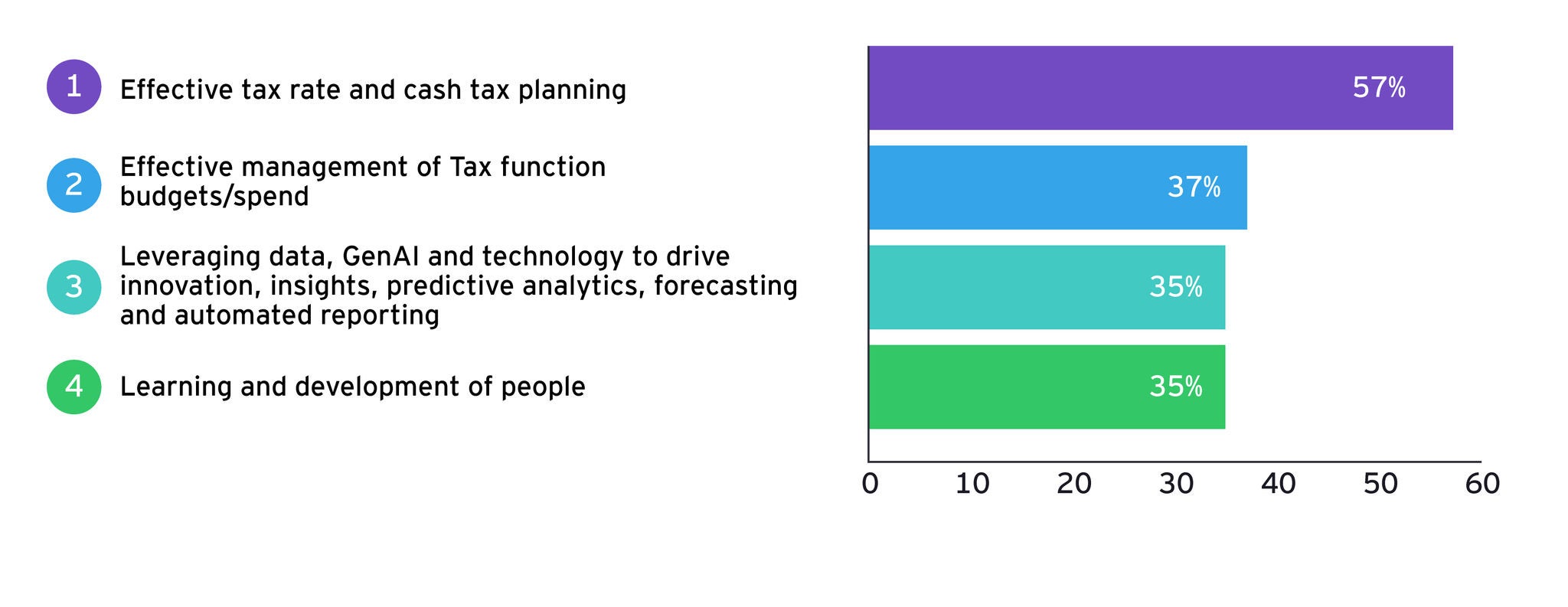
As companies navigate the complexities of the modern tax landscape, the EY TFO survey revealed several key priorities that emerged:


Top US tax function priorities over the next three years

Transformation RHC

These priorities reflect a strategic shift among companies. By focusing on tax consideration, budget management, compliance, technology integration and talent development, organizations are positioning themselves for future challenges while enhancing operational efficiency.


Key challenges for real estate tax and finance functions

Companies face several challenges when enhancing their tax and finance functions, as highlighted by the survey.


As mentioned earlier, a significant barrier for 37% of respondents is the lack of a budget, making it difficult for tax departments to invest in essential technology, talent acquisition and training. Additionally, 32% of executives report challenges in hiring and retaining skilled talent, indicating a broader labor market trend where demand exceeds supply.


The complexity of the global tax landscape poses another challenge for 23% of respondents. As regulations evolve, organizations must navigate a maze of compliance requirements, increasing the risk of noncompliance. Furthermore, 8% of executives note the struggle to implement sustainable data and technology plans, often hindered by legacy systems and disjointed data strategies.


Budget constraints, talent retention issues, regulatory complexity and technology integration challenges create a tough environment for companies in terms of tax and finance functions. To overcome these obstacles, organizations must prioritize investments in talent, technology and compliance to effectively navigate the evolving tax landscape.


Technology and AI in real estate tax and finance

The integration of technology and AI is transforming the tax and finance functions of companies. Insights from the survey reveal a growing recognition of AI’s potential to enhance efficiency and effectiveness. Notably, 88% of executives now express optimism about AI’s role in this effort, a dramatic rise from just 9% in 2023.

of executives believe AI will increase tax function effectiveness.

Data acquisition and cleaning are expected to be the most impacted areas, with 25% of respondents highlighting automation’s importance for compliance and reporting. Additionally, 19% foresee AI enhancing compliance processes, while 18% expect improvements in income tax and accounting.

However, challenges remain. Data security and privacy concerns are cited by 19% of executives as significant barriers to AI adoption, alongside a 16% acknowledgment of the talent shortage in data science and AI. Many companies are still in the early stages of AI integration, with 21% reporting minimal or no GenAI maturity and only 8% fully utilizing AI technologies.

While technology and AI offer significant opportunities for tax and finance functions, organizations must address barriers such as data security and talent shortages. By investing in technology and workforce development, companies can effectively leverage AI to drive innovation and efficiency in their tax and finance operations.

Talent struggles within real estate tax and finance

Attracting and retaining skilled professionals is a major challenge, according to the survey, with 51% of executives acknowledging the competition for talent, particularly as senior tax staff retire: 67% believe this poses a disadvantage for their organizations. Companies must prioritize strategies to attract new talent and develop the skill sets of existing employees.

To address these challenges, 21% of executives are exploring co-sourcing with providers that have strong data and technology capabilities, allowing them to leverage external expertise and scale. Additionally, a focus on automation within tax and finance functions is gaining traction, with 21% of executives prioritizing this approach to enhance efficiency.

Return-to-office policies also impact talent retention. While 37% of executives report no effect on retention, 29% believe flexible work arrangements can attract top talent. Furthermore, 59% of organizations are shifting their hiring practices to value skills and experience over traditional degrees, reflecting a broader change in workforce strategy.

As the tax and finance landscape shifts, the interplay between talent and operating models is vital. By prioritizing talent development, embracing co-sourcing and automation, and fostering flexible work environments, companies can build resilient tax and finance functions ready to navigate the evolving landscape.

Legislation, regulation and transparency in real estate tax

Companies are increasingly prioritizing compliance with changing regulatory requirements.

of executives feel that real-time and digital tax filings will significantly impact their tax functions.

Notably, 61% of executives surveyed believe that real-time and digital tax filings will significantly impact their functions, necessitating adaptations in processes and technologies to maintain timely compliance. As tax authorities enhance their real-time data capabilities, companies must be prepared to meet these demands to avoid penalties.

Transparency is also on the rise, with 62% of executives planning voluntary public disclosures regarding corporate income tax. This trend reflects a commitment to accountability and builds trust with stakeholders.

However, challenges remain. Twenty percent of respondents cite a lack of skilled resources as a major hurdle in meeting tax sustainability reporting requirements. Additionally, many executives report significant adjustments needed to source system data for tax-ready information, underscoring the importance of investing in technology and effective data management.

As organizations navigate new reporting requirements and regulatory changes, prioritizing compliance and transparency is essential. By investing in skilled resources and robust data practices, companies can effectively manage the complexities of the regulatory environment while enhancing their credibility with stakeholders.

Darren Beardsley also contributed to this article.

Summary 

Real estate companies should consider adapting their tax and finance functions to meet emerging challenges and seize opportunities. By prioritizing effective tax planning, embracing technology and artificial intelligence (AI), addressing talent shortages and remaining compliant with evolving regulations, organizations can enhance their operational efficiency and transparency. This proactive approach will position them for sustainable growth and success in an increasingly complex and competitive landscape.

About this article

Related articles

Financial services tax and finance transformation trends and opportunities for 2025

In this webcast, EY panelists explore key trends shaping financial services organizations’ tax and finance functions.

Tax transformation:  Adopting AI to drive efficiencies

41% of global CEOs said adopting AI technologies is likely to be a priority. Read how AI might support and enhance tax compliance.

How generative AI is transforming the future of commercial real estate

Commercial real estate leaders need to evaluate the risks as they seek to leverage the benefits of GenAI in real estate.