Business meeting in the office

Do executive compensation incentives really matter?

Deepak Jayanti, EY-Parthenon, also contributed to this article.

Many companies don’t link incentives to return on investment and cash flow. Are they getting what they’re paying for?


In brief
  • An EY-Parthenon analysis looked at the importance of including return on invested capital and cash flow metrics in executive compensation incentives.
  • The study shows that companies get what they pay for: Those that included these measures in executive incentives outperformed those that did not.
  • EY-Parthenon teams help clients identify appropriate KPIs that align financial results with strategic business objectives.

When it comes to executive incentives, the conventional wisdom is clear — if you want to improve a metric, tie compensation to it. Unfortunately, creating the right mix of incentives to influence the right combination of outcomes is tricky, and many companies fail to do this well.

A new analysis by the EY-Parthenon team closes the loop on an important question: How much do executive compensation incentives matter in improving a company’s focus on return on invested capital (ROIC) and cash flow (CF)? The analysis has lessons about designing incentives that achieve the desired outcomes.


The insights are important for overall corporate performance. We found in a previous analysis that ROIC performance and overall capital efficiency are strong predictors of total shareholder return (TSR) performance. Companies that evaluate how effectively they are using their balance sheet, with ROIC as a key measure, consistently outperform their peers. We also looked at how public companies’ compensation incentives tend to emphasize P&L-related metrics, while ROIC and CF are underrepresented. The report showed that 38% of companies included neither ROIC nor CF in their compensation incentives to a meaningful degree.


Given the importance of executive compensation incentives, the findings invite a closer look. How and to what degree do these important financial measures influence outcomes when they are included or excluded from compensation incentives? Do compensation-linked metrics influence executive behavior as expected, or are these metrics secondary concerns for leaders deeply immersed in daily operational challenges?


To address these questions, keeping in mind the strong linkage between ROIC and CF metrics and TSR, we analyzed whether companies that incorporate them into their compensation structures achieve higher performance in ROIC and CF compared with their respective industry averages.


Compensation incentives: corporations do get what they pay for


Our study finds, reassuringly, that across industries, corporations get the performance that executives are incentivized to deliver. We also learned some interesting lessons about how these two metrics affect performance and the differences between them.


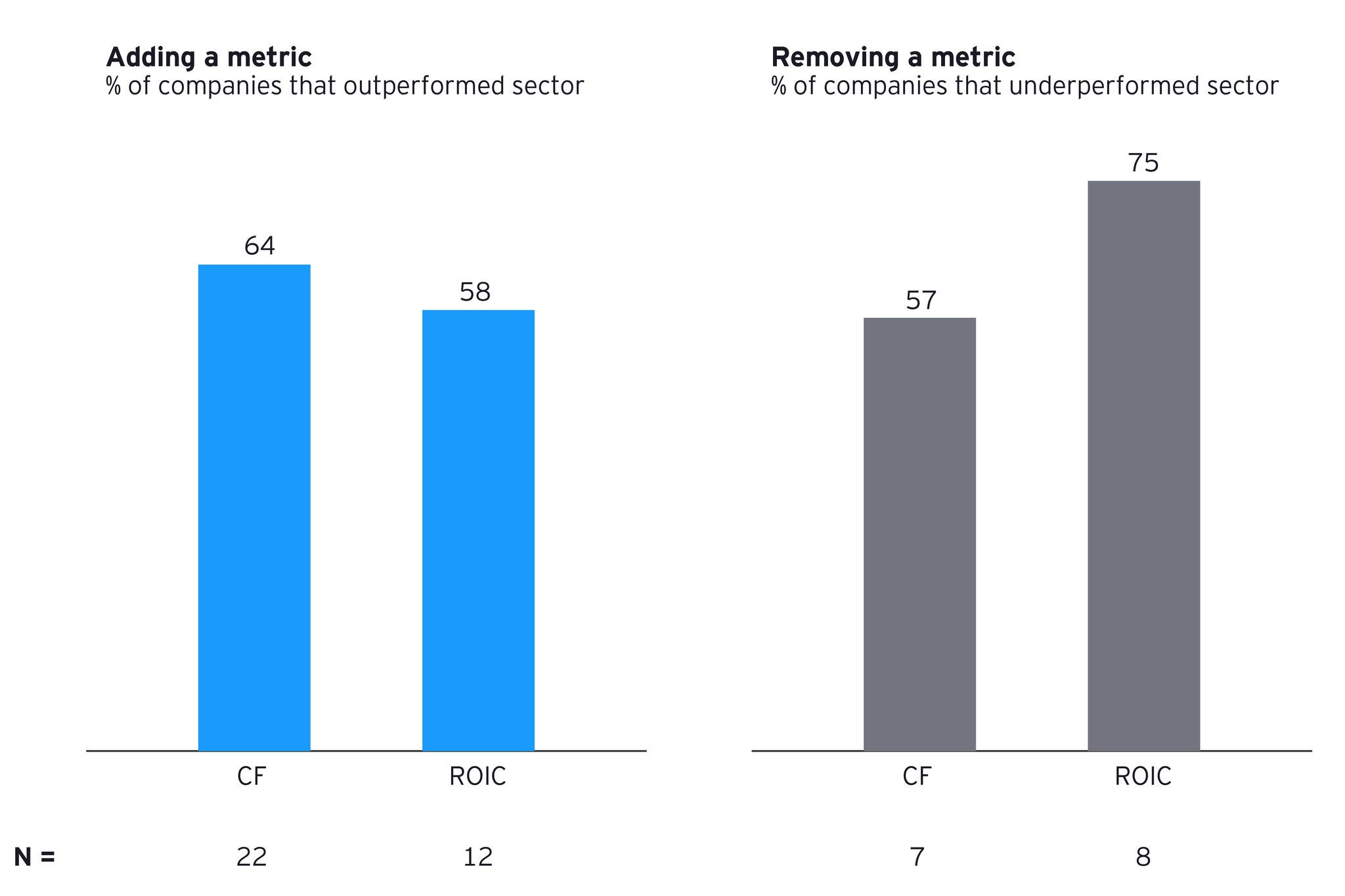
We compared the performance of companies in the S&P 500 in two recent periods, 2018 to 2020 and 2021 to 2023, to understand the impact of adding or removing these metrics in executive compensation incentives. In the case of both ROIC and CF, companies that included these measures outperformed those that did not. (Figure 1)


Although the sample size is limited by the number of companies in the S&P 500 that fit the study criteria (see Research methodology, below), the analysis yields some valuable insights.

Figure 1

The cash flow metric

The ROIC-CF paradox: unraveling the impact of executive compensation

While the findings reinforce the key message that both ROIC and CF are valuable components that should be considered in a well-designed compensation incentives program, the analysis also reveals an interesting nuance. Companies that eliminated ROIC from incentives experienced a larger negative impact than those that eliminated CF, while companies that added CF metrics to incentives that hadn’t previously included them saw a greater positive improvement than those that added ROIC metrics. While the underlying reasons are not entirely clear, we propose some explanatory theories.

ROIC, as a comprehensive performance measure, demands sophisticated implementation. It compels executives to consider both income statement and balance sheet dynamics simultaneously. Its complexity has benefits as well as drawbacks, however. Many organizations are still developing the capability to calculate ROIC rigorously, and, at the granular level, that is necessary to meaningfully inform value-creating decisions. Companies that eliminate ROIC metrics might be making a concerning shift toward simplistic growth metrics, prioritizing revenue or EBITDA expansion without adequate consideration of capital efficiency.

In contrast, adding CF metrics seems to offer more of a direct performance boost. CF metrics are typically easier to calculate and understand with fewer inputs than ROIC, and our data suggests they broadly drive positive performance outcomes. This comparative accessibility potentially reduces implementation risk, making CF particularly attractive for the more mature organizations in our data set that may have historically underemphasized CF management or that may need to transition to more cash-based metrics as their growth rates slow. Interestingly, when CF metrics are removed, there is less downside; organizations seem to maintain underlying cash management disciplines, suggesting that these positive practices are sticky when habituated over time.

A path forward for effective executive compensation incentives

Organizations often operate in silos, with weak or inadequate coordination among strategy, finance and HR functions. We advocate integration, where:

  • Strategic initiatives align with appropriate and measurable key performance indicators (KPIs) that can drive performance improvement at a granular level.
  • Accurate financial forecasting provides challenging yet achievable targets and flags issues and leading practices early.
  • Compensation structures woven into middle manager ranks reinforce these objectives.

Education and awareness form the critical foundation of this integrated approach. Both knowledge and incentives must cascade from the C-suite throughout the organization, making decision rights align with strategic objectives at every level. 

A robust data and analytics infrastructure is needed to make it easier for executives to measure CF and ROIC at the desired granularity. Without effective measurement of KPIs integrated into the operating and strategic planning processes, organizations will not be able to align management behavior to focus on CF and ROIC.

One example is a global pharma and medical technology company that incentivized its management teams to focus on CF in addition to traditional P&L metrics. Finance and business teams invested in data technology to improve visibility into CF, implemented quarterly reviews of CF and balance sheet metrics, and used the insights to improve cash drivers.


Summary 

When setting performance targets, many companies overemphasize revenue and growth goals and underemphasize return on invested capital and cash flow that more directly drive value creation. A powerful way for companies to correct this imbalance is to consider including ROIC and CF metrics in executive compensation incentives. An analysis by EY-Parthenon teams shows that 58% of companies that added ROIC to compensation incentives outperformed their industry average ROIC, while 64% of companies that added CF metrics outperformed their peers in CF.

Research methodology

Our study tracked executive compensation weights across short- and long-term incentive programs for the 220 largest nonfinancial companies in the S&P 500 for three years: 2018, 2021 and 2024. This approach enabled us to compare corporate performance between two distinct periods: 2018 to 2020 and 2021 to 2023.

Our research methodology focused on two principles:

Identifying meaningful changes: We narrowed the list of 220 companies to examine only instances where ROIC or CF compensation metrics were meaningfully added or removed in 2021. We defined “meaningfully” as changes of 30% or greater in either annual or long-term incentive program weights. This methodological approach reduced our data set to 49 instances. By targeting companies with notable compensation structure changes and excluding those with consistent ROIC or CF metrics, we aimed to test our hypothesis: that alterations in compensation design would correlate with performance variations in the newly added or removed metrics.

Controlling for market factors: We adopted a sector-based approach to measure relative performance in ROIC and CF margin.[1] This allowed for more meaningful comparisons; for example, it would be difficult to draw conclusions from comparing the ROIC or CF of an oil company to an airline given each company’s different exposure to commodity prices.


About this article

Authors

Related articles

Investing in innovation: unlocking value in MedTech

An analysis of value creation among MedTech sector companies underscores the pivotal role of investment in R&D as a driver of long-term value creation.

Earning the right to grow: how capital efficiency drives TSR performance

Companies should assess their ROIC before pursuing growth. Read the article to explore strategies for improving capital efficiency and success.

Value metrics missing from executive compensation and earnings calls

Companies can do a better job of using cash flow and return on capital metrics to create lasting value.