Businessman holding a digital tablet talking to a female doctor

How AI can form the foundation for an always-on biopharma deal radar

AI can help biopharma companies identify M&A targets to build up their R&D pipelines as they face a “patent cliff” for existing treatments.


In brief
  • Biopharma companies are increasingly looking externally to find their next drug candidates as they seek to renew their R&D pipeline.
  • AI agents can constantly search various databases, investor meetings and news to help form an always-on biopharma deal radar to find viable targets.
  • EY-Parthenon practice works with biopharma companies to set up this AI-enabled screening.

In the pharmaceutical industry, external innovation has become paramount for growth. But how can companies find the best acquisition candidates ahead of the competition, especially as many of the most promising candidates are being developed by precommercial organizations?

An AI-powered deal radar that constantly scans myriad data sources for candidates that fit a biopharma’s strategy can provide a competitive advantage.

The growing quest for the next innovative treatments

Since 2018, a significant majority of new drug revenues have come from products sourced through acquisitions or licensing rather than in-house research and development (R&D). This reliance on business development and licensing (BD&L) is only increasing as large biopharma companies confront intensifying competition for cutting-edge therapies and major revenue threats in the coming years.

The “patent cliff” and other factors are further fueling the growing need for attractive BD&L. Blockbuster drugs worth an estimated $230 billion in annual sales are set to lose exclusivity by 2026–2029, creating enormous revenue gaps.¹ At the same time, the latest EY Firepower report shows the growth gap for industry leaders is expected to reach $370 billion by 2032.

To bridge the gap, companies are scrambling to replenish pipelines through deals — fueling a wave of mergers and acquisition (M&A) and licensing. Through November, high-value strategic acquisitions, especially in oncology, diagnostics and infectious diseases, have helped drive $217 billion in life sciences M&A, up 64% from all of 2024, according to an EY deal analysis.

At the same time, licensing and partnership deals remain critical for accessing innovation.

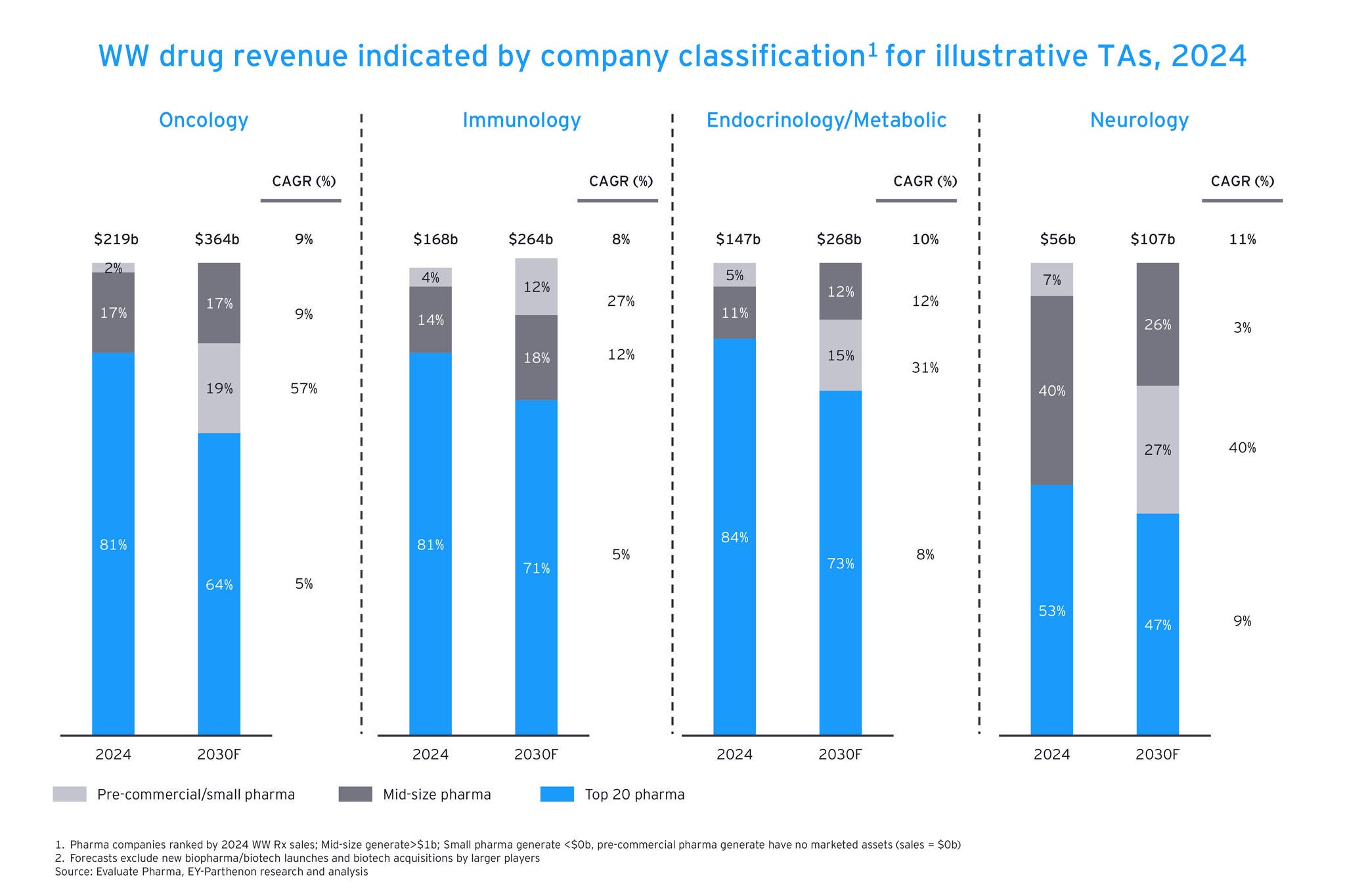
Figure 1: Current and projected revenue within a therapeutic area segmented by biopharma size

Top 20 mid-size, small and precommercial; data shown for illustrative therapeutic areas: oncology, immunology, neuroscience, and metabolic disorders)

WW drug revenue indicated by company classification1 for illustrative TAs, 2024

The majority of today’s most promising pipeline drug candidates originate from precommercial, small and mid-sized biotechs. Consequently, a growing share of predicted future asset revenue will originate outside of the largest biopharma companies. Competition for attractive candidates is fierce. Early detection and assessment of attractive candidates is critical. In oncology, for example, about 80% of pipeline assets are held by small and precommercial biotechs, about 60% of clinical trials are driven by emerging biotechs and about 20% of projected total 2030 revenues will come from small and precommercial biotech companies. Of note, these companies only account for about 2% of all oncology revenue today.


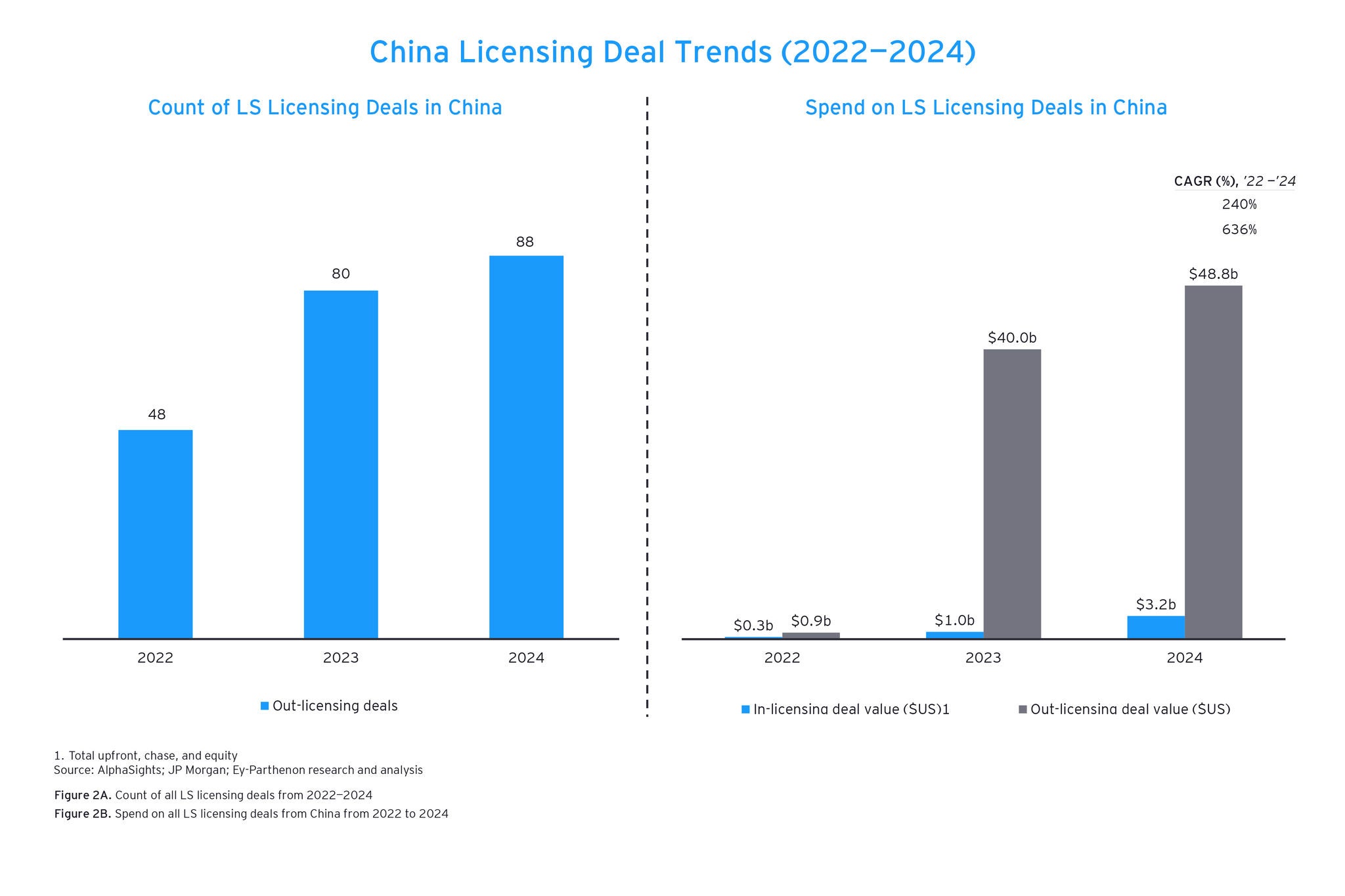
The costs of drug development, stricter drug pricing regulations and macroeconomic uncertainty are all pressuring the industry, driving an even greater demand to identify acquisition and licensing opportunities earlier and ahead of the competition. As life sciences dealmaking pivots toward smaller, smarter investments, the search for early-stage innovation is expanding beyond traditional markets. China is rapidly becoming a global R&D powerhouse, especially in oncology, with a surge of novel therapies and out-licensing deals. We highlight a surge in both ex-China licensing deal volume and value.

China Licensing Deal Trends 2022-2024

By integrating global trial data, scientific publications and partnership signals, a deal radar platform that continuously scans these dynamic regions to uncover high-potential opportunities can surface from emerging innovation hubs and empower deal teams to act early on licensing opportunities.

Artificial intelligence can be the key to modernizing the search and evaluation process, creating an always-on deal radar that can sort through these signals – including academic literature, scientific papers and competitive intelligence reports to find the best candidates.

Growing role of agentic AI in continuous biopharma deal landscape surveillance

The current search and evaluation process has flaws that can hinder the ability to identify and acquire promising deal candidates earlier or identify warning signs that a therapy might not be successful. Current approaches often rely on sporadic literature reviews or conference attendance for these signals, which can cause delays.

Meanwhile, deal teams need to monitor siloed databases and generating analysis from these databases is highly labor-intensive. Not only is data siloed, but the workflows and tools used by teams are disjointed, meaning it can take even more time to gather and analyze the data.

Deal teams want a comprehensive profile of each prospective target – scientific merit, clinical trial results, patents, regulatory status, commercial potential, competitive positioning and even team and talent strength — and they want it at a granular level. They need to know the landscape for the potential treatment, including patient needs, which competitors have similar programs and where the whitespace that can be exploited lies. They also need this in real time, with constant updates rather than sporadic, outdated snapshots.

They also need to know how a potential target will fit within the company’s wider portfolio and to have comprehensive deal benchmarking to inform valuation and deal structuring.

Recent advances in artificial intelligence (AI), especially in natural language processing and autonomous agents, offer a breakthrough opportunity to overcome these challenges. For biopharma M&A and licensing, a new generation of AI-powered solutions is being developed to help identify and evaluate targets more quickly and effectively.

Think of these as AI deal radars that continuously read scientific papers, tracks clinical trial registries, monitors news feeds, query databases and even generate summaries or draft analyses – all tailored to a biopharma’s strategic interests.

The AI agents that power the deal radar

This “always on” deal radar is driven by a series of AI agents that can augment human intelligence rather than replacing it.


The goal is not to replace human judgment, but to augment it. AI can surface patterns or facts that humans might miss, but experts still interpret the insights, validate them and negotiate the deals.

After identification, AI in valuation

Similar techniques are being applied to related deal-making stages enabled by AI in market intelligence platforms such as the EY Competitive Edge. During commercial due diligence, AI rapidly analyzes data rooms and documents of target companies, flagging risks or anomalies that warrant human review. In post-merger integration and value tracking, AI helps monitor synergy realization and financial performance, using analytics to ensure the deal delivers the intended value. It tracks key performance indicators (KPIs), integration to-dos and even cultural integration metrics in real time. These applications show that AI’s impact spans the full M&A lifecycle. Experienced executives will be thinking holistically about injecting AI from deal sourcing all the way through integration. Early successes in the “always on” search phase can build momentum (and data assets) to later apply AI in diligence and integration.

Next steps for building the always-on biopharma deal radar

Several steps that executive teams can take to make this deal radar a reality include:

  • Audit existing data subscriptions and internal data relevant to BD&L to map out overlaps and gaps vs. priority therapeutic areas. Many organizations find they have redundant sources or underutilize some. Rationalize what is truly needed and ensure access to data in a form that can be aggregated.
  • Invest in a “thin ontology layer” – essentially a master set of definitions and mappings for key entities like company names, drug names, targets and diseases. Standing up a lightweight ontology or knowledge graph in a secure data lakehouse enables all incoming data to be linked by common identifiers, allowing AI agents to connect the dots across datasets.
  • Pilot a focused AI-augmented watchlist and deploy an AI solution to monitor it continuously. Then define specific metrics for success, such as whether the AI alerts capture meaningful developments before humans. Connect with the business development team to determine if the information is relevant, accurate and usable. Early pilots not only demonstrate value, they also help refine the AI models and filters.
  • Layer on GenAI for summarization and query, making the platform interactive. A practical feature is to auto-generate meeting briefs or periodic reports. For example, if a team has a monthly pipeline review meeting, AI could generate a draft “landscape update” document that summarizes key happenings for each asset or area in scope. Leverage large language model capabilities to turn raw data such as trial results and news into concise bullets and even attempt an analysis. Humans edit these reports, but even a first draft saves time. Additionally, enable natural language query on the deal intelligence repository. For example, team members should be able to ask, “What companies have KRAS-targeted lung cancer drugs in Phase I?”
  • Expand to end-to-end workflow integration once the pilot has delivered proven results. Broaden the scope of the watchlist or number of domains covered. Also, work on connecting the workflow from signal to action. For instance, integrate the AI alerts with customer relationship management (CRM) or pipeline management tools. The goal is to embed the AI outputs into the team’s normal processes, so it augments daily work rather than feeling like a separate experiment.
  • Track KPIs to demonstrate the ROI of the always-on model. Some metrics might include: reduction in time to assemble initial target profiles; increase in number of opportunities identified proactively; improvement in “target fit” or success rate of pursued deals; hours of analyst time saved or reduced need for costly external market research reports.

With proof of concept achieved, biopharma companies can scale the “always on” model to additional therapeutic areas or business units. But as the platform scales, governance becomes important. Establish clear protocols for data quality, bias checking and confidentiality, especially if integrating internal proprietary data or notes into the system.

Conclusion

The biopharma industry’s dealmaking paradigm is shifting. With more targets to watch, more data to digest and higher stakes on each deal, the old model of episodic, manual analysis is stretched to its limits. An “Always ON” AI-enabled search and evaluation model offers a path forward — one where insight generation is continuous, not periodic; where teams are alerted to opportunities and risks in near real time; and where human expertise is amplified by the breadth and speed of artificial intelligence.

Thanks to EY-Parthenon Osefame Ewaleifoh for his contribution to the article.


Summary 

Biopharma companies are seeking new treatments to help fill their pipelines to make up for the billions of dollars of treatments that will lose patent protection in the next several years. Most of that innovation now comes from outside these companies. AI can help power an always-on biopharma deal radar to sort through myriad structured and unstructured data sources to help identify acquisition targets early.

About this article

Authors

Contributors

Related articles

Macro Bites: Life sciences adapt to a new economic paradigm  

Macro Bites: Tariffs on active pharmaceutical ingredients spark transformation in life sciences. Learn more.

How do CEOs reimagine enterprises for a future that keeps rewriting itself?

EY-Parthenon CEO Outlook 2026 explores how leaders use AI, transformation and portfolio strategy to navigate uncertainty and drive sustainable growth.

How Bristol Myers Squibb overhauled working capital to fund its future

EY-Parthenon team helped BMS establish a cash leadership office as part of an award-winning Treasury transformation. Learn more in this case study.