


EY refers to the global organization, and may refer to one or more, of the member firms of Ernst & Young Global Limited, each of which is a separate legal entity. Ernst & Young Global Limited, a UK company limited by guarantee, does not provide services to clients.
Recent Searches

The Challenge
Generative artificial intelligence (GenAI) is prompting a dramatic reimagining of how retailers and brands will operate in the near future. Having already adopted this relatively new technology at varying speeds, most consumer products and retail (CP\&R) companies seek to integrate GenAI across the enterprise to improve overall business performance and, more importantly, drive a complete re-examination of the company, how decisions are made and the role of humans. But many industry leaders are uncertain about how to retool their operating models to incorporate GenAI and machine learning (ML), and lack cross-functional visibility into the value proposition, business impact and operational benefits of modern AI innovation.
Although AI is not new, a transformative wave of change is occurring. CP\&R companies seeking to enhance value through AI innovation need to engage functional leaders for a strategic, unified mindset around AI. This involves a fundamental rethinking of organizational structures and processes, product design, customer and consumer engagement, and the ways and extent to which AI-driven decision-making will be adopted. Often accompanying this strategic thinking is the identification of which value levers to consider when deciding investment and adoption speeds:
- Improving efficiency
- Improving decision support
- Reducing risk/improving resiliency
- Enhancing experience
- Generating revenue
Once a modern, strategic view of the business is established and levers are identified, there are four potential approaches to start the strategic AI adoption journey:
- Create a top-down vision.
- Build an AI Center of Excellence poised to accelerate the development of value-added use cases.
- Experiment and test use cases.
- Do all the above in tandem.
While starting with a top-down vision is advisable, there are multiple pathways a company can take. The area where AI innovation will create business value sheds light on the pathway best suited to your organization. Strategically assess what is best for your company. Not everyone needs to be “leading.” By identifying your vision and value levers, you may determine that the “optimizing” maturity and adoption stage makes the most sense.
The journey does not need to be linear. And not all pathways need to be explored. For example, some companies can move from “ideating” straight to “optimizing,” while others begin their journey at “experimenting.”
Companies are also recognizing that establishing ROI means much more than driving shareholder returns. These businesses see the need to develop new methods for calculating ROI in the fast-moving space of AI innovation that address the impact to employees, accelerate internal innovation, drive better and more sustainable products, augment decision-making and enable improved experiences. As such, understanding where and how to invest strategically in GenAI and other AI capabilities can be challenging.
In today’s rapidly changing consumer environment, CP\&R companies often face competing goals: on one hand, wanting to adapt quickly to keep pace with expectations and, on the other, needing to properly vet potential use cases and their potential value and risk. Other barriers to strategic GenAI adoption include technical complexities, data-related inefficiencies, integration issues and people challenges. And often, organizations don’t have the master data systems needed to lean into GenAI with enterprise knowledge responsibly. Also, concerns persist around costs of implementation, legal compliance, scalability and ethical considerations. In a recent EY survey, 54% of global consumer CEOs strongly agreed that GenAI complicates AI strategy development and implementation.
AI is a multidisciplinary field involving intelligent agents that can perceive their surroundings and deploy reasoning and decision-making to achieve specific enterprise goals. ML, an AI subset, centers on developing algorithms and statistical models that enable machines to learn patterns from data without explicit programming. GenAI, another AI subset, creates algorithms and models to produce new content, including images, music, text and virtual worlds.
ML addresses complex problem-solving tasks requiring human intelligence, while GenAI concentrates on content creation. It also empowers machines to adapt and improve performance based on accumulated data and experience, a powerful tool to address real-world CP\&R challenges.
Although AI is not new, a transformative wave of change is occurring. CP\&R companies seeking to enhance value through AI innovation need to engage functional leaders for a strategic, unified mindset around AI. This involves a fundamental rethinking of organizational structures and processes, product design, customer and consumer engagement, and the ways and extent to which AI-driven decision-making will be adopted. Often accompanying this strategic thinking is the identification of which value levers to consider when deciding investment and adoption speeds:
- Improving efficiency
- Improving decision support
- Reducing risk/improving resiliency
- Enhancing experience
- Generating revenue
Once a modern, strategic view of the business is established and levers are identified, there are four potential approaches to start the strategic AI adoption journey:
- Create a top-down vision.
- Build an AI Center of Excellence poised to accelerate the development of value-added use cases.
- Experiment and test use cases.
- Do all the above in tandem.
While starting with a top-down vision is advisable, there are multiple pathways a company can take. The area where AI innovation will create business value sheds light on the pathway best suited to your organization. Strategically assess what is best for your company. Not everyone needs to be “leading.” By identifying your vision and value levers, you may determine that the “optimizing” maturity and adoption stage makes the most sense.
The journey does not need to be linear. And not all pathways need to be explored. For example, some companies can move from “ideating” straight to “optimizing,” while others begin their journey at “experimenting.”
- Capture a complete picture of your organization’s readiness to embrace GenAI and ML across the entire organization.
- Ensure clarity and agreement around where value can be realized and will be most effective.
- Collaborate across the C-suite to establish a holistic blueprint for AI that uncovers the interplay of organizational elements including the future role of workers.
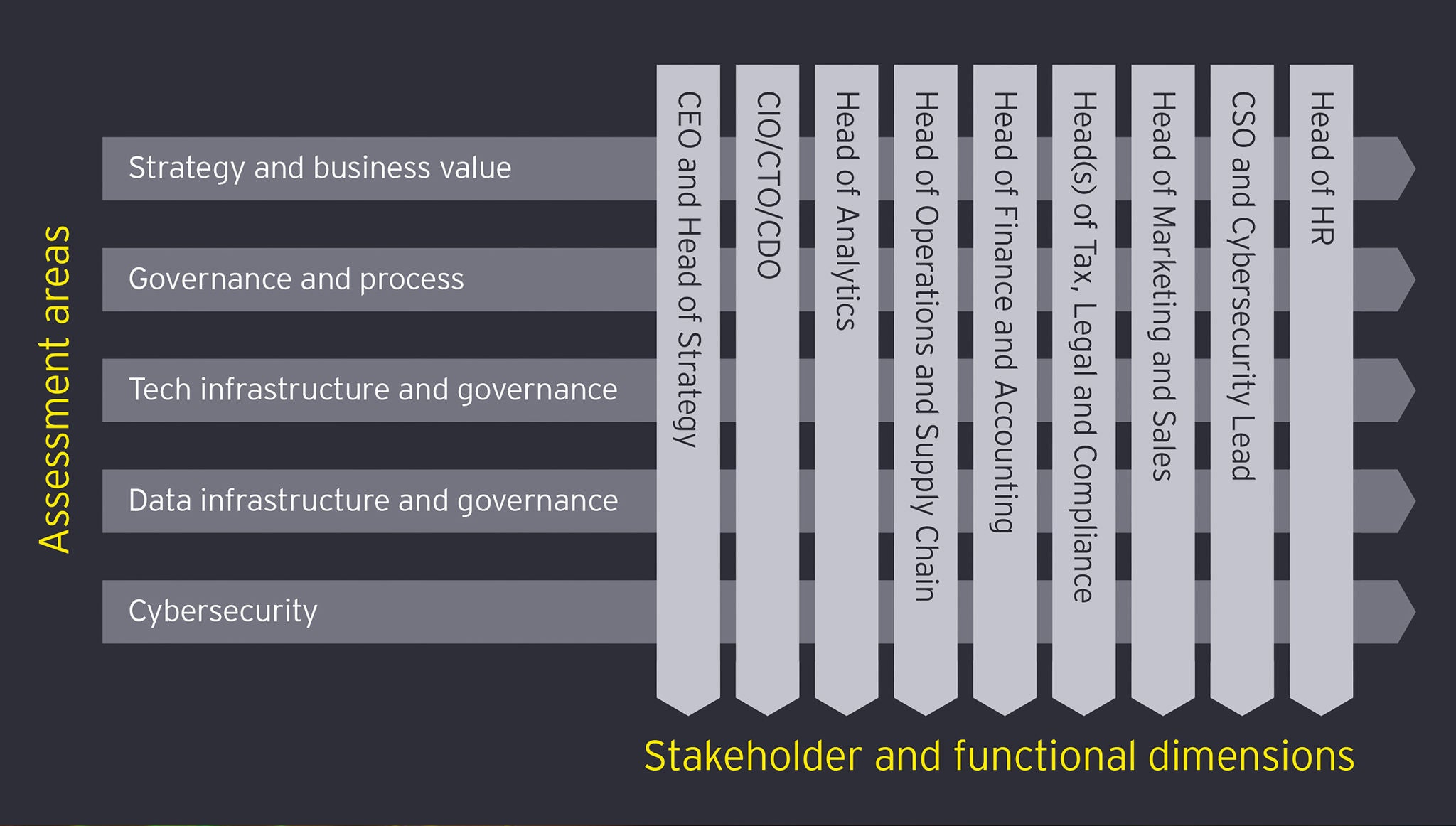
- Current state maturity and desired destination, and how quickly adoption should be realized
- How GenAI and ML will impact operational structures and processes
- Clarity and leadership agreement on use cases, focusing on high-value opportunities
- Realistic building blocks, timelines and implementation processes that align leadership oversight to different tracks, creating visibility into progress and adoption across teams
- Form cross-functional and multidisciplinary execution teams including functional, technical data and change management stakeholders to oversee the development and adoption of the AI strategy, which should include specific enablers around GenAI and ML.
- Ensure adherence to established and future regulations locally and globally that cover privacy, bias and other issues.
- Develop an operating model and process to continuously measure progress, gain feedback, and mitigate bias and other control risks.
- Evaluate existing data quality and management to allow for a solid foundation.
- Embed a GenAI and ML strategy alongside business priorities, identifying benchmarks and key metrics.
- Gain consensus on where value will be realized, and consider a full list of value levers.
- Harness the power of AI to drive human-centered transformation, optimizing performance, enriching experiences and unlocking new sources of sustainable growth.
- Assess current skills gaps and determine the future skills required to align to the organizational GenAI strategy.
- Develop a change management plan and communication cadence to bring employees along with you.
- Consider GenAI as a platform to augment people’s potential, creating seamless human-AI collaborations.
In Practice
Embracing AI capabilities is crucial for CP\&R success. Companies that strategically transform their enterprise across all functions, emphasizing value creation and re-evaluating humans’ role, will sustain long-term growth and competitiveness. To maximize success in deploying new capabilities and modernizing their businesses, companies need a holistic approach, and redesigned processes, operating structures and human involvement in decision-making.