







Group of office workers talking with manager

How supply chain leaders are confronting persistent global disruption

Scenario planning and AI investments are among two ways to triumph over inertia amid macroeconomic instability.


In brief
  • In an EY Center for Executive Leadership roundtable, top supply chain leaders have a bearish or neutral outlook about today’s business environment.
  • Amid macroeconomic volatility and geopolitical turbulence, resilient supply chains are needed more than ever to effectively address and counter the fallout.
  • AI initiatives largely remain in pilots for our COOs. Holistic strategies involving data and change management must be prioritized over individual use cases.

Globalization was the driving ideology in business for over 20 years, but today’s chief supply chain and operations officers are tasked with navigating the re-emergence of geopolitical conflict and trade barriers, in which the post-election optimism of six months ago has taken on a more uncertain edge.

Volatility is now structural, not an environment of one-off disruptions that can be easily resolved and mitigated, said Adam S. Posen, President of the Peterson Institute for International Economics, who spoke virtually in a roundtable of COOs from market leaders across sectors organized by the EY Center for Executive Leadership (CEL). We see that disruption in trade policy, in which the map of global alliances is being redrawn, and in actual wars, in which longtime adversaries have rekindled their animosities — all while artificial intelligence upends our notions of what’s possible.


“Every time you think you’ve figured it out, something new pops up,” said Kristin Valente, EY Americas Chief Client Officer. “I think it’s a great time to be testing our scenario-planning skills. And as C-suite executives, we must think about our functions and remits but also how we’re collaborating with our peers in our organizations and ecosystems.”


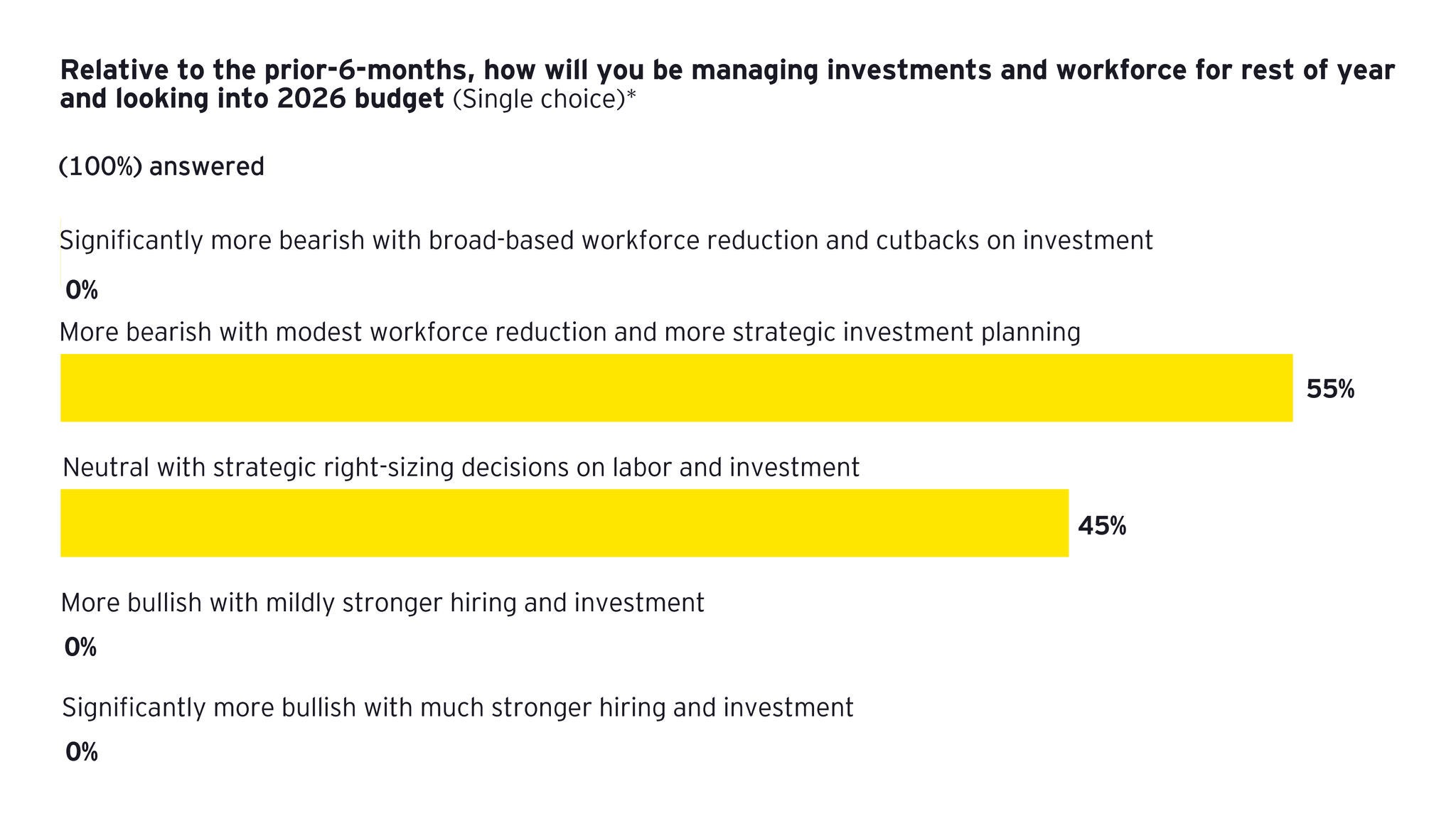
Echoing sentiment from other C-suite leaders, these COOs at the roundtable have a cloudy economic outlook, with 55% saying they were more bearish as they look toward the rest of the year and into 2026, citing modest workforce reductions and more strategic investment planning. The rest were feeling neutral, with strategic rightsizing decisions on labor and investments.


Juan Uro, EY Americas Leader for the CEL, noted that these results were identical to those from recent roundtables of Fortune 250 CFOs, CIOs and CAOs. “The sentiment you’re echoing is uncertainty for the second half, and you end up being a little more conservative,” he said.


How do you tackle what’s next in a world that, in many respects, is attempting to unwind many of the dominant economic schools of thought that executives have followed their whole careers? Today, virtually every CEO in a recent EY survey is concerned about tariff impacts and trade policies — and meanwhile, weather disruptions and cybersecurity risks are taking tolls on supply chains in the tens of billions of dollars, while emerging technologies such as AI add another complex layer of disruption. Here is how supply chain leaders are assessing today to prepare for tomorrow in areas such as borders and tariffs, geopolitics, and AI.

1

Chapter 1

Borders and tariffs: gauging the complex benefits and drawbacks

The changes underway today are not about the motivations of any particular US administration, said economist Adam S. Posen: instead, “The world has changed.”

Posen highlighted these trends that are posing complications for supply chain leaders:

  • Geopolitical instability manifests as fiscal risk to companies, with the US government providing less “insurance” against mitigating that instability. “The peace dividend is gone —it’s not just 2% to 3% of GDP a year,” Posen said.
  • Trade policy has fundamentally changed, with flows of foreign direct investment diminishing and a “steady state” still elusive. The US is relying less on Chinese imports, but other geographies will potentially rely more on them. “We should be expecting higher inflation, higher interest rates and higher deficits everywhere, not just the US,” he said.
  • The US dollar is losing its “centrality” in global markets. “I say that carefully,” Posen noted. “We have not ceased to be a reserve currency. It’s not that the dollar is falling out of usage. But we are seeing, to a speed and extent I didn’t expect, very large shifts.”
  • Increasing incentives among foreign governments to have standards diverge from those in the US, particularly in environmental issues.
  • “Growth will be very weak in most of the world,” Posen predicted.

In the face of these trends, leaders are leaning into no-regret decisions, said Don Frieson, COO Advisor in Residence at EY CEL and formerly the Executive Vice President of Supply Chain at Lowe’s. “It manifests in modest investment in automation and AI to streamline workforces,” Frieson said. “It’s something they would do in any cycle but certainly where there is uncertainty.” One COO said he saw more companies pausing capital.

But is that enough? “We still have to answer: what do you do to run the company differently?” a participating executive said, warning not to succumb to inertia amid such uncertainty. Recalling the COVID-19 pandemic, another COO saw the benefit of boldly investing during a crisis, not assuming a posture of wait-and-see, which paid off for his company with a 15-percentage-point gain in market share. Posen echoed this sentiment: “There are robust studies showing that leading companies that increase investment during uncertainty build advantages.”

Another COO from a large, diversified consumer company added another dimension: resilient supply chains must account for consumer priorities and how to deliver them cost-effectively. “If you successfully got through COVID, you’ll get through this period, because it’s just about building resiliency in your supply chain,” he said. “But if consumers don’t buy your product anymore, then the supply chain doesn’t matter.”


Based on our work with EY clients, we see five core focus areas for COOs for driving supply chain resilience:

  • End-to-end process excellence and operational resilience. Amid greater volatility, better companies are indulging in smarter designs — not relying on more buffering for more volatility. Principles of continuous improvement, not more inventory or production buffers, are better ways to respond to volatility, through the lenses of people, process and technology.
  • Shared ownership across commercial and operations. True resilience starts with commercial, not just operational, choices. Volatility is often handed off to the supply chain to solve. But stronger risk mitigation comes from coordination between the commercial and operational sides — jointly managing pricing, channel exposure and SKU complexity from the start.
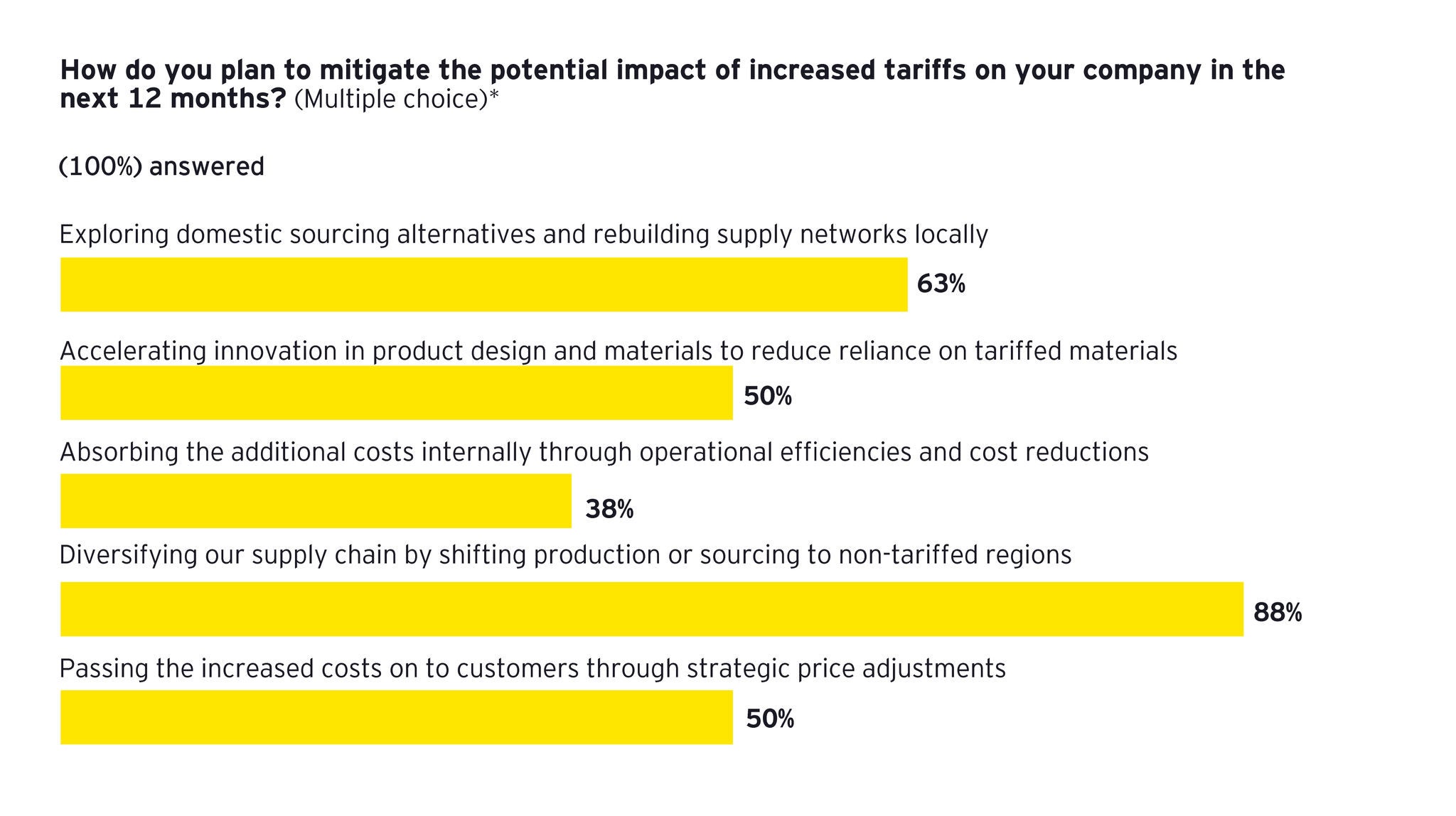
  • Global tax and tariff reengineering. Significantly reduce operational costs by leveraging tax incentives, exemptions or lower tariff rates through strategic sourcing and logistics. Understand that trade friction can be used to drive transparency, renegotiate supplier terms or reset pricing structures, unlocking moves that were once off-limits due to political or organizational inertia.
  • Tech, data and advanced analytics platform led supply chain cost visibility, price validation and mitigation. Digitally wire your supply chain for more insight into current performance and optimizations. Further, through platform upgrades, data integration and analytics, be better positioned to understand, verify and manage costs to enhance efficiency, reduce waste and improve profitability.
  • Reimagined supply chain networks and ecosystems. Foster collaboration with partners and strategically refine locations to avoid silos and the limitations of mere regionalization, which can result in silos or reduced resiliency. Without digital coordination across regions, companies risk fragmentation in a “local-for-local” supply chain, risking limited surge capacity when disruptions hit.

Key takeaways: The role of the US in the global economy is morphing, redrawing the norms around what supply chain strategy is most effective. Resiliency becomes a must, leveraging new processes and new technologies that mitigate costs while enabling agility.

2

Chapter 2

Geopolitics: China’s shift from economic engine to cautious partner

China and its steady decoupling from the US economy present just one facet of a global landscape of risk.

China was on the minds of all our executive attendees. Taiwan remains an important focal point, with fragile semiconductor supply chains and shipping lanes in the South China Sea are creating exposures in any potential conflict with China. “We’d be fools as leaders if we didn’t plan for something,” one COO noted.

And countries such as Brazil, India, Indonesia, Mexico, Poland and Turkey are, to some extent, strong enough to assert themselves with more autonomy with both China and the US, Posen said, which can pose geopolitical complexities for supply chain leaders to work through. Investments in other smaller, less stable economies are moving into these six economies instead, and many of the native populations are staying home as US and Europe cut back on net migration shifts.

One supply chain leader said his company is closely scrutinizing what to make in the US vs. what will continue to be in China. “We’re touching a number of industries, and more of our customers are overseas and going to India and Indonesia, for example,” he said. “They want us to be where they are.”

Our COOs were working to mitigate exposures and pursue dual sourcing to have levers going forward, building off prior efforts to target low-hanging fruit. They were also shifting locations, if not the ownership, of plants, or pursuing licensing agreements with the people who own the intellectual property (IP) elsewhere. Others suggested lobbying for waivers even in some sectors where they haven’t usually been provided. “I’ve seen a lot of progress in areas that may have been off-limits if you get to the right people,” a COO said.

One executive reminds us that the risks from decoupling run in both directions. “The big businesses in China depend on support from other countries,” he noted. “From the other side, the same answer we’re looking for has to be thought out for Chinese customers.”

Talking to COOs, EY leaders see five potential strategies to consider related to China, based on the specifics of your organization:

  • Strategic sourcing solutions: Optimal mix of China and dual sourcing (such as India, Southeast Asia and Mexico) with real-time cost/tariff modeling.
  • Collaborative innovation framework: R&D partnerships with tight IP controls, with risk balancing for core technology.
  • China as a self-contained market operation: Redesign products and develop IP strategy just for the China market. Use redundancy, segmentation and scenario planning.
  • Agile capacity management: This strategy relies on tight tolerances in China, with capacity mirrored in non-China locations and supply agreements for agile pivoting.
  • Sustainable natural resource partnerships: Long-term contracts and joint ventures are forged in China for rare-earth minerals, coupled with alternative supply chains (in sourcing and refining) and public-private partnerships.

Key takeaways: The erosion of relations between the US and China is a dramatic shift in the global economy and shows no signs of abating, with implications for most multinationals. Supply chain leaders should be focused on leading the discussion on creating a playbook of strategies that could include dual sourcing, partnerships, redundancy, segmentation and retention.

3

Chapter 3

North America: how do you make the supply chain math work?

In this bifurcated landscape, the divisions are not just between the US and China: they are across every continent and even within them, even by traditional allies in North America.

Sizing up the impact of recent debates between countries in North America, one COO said: “In Canada, you had shelves published in newspapers that said: ‘Buy Canadian products’ — simple as that. That has a much larger impact if that were to hold than a supply chain with a tariff of 10% or 20%.”

Naturally, different industries are experiencing different impacts on the continent. “If you build your product close to where your customers are, and you have more than one supplier, it’s still a good strategy,” one manufacturing COO said. Yet in oil and gas and in aerospace and defense, added geopolitical dimensions complicate what is possible. “We surely won’t be moving everything to the US; there will be balance from a global standpoint,” the supply chain leader of Fortune 100 company said. Generally, exploring partnerships where possible is best for flexibility, one consumer products COO added.

Adding manufacturing in the US bumps up against the reality of labor in the US: hard to find and more expensive than in other countries. But those who figure out the puzzle can capitalize on it greatly: “If you get the right people in the right place, there’s no better place in the world than the US,” a manufacturing CEO said. Our executives say they are pursuing:

  • Automation, which is heavier on upfront capex.
  • High school programs in trades like welding and pipefitting. “These trades have gone away, so the average family doesn’t actually have much familiarity with them,” a COO said.
  • Internships. “It’s partly about us using lower-per-dollar cost labor, but it drives a lean methodology,” one participant noted. “We soften the playing field and make them want to come back.”

Key takeaways: The US has distinct advantages and drawbacks in terms of labor, and getting the math to work for domestic production could be within reach for those organizations that move forward creatively in an uncertain environment.

4

Chapter 4

AI: getting past pilots into business-as-usual

Many AI pilots — and most participants in the roundtable are still experimenting at this level — are hitting a wall because of a lack of data, integration and change management.

Although the discussion around GenAI has been moving in the direction of agents, the technology today is better at driving supply chain conversations than automating decisions. Clients are using generative AI (GenAI) to execute orchestrated insights and surface trade-offs in natural language, rather than just creating analytics dashboards. But executives cited persistent challenges in getting many AI pilots off the ground.

“We’ve seen a wide range in terms of clients adopting AI,” Valente noted. “There’s a bit of fatigue — a wait-and-see mode.”

Companies that are capturing a competitive advantage aren’t just piloting visibility tools — they’re building centralized “nervous systems” that continuously sense, simulate and respond across planning, procurement and logistics. From dashboards to dynamic narratives instead of static analytics, AI enables contextual, real-time decision support — translating complex trade-offs into natural language for faster, more intuitive action. For instance, AI uncovers climate risks that often lurk in blind spots, such as water scarcity and extreme weather, through satellite imaging and risk modeling. The value surfaces not from models but from model-enabled decisions, tracked in metrics tied to operational KPIs such as inventory turns, lead-time reduction, service uplift and cost avoidance.


This is one of the most top-of-mind issues that the firm encounters with clients, and based on those discussions, here are three points worth emphasizing:

  • Scaling AI starts with people and processes, not models. Pilots that show ROI often still fail to scale — because they don’t change workflows. The old way of working is codified instead of reimagined.
  • Strive for relevant data, not perfect data. Companies push out AI adoption believing that perfect data readiness is required, but speed to impact comes from using messy data with clear feedback loops.
  • Centers of excellence alone are not the answer. CoEs can stall progress if they don’t push ownership to the edges. Centralization is meant to create standards, but distributed experimentation with light-touch oversight often drives adoption.
  • AI delivers returns only when anchored in operational outcomes. AI creates real value when linked directly to core KPIs like service levels, inventory turns and throughput — not just innovation pilots or isolated use cases.

Key takeaways: Many organizations recognize that AI is the future, yet they are bogged down in experimentation and pilots shoehorned into existing ways of working, with uncertain ROI. Do not overlook the additional interplay of people and processes, as well as your data foundation, as part of a broader strategy for enablement, not one-off use cases.

Summary 

Supply chain leaders are adapting to ongoing global disruptions, focusing on efficiency and resilience while embracing new technologies like AI. Their outlook remains cautious, with many expressing concerns about geopolitical risks and trade barriers. Executives are making no-regret decisions to invest in automation and AI, aiming to streamline operations amid uncertainty. Beyond that, executives must enhance their supply chain networks and processes to better withstand volatility and improve efficiency.

About this article

Related articles

How CFOs are striving to get unstuck from uncertainty

Fiscal, tax and trade policies are all up the air. CFOs are planning for scenarios and locking in rates while experimenting with agentic AI. Learn more.

How CIOs drive innovation while managing costs and weighing risk

IT cost optimization and agentic AI are top of mind as tech leaders confront many dimensions of uncertainty, an EY roundtable shows.

Juan Uro + 1

Three critical areas of change faced by CAOs and Controllers

Finance function leaders confront the implications of the new administration, cyber breaches and a redefining of their roles.