


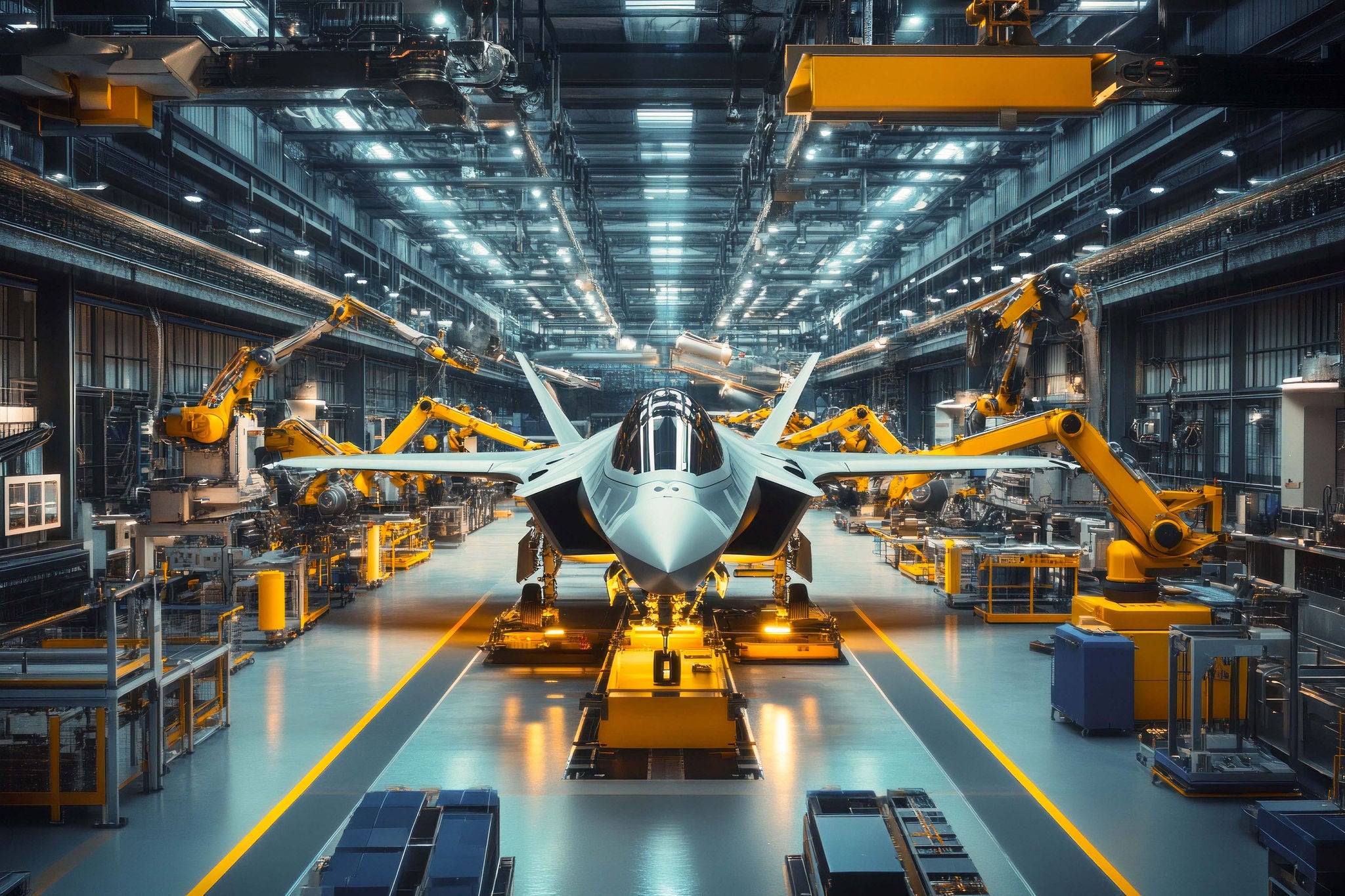

ey fighter jet assembly line robotic arms

How the A&D industry can turn record demand into assured throughput

A key challenge in A&D is not securing demand, but converting it. The supply base impacting conversion was not built to perform at this scale.


In brief
  • Record A&D demand and backlogs now make delivery the industry’s key challenge, shifting focus from winning orders to assured throughput.
  • A cost- and scale-driven supply base is exposed as geopolitical, trade, labor and cost pressures shift risk to industry and reward delivery.
  • Throughput is the new advantage, requiring resilience, risk prediction, connected supplier data and talent managed as a capacity constraint.

The conversion challenge

The aerospace and defense sector enters this period at record strength, and the demand signal is unambiguous. The commercial order backlog now represents well over a decade of production at current rates.1 Global defense spending reached a record level in 2025 — its eleventh consecutive annual increase, lifting the military burden to its highest share of world output since 2009 — but the decisive break came the year before: 2024 brought the steepest real-terms rise since the end of the Cold War, and 2025 has held that elevated base rather than retreated from it.2 The space economy, now more than US$600 billion, continues to expand at high single digits.3 Yet across all three markets the binding question has shifted. It is no longer whether the demand exists, but whether the industry can convert it — consistently, and at certified quality — into delivered output.

Two forces make that conversion difficult, and they are arriving together. The first is structural: the supply base now expected to deliver at record rates was never designed for resilience. The second is that governments, the sector’s largest customers, are simultaneously transforming how they buy — biasing procurement toward speed, volume and long-term commitment, in some cases contracting directly with lower-tier suppliers, while shifting more risk onto industry through incentive-based contracts and penalizing non-performance through mechanisms such as withheld payments.4 The result is both opportunity and pressure: more durable demand on one side, and a harder-edged, less forgiving customer on the other.


That combination is why throughput, not demand, now defines competitive advantage — and why resilience can no longer be assumed but must be deliberately engineered in. This article examines why the supply base is so exposed, and sets out four moves through which industry leaders can turn record demand into assured throughput.

The supply base behind the backlog

The strength of the order book draws attention to the supply base that must fulfil it. That base is the product of decades of deliberate choices — choices that optimized for cost and scale, and that left the industry highly capable but structurally exposed. Understanding why conversion has become so difficult requires examining three things in turn: how the supply base came to be configured as it is, the external pressures now acting upon it, and the operational consequences that follow.

Built for efficiency, not resilience

Decades of consolidation and single-sourcing produced a base optimized for cost — and inherently exposed.

It is tempting to describe the supply base as having lost resilience. A more accurate assessment is that resilience was never a primary design objective. Since the 1990s, the US defense industrial base has consolidated from 51 prime contractors to five, while the number of suppliers of tactical missiles has fallen from 13 to three and of fixed-wing aircraft from eight to three.5 Each stage of consolidation was a rational response to cost and scale pressures, but the cumulative effect was to embed single-source dependencies, supplier-held intellectual property and tooling, high switching costs, and limited visibility below the first tier. The consequences extend deep into the chain: the US Department of Defense relies on a network of more than 200,000 suppliers yet holds country-of-origin information on fewer than one in ten of the components and materials flowing through it.6 These are not recent failings; they are the inherent characteristics of a system optimized, over many years, for efficiency rather than assurance.

External pressures compound the strain

Geopolitical, trade, labor and cost pressures do not create the underlying fragility; they expose it — because a base with no slack cannot absorb them.

The significance of these pressures lies in what the supply base cannot do: absorb them. A base built without redundancy — single sources, thin lower tiers, long qualification lead times and little inventory buffer — has no slack. When several pressures arrive at once, a disruption that would once have been contained at a single supplier instead cascades across programs, because there is no qualified alternative to switch to and often no visibility to see it coming. That is the mechanism that turns routine risk into stalled production.

Four pressures are now acting together. The first is geopolitical concentration in critical materials. Rare-earth permanent magnets are embedded in the actuators, guidance units, motors, radar and precision-guided systems on which both military and commercial platforms depend — a single Virginia-class submarine, for instance, contains roughly 9,200 pounds of rare-earth material. Yet defense accounts for less than 0.1% of global rare-earth demand, which leaves it a price- and access-taker on a supply chain it cannot move on its own: a single country processes more than 90% of global capacity, and from 2027 a US rule will require defense-bound magnets to be free of prohibited-source content across the entire supply chain — from the mined element through to the finished magnet — forcing traceability far deeper than most of the industry can currently see.7

The second is trade policy. Tariffs on steel and aluminum, the core structural inputs for airframes, were doubled to 50% during 2025. Their effect on the price of a finished aircraft is modest — these metals are a small share of total aircraft cost, and prime manufacturers source most of their structural inputs domestically — but the real burden falls on the thinly capitalized lower-tier suppliers least able to absorb it; one mid-tier supplier alone disclosed more than US$10 million in tariff-related costs in a single year.8

The third is labor: the sector needs roughly 2.4 million new personnel over the next two decades even as its experienced workforce retires, and wages for skilled aerospace-manufacturing roles have risen sharply.9

The fourth is input cost more broadly — and here a common assumption needs correcting. Commodity prices have not uniformly eased: steel has come down from its 2021 peak, but aluminum has since climbed to a fresh high and titanium has continued to rise, even as aerospace-grade material, processing and skilled labor have each grown more expensive by roughly a fifth since 2021. The one commodity that has eased is the one that matters least to an airframe; the costs that dominate aerospace conversion have not.10

How the strain surfaces in production

The structural and external pressures combine to produce visible, recurring constraints on delivery.

The consequences are now evident throughout the production system. A single delayed component can prevent the delivery of an otherwise completed aircraft; work is increasingly carried out of sequence; inventory accumulates even as deliveries fall short; and a quality escape at a lower-tier supplier can halt an entire assembly line. The clearest example is propulsion, where engine availability — not airframe capacity — has become the pacing constraint on commercial deliveries. The cause is instructive: the most acute problems sit with newer-generation engines, where durability and quality issues have forced manufacturers into costly retrofit and remediation programs that they must fund themselves, largely under warranty. Scarce engineering and shop-floor capacity is consumed by fixing fielded engines rather than building new ones, and new-build engines are diverted into spare pools to keep grounded aircraft flying — leaving otherwise-complete airframes parked, waiting on propulsion. It is a constraint of quality and capacity, not of demand.11

Taken together, these characteristics describe a supply base that is structurally fragile, externally pressured, and already showing the strain in its output. The implication is unambiguous: the response cannot be incremental. A resilience the base never possessed cannot simply be restored; it must instead be deliberately engineered into how the supply chain is designed, how risk is managed, how data connects the chain, and how talent is built and retained.

Four priorities for assured throughput

If throughput is the objective, it will not be achieved through a single intervention. It requires a sequence of mutually reinforcing moves: designing the supply chain for resilience, predicting risk within it, connecting the data that allows manufacturers and suppliers to communicate in both directions, and managing talent with the same discipline as any other constrained input. Each addresses a different dimension of the fragility described above, and each is more effective when pursued alongside the others.

Conclusion

The next source of advantage is conversion.

Demand is settled; throughput is the contest that will define the coming years. The supply base was not built for resilience — current pressures are revealing that condition rather than creating it, while governments are now raising the cost of failing to deliver. The four moves set out here — designing the supply chain for resilience, predicting supply risk, connecting data to enable two-way communication, and managing talent as a capacity constraint — are the means by which leaders can convert record order books into delivered capability. The essential shift is one of perspective: resilience cannot be restored to a base that never possessed it, but it can be engineered in. The organizations that come to treat conversion as a problem of design rather than of demand will set the pace for the remainder of the decade.


Summary 

The A&D industry’s key challenge in meeting increasing demand is converting backlogs into delivered output. Supply chains built for cost efficiency, not resilience, are struggling under geopolitical, trade, labor and cost pressures. Governments are also shifting procurement toward speed, volume and accountability, increasing pressure on suppliers to perform. Throughput, not demand, is now the main source of competitive advantage. To improve delivery, companies must redesign supply chains for resilience, predict supply risk earlier, connect data for clearer supplier communication and manage talent as a core capacity constraint.

About this article

Authors

Related articles

Building geopolitical resilience in aerospace, defense and mobility

Companies will face challenges in managing the uncertainties created by new geopolitical realities. Learn how to succeed in this volatile environment.

How can digital supply chains help manage aerospace risk?

To combat disruptions in the A&D sector, build a foundation of digitization, AI and machine learning for enhanced agility and resilience. Learn more.