







energy and power

How CIOs are pivoting toward using AI to enable growth in 2026

Productivity gains move the needle a bit, but innovation has unlimited upside, EY roundtable participants say. But getting there is tricky.


In brief
  • By bridging the gap between IT and the business, CIOs are uniquely positioned to deliver AI success amid organization complexity.
  • One pitfall is to stick AI into existing processes rather than reimagining processes for the AI era — to do different things, not just do things differently.
  • Those who get beyond mere automation of yesterday’s work face a conundrum about how best to evidence the ROI of their AI efforts, which can be pricey.

For tech leaders, we’ve entered another year with the same agenda: accelerating artificial intelligence (AI) and generating greater value from it. But discussions are taking on a different tone, one that increasingly acknowledges that delivering cost savings through efficiency is not as transformative as achieving different goals entirely for greater growth.

“In a lot of these eras of technology, cost savings is the initial focus because it’s the easiest to count rather than agility and innovation, for example, which are harder to quantify,” said Rakesh Malhotra, Digital & Emerging Technologies Principal with Ernst & Young LLP. “But the latter become more apparent over time. We’re seeing CIOs making the shift to bigger aspirations with AI that enable growth.”

A January roundtable of CIOs facilitated by the EY Center for Executive Leadership, validated that outlook: about two-thirds said their AI priorities were focused on growth of new capabilities and products, while a third said cost savings and efficiency. With so much riding on AI as an organizational imperative, these leaders find themselves at the crossroads — or in the crosshairs — between the business units and the enabling IT functions in a tumultuous business landscape.


“Over the last three years, there’s been a lot of focus on tech — people believe tech is the solution, but they haven’t thinking as much about mindset and skill sets,” said Dan Diasio, EY Global Consulting AI Leader. “Now they’ve shifted to competitive differentiation and innovation.”


Our roundtable participants sounded off on where they are today with AI and how they are seizing upon bigger aspirations in 2026.

1

Chapter 1

Is AI-driven productivity enough?

CIOs remain perched between the short term and the long term, needing to make bets that deliver cost savings but also position their organizations for bigger possibilities.

Roundtable participants all signaled their growing awareness that productivity, on its own, was a smaller play in the AI era with a more limited potential for ROI. Yet the tension between cost efficiency and growth persists: organizations are pursuing both, not one or the other, as the pressure to do more with less remains constant.

“Because we’re in a regulated industry, we had been apprehensive about what the Securities and Exchange Commission and others would think about using AI in our decision-making,” said one CIO in asset management. “But if you look at the efficiency savings, our costs and our compensation budget is capped; you can only save so much, whereas the growth is uncapped.”

For another CIO in retail and health care, the three A’s — AI, automation and agentic, which are not actually synonymous — presented opportunities to drive out both costs and friction for customers as well as other stakeholders. “We measure this in terms of seconds, and productivity does pull through to cost,” he said.

But as these projects develop, leaders encounter two challenges that pull them in different directions. CIOs may feel reluctant to make a clean break with the past, or with proofs-of-concept that are not delivering measurable impact. Yet when they do, tech debt — that bane of the CIO’s existence — rears its head as greater dependencies exist downstream.

2

Chapter 2

Reject your limits in current processes — don’t work within them

Leapfrogging out of yesterday’s processes into the true creative potential of AI requires merging a team’s deep knowledge with outside perspectives, from resources like software engineers and others.

Those inside a system may accept the bounds of that system, and those outside it lack the knowledge of what truly needs to be done and why.

Our CIOs were about evenly divided between applying AI to existing processes (54%) and inventing processes with AI at the core (46%). “The barrier to entry to patch up existing processes is very low,” one CIO noted. “With reimagination, you’ve got a team of people and multiple stakeholder groups to engage, and that’s much more difficult to undertake.”

Diasio noted than an internal EY team was quite satisfied to trim one process down to 32 hours from 45 hours, but it was slashed to mere hours when different thinkers were included. A pharma CIO said: “We’re very compliant-centric and focused on controls, so reimagining work here is hard. How do we give people permission? We put the ownership back on leaders to drive the conviction.”

Everyone in the C-suite is talking about AI, and Juan Uro, EY Americas Leader for The Center for Executive Leadership, notes that these discussions often land in the same places, no matter which leadership group is involved. “CFOs also want true reinvention, like shortening innovation times, but their people do checks and balances — it’s not in their DNA to innovate,” he noted. “Software engineers and others think completely differently. You need to think about the outputs you want to effect and then work backward, while injecting the accountability in the beginning rather than ending with it.”

This is a cultural problem even more than a technological one, and CIOs who have relationships across the business, and who understand how to enable the business, are invaluable. “We’re at a point of structural uncertainty, and that requires a different leadership playbook,” said Kristin Valente, EY Americas Chief Client Officer. “We’re seeing that the model that evolves here is more of a superfluid enterprise: flexible, modular and AI-native, with a free flow of information and value. If your best ideas are mired in committee or your data is in silos, you’re not superfluid — you’re super-stuck.”

To thread the needle between the short term and the long term, one CIO had a dual track: a group tasked with justifying processes to ensure alignment with business goals, alongside an “inventory of ideas” enabled with self-serve capabilities and engineering that would rethink workflows from the start.

And for another leader, the core takeaway was to practice what you preach: “The people who are thinking about retaining the old stuff is us, the senior leaders. The best thing we’ve done is to get the leadership out of the way.”

3

Chapter 3

Getting past AI adoption into transformation in ROI

As AI matures in organizations, and as executives grow more aspirational about deploying it for growth, the ROI equation becomes more opaque.

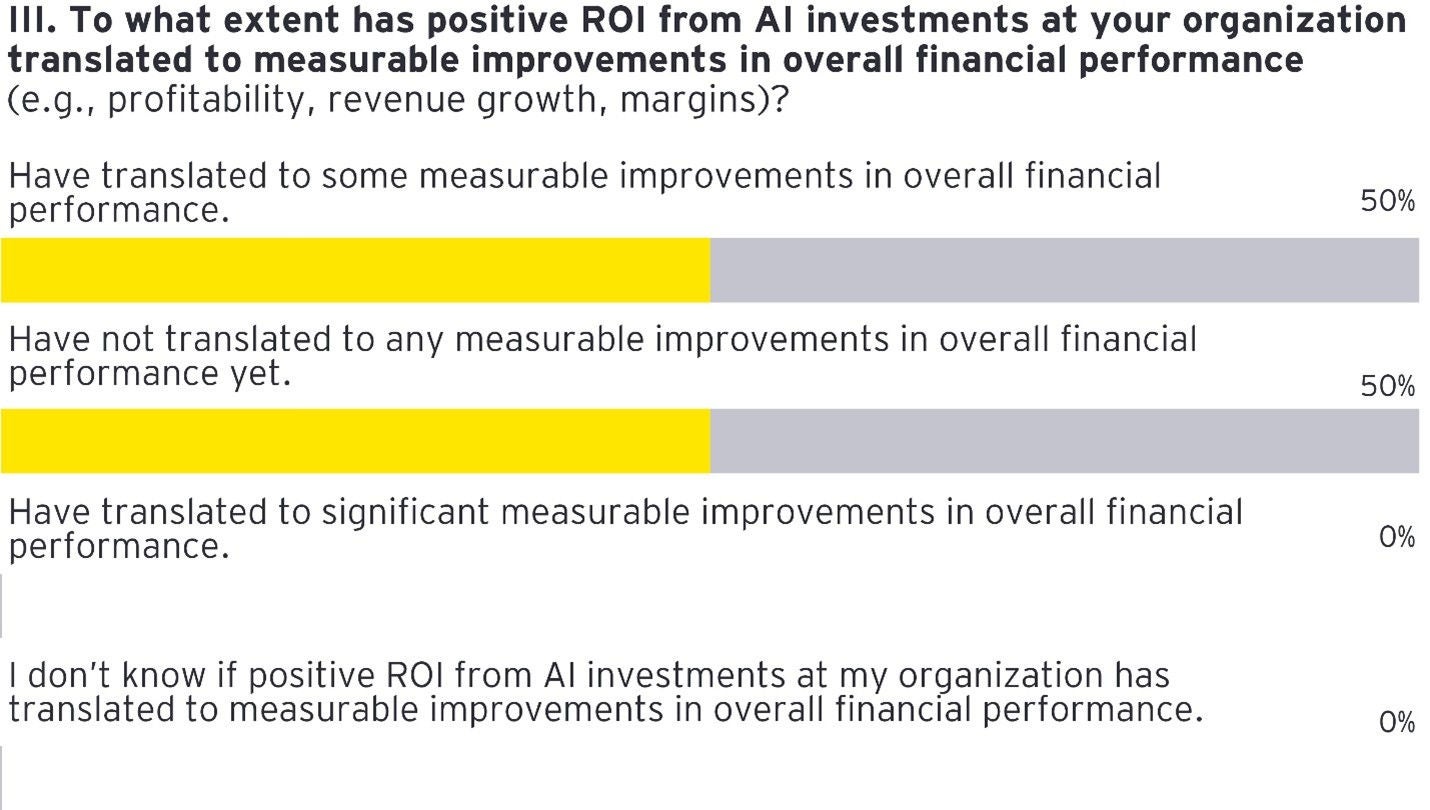
The most recent EY AI Pulse Survey, from late 2025, found that 96% of executives cited some amount of AI-driven gains in productivity, including 57% who said those gains were significant. Our cohort of CIOs in the roundtable were a bit more muted: half cited some measurable improvements in overall financial performance from AI investments, and half are still waiting for them. 

Poll asking about positive roi from ai initiatives

Diasio said, “Despite a lot of the market hype, there is a public and private divide in how executives feel about AI, and these CIOs see a more challenging reality. The numbers show us that, to truly unlock transformative value, leaders need to apply this technology to transformative outcomes, not merely to squeeze out more cost.”

CIOs in our cohort did not profess to any significant improvements in financial performance thanks to AI, while adding that their efforts are still gaining momentum.

“We didn’t want to hit a high ROI bar early on,” said one leader. “We’re building a culture, not as focused on hitting the bottom line materially. Do we have the data? Do we have blockers we’re not aware of? We’ll evolve as we do more projects, and we’ll get to a more rigorous ROI measure. They’ll aggregate to something meaningful, but we’re still relatively early just trying to get wide adoption.”

To scale AI and therefore boost ROI, leaders suggested:

Employing a platform approach that is not quite decentralized or too centralized. “Rather than having one-off, siloed use cases, executives create a different set of capabilities that different teams can tap into through a platform,” Malhotra said. “It still doesn’t bottleneck into a core team. It’s centralizing but also with a self-service platform to keep the velocity up.”

Helping IT sharpen its business acumen. These professionals may not intuitively speak the language of ROI or understand the impact on operations. “Fifteen years ago, the business would ask for the money to get the tools, but what is AI going to get me?” a CIO asked. “Where we see that we’re getting that payback, it’s where the IT and business acumen come together.” She added: “Even though we all have to worry about costs all the time, there’s this exciting opportunity to impact how we do business. The excitement at the grassroots level is changing how we do things.”

Summary 

Ambitions for AI in 2026 are high: to drive growth and not just productivity, and to reimagine work, not just automate it. CIOs can be the master strategists bridging the gulf between IT and the business if they are empowered to build with AI, not just bolt it on, with outside perspectives and a willingness to embrace change.

About this article

Authors

Related articles

How CFOs plan to leverage AI for growth and productivity in 2026

CFOs discuss the challenges and opportunities of integrating AI in finance. Discover key strategies to navigate AI adoption in your organization.