


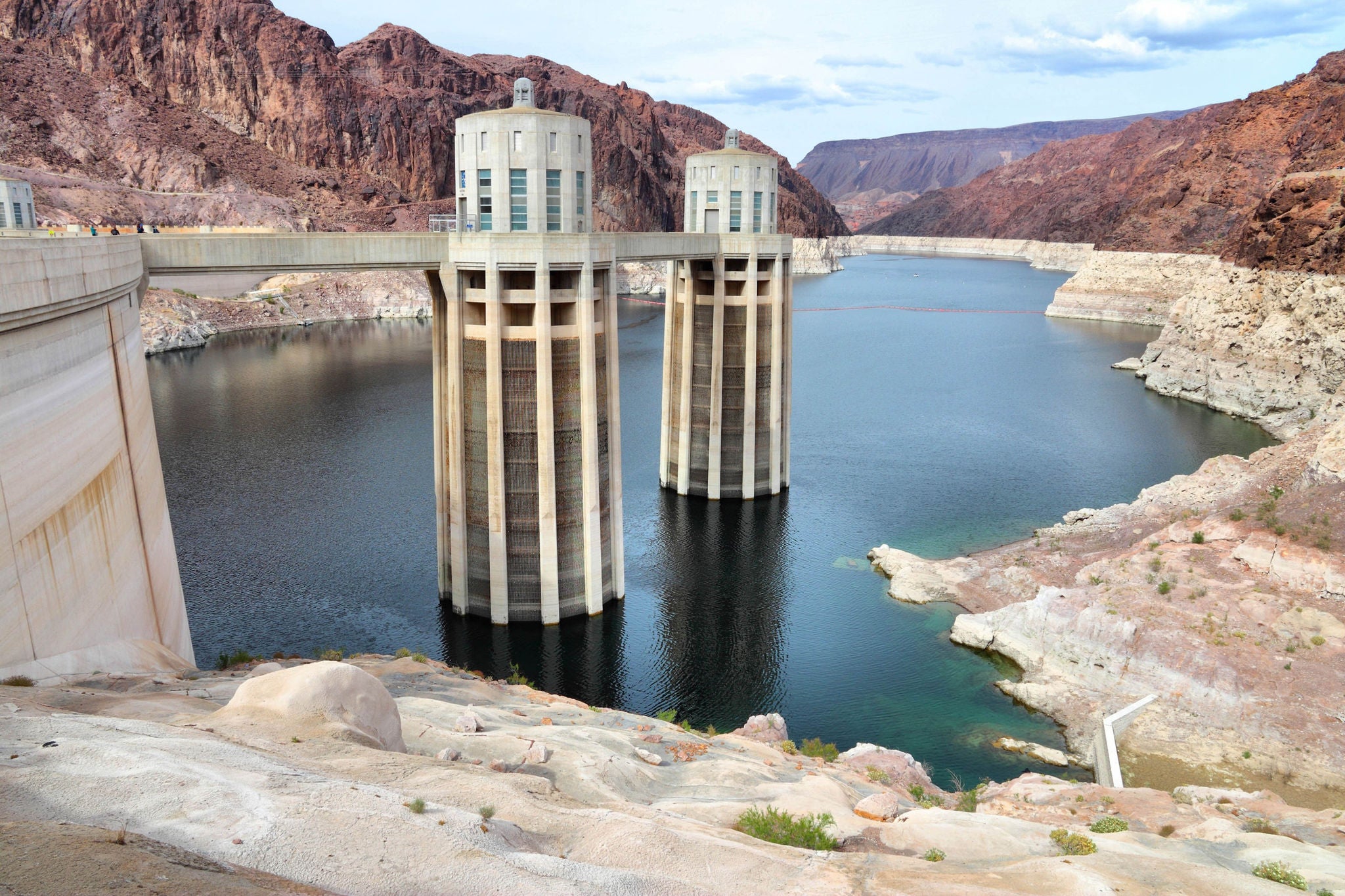




Hoover Dam in United States. Hydroelectric power station on the border of Arizona and Nevada. Low level water reservoir.

Navigating water risks in the age of AI and energy transformation

AI data centers and energy shifts are straining freshwater supplies in key US regions, raising risks and investment challenges.


In brief
  • Water demand from AI data centers and power generation places pressure on scarce resources, challenging communities and investors in key US states.
  • Water-saving technology and repricing are increasingly being implemented to respond to this rapid increase in demand.
  • New financial tools help banks and investors price, hedge and invest in water risk, linking KPIs to products and funding resilience plans.

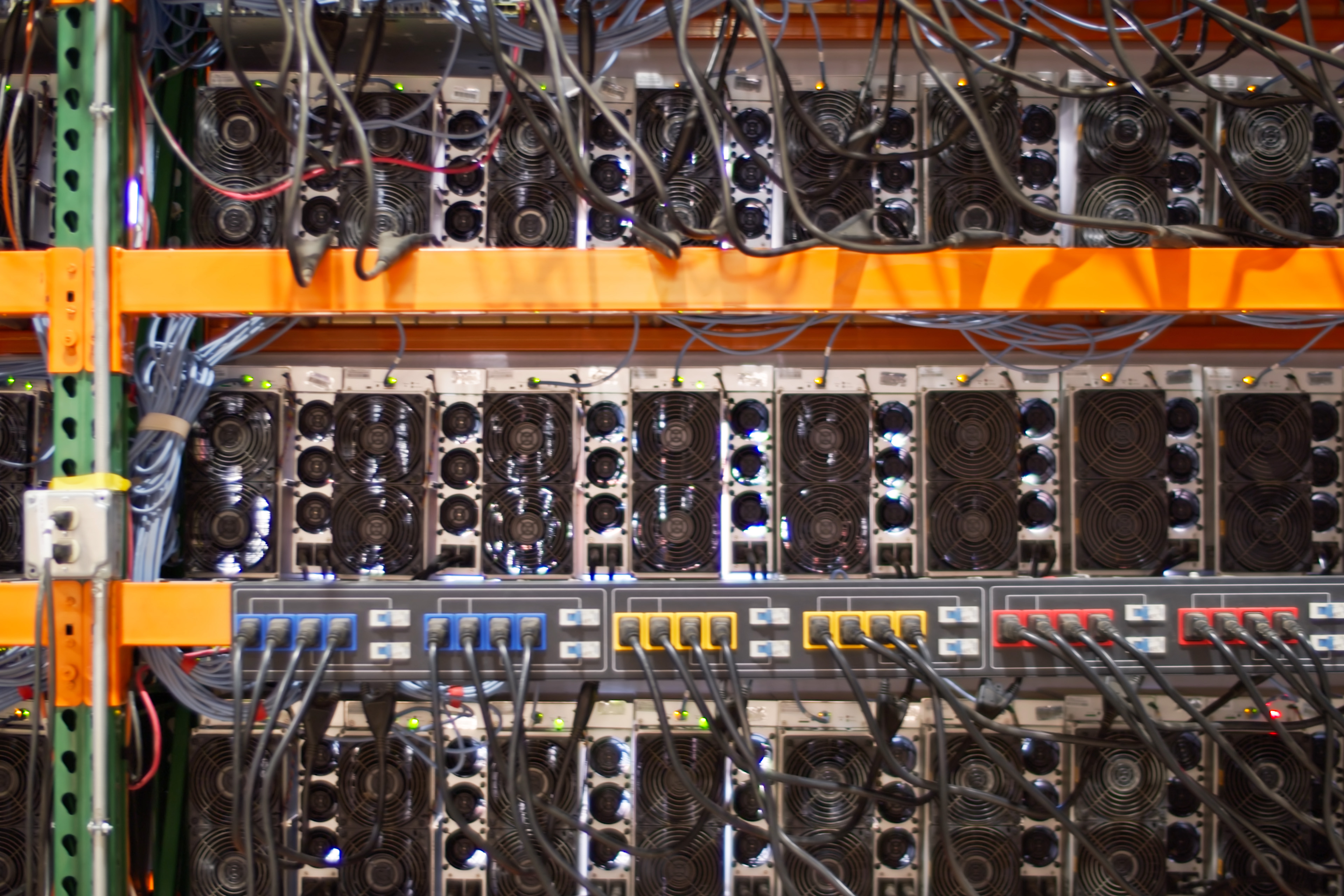
Water is essential to the digital economy. AI data centers, cloud computing hubs and crypto mining operations generate significant heat that requires constant cooling to keep equipment running smoothly and to avoid costly downtime. This cooling depends heavily on fresh water, making water availability a critical resource in the tech sector’s rapid growth.1 While the rise of data centers contributes to economic growth in local communities2 and empowerment in our digital lives, water availability and cost represents a diligence factor for data center financing.


We are entering an era of global water shortage, where demand outpaces supply and safe withdrawal limits are being tested in many regions.3 This article examines the risks facing asset managers, banks and insurers in water-stressed areas of the US, such as Texas, New Mexico and Utah, including rising water demand from data centers and power generation, water pricing pressures, energy trade-offs and geopolitical risks. It also explores financial tools for managing scarcity and strategies to improve water valuation, resilience and equity.


Discover how these trends are shaping the future of water use and AI investment. Read on to learn more.

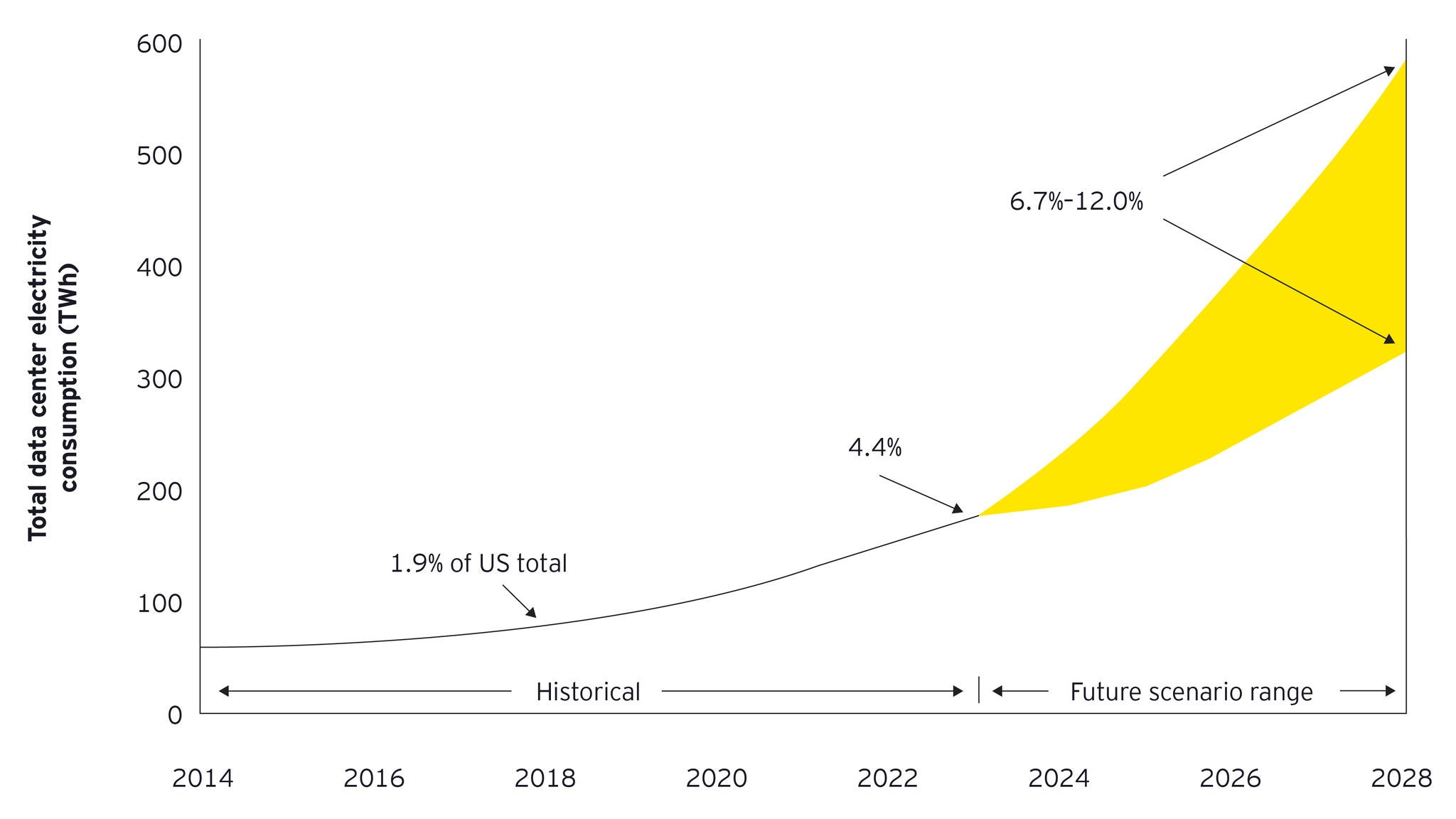
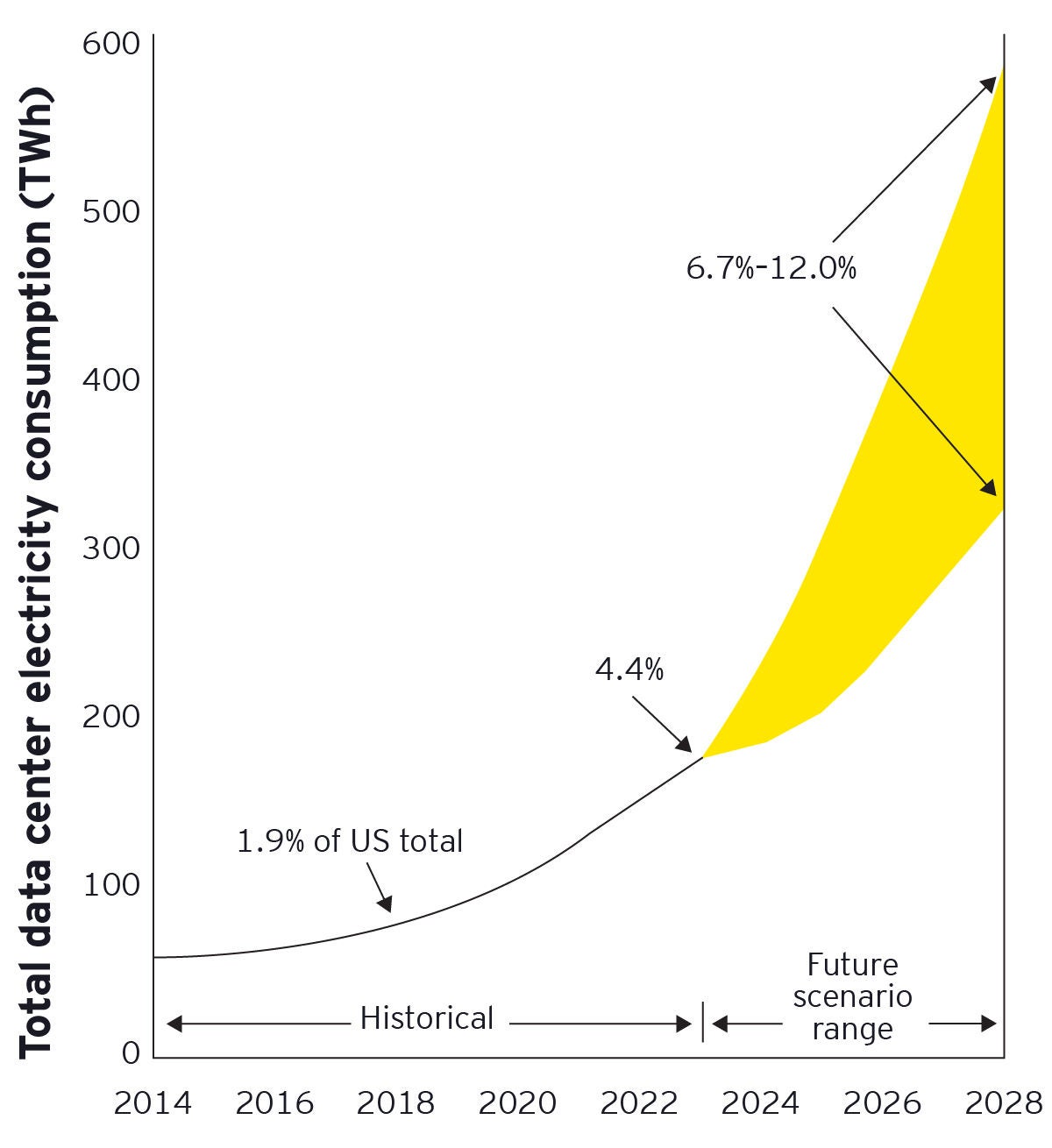
total data center electricity consumption
ey-total-data-center-electricity-consumption-mobile

2024 United States Data Center Energy Usage Report

Source: https://eta.lbl.gov/publications/2024-lbnl-data-center-energy-usage-report


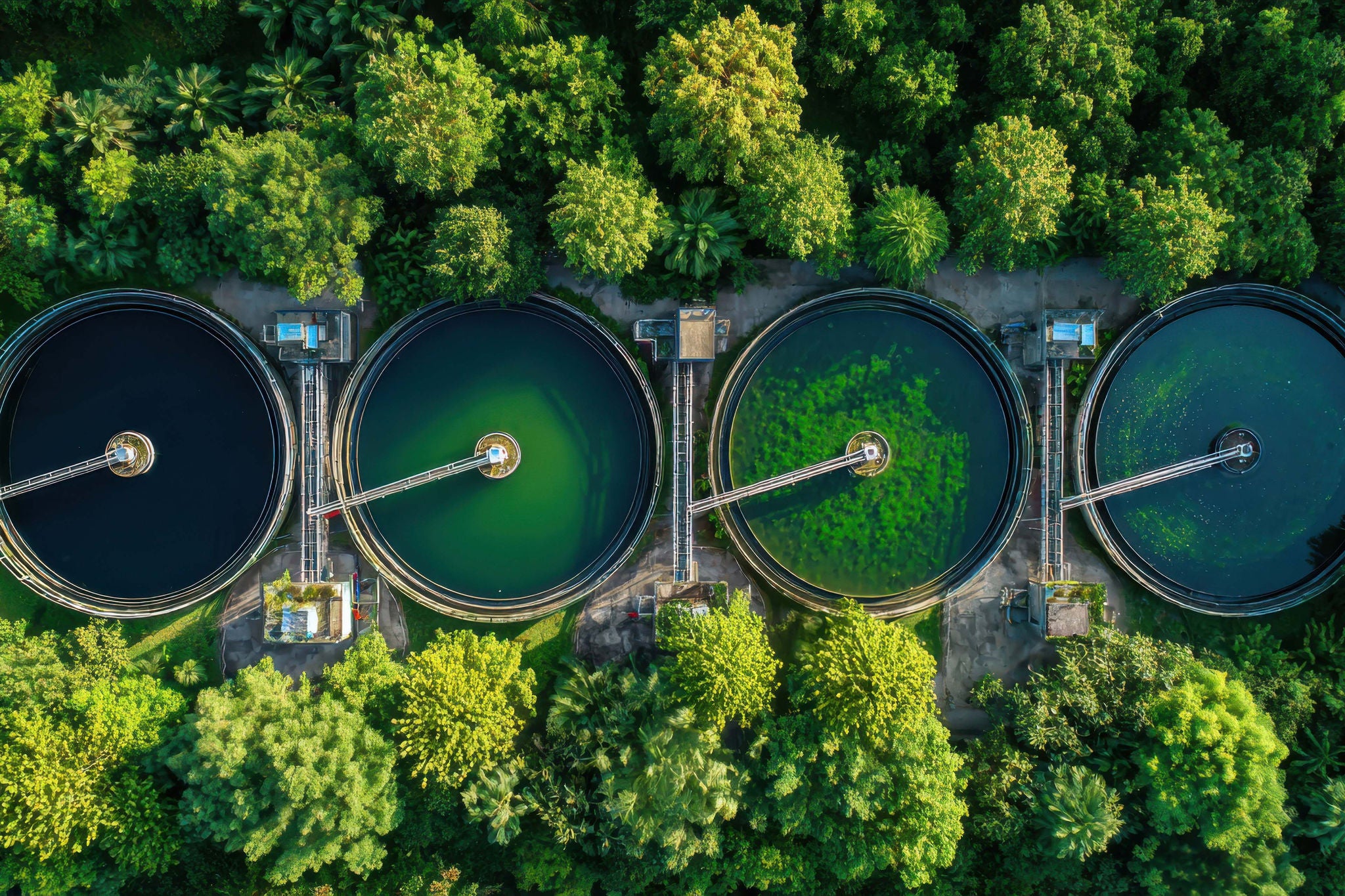
Purification Ponds: Aerial view capturing the vital process of water treatment with a network of circular ponds, a symbol of environmental stewardship.
1

Chapter 1

Data centers are in high demand but need significant water resources

AI data centers and energy shifts drive heavy water use in dry US regions, straining supplies and raising costs as droughts intensify and demand soars.

Data centers and growing water pressure

The rise of AI data centers and energy transition are driving fierce competition for water in dry regions.4 While data centers can help drive employment in local communities,5 a mid-sized data center can use as much water as a small town, and the largest AI facilities may consume up to 5 million gallons daily — equal to a city of 50,000 people.6 In Texas where significant data center growth is expected7, data center water use could jump from 49 billion gallons in 2025 to nearly 400 billion by 2030.8 This increase could raise their share of the state’s water use from less than 1%, to 2% or 3%, drawing down reservoirs like Lake Mead by over 16 feet annually.9 Reservoirs, such as Lake Corpus Christi and Choke Canyon, are critically low, both below 10% capacity.10 The city of Corpus Christi is prepared for mandatory water cuts in 2026. This crisis reflects a gap between aging water systems and rapidly changing environmental conditions rather than errors in climate forecasting.11

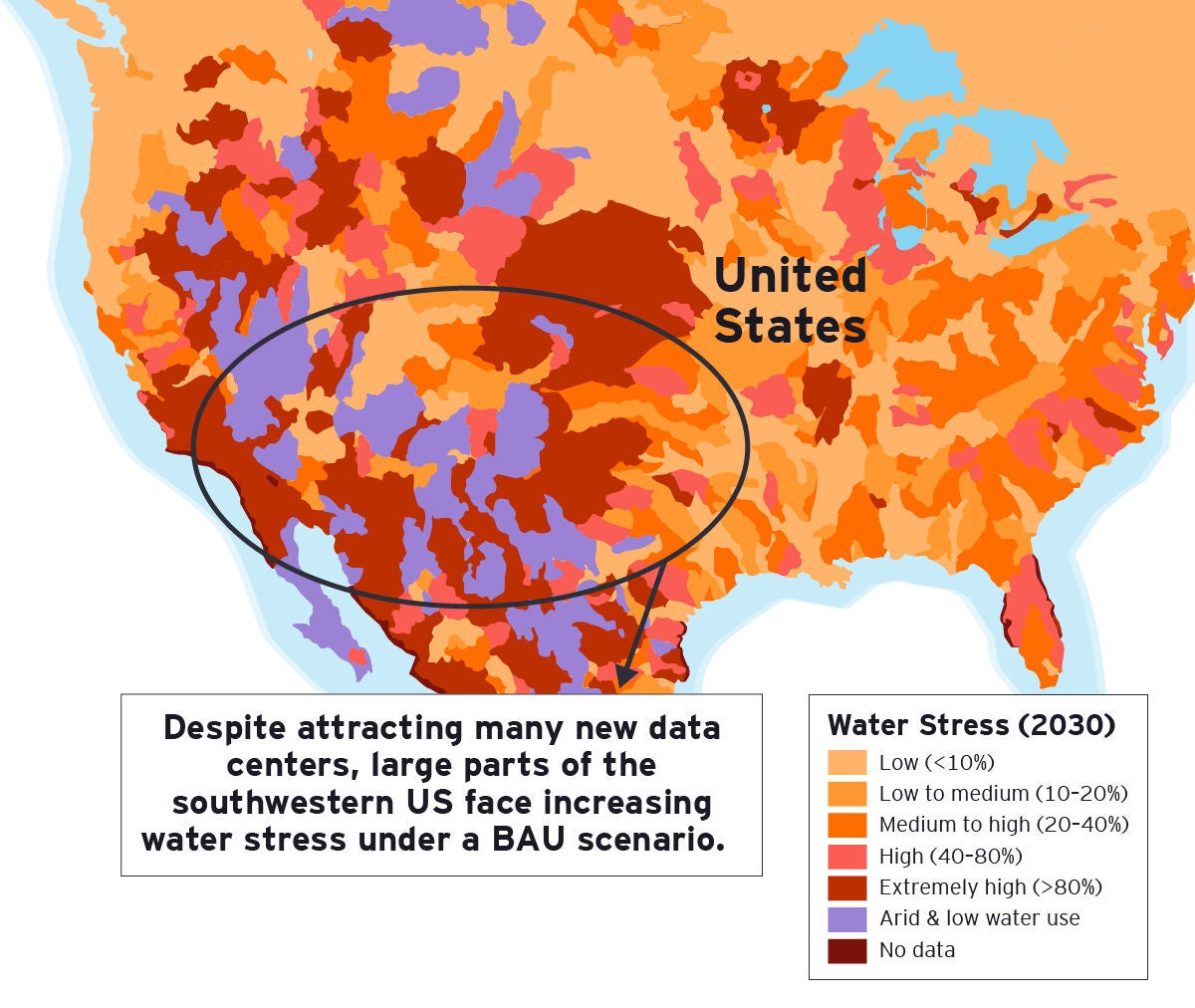
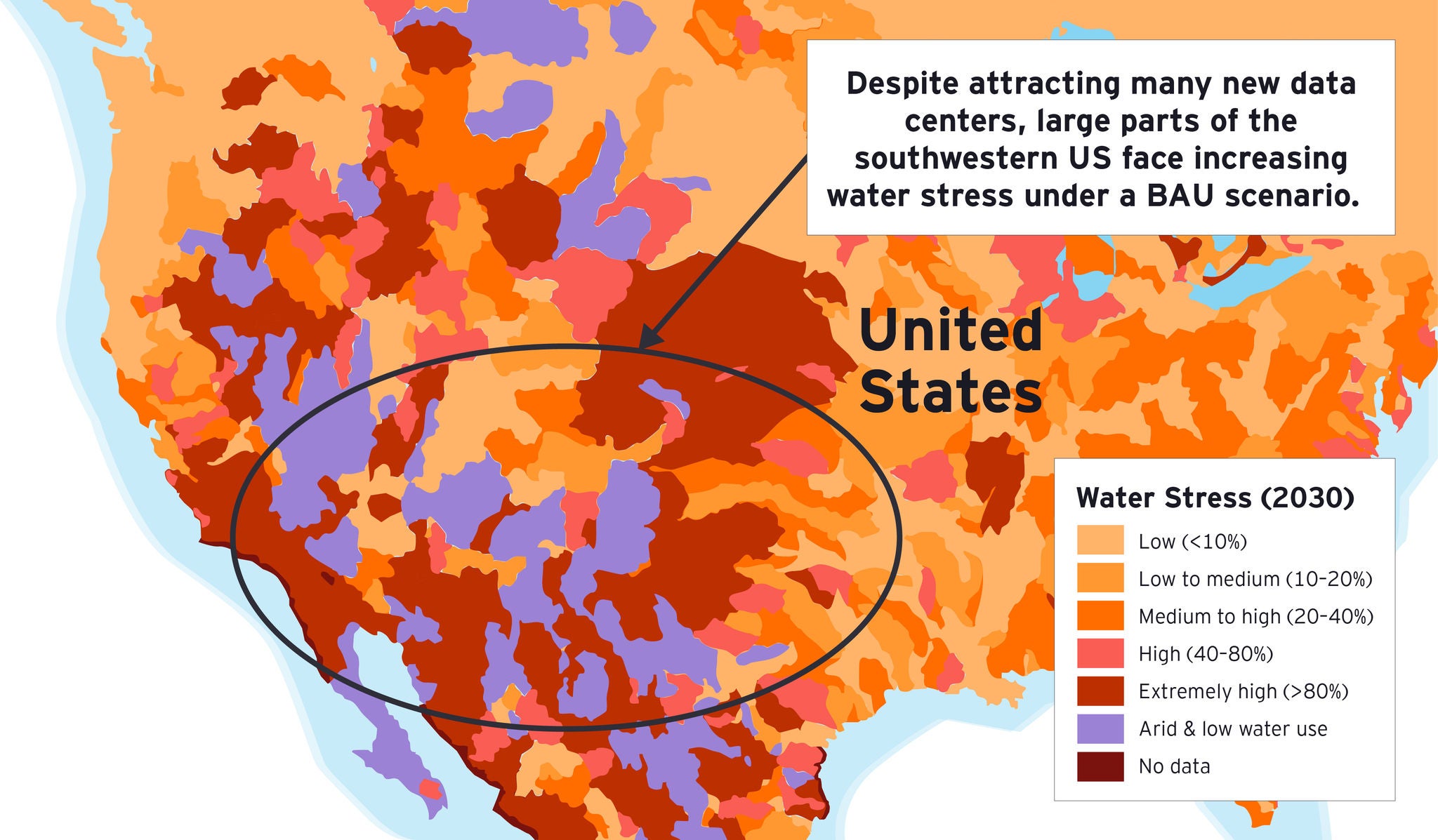
Most of the water used by AI data centers cools servers, as AI chips generate intense heat. In response, many centers rely on evaporative cooling, which consumes water through evaporation, reducing downstream supply and leaving behind concentrated brine that harms water quality. However, alternatives to traditional evaporative cooling are gaining traction. For example, closed-loop systems that recirculate water can significantly reduce freshwater withdrawal, though typically require higher energy consumption, a trade-off that banks and investors can weigh as part of their data center financing due diligence. Regardless, this localized demand acts like a giant straw, heavily drawn from single basins. While some data centers are working to cut freshwater use, about two-thirds of new data centers since 2022 are located in water-stressed regions, including parts of Utah, Nevada, Arizona, New Mexico, Colorado and Texas.12 Many states have attracted these projects with tax breaks and cheap resources despite local water shortages.13

Water stress
Water stress

Projected Southwestern US Water Stress, 2030

Source: “Aqueduct Water Risk Atlas,” World Resources Institute website, https://www.wri.org/applications/aqueduct/water-risk-atlas/#/?advanced=false&basemap=hydro&indicator=w_awr_def_tot_cat&lat=30&lng=-80&mapMode=view&month=1&opacity=0.5&ponderation=DEF&predefined=false&projection=absolute&scenario=optimistic&scope=baseline&threshold&timeScale=annual&year=baseline&zoom=3, accessed May 15, 2026.


Water pricing, energy use and the true cost of cooling

Water remains heavily underpriced in many US states with only 20% of water utilities able to cover the cost of drinking water services.14 This encourages water-intensive cooling methods that are cheaper than electric alternatives but fail to account for freshwater’s real cost. As droughts intensify and populations grow, higher water rates, tighter limits and pressure to adopt water-saving technologies are reshaping how businesses manage water and energy use.15

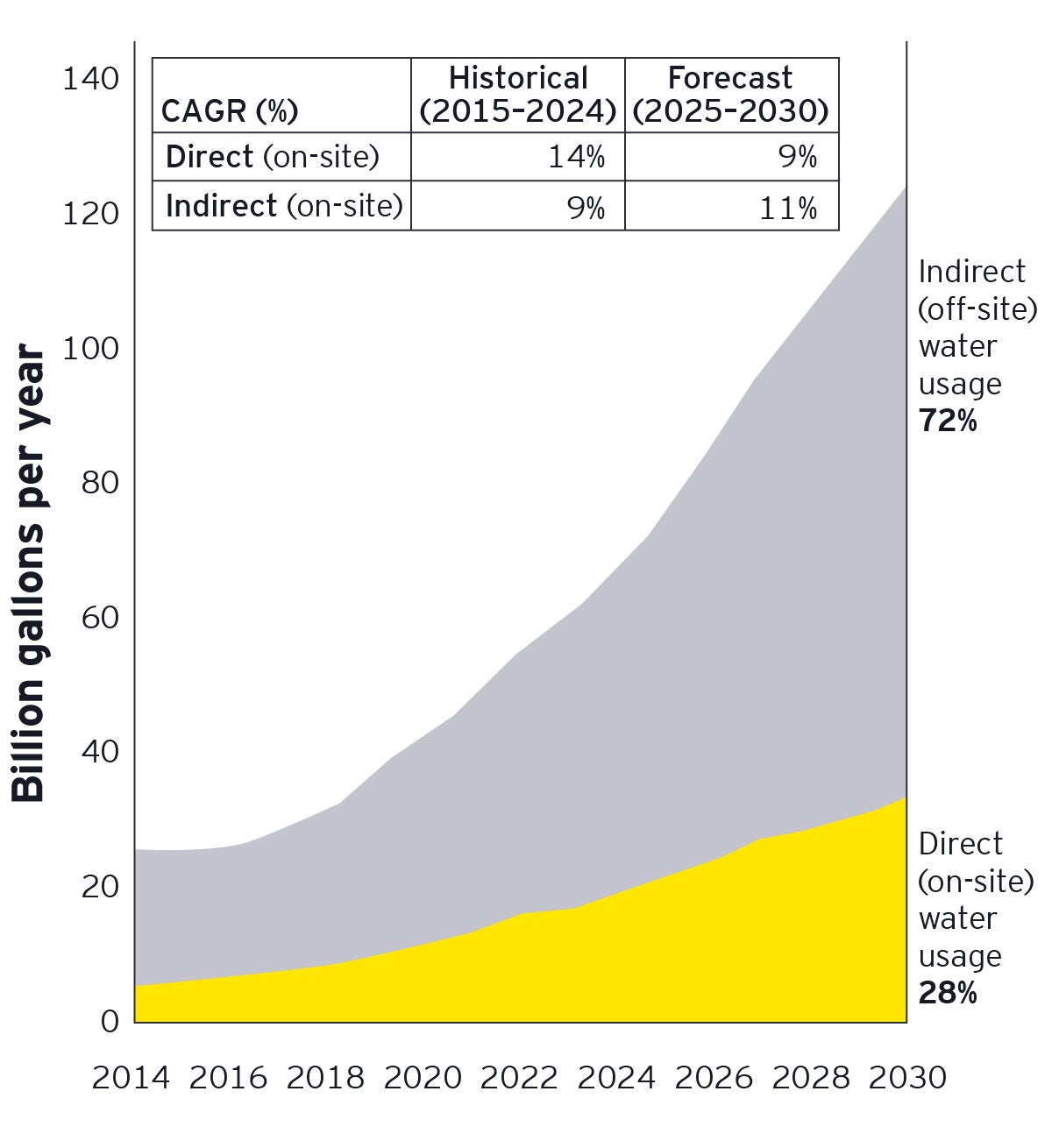
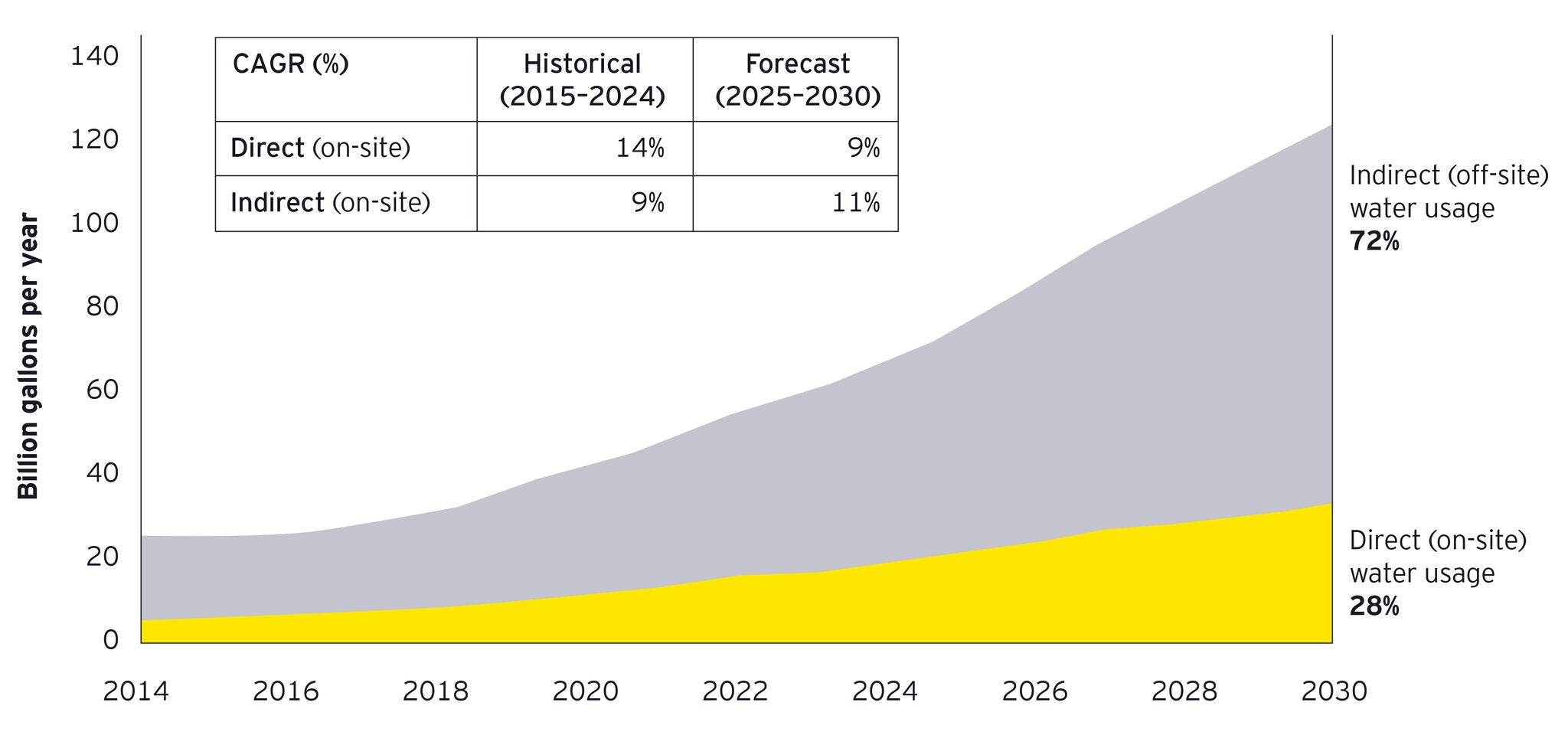
Water use also extends beyond cooling servers to power generation, adding complexity to infrastructure planning and development.16 Energy shifts from increased electricity demand and a changing power generation mix are increasing water consumption. For example, thermoelectric power plants, including natural gas, coal and nuclear, consume large volumes of water for cooling — approximately 50 trillion gallons per year in the US.17 This creates a double impact on scarce freshwater supplies, with nearly 60% of an average data center’s total water footprint coming from off-site power generation.18

Billion gallons per year

Data Center Water Consumption Footprint, 2014-2030

Source: "Data Center Electricity Demand Nearly Doubles to 8.9% by 2030, Shifting Water Risk from Cooling to Power Generation," Bluefield Research website, accessed May 15, 2026


Additionally, water pricing reforms could significantly impact project economics. Utilities in arid regions may adopt tiered pricing or impose fees on water usage, driving up costs for water-intensive operations and potentially limiting consumption.19 On the other hand, investing in water recycling, rainwater harvesting or dry cooling offers a way to reduce reliance on municipal supplies and manage risk appropriately.20 While wind and solar photovoltaic (PV) generation profiles are variable, they can provide significant system value when effectively integrated into power grids,21, 22 require very little water for operation and have minimal lifecycle water use relative to water-cooled thermal generation.

Scaling renewables can also reduce the water footprint of the power system, alongside emissions and decreasing exposure to water stress by reducing dependence on generation vulnerable to cooling water constraints.23 These strategies may become essential as water scarcity reshapes the financial landscape for data centers and related assets.

Aerial top view of Drinking Water Treatment plants. Microbiology of drinking water production and distribution for big city from water management, water recycling.
2

Chapter 2

Water scarcity emerges as a top geopolitical and financial risk

Water risk threatens bonds, operations and insurance claims. Financial institutions must factor water scarcity into investment and risk strategies to navigate this evolving landscape.

Geopolitical risks at the water, energy and technology intersection

Beyond data centers, water security in general has become an increasingly geostrategic issue. The EY Geostrategic Outlook 2026 ranks water scarcity among the top 10 geopolitical risks, alongside the necessity of sourcing critical minerals and energy security. As weather patterns change, water is becoming a more contested resource, with nations and states competing for access and control. Weak governance and extreme droughts or floods raise the risk of conflicts over shared rivers and aquifers.

Domestically, local governments are reassessing water allocation to address rising scarcity, often prioritizing essential needs like drinking water and agriculture over industrial use during shortages. Industries from farming to semiconductors face increasing risks as water stress becomes a top threat, especially for sectors key to the clean energy transition. Data centers and AI infrastructure sit at the center of this challenge. These vital assets support economic and national security but consume significant water, competing directly with cities and farms. Policymakers are closely watching this growing tension.

The Colorado River crisis illustrates the stakes. The seven states sharing the river have missed the deadline to agree on a new management plan. The US Department of the Interior stands ready to intervene if the states cannot reach a deal. A two-decade drought has slashed the river’s flow by millions of acre-feet, leaving reservoirs dangerously low. Both state and federal leaders recognize the severity of the situation and are committed to collaboration and coordinated action to secure the river’s long-term sustainability and resilience.24

Of course, water scarcity isn’t just a US challenge. Globally, India’s unilateral suspension of the Indus Waters Treaty in 2025 signals a major geopolitical shift with serious ecological risks for the subcontinent. For six decades, the treaty provided a rare and stable framework for water sharing between India and Pakistan across a tense border. The suspension, sparked by a deadly terror attack, threatens to unravel this delicate balance, raising environmental concerns, legal disputes and regional instability.

For financial institutions, water risk increasingly translates into credit and market risks. Regions facing water conflicts may experience bond downgrades, while tech companies caught in water disputes risk operational shutdowns and legal challenges. Insurers could see a rise in risk claims tied to water, including government actions or unrest disrupting business. Understanding these risks is important for sound investment and risk management decisions, but it also creates an opportunity for greater investments in alternatives.

Engineers inspect gas and water pipes for power and cooling in industrial and building systems. workers in safety gear work seriously in oil and gas refining plant with pipes connecting to machinery.
3

Chapter 3

Water KPIs benefit data center investments, insurance and financing

Sustainability-linked finance rewards companies that are reducing water use, while credit guarantees and basin funds support nature-based solutions and secure water access.

Financial instruments to manage water risk

Rising financial risks linked to water scarcity have spurred the creation of new tools for banks, asset managers and insurers to price, hedge and invest in water outcomes, providing a sustainable blueprint for those financing data centers.

These instruments integrate water-related key performance indicators (KPIs) into financial products, transfer risk and direct capital toward resilience projects. Key options that can benefit both financiers and data centers include:


Large-scale industrial water treatment plant purifying and recycling water through filtration and chemical processes to meet health and safety standards.
4

Chapter 4

Elevating water as a strategic consideration in data centers

Accurate water valuation, transparency and disclosure are key to managing risk and steering capital toward efficient, resilient water solutions in data center financing and investments.

Strategic recommendations for financial institutions

To effectively manage water-related risks and seize opportunities, financial institutions should elevate water to a core strategic consideration. With $3t of expected global investment in data center infrastructure through 2030,27 financial institutions have an opportunity to integrate water sustainability. Here are key recommendations for asset owners, managers, banks and insurers:

Leadership and cross-disciplinary collaboration are essential. Water risk spans operations, regulation, community relations and finance. Enable internal water risk governance, combining sustainability practitioners, scientists, risk management professionals and strategists to guide decisions.

Conclusion

The increasing demand on energy production and surge in AI data centers are putting new strains on freshwater supplies already stretched thin.28 Water scarcity has shifted from a local issue to a potential financial risk and a potential source of geopolitical tension. For financial institutions, water risk must move higher on the corporate agenda. Early actions can protect assets, reveal investment opportunities and balance growth with sustainable resource use.

Financial tools, such as loans tied to water targets and resilience bonds, paired with active risk management, offer ways for banks and investors to create better outcomes. These strategies assign real value to water, encourage efficiency and innovation and channel capital to build resilience for assets and communities alike.

Addressing water risk provides a clear path to strengthen portfolios and support long-term value. Financial institutions that embrace a broad, forward-looking approach to water stewardship will not only help mitigate risk but also help create solutions for one of the defining challenges of our time.

Brian Mikovits and David Richardson also contributed to this article.


Summary

The energy transition and AI data center growth are intensifying freshwater scarcity, turning water risk into a major financial and geopolitical concern. Financial institutions should closely examine water risk to protect assets and uncover investment opportunities. Tools like water-linked loans and resilience bonds, combined with proactive risk management, help assign real value to water and drive innovation. Embracing water stewardship strengthens portfolios and supports long-term value.

About this article

Related articles

How firms can build compliance, resilience for water and climate risk

Addressing water-related climate risks can enhance resilience and support sustainable business practices amid increasing regulatory demands.

How to enable data center growth and advance sustainability simultaneously

Building the data centers sustainability necessary for AI and emerging technology shouldn’t require sacrificing environmental and climate goals. Read more.