





Modern Medical Research Laboratory: Two Scientists Working, Using Digital Tablet, Analyzing Test,

How to accelerate growth through commercial transformation in pharma

Related topics

Facing intensifying pressure to drive stronger customer engagement, growth and efficiency, organizations in the industry must evolve.


In brief

  • Market complexities are compelling companies to reshape their interactions, strategies, roles, operations and how they leverage technology.
  • Collaboration and data-driven decision-making are among the elements that will help organizations navigate today’s significant change.
  • Success will hinge on the ability to adapt to shifting dynamics while optimizing operational efficiency and delivering value to all stakeholders.

The pharmaceutical industry is facing an ever-growing need for commercial transformation in an increasingly dynamic and challenging environment. Insights from the EY Life Sciences CEO Outlook Survey conducted in January 2025 underscore this urgency.1 Notably, 48% of respondents indicated that improving customer engagement and retention is their top priority for the coming year through their company’s transformation initiatives. This emphasis on customer engagement reflects a broader industry trend, as organizations recognize the importance of building stronger relationships with their clients. Additionally, 42% of respondents aim to accelerate top-line growth through their transformation initiatives.

Priorities in pharmaceutical transformation initiatives

This dual focus on engagement and growth highlights the complex landscape that pharmaceutical companies must navigate. Looking ahead, large pharma companies are projected to outsource over 50% of their commercial activities within the next five years, signaling a significant shift in operational strategies.2 This transition emphasizes the need for greater efficiency and indicates how these organizations are adapting to evolving market demands. 

The need to look at the commercial model through a new lens has become even more evident for several reasons, including:

Reasons for evolving commercial models


Consequently, pharma is focusing on the evolution of customer-facing roles toward ecosystem activation and beyond the salesforce. To meet evolving needs, biopharma is adapting by reshaping established roles such as key account managers and creating new specialized positions like diagnostic partnership liaisons and population health specialists. According to a recent survey conducted by ZS, about 94% of the senior-most pharma executives consider key account managers to be a strategic priority for commercial success.3 Sixty percent of pharma executives indicated in another survey by ZS that field medical excellence positions are their top priority and organizations are investing in nontraditional field roles.4


Pharma is also pushing for an enhanced focus on patients through direct patient inputs.5 Improving the experience for patients remains among the top three commercialization priorities of companies in the industry over the next three years.6 Comprehensive offerings focused on enhancing patient care aim to provide seamless, patient-centered health care journeys. For patients, this includes education and awareness on symptoms and treatments, early diagnosis initiatives, access to medications even in underserved areas and ongoing support throughout their treatment. For health care providers, offerings powered by advanced technologies like AI could help streamline their workflows and reduce administrative burdens, improving patient engagement. Pharma companies can develop initiatives that aim to create a more cohesive and efficient support network for patients, ultimately transforming the health care experience for all stakeholders.


As new and advanced commercial capabilities such as omnichannel and AI continue to gain momentum within pharma, it is critical to understand and assess the synergies and gaps at multiple levels along the spectrum of commercial transformation to inform and optimize future decision-making.


Imperative for commercial transformation


A successful commercial transformation requires a pharma company to understand and define the interactions between commercial functions and the rest of the organization. For instance, the commercial team must provide R&D with critical market insights and data on unmet needs, directly influencing drug development decisions. Similarly, market access plays a vital role in guiding commercial strategies through expertise on pricing and reimbursement. HR contributes by shaping salesforce recruitment, training, coaching and performance management, while supply chain ensures seamless operations by providing accurate sales forecasts, market demand assessments and inventory management. Furthermore, collaboration with medical affairs is essential, as that function’s scientific expertise supports sales and marketing efforts. By fostering these crucial interdepartmental synergies, organizations can optimize their commercial strategies and drive sustainable growth.


A thorough understanding of these inter-functional engagements can help pharma identify key linkages between different levels of strategy planning and data integration. Connecting data across these functions is essential to generate insights that benefit the enterprise and achieve an enterprise-centric transformation in a true sense. 


Integration and cross-functional collaboration for a holistic pharma enterprise strategy

Click to see the different levels of strategy planning.


Transforming commercial functions: the impact of cutting-edge technologies

Artificial intelligence (AI) and generative AI (GenAI) are changing the pharma ecosystem by transforming how commercial teams work. Integrating next-generation AI and machine learning (ML) algorithms and models into a pharma company’s IT infrastructure to improve business processes and automate decision-making and insights from data (e.g., generative AI (GenAI)) has become a baseline expectation. Pharma companies can enhance their operations by incorporating innovative AI and ML technologies (e.g., reinforcement learning, generative adversarial networks); additionally, leveraging real-time data processing and analytics, along with advanced data visualization and reporting capabilities, will enable more informed decision-making. This integration should be seamless with other systems and applications for a cohesive, efficient workflow across the organization.

The future of commercial success in pharma lies in intelligent automation, data-driven decision-making and AI-enhanced field operations. According to EY research, over 20% of life sciences’ AI investment is targeting commercial applications ranging from optimizing pricing strategies to building and curating platforms for engagement and education.7

In addition, a 2024 EY survey of 100 life sciences CIOs in the US revealed significant trends in budget allocation for technology. Notably, 79% of respondents expect to dedicate 5% to 25% of their technology budget to GenAI spending over the next two years; furthermore, 77% anticipate an increase of 1% to 25% in both their overall GenAI budget and GenAI hardware budget by 2025.8

This indicates a strong commitment to investing in GenAI technologies as a key component of their strategic initiatives. 

To further drive operational efficiency, pharma companies can implement robotic process automation (RPA) and low-code technologies (LCT) to automate repetitive, rule-based tasks. This enhances efficiency and accuracy while ensuring compliance across various operational areas. Additionally, investing in transformative technologies such as AI and ML allows companies to hyper-automate their processes. This level of automation is tailored to individual user needs, with IT serving as the central hub for data management, enabling the generation of specific, scalable implementations to streamline operations effectively.

As companies embrace these advances, numerous examples and use cases illustrate how leveraging data and AI can drive process-related transformations within the industry. Here are some notable instances:

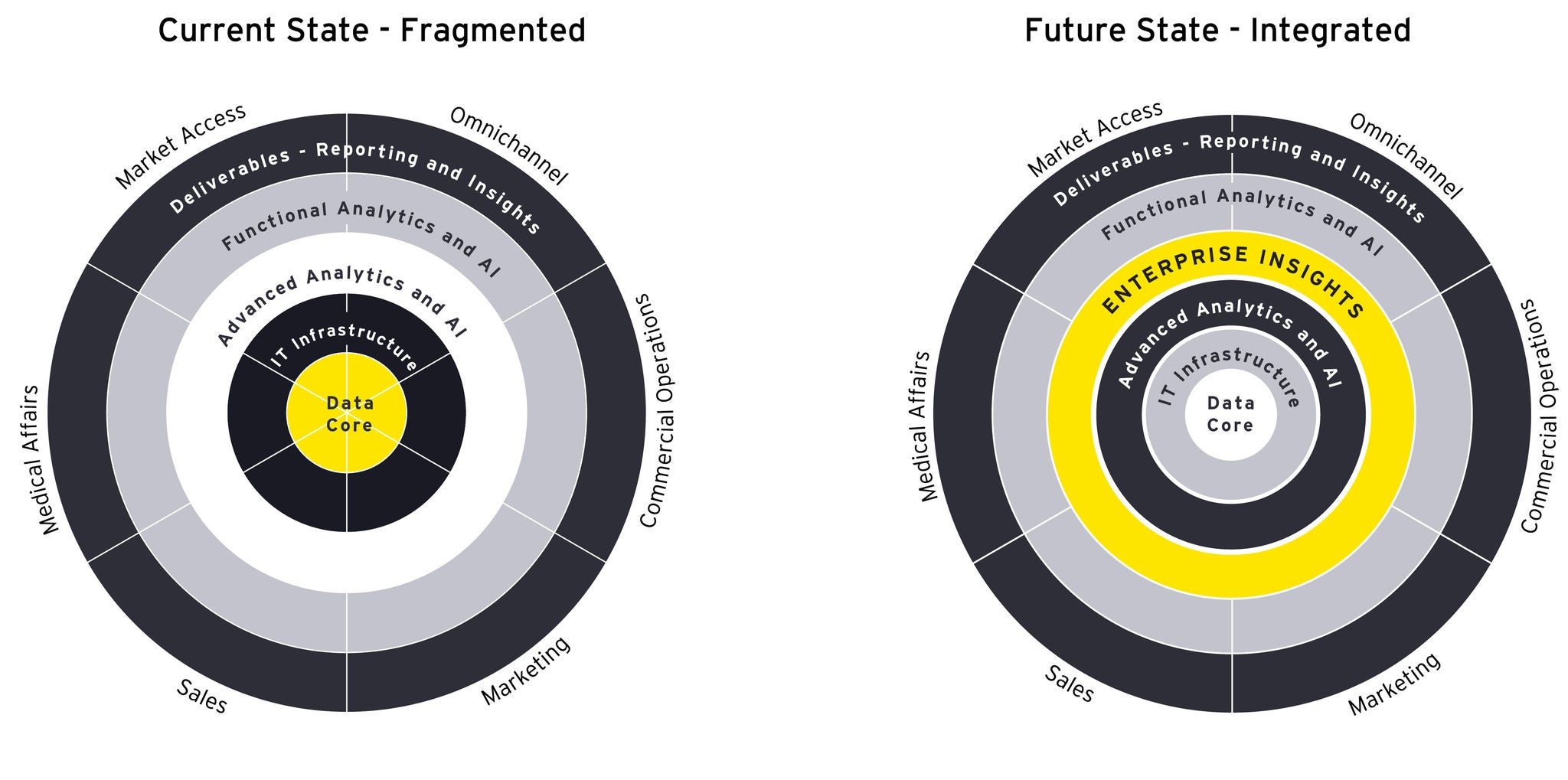
To unlock the technologies’ full potential, pharma companies must strategically shift from a “fragmented” data and AI infrastructure to an “integrated” model (see graphic below). The integrated state centralizes enterprise insights at a higher level, using an enhanced advanced analytics and AI capability and a strengthened IT infrastructure connected to a centrally unified data core. This indicates a shift away from silos for better cross-functional collaboration and insight generation, a transition that aims to enhance decision-making and operational efficiency through a comprehensive, interconnected data environment. Furthermore, this framework can retain the functional/local analytics capabilities required for informed decision-making for each functional area. 

As companies embrace this integrated approach, creating an ethical AI framework for pharma commercial organizations will be a key consideration for life sciences companies.14 According to the 2024 EY survey of 100 life sciences CIOs in the US, 41% of organizations with and without a center of excellence are leveraging a decentralized AI governance model. The top concerns indicated were a lack of data/infra platform, data security and intellectual property protection, and compliance, ethical and legal risk.15

Leveraging integrated data and AI infrastructure for better insights and enhanced decision-making

ey-chart-1-Enabling-pharma

Commercial capability assessment to achieve enterprise-wide transformation


To achieve a commercial transformation in an increasingly complex market landscape, pharma companies need robust, integrated commercial capabilities. A capability assessment framework can help organizations in this respect. The framework shown here outlines the components necessary for success across seven key functions: marketing, omnichannel, sales, insights and analytics, market access, commercial operations and medical affairs. By using a framework like this one to evaluate and strengthen these areas, organizations can optimize their go-to-market strategies, enhance customer engagement and drive business growth. Each of the following functions plays a vital role in enabling commercial success and transformation within the pharmaceutical industry:

  • Marketing encompasses strategic brand development and targeted customer engagement through tailored content. It leverages data-driven insights and technology to optimize campaigns and manage agency partnerships for effective brand promotion and market penetration.
  • The omnichannel function focuses on strategic, persona-driven customer engagement through tailored customer journeys, using technology for seamless execution. It prioritizes agile, personalized content development and robust data analysis to optimize the customer experience and measure and monitor success in an omnichannel approach. It also helps develop collaborative teams to adopt new, omnichannel ways of working and deliver outcomes consistently across key capabilities.
  • Sales capabilities include an understanding of the market or customer, account management and deployment planning. The function focuses on proactively monitoring competitive and regional dynamics (e.g., prescribing behavior, demographics), driving informed account management and field force deployment decisions. Sales execution emphasizes data-backed, customized engagements to connect customer needs with internal capabilities so that sales teams are equipped to navigate competitive landscapes and build strong customer relationships, driving sales growth.
  • The insights and analytics function establishes a robust data strategy to guide the organization’s AI and analytics efforts, data capture and processing; develops advanced forecasting and predictive marketing models; and creates user-friendly data visualizations for efficient consumption. It also implements data governance to effectively align people, process and technology.
  • The market access function focuses on strategic pricing and contracting to optimize revenue and establishes comprehensive, personalized patient-centric support programs and innovative partnerships that enhance market differentiation. It leverages payer insights to shape access strategy development and generates pre- and post-launch evidence to facilitate successful product promotion and market penetration.
  • Commercial operations encompass strategic planning driven by market insights, efficient field operations to optimize sales performance and comprehensive commercial training for compliant, effective engagement. It also handles strategic meetings and events to build relationships and generate sales opportunities for maximizing market reach and driving commercial success.
  • A robust medical affairs capability focuses on strategic medical planning, efficient enablement and execution management (including risk and compliance, data analysis and talent acquisition), impactful KOL engagement and scientific exchange, and comprehensive evidence generation and clinical trial support to drive scientific leadership and patient outcomes.

To execute an efficient commercial transformation, organizations need the right talent equipped with evolving skills and thorough training to navigate the complexities of the changing landscape. Investing in upskilling and attracting people with the requisite capabilities are crucial for realizing the full potential of commercial transformation initiatives.

Transformation at the therapy area and portfolio levels

With technology underpinning sweeping changes in commercial organizations, companies must carefully evaluate their strategic choices and trade-offs at the portfolio and therapy area levels as their portfolios evolve. These include:

  • New and emerging science: assessing existing and new infrastructure capabilities to develop products
  • Overlapping patients and indications: identifying opportunities to expand within existing assets or into new indications
  • Overlapping treaters and prescribers: identifying the potential to deepen or expand presence using existing provider relationships and networks
  • Customer engagement models: evaluating requirements to build new customer engagement strategies or capabilities to reach new customer types or leverage the existing field force and engagement structure to expand
  • Opportunity areas: identifying areas with remaining unmet needs within and outside portfolio areas

A structured approach to assessing these choices and trade-offs can help shape future objectives and investment priorities. By doing this, a pharma organization can understand the key gaps in their capabilities while identifying unaddressed complexities. This will help them develop a well-informed future capability roadmap.

Components of a successful commercial transformation

To navigate the complexities of commercial transformation, organizations must take decisive actions that align with their strategic vision. The following vital steps are helping pharma companies enhance their operational effectiveness and drive meaningful change, positioning themselves for successful commercial transformations:


Article includes contributions from Tanushree Jain, Associate Director, Clients & Industries, Ernst & Young LLP (India), and Ramya Korada, Supervising Associate, Clients & Industries, Ernst & Young LLP (India).


Summary

Pharmaceutical companies are compelled to transform commercially in response to dynamic market conditions. The integration of cutting-edge technologies, such as AI and machine learning, is pivotal for transforming commercial functions within the pharmaceutical industry. These innovations facilitate data-driven decision-making and enhance customer engagement strategies. To achieve enterprise-wide transformation, companies must conduct thorough assessments of their commercial capabilities, evaluating key functions like marketing and sales. This process helps identify gaps and synergies, fostering collaboration across departments. By focusing on these areas, pharmaceutical organizations can optimize their operations, drive growth and respond effectively to the complexities of the market landscape.

About this article

Authors

Related articles

Drive commercial success by effectively navigating loss of exclusivity

Pharmaceutical companies facing patent expiration must carefully craft the right brand strategy to increase value. Learn more.