EY helps clients create long-term value for all stakeholders. Enabled by data and technology, our services and solutions provide trust through assurance and help clients transform, grow and operate.
At EY, our purpose is building a better working world. The insights and services we provide help to create long-term value for clients, people and society, and to build trust in the capital markets.
How data and AI enable utility operations resilience
EY and Microsoft leaders discuss utilities progress in technology adoption and how to convert these investments into value.
As the utilities sector faces increasing demands for efficiency and innovation, the convergence of IT and operational technology (OT) presents valuable opportunities and significant challenges. Industry leaders are exploring how to leverage data integration and artificial intelligence (AI) to enhance their organizations’ operational capabilities and drive value.
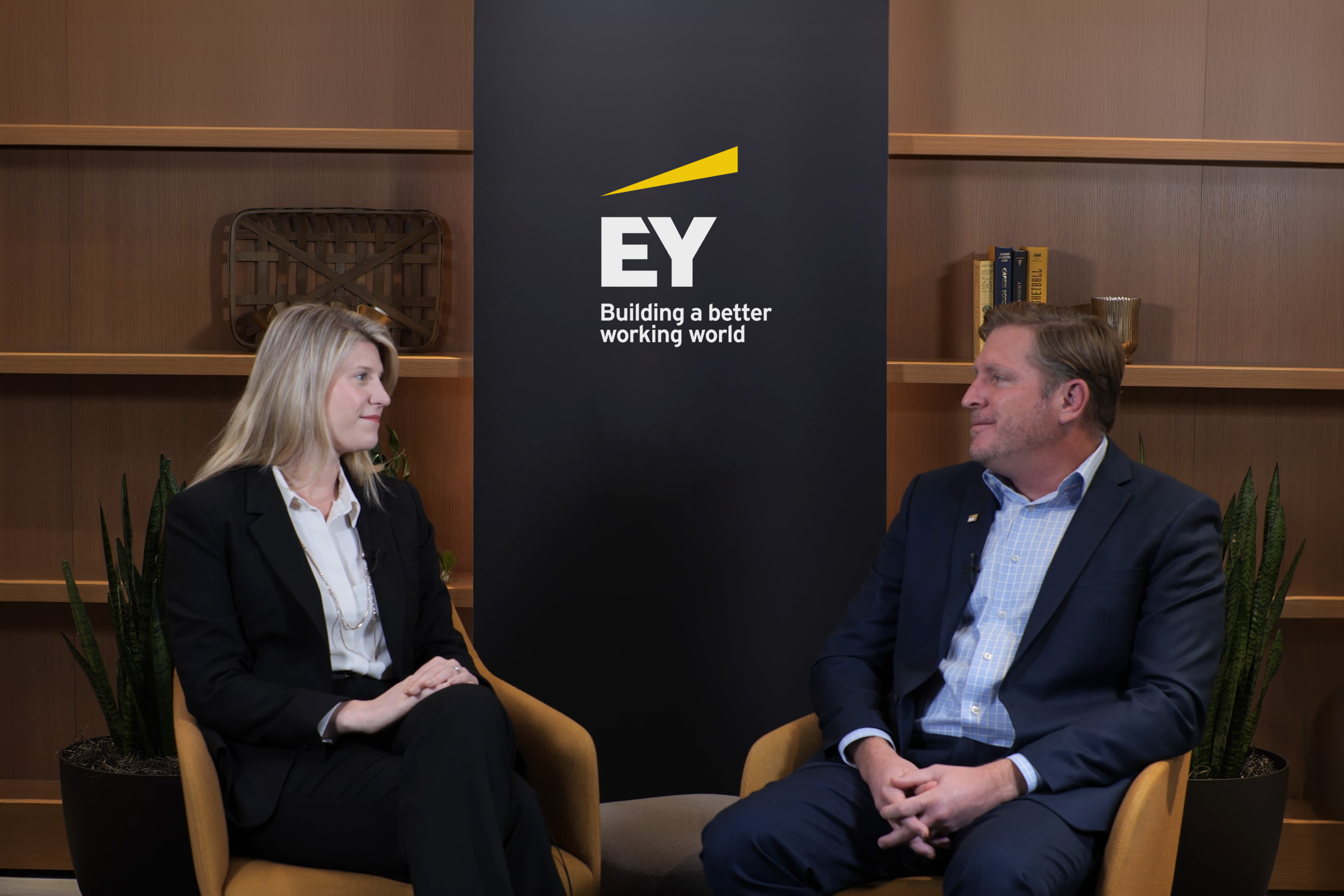
In this conversation, Pat Lo (Power and Utilities Industry Advisor, Microsoft) and Ryan Levine (EY Americas Consulting Power & Utilities Leader) discuss the significance of this convergence, the role of AI in transforming utility operations and the importance of looking beyond traditional industry boundaries for solutions.
Q: What opportunity are you seeing with the rise of operational technology out in the market today?
Historically, Microsoft has been in a lot of conversations with IT.But the main thing we’re noticing really is the IT and OT convergence.
Another thing coming back is: How can I get more value generated with these systems? I keep saying, “How do we get more value out of these OT systems?” And it’s going to be data. It’s probably no surprise right now that with a lot of these software systems, they kind of run independently and on their own. So, data is siloed. And the business will say, “Well, I need my AMI [advanced metering infrastructure] data to talk to my DMS system [distribution management system]. How do we do that?” And so that’s where Microsoft has really been focused in on and dialed in on — how do we just work with you on not only migrations but unifying your data all together?
Q: What are some of the challenges you’ve seen at utilities you have supported, and what are you solving for with them?
From a utility standpoint, there’s consistently the degree of how they prove the prudence in these investments. You talk about some of those large-scale operational technologies. Well, those are large-scale capital investments that utilities are making. And one of the things that we’re doing in collaborating with them is leveraging some of the power that we’ve actually collaborated with Microsoft in building an AI rate case analyzer that really helps the utility work through all the filing aspects and the interrogatories and the documents they have to go through. It takes out a lot of time and effort and improves their efficiency and actually ultimately improves the accuracy of what they build into that rate filing to actually help them operationalize things. So you can start to find that convergence across those OT systems underpinned by a really strong regulatory filing. That’s a big area where the EY organization is really supporting in collaborating with our utilities.
Q: How has generative AI been helping accelerate this entire process itself?
Historically, the AI has been more around artificial intelligence and machine learning building on large-scale big data models. That’s been going on for the last decade or so. With generative AI, it’s really allowing folks that haven’t really engaged in that space to get involved in leveraging and using those AI tools to actually help them with their day-to-day job.
There’s a great example where we’ve built an AI tool on Copilot that actually helps engineers pull up the right standards that they require as they’re actually going through and designing and building some of their large-scale capital construction jobs. This not only saves time but also improves accuracy. It actually gets the business and the engineering side of the house really excited about the use of what technology can actually offer them in their day-to-day life.
Q: If you had just one takeaway for utilities, what would that be in the concept around AI today?
When I was in the utility sector, I had the utility blinders, the utility lens on. But coming to Microsoft, we work with retail. We work with telco. We work with manufacturing. A lot of the problems that utilities are trying to solve today have been solved already. And so it’s not a far stretch of imagination that can be done. I think what the utilities could really take value in is just looking outside the industry. And that’s one of the commitments for Microsoft as well.
Utilities are really good at leveraging their lessons learned from each other, so why not look outside the industry?
There’s a race to show the value and proof of generative AI in their day-to-day operations. But I also think there has to be a parallel path that utilities should really focus on how they build scalable architecture that actually allows them to get to that pace. Because if they’re building use case by use case, you’re limited by the imagination and the idea of the individual themselves. But if you start to build the scalable architecture, you can actually start to decentralize and actually allow others to get involved in the creation of these use cases. And it just speeds up the value for it, for the utility and how they serve their customers, their communities.
Key takeaways
Leaders should recognize the transformative potential of data integration and AI as the utilities sector embraces the convergence of IT and OT. By focusing on unifying systems and leveraging AI tools, utilities can enhance operational efficiency and improve regulatory compliance. Additionally, looking beyond the industry for solutions can result in valuable insights and strategies. To maximize the benefits of these advancements, utilities should prioritize building scalable architectures that foster innovation and collaboration.
The EY and Microsoft insights shared highlight how critical adaptability and forward thinking are for utilities navigating the evolving landscape of the sector.
The views of third parties set out in this publication are not necessarily the views of the global EY organization or its member firms. Moreover, they should be seen in the context of the time they were made.
Dive deeper into how technology is helping utilities create value
Watch the webcast featuring EY and Microsoft leaders.
Data-informed, technology-enabled and people-centric solutions around AI and the energy transition can drive profitability and sustainability. Here’s why.