


EY refers to the global organization, and may refer to one or more, of the member firms of Ernst & Young Global Limited, each of which is a separate legal entity. Ernst & Young Global Limited, a UK company limited by guarantee, does not provide services to clients.
Recent Searches

A potential move to semiannual reporting and how to adjust guidance to the Street amid current volatility are top-of-mind for CFOs.
In brief
- Over 20 Fortune 500 CFOs are largely undecided about a potential SEC change to reporting, since quarterly data can be vital for investors.
- AI is delivering measurable gains in finance, but CFOs are starting to project its long-term cost against long-term expected value.
- Traditional career pathways in finance will demand development of new skills, particularly to understand the business and its operations.
To help push AI experimentation into transformation in 2026, CFOs are taking a leading role to translate productivity gains into real impact and metrics, as well as to address data readiness, operating model changes and adoption at scale throughout finance. And as their capabilities mature, two challenges demand attention:
- The long-term cost implications of AI
- The fact that automating low-level tasks eliminates educational opportunities for new hires, rupturing the traditional finance career model
Meanwhile, geopolitical tensions are upending financial forecasts, and the SEC will soon propose changes to its reporting mandates. Amid such uncertainty, over 20 Fortune 500 CFOs talked over how they are advancing their agendas, across two roundtables hosted by the EY Center for Executive Leadership.
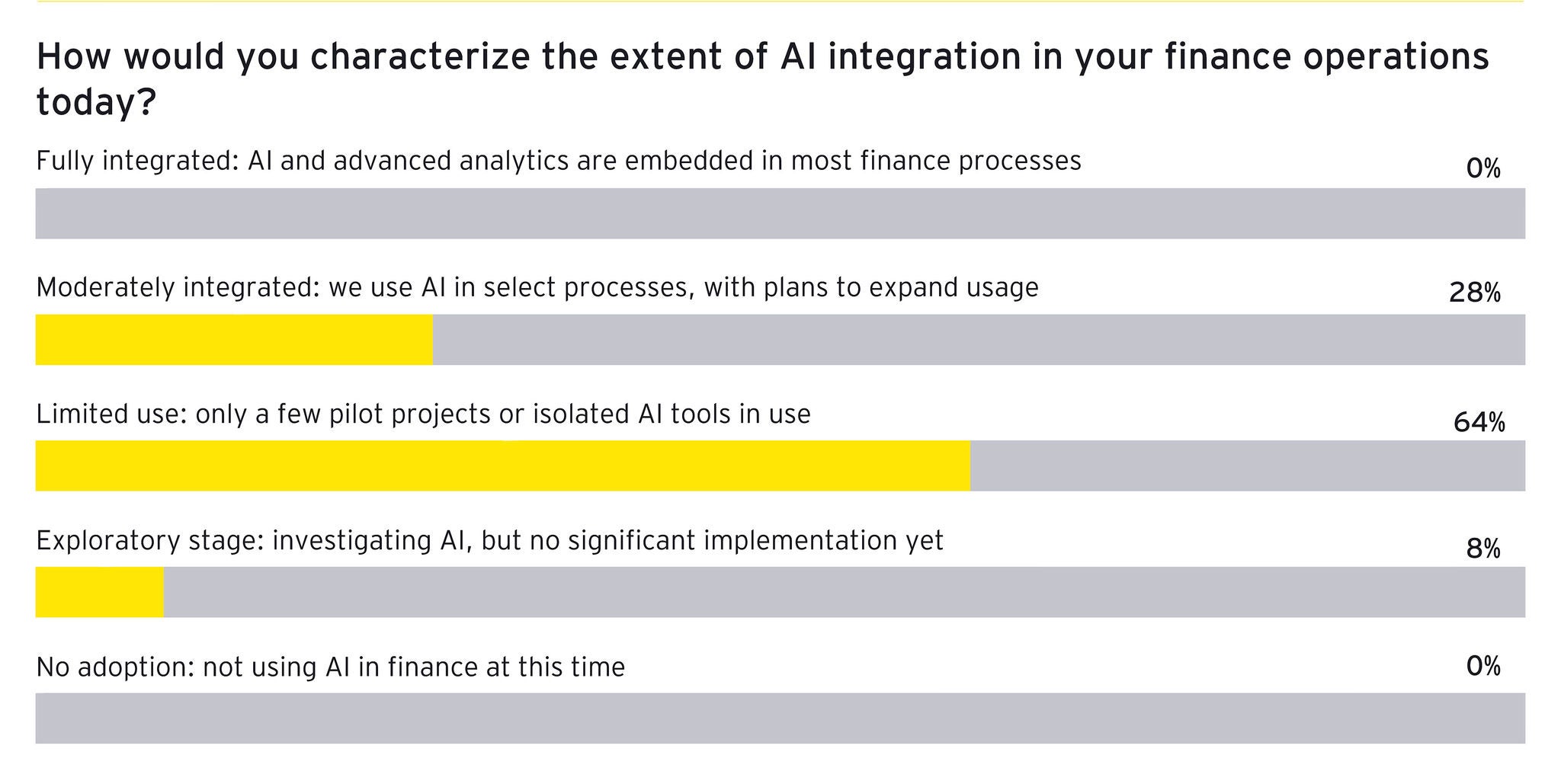
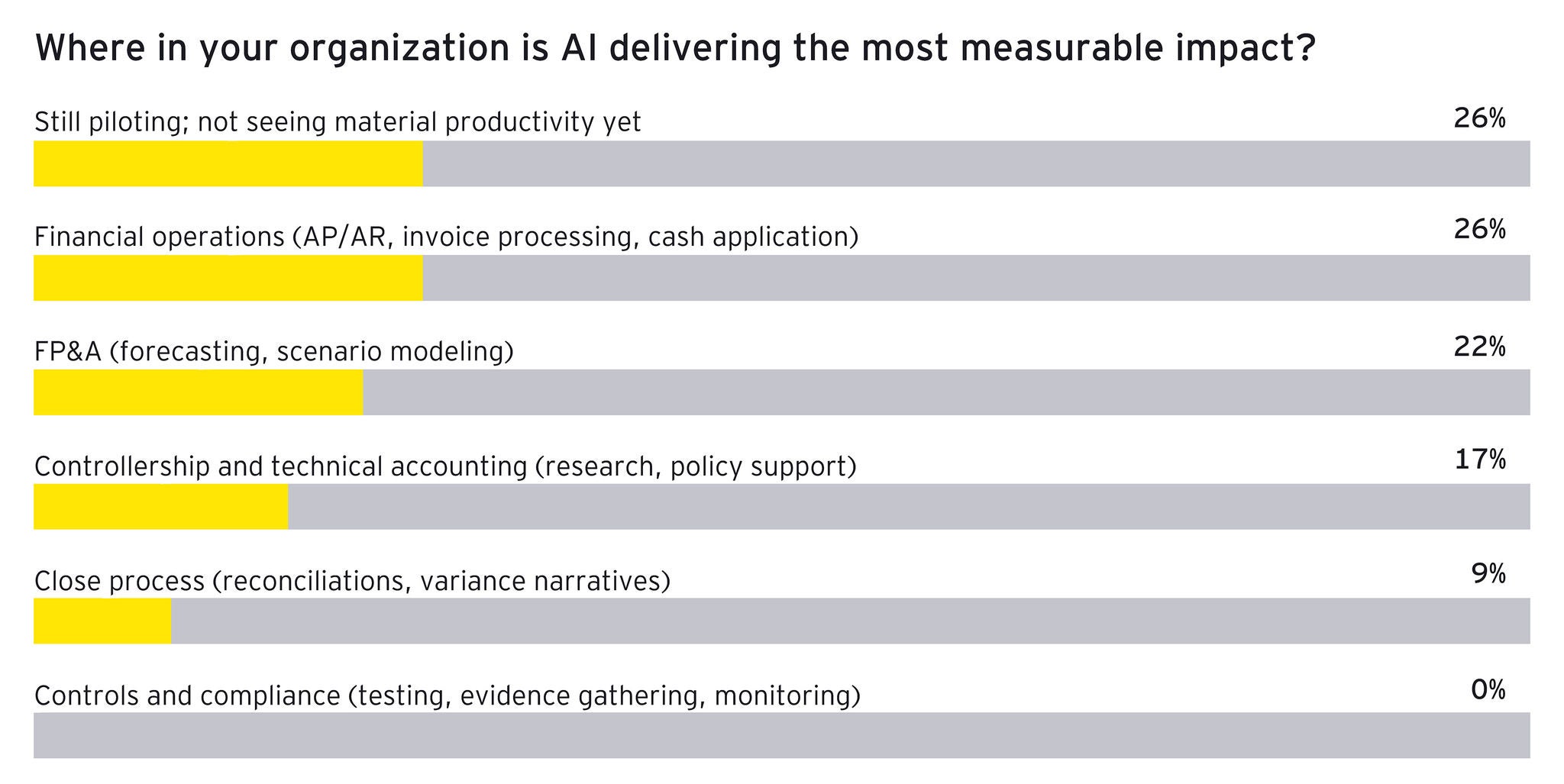
Taking into account similar CFO discussions over the last 12 to 24 months, we continue to see progress on AI across the finance function. While about 70% of CFOs are still in pilot projects, almost 30% have reached a moderate level of integration across a number of finance processes. And about 75% of executives can already point to measurable impact from AI in areas such as finance operations, FP&A, technical accounting and the close process.
1
Chapter 1
Semiannual reporting and market guidance
The SEC’s expected proposal allowing semiannual reporting, combined with level of uncertainty, encouraged CFOs to rethink the norms of how they report and provide guidance to the Street.
In 2025, President Trump encouraged the SEC to consider changing its periodic reporting requirements from a quarterly to a semiannual cadence, with a proposal expected soon. “This will likely be a voluntary framework, and there’s been mixed reaction in the markets,” says John Hallmark, EY US Political and Legislative Leader. “Investors are saying this will raise the cost of capital and exacerbate information asymmetries. Those issuers who support an examination of this cite lowering costs and lowering pressure on short-term earnings. And smaller companies perhaps want a longer onramp to being public.”
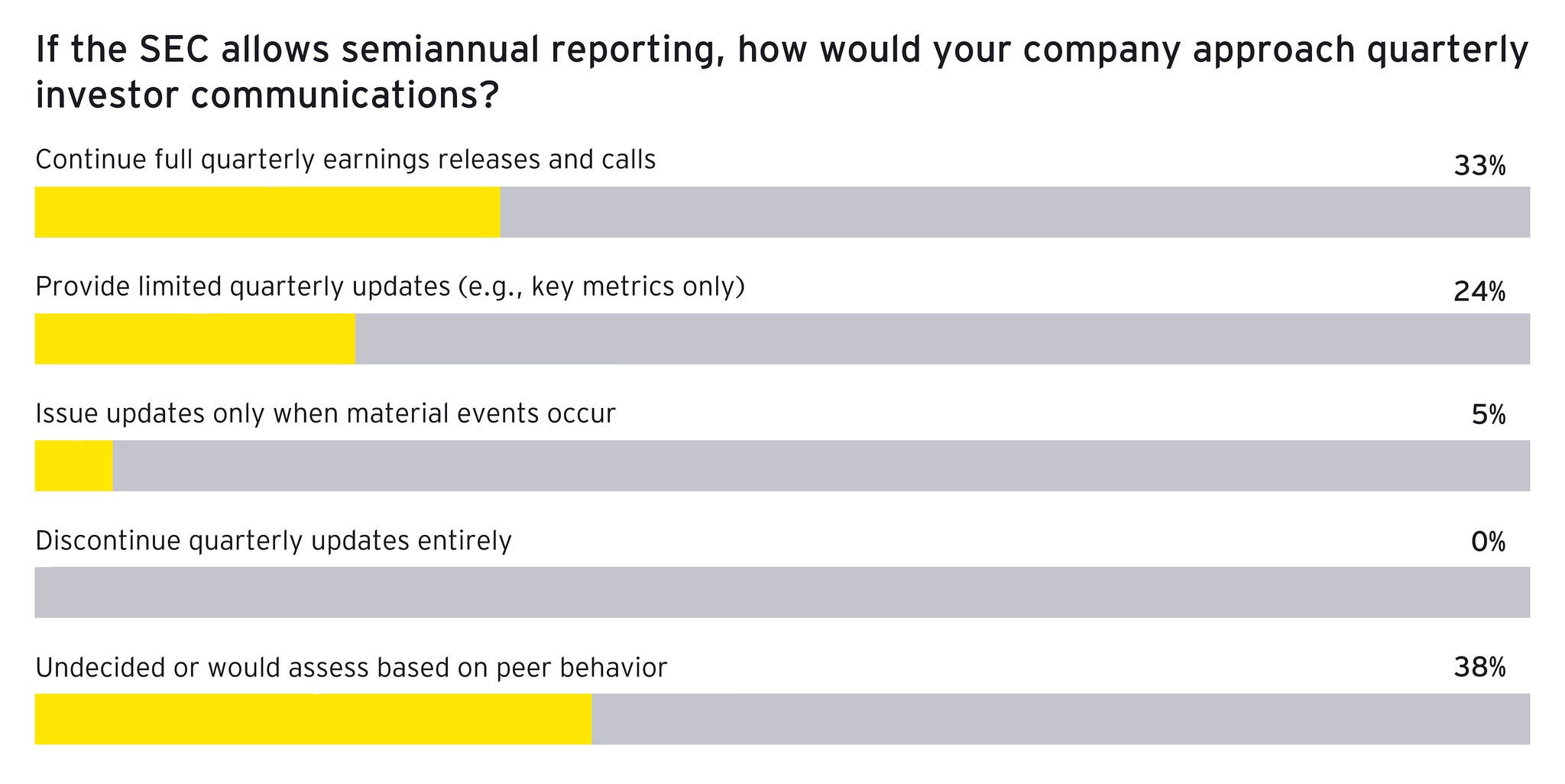
CFOs in our roundtables were largely undecided on the topic, with almost 40% looking to get more details about the proposal and waiting to define a path. Around a third stated that they would need to maintain an ongoing cadence based on investor expectations and other considerations, including the discipline and rigor that quarterly reporting creates. Nevertheless, about 30% would pursue some type of changes but mostly still provide some quarterly updates. “If there’s a path to not do a 10-Q every quarter, that could be useful ... but providing regular supplements is what we’ll continue to do,” a CFO of a large software company said.
A CFO in semiconductors was one of many who saw value in the “muscle memory” of quarterly reporting, especially when the internal 90-day cadence would persist. “If you decrease the frequency, you increase the possibility of mistakes,” he said. Others believed that their investor bases left no choice but to continue with business as usual. “We see value in the transparency of the conversation,” a leader in the tech industry said. “If you broaden that out to a six-month period, you’re leaving a lot of white space there for interpretation.” In such an environment, trying to secure more capital would likely reach a dead end.
The temporary nature of rules in the modern political era presents its own concern. Presidents increasingly rely on executive orders, which can be easily overturned by the next administration, rather than working with Congress to enact laws, Hallmark noted. Why bother pursuing an entirely different reporting regime if it won’t pass regulatory muster in two years?
Nonetheless, CEOs and other C-suite leaders may have their own thoughts, weighed down by dealing with investors focused on the short term, highlighting the separate issue of how organizations offer guidance to the market. The CFO of an airline who was more focused on semiannual reporting said: “It’s an extra tax on the management team and the board to think about long-term strategy and then have to respond to questions about next week. It’s our basic thinking to try to get everyone focused on the long term again.”
The flipside is that “the absence of information is filled with dirt,” as one CFO of a health insurer said. “If you don’t tell your story then one will be told for you,” another leader at a transportation services company noted. “I don’t want to tell our story less.”
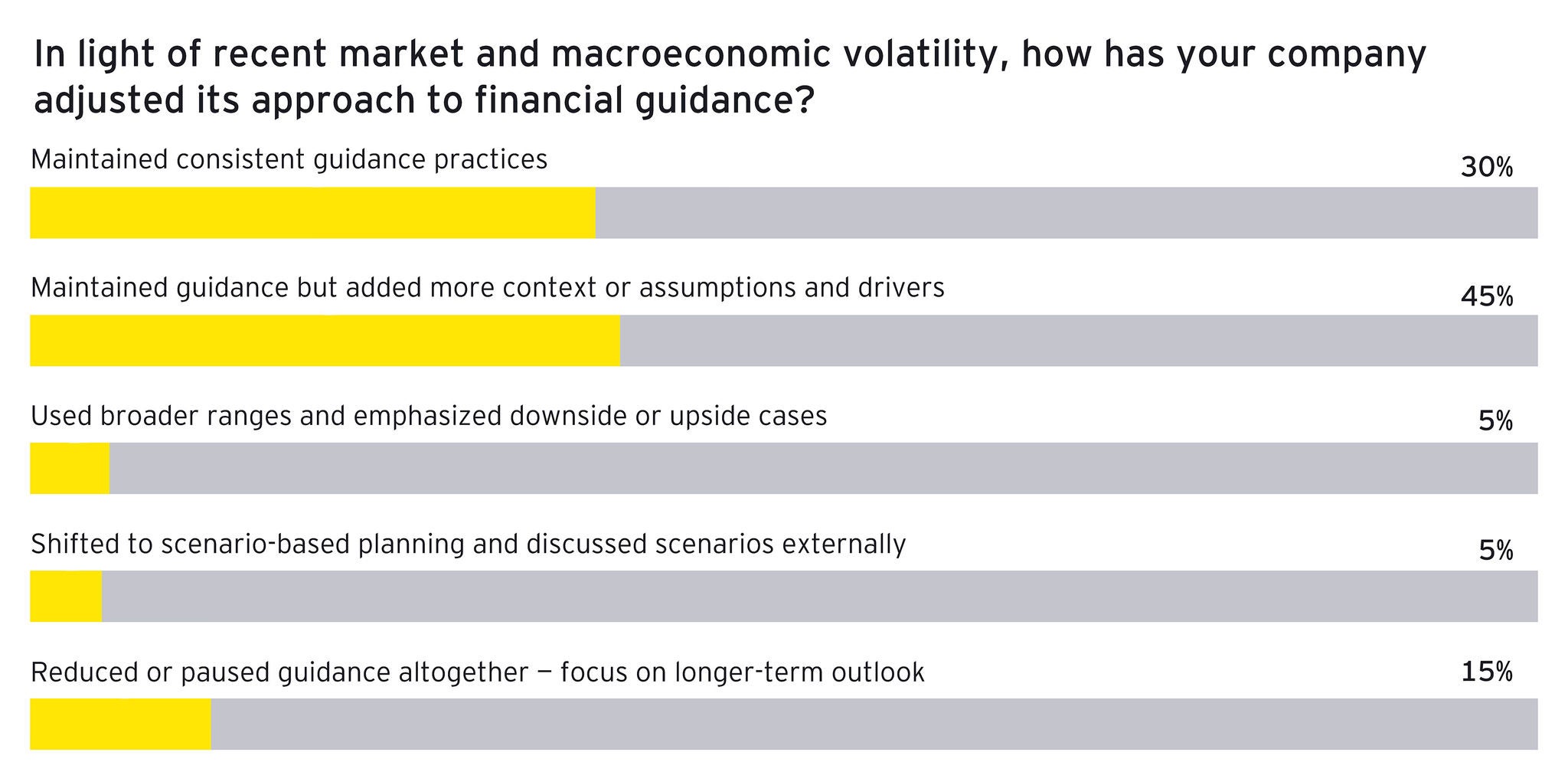
These are issues that CFOs are navigating today, with increased uncertainty in the economy and geopolitical environmental nudging them into providing more sensitivities, qualitative views and frameworks for understanding market realities. “We provided more supplemental information underpinning our guidance,” the CFO of a tech company said. “We’re providing help to the investor community on how we’re seeing the underlying market and frankly giving them a framework — like ‘if production came out better, it would look like this.’ That was well-received.”
This has opened the window for new ways of engaging with the Street while also potentially stepping back from quarterly reporting. “We are filing like a 10-K that’s 100 pages on a quarterly basis, and no one is even seeing part of it,” a pharma CFO said. “You could tell your story with rigor on a quarterly basis, while maybe eliminating a few steps on quarterly reporting with a lot of work. Instead of us reporting back small deviations in small lines, we give more perspective to the strategic views of the company. It allows us to focus on the right things.”
As the SEC prepares its proposal, CFOs should be prepared to discuss this topic with their CEOs (if they haven’t already). Clarify what’s vital to retain and what can be rethought, and explore the difference between what would be mandatory reporting and the key metrics that they may maintain with the Street on a quarterly basis. A potential alternative: Show high-level key metrics around growth, earnings per share, and working capital and cash flow quarterly while revealing the rest of mandatory requirements twice-yearly.
2
Chapter 2
AI: CFOs trying to put together the pieces in the cost/benefit puzzle
AI FinOps” and governance weigh heavily on the minds of our executives as they look at scale up AI and transform the cost equation in their organizations.
The technology evolves so quickly that just keeping up with the discourse can feel like a full-time job on its own. Traci Gusher, EY Americas AI and Data Leader, set the stage with three debates about AI that she’s hearing in C-suites today:
- The total cost of ownership of AI. As AI consumption bills roll in, CFOs are struggling to understand the cost/benefit equation — what Traci and CFOs would call “AI FinOps” — at a time when capital is precious. The equation for AI work includes: the price per token, the underlying data stores and platforms used, the compute cost for them and the licensing of tools. And the type of application creates a lot of variation. For instance, software development doesn’t require a ton of tokenization, but it does to replace human workers with AI agents in a massive call center.
- Purposefully built AI architectures. A prominent telecom company published a paper showing that it slashed its AI costs by selectively deploying small language models rather than large language models (LLMs), showing that organizations have some levers to pull on cost when they understand what their goals are. Individual users are also typically not given guardrails and therefore use AI entirely at their discretion. Agentic tools from vendors may start free but then could spike in cost, while potentially locking organizations into legacy processes.
- The process component. CFOs are seeing value that doesn’t significantly impact P&L statements because their crowdsourced use cases target individual employee productivity gains, not transformation. “Many leaders are looking at their processes with tech debt, process debt and talent debt and using AI as a bolt-on to fix them,” says Gusher. “The biggest value is in getting to the outcome and redesigning to process from scratch to enable it. Instead of giving tools to financial analysts to make them more productive, why not redesign FP&A with an AI-first approach?”
“I’ve heard firsthand about such an approach for journal entries,” says Juan Uro, EY Americas Leader for The Center for Executive Leadership, who facilitated the discussion. “It involved an entirely new process and a custom app, connected to an ERP. The code was written by a 26-year-old who knew nothing about accounting, and it resulted in much fewer reclasses and more people looking at the right things. It also took $10 million out of the budget. ”
CFOs understood the potential but also were forced to tread cautiously on governance, especially as “vibe-coding” increasingly enters the mainstream. “We have no idea what the governance model is: who owns the code, who maintains it or what does IT do — we’re not ready for that,” one CFO said. Navigating those concerns while also moving ahead assertively is a tough balance. “We have to figure out how to turn this model around,” a CFO in oil and gas said. “I can’t have IT reviewing every line of Python. The command-and-control model isn’t going to work going forward.” Gusher emphasized that agentic AI, while separate from AI that augments human workers, acts just as employees would and therefore would fall under similar governance models.
Task a transformation finance team with redesigning processes, data strategies and org designs to avoid duplication of work. This team should be multidisciplinary: accountants, naturally, but also engineers and technologists. Go deep, not broad, to reinvent an entire area with a new process.
3
Chapter 3
Talent: In search of the new finance talent pipeline — and career path
If AI replaces thinking and awareness, then human workers are surrendering their true advantage — and workplaces will suffer.
Executives were worried about the potential unintended AI impact of knowledge loss, amid early evidence that entry-level tasks would disappear yet higher-value insights would remain necessary.
“I’m not concerned about rote financial reporting,” one CFO said, “but we have smart people who don’t know anything about the business. You used to get it during regular process work during close and that’ll be gone.” Another leader at a department retailer echoed that view: “I’m totally concerned about pipeline of talent. We’re skipping over the beginning and going right to the middle. And I don’t know how long the universities will need to catch up.”
But as AI presents a challenge, it also presents several possible solutions. “I’m thinking in the next two years we’ll have to set up a process with an LLM to indoctrinate new talent on how business works, not how AI works,” one participant said. With 15 years of experience in AI, Gusher built a four-week training program to better understand semiconductors and GPU technology: “I get a curriculum, a class every day. If you fast-forward that into an enterprise, we will be able to use agentic systems to train people on our business as we capture more of our decisions.”
Deirdre Ryan, EY Global Finance Transformation Leader, outlined the four B’s of the future of work:
- Buy — Acquire the talent for an AI factory (which is costly).
- Build — Upskill and reskill your current workforce.
- Borrow — Tap into a contingent workforce.
- Bot — Automate the skills you need.
“I know there will be a lot of compute capacity, and the models will work themselves out, so I put most of my thought on the people side of things,” a CFO in oil and gas said. “We mapped out the characteristics and skill sets now and what that looks like going forward. Having a strong people plan will work things out in the end.”
Accept that, independent of AI, today’s finance roles differ from those of 10 and 30 years ago. Be intentional about orchestrating different experiences that complement automation wherever the most value exists in your organization. Through education, AI can present its own solution to the possibility of cognitive offloading.
Summary
CFOs expressed mixed and cautious views on the potential shift to semiannual financial reporting if the SEC allows it, emphasizing the discipline and “muscle memory” of quarterly reporting. While most finance organizations remain in early stages on AI, leaders are seeing the value and are increasingly focused on process redesign, governance and people strategies to convert AI potential into durable value.

How EY can help
-
Helping top leaders to achieve peak performance, professionally and personally, by providing insights and networking opportunities.
Read more