Economic transformation is less a single breakthrough than a cumulative process. The challenge, therefore, is not whether AI will reshape the economy. It almost certainly will. The more important questions are how, where and over what horizon. Understanding those distinctions is essential for separating genuine long-term potential from overly ambitious short-term expectations.
Misconception #1: AI will immediately generate a productivity boom
The assumption that AI will immediately generate a surge in productivity is difficult to reconcile with economic history. Major technological revolutions rarely produce economy-wide gains overnight. It took nearly a century for the steam engine to translate into sustained productivity growth in Britain, roughly five decades for electricity to reshape industrial production and close to a decade before the computer revolution produced measurable improvements in aggregate productivity.
The first stage of any technological revolution is the buildout of the infrastructure that enables it. In the case of AI, that means expanding data centers, semiconductor manufacturing, electricity generation, cloud computing capacity and digital infrastructure. It also requires developing the talent needed to deploy and manage these technologies before they can diffuse across the broader economy.
It’s crucial that firms redesign business processes, reorganize production, retrain workers, adapt management practices and rethink operating models. Early adoption is therefore often characterized by implementation costs rather than productivity gains. Productivity frequently follows a J-curve, with the costs of adjustment arriving first and the benefits emerging only gradually as organizations learn how to deploy new technologies effectively.
That historical pattern is worth keeping in mind because much of the recent improvement in US productivity is not yet an AI story. Rather, it reflects a post-pandemic adjustment. Faced with higher financing costs, labor scarcity and elevated uncertainty, businesses have spent the past several years becoming more efficient through organizational streamlining, stronger workforce retention, targeted training and more disciplined capital allocation. In a higher cost-of-capital environment, firms have also become more selective, focusing investment on projects with clearer and higher expected returns.
AI will likely reinforce productivity over time, but the pace of economy-wide gains will likely depend less on technological breakthroughs than on how quickly firms reorganize production, develop complementary skills and integrate AI into their operations.
For business leaders, the priority should be to set realistic productivity expectations and focus on the organizational changes that unlock value. AI creates the greatest competitive advantage when firms redesign processes, redefine roles and rethink operating models rather than simply layering new technology onto existing ways of working.
Misconception #2: AI is nearly free
The assumption that AI adoption is inexpensive overlooks an important economic reality. Unlike traditional enterprise software, AI carries a meaningful marginal cost every time it is used.
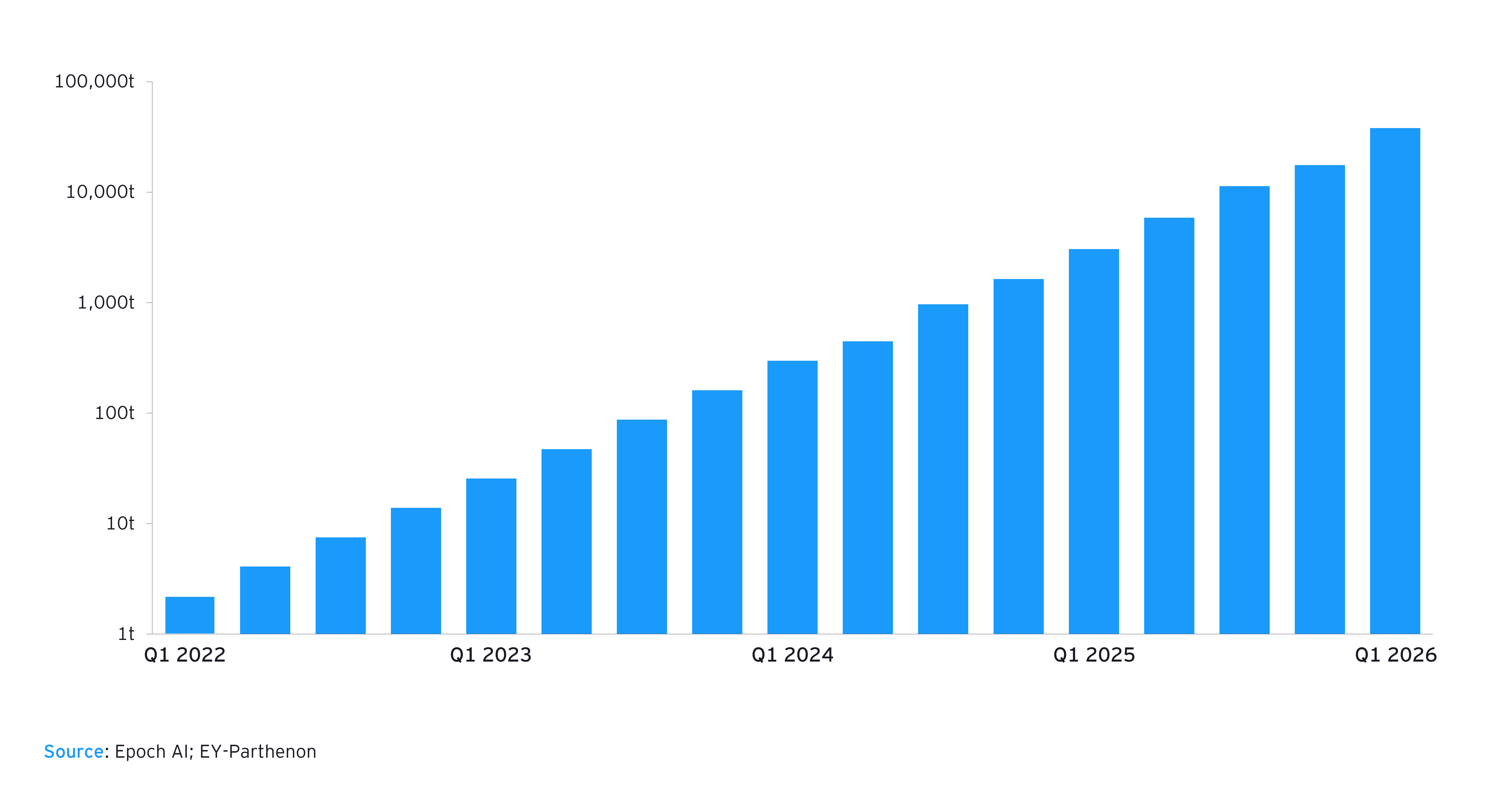
For many businesses, the initial investment on licenses, infrastructure and training is only the beginning. Every prompt consumes tokens, computing power and electricity. As AI becomes embedded across organizations, costs accumulate rapidly, transforming AI from a one-time technology investment into a recurring operating expense.
Many early adopters are already discovering this reality. Several firms have reportedly exhausted annual AI budgets within months as employee usage exceeded expectations, prompting the introduction of token budgets, usage caps and tighter governance. At the same time, frontier AI providers continue to introduce more capable reasoning models whose greater performance often comes with higher token consumption and greater operating costs.
Tokens processed per quarter across all providers (log scale)
Q1 2022-Q1 2026