





Young married couple sitting on the floor in living room at house.

Why mortgage lenders should invest in home equity offerings

Lenders who invest strategically and adopt digital capabilities will attract more interest in home equity loans and lines of credit.


In brief
  • Homeowners face challenges accessing liquidity, presenting a substantial opportunity in home equity lending.
  • Home equity products have suffered from a lack of modernization; lenders who offer a simplified, expedited origination experience will gain an advantage.
  • Making the right decisions around people, processes, and technology will impact ROI on investments in home equity lending.

Buying a home is one of the most impactful financial decisions that individuals make in their lifetime. By building home equity, homeowners create an avenue to leverage capital, which can help them manage finances and debt, fund significant purchases, and invest in home improvements. However, the recent housing landscape has created challenges for homeowners seeking liquidity.

In 2021 and 2022 when mortgage rates were low, mortgage refinancing accounted for more than 60% of total home loan originations, according to Home Mortgage Disclosure Act (HMDA) data.¹ As mortgage rates soared over 7% in 2023, refinancing lost its allure to homeowners unwilling to relinquish their lower interest rate loans. Simultaneously, home equity values reached record levels. With the Federal Reserve Economic Database reporting $35 trillion in homeowners’ equity for Q2 2024 – which is near all-time highs, relative to mortgage debt outstanding – there is significant potential for growth in lending against outstanding home equity.2 The demand for borrowing against home equity has been further boosted by the lock-in effect from high rates driving home improvement as an alternative to moving, as well as increasing consumer debt from auto, credit card, and student loans. Furthermore, investor demand is growing, with an active secondary market for home equity loans and lines; any further focus from the government-sponsored enterprises (GSEs) on closed-end second liens could accelerate this structural change.

But substantial challenges in the industry remain. In this competitive environment, lenders who address their operational inefficiencies and enhance the customer experience will be the ones best positioned to capture an upswing in home equity lending.


Part of the struggle to meet consumer demand is grounded in the aftermath of the 2008 housing financial crisis and uncertainty from the COVID-19 pandemic, when a significant number of larger banks chose to pause or exit the home equity market. This retreat hindered modernization and stunted investment in home equity capabilities. On the banking side, outdated processing systems, extensive manual labor, and compliance requirements contributed to the product line being less profitable. On the customer side, the experience can be marred by cumbersome application processes that require branch visits, slow approval times, and a general lack of intuitive digital interfaces. To meet the needs of today’s homeowners, lenders should look to embrace technological advancements and innovative lending practices.


Leaders have modernized their home equity offerings in a variety of ways. First, they have digitized the client experience so the customer can seamlessly apply and close fully digitally (where allowable). Second, they have modernized their platform and streamlined their processes, cutting time to originate a HELOC by up to 80% — from one month to less than a week from application to funding.3 As a result, cost to originate has been drastically reduced. Third, they have opened capital markets flow to reduce balance sheet impact and improve profitability of the offering.


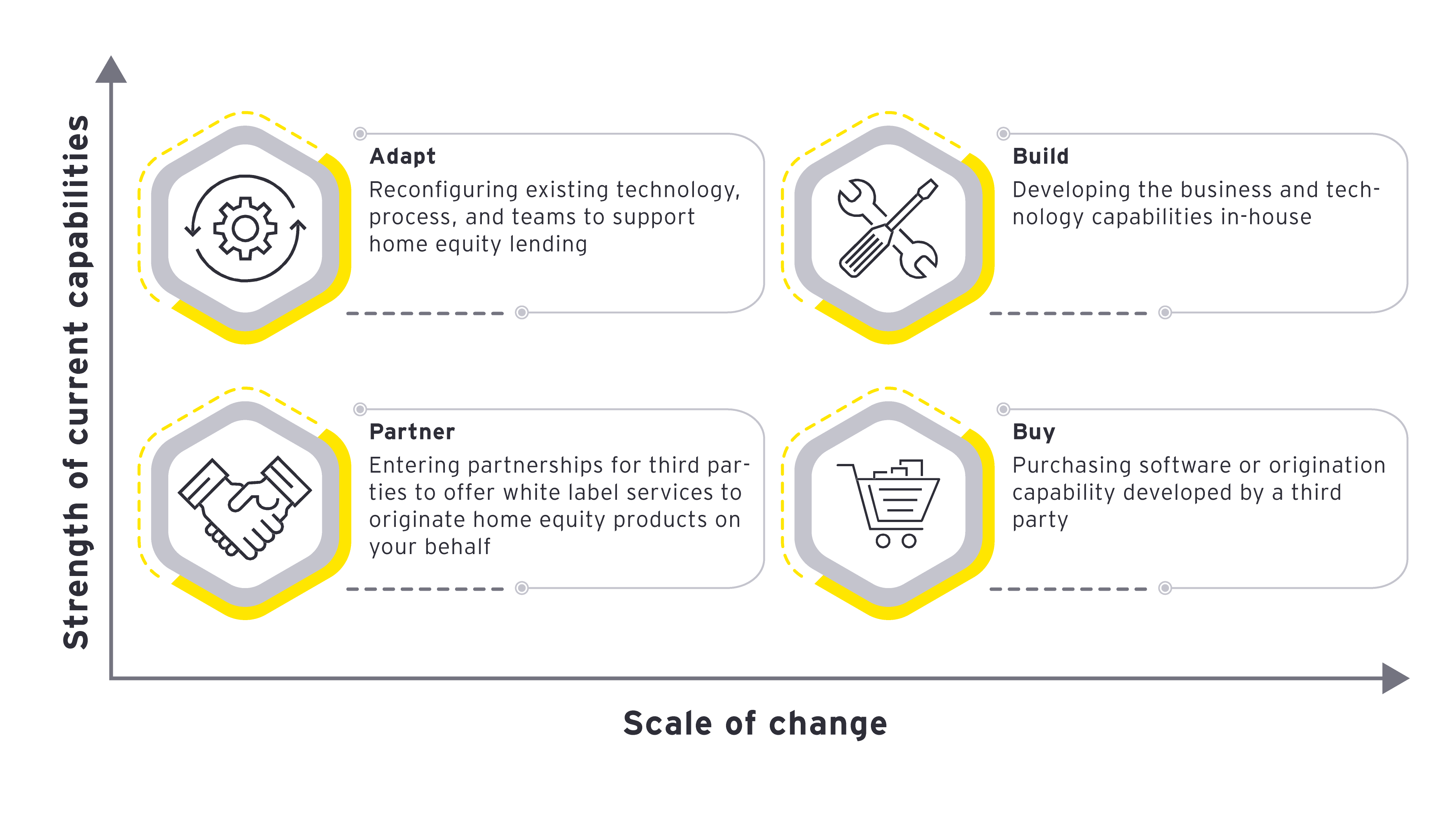
What is the right approach for lenders to enhance or launch their home equity offering? Banks and nonbank lenders have been facing a key strategic question on their operating model – should they build, buy, partner, or adapt their systems? The right option depends on the strength of the lender’s existing capabilities and willingness to invest in the origination process.

Scale of change

Build

This approach involves developing a new platform to support home equity lending. Given the investment required, it is typically only undertaken by tech-first lenders who seek to build a competitive advantage through their own offering, maintain control over developing a custom solution, and retain the intellectual property.

Buy

Many leading loan origination systems (LOS) have home equity offerings. The right LOS, combined with point of sale, can drastically reduce the cycle time and cost associated with originating home equity loans (HELOAN) or lines of credit (HELOC). Following implementation, personnel with the right expertise must be in-house to run the operation. It can be more cost-effective and result in faster speed to market, relative to building the platform in-house.

Partner

Top home equity lenders offer white label services to originate on another firm’s behalf. For many firms looking to offer a digital HELOC or HELOAN, this becomes the path of least resistance. This can enable originations with lower operational costs, with the trade off on customization of the process and experience. When partnering, key decisions must be made on which aspects of the offering the partner will control.

Adapt

Many lenders have recently revamped their loan origination system and supporting processes. Most major LOS can be configured to support HELOCs, particularly when paired with digital third-party solutions; the right scale is critical to a profitable offering. EY research indicates that most consumers prefer to execute banking transactions digitally. By providing a user-friendly interface accessible via online and mobile platforms, potential borrowers can easily apply for and manage their home equity loans and lines.

The above framework is not one size fits all, but common themes drive success regardless of the approach selected. First, improving lead generation allows lenders to capture more of the demand at a lower acquisition cost. Second, using modern technology is essential for quickly originating loans and lines of credit. Finally, a seamless, compliant customer experience is critical to avoid introducing undue risk. By strategically modernizing their operations and enhancing the customer experience, lenders will be prepared to capitalize on the growing demand for home equity lending.

Adam Williams, David Kaiser, Jonathan Pryor, and Daniel Yero contributed to this article. 

Summary 

Despite high home equity values, homeowners currently face challenges accessing liquidity. The opportunity in home equity lending is substantial, but outdated systems, manual processes, and risk/compliance concerns suppress lenders’ profitability with traditional HELOCs and create cumbersome experiences for customers. Lenders can gain a strategic edge by enhancing their capabilities through new partnerships, modern platforms, or performance improvement initiatives focused on streamlined processes and more effective use of data.

About this article

Authors

Related articles

How pursuing GenAI can transform mortgage lending

By applying GenAI innovations across the lifecycle, mortgage lenders can gain a strategic advantage. Learn more.

How can financial institutions modernize their fair-lending practices?

FIs that disregard fair banking are lagging behind FIs that enhance compliance procedures, lending models and data analytics to become more compliant. Read more.

Modernize your mortgage lending platform

Banks that undergo lending platform modernization can provide customers mobile-accessed, data-driven, digital, holistic mortgage borrowing experiences. Read more.