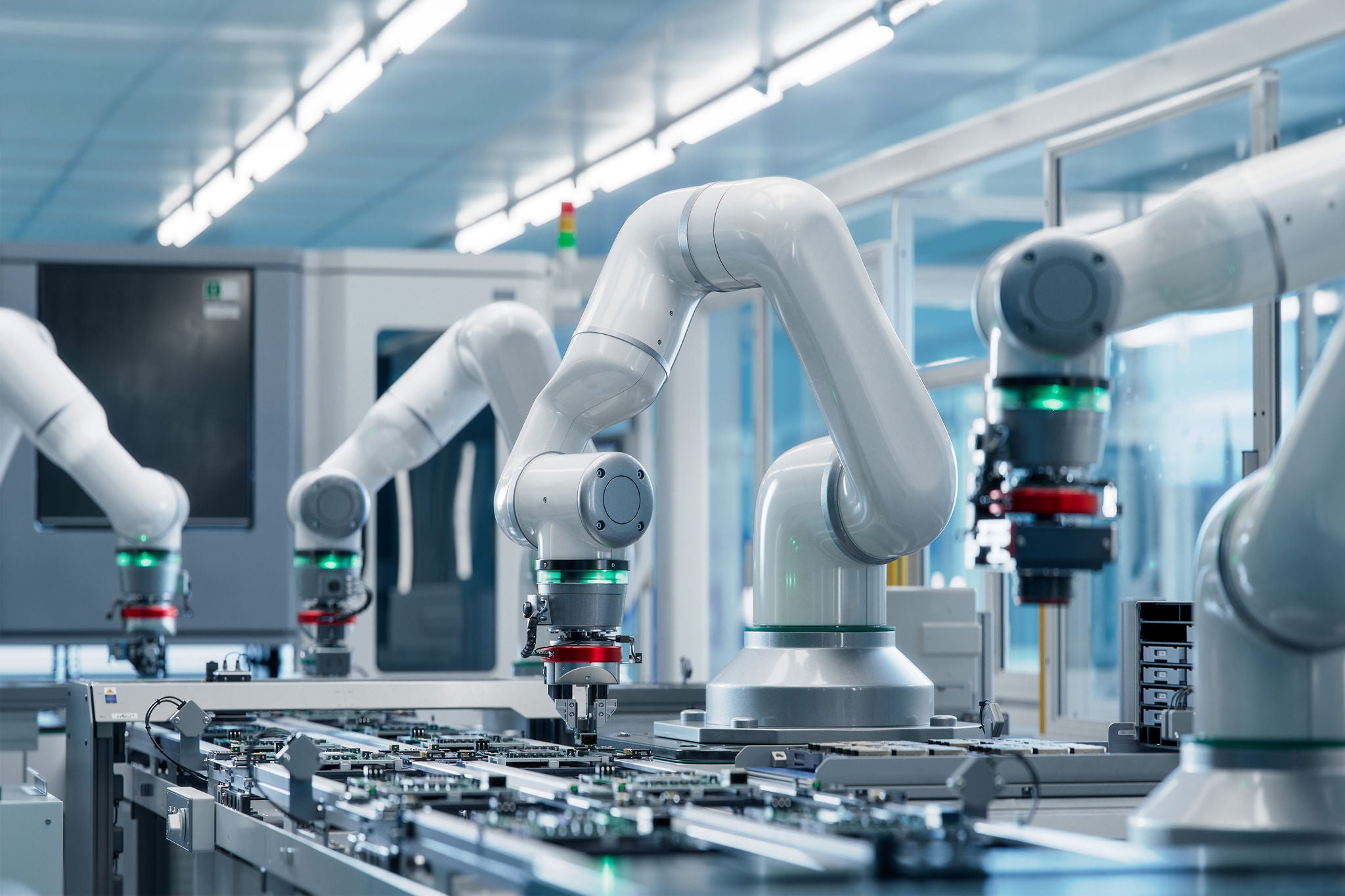
Advanced High Precision Robot Arm inside Bright Electronics Factory. Electronic Devices Production Industry. Component Installation on Circuit Board. Fully Automated Modern PCB Assembly Line.

How physical AI is transforming supply chains for real-time resilience

Organizations are seeking to bring make-move-deliver autonomy to supply chains.


In brief
  • Organizations are turning to physical AI to address a wide range of challenges, from labor shortages to providing around-the-clock operations.
  • Leveraging AI-ready data is a key element in driving intelligent decision-making for autonomous machines.
  • Human oversight remains an essential feature in establishing a solid framework for responsible AI in autonomous supply chain operations.

As organizations confront ongoing labor shortages, rising operational costs, safety concerns and the constant pressure to remain available around the clock, the urgency to create supply chains that can adapt in real time has never been greater. Physical AI — the integration of artificial intelligence (AI) into physical systems that interact with the real world — is emerging in direct response to these immediate challenges.

But just how practical are supply chains based on physical AI? How advanced is the enabling infrastructure, and are companies achieving real return on investment (ROI) in these deployments? We will explore how organizations are seeking to answer these questions by selecting KPI‑anchored pilots, designing for scale, and advancing governance models and safety protocols.

Why physical AI, why now

Advances in automation, fueled by lower on-site computing costs, more sophisticated robots and increasingly accurate simulation tools such as digital twins have made the adoption of physical AI feasible. The digital twin market is expected to grow from $9 billion in 2022 to $137 billion in 2030, largely driven by physical AI and the need to create precise replicas of physical assets.1


This shift allows organizations to achieve greater flexibility, adjust capacity, deliver higher product quality and create a safer work environment. The move also enables more resilient supply chains capable of recovering from supply chain shocks.


By shifting from isolated pilots to connected systems that share data and work with existing manufacturing and warehouse systems, organizations can fully leverage physical AI while respecting safety and production guidelines. As more organizations deploy physical AI, it becomes less about implementing specific machines or investments in robotics and more about establishing an overarching environment where machines and systems learn and coordinate across the factory floor and enterprise.

Three keys to unlocking physical AI:

  • AI-ready data to fuel intelligent decision-making and automation
  • Digital twin simulation to model and optimize physical processes before deployment
  • Responsible AI frameworks to enable safety, trust and compliance at scale

What’s different now: the tech stack has caught up

While factories began using robots more than 50 years ago, machines that leverage human robotics and AI are relatively new to manufacturing. Manufacturers have begun using them in general-purpose work in human-designed spaces, with early use cases ranging from handling materials to tending to machine parts and performing inventory inspection. Robots have also been used in basic assembly where human-like reach and mobility offer an advantage.

Mobile robots — also known as AMRs (autonomous mobile robots) and AGVs (automated guided vehicles) — form the backbone of new enabling technology that drives a flexible, responsive internal logistics system. These machines are capable of physically moving materials — parts, pallets, totes — around inside a factory or warehouse, guided by vision/LiDAR navigation, precise docking and fleet orchestration that dynamically routes materials, kits and pallets.

As companies adopt this technology, deploying digital twins offers a safe bridge between concept and execution. Creating virtual replicas of production lines, warehouses and processes enables teams to test changes, train systems and forecast outcomes before entering production.

At the same time, advances in computer vision hold the potential to help physical AI mature into a practical workhorse. Modern 2D/3D vision models can now recognize parts, estimate pose and spot defects reliably.

Further, orchestrating this across both the manufacturing plant and cloud keeps everything current, allowing the system to continuously monitor and provide updates and safety checks. If something should go awry, the humans overseeing operations on the manufacturing team retain the option to roll back actions if necessary. To mitigate the possibility that adding autonomy will introduce unacceptable risks, safety and cybersecurity are embedded from the start. Organizations need to keep safety top of mind throughout the deployment, especially in warehouse settings where machines will share the same space with human workers.

Where physical AI proves its value: ROI signals that matter

When deployed responsibly, physical AI deployments can deliver impressive results, improving throughput as systems minimize minor stops, drive faster changeovers and maintain cycles. Quality and yields increase as vision checks identify issues early, adjusting to automatically stay within optimal ranges, reducing scrap and rework. This significantly improves productivity by automating repetitive transport and inspection tasks, while safety machines tackle more hazardous tasks.

Deploying physical AI will also enable organizations to improve working capital by synchronizing the tasks of making and moving products, improving inventory turns and reducing the need for large buffers. Organizations are building upon this to measure ROI by tracking common baselines such as equipment effectiveness, defect rates, changeover time, on-time delivery and safety incidents.

How manufacturers are using physical AI today

Most organizations have yet to deploy physical AI at scale due to initial implementation costs and the inherent challenges of integration with existing legacy systems. However, some manufacturing organizations are turning autonomous supply chains into reality. Here, we outline use cases across the make, move and deliver phases.


Three things supply chain leaders should do to build autonomous operations

As a first step, supply chain leaders should:

  • Target value creation by prioritizing high-impact, repeatable opportunities linked to key metrics. Pilots should be designed to demonstrate the operational and financial impact on the bottom line, setting a baseline before the organization moves forward with an initiative to scale the technology.
  • Architect for scale by arriving at a consensus on how edge computing, connectivity, data, digital twins and system integration will work together. After establishing clear rules for testing, deploying and monitoring models and robot behaviors, leaders then need to choose partners and platforms that provide flexibility for future operations. They should avoid getting locked into one system.
  • Embrace responsible AI and make significant investments in upskilling people and establishing clear guardrails. A key part of any physical AI deployment is to upskill operators and technicians, and set governance for data quality and exception handling, establishing safety and accountability as key parts of the deployment checklist.

As organizations move forward, they need to provide transparency for critical decisions made on the warehouse or shop floor and invest in employee training to minimize job displacement. This will help organizations harness the transformative potential of physical AI while achieving sustainable success. Those organizations that prioritize responsible AI will not only enhance their operational efficiency, but they will also reinforce their brand as leaders in a rapidly changing global manufacturing ecosystem.


Summary

Physical AI — intelligence embedded in machines and robots — is helping manufacturers move factories from fixed automation to more adaptive autonomy. Organizations have begun to leverage the capabilities of physical AI to optimize supply chain operations for logistics, load building and returns processing. To create sustainable value, forward-leaning organizations should focus on building scalable architecture, flexible platforms and an upskilled workforce that operates within strong safety and governance parameters.

About this article

Authors

Related articles

Designing physical AI with humans at center

Explore the complexities of physical AI, focusing on human interaction, safety, and effective communication for a collaborative future

Transforming supply chain strategy with AI

Discover our white paper series that helps organizations revolutionize supply chain strategy with AI and data-driven insights.

How to build real-time supply chain cost monitoring with agentic AI

Unlock the potential of agentic AI for real-time supply chain cost management, streamlining inventory and enhancing decision-making efficiency.