





EY refers to the global organization, and may refer to one or more, of the member firms of Ernst & Young Global Limited, each of which is a separate legal entity. Ernst & Young Global Limited, a UK company limited by guarantee, does not provide services to clients.
How EY can help
-
Government Contract Services team delivers accounting, pricing and compliance frameworks and dispute support, as well as federal drug pricing program optimization. Learn how.
Read more
The importance of federal funding and key sectors
Federal funding remains a vital resource for organizations across various sectors, but the landscape is evolving under the current administration. New policies, deregulation, restructuring and shifting federal agency priorities present both challenges and opportunities. For instance, the Federal Acquisition Regulation (FAR) overhaul eliminates outdated rules, simplifies the regulatory framework and streamlines the acquisition process by removing anti-competitive barriers, thereby fostering entrepreneurship and innovation. Executive orders such as America First are expected to increase funding for key agencies, including the Department of Defense (DoD), Department of Homeland Security (DHS) and Department of Justice (DOJ), while the Department of Energy (DOE), Department of Health and Human Services (HHS), and the Environmental Protection Agency (EPA) face reorganization, funding reductions and new priorities. Notably, while the initiatives for clean energy and electric vehicles will be deprioritized, new opportunities for US energy dominance and independence are emerging, especially in the nuclear field.
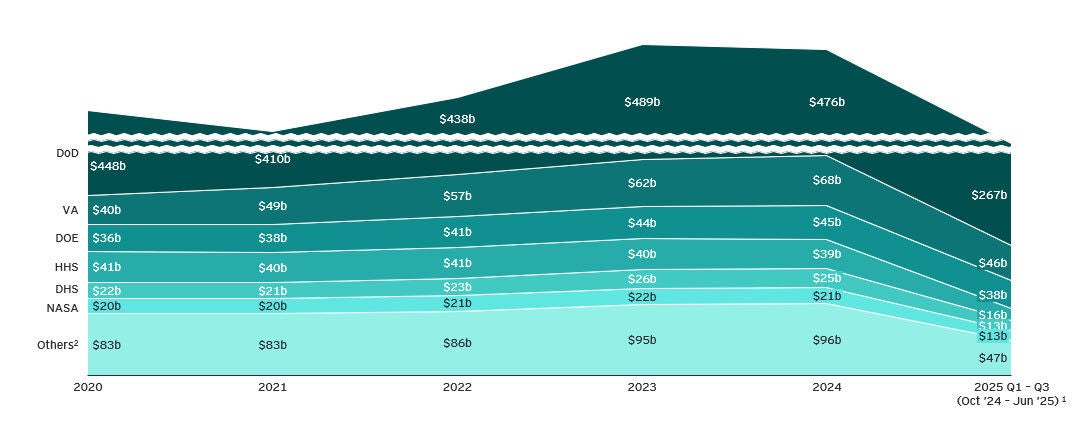
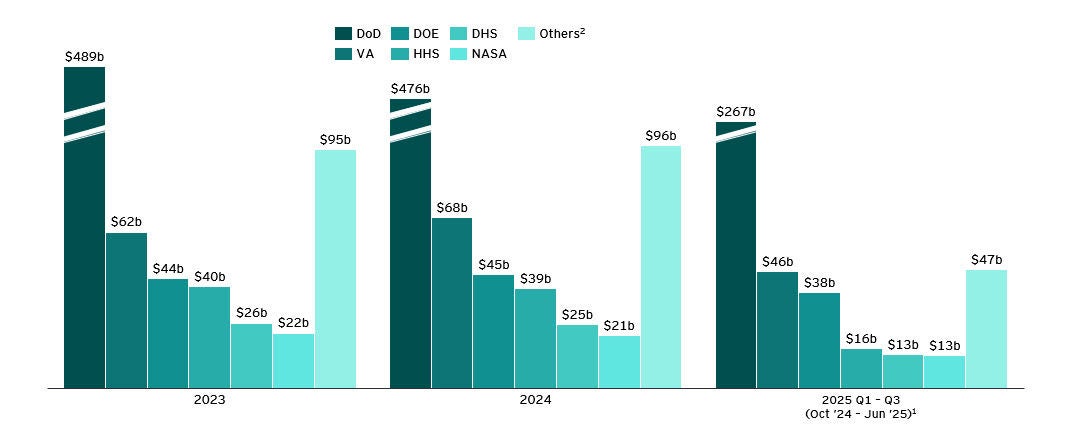
The spending data for the first quarter of the current administration aligns with expectations. While largely maintaining FY24 levels, funding has increased for the DoD, DHS, Veterans Affairs (VA) and Federal Aviation Administration (FAA) compared to FY24. Additionally, the DoD has gained flexibility to initiate new projects with the removal of the “No new starts” provision for defense contracts. Conversely, funding has decreased for the US Agency for International Development (USAID), federal buildings managed by the General Services Administration (GSA) and EPA assistance awards. This includes the rescission of $20.2 billion in Internal Revenue Service (IRS) funds from the 2022 tax and climate law and the discontinuation of earmarked projects from FY24.
As we look ahead, it is essential to reassess past spending patterns and align strategies with the current administration’s focus areas to capitalize on emerging funding opportunities.