









EY refers to the global organization, and may refer to one or more, of the member firms of Ernst & Young Global Limited, each of which is a separate legal entity. Ernst & Young Global Limited, a UK company limited by guarantee, does not provide services to clients.
Recent Searches

Private equity (PE) firms are charging full speed ahead on artificial intelligence (AI), as highlighted in the 4Q EY AI Pulse report. Today, investing in AI isn’t just a trend — it’s the new standard, with data showing that firms embracing this technology are seeing real, measurable gains. The debate over adoption is over; the race now is about how you create differentiation and not just “get to average.” While the market has caught up and investment levels across PE are matching those in other sectors, the essence of private equity is about pushing boundaries, unlocking growth and carving out differentiation. Early wins from AI are promising, but this is just the beginning. To truly leap ahead, PE firms and their portfolio companies need to adopt new approaches to generate enterprise value at scale in concert with their value creation plans, aiming not just for parity, but for an unmistakable competitive edge.
Private equity leadership commitment to AI is accelerating
A notable 84% of PE firms have appointed a chief AI officer (CAIO), indicating a strong strategic commitment to integrating AI into their operations, slightly above the broader private sector average of 82%.
AI budgets are growing quickly among private equity firms. While a vast majority (92%) of PE firms have been directing 25% of their total business units’ budgets toward AI, investments are ramping up. Nearly half of PE respondents are investing between 25% and 50% of their budgets in AI projects, with 38% expecting to spend more than half of their total budget on AI, highlighting just how central AI has become to their strategy.
Investment levels in AI are also witnessing a significant uptick. Three years ago, the largest share of PE firms (28%) invested between $15 million and $50 million in AI, across all AUM (assets under management) tiers. However, as the landscape evolves, aggregate investment levels have risen dramatically, with a third of firms now topping out AI allocations between $50 million and $100 million. By 2026, a comparable percentage is expected to invest over $100 million, signaling a profound shift in how PE views and prioritizes AI as a cornerstone of future growth and innovation.
PE firms are recognizing AI’s potential to drive value and enhance operational efficiency as demonstrated by their increasing commitment. The question now is not whether to invest in AI but how to invest to create differentiation. Success requires avoiding the pitfall of “use case syndrome,” where volume of use cases becomes the measure of value, as volume of disconnected use cases rarely equates to differentiated enterprise value. Firms that are achieving differentiated performance instead focus on how AI is disrupting the value chain of the sector where the investment sits. These firms then create targeted value creation initiatives (VCIs) linked to the overall value creation plan (VCP) to address the disruption; this is differentiated value created in private equity.
A majority of PE firms have witnessed positive ROI from their AI investments
The surge in AI investment and positive ROI experienced among private equity firms is particularly noteworthy, especially when contrasted with the sector’s overall outlook just two years ago. As highlighted in the previous chart, PE firms are already seeing real operational efficiency gains — a crucial initial phase in realizing the benefits of AI. To unlock even greater returns, firms must progress beyond basic operational improvements to reimagine their operating models. This means fundamentally redesigning operations and redefining how work is done with AI. Organizations that embrace a reimagine mindset are realizing two to three times the benefits from AI investments when compared to a more traditional optimization approach, based upon our client work. The distinction between mere optimization and genuine reimagining unlocks differentiated value and lies in rethinking the operating model.
The next frontier is applying AI to rethink business models. Leading portfolio companies, regardless of industry, are now using AI to innovate and create value for their clients and stakeholders. This opens endless opportunities for PE-backed organizations to drive innovation around new products and services as well as acquire new capabilities via M&A, joint ventures, and the expansion of alliances and ecosystems. We are finding that, ultimately, the highest ROI emerges when AI investments can reimagine business models — delivering entirely new sources of value.
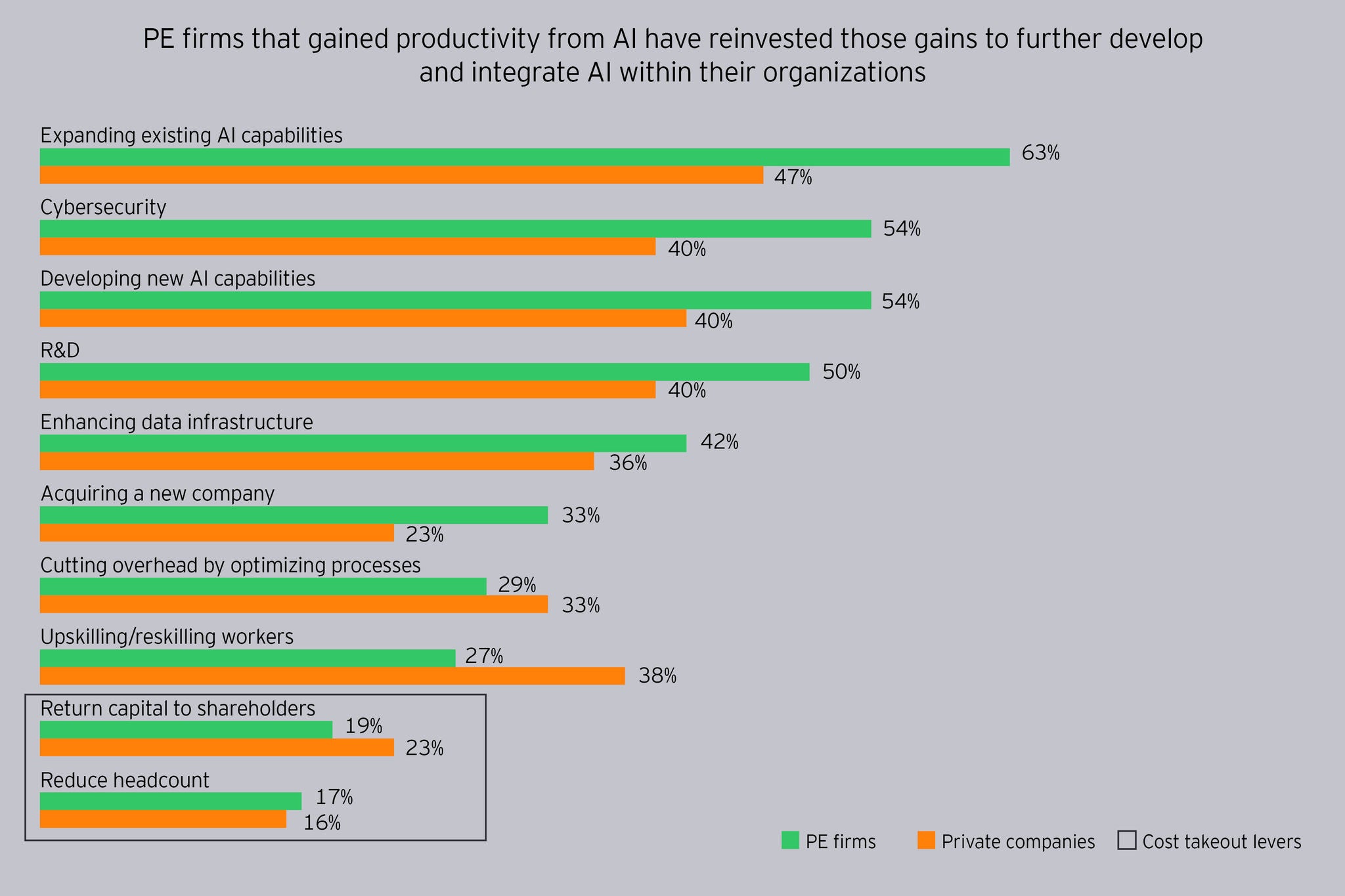
PE firms are reinvesting their gains to further bolster their AI capabilities
Private equity firms are strategically channeling their AI-driven productivity gains into initiatives that foster growth, innovation and resilience, rather than merely focusing on cost reduction. More than half are not only reinvesting in their current AI systems to boost performance and efficiency but are also developing new AI solutions to maintain a competitive edge. Recognizing both the opportunities and risks that AI presents, PE firms are making cybersecurity a top priority to maintain robust asset protection. R&D ranks among the leading areas for targeted reinvestment, nurturing innovation and strengthening market positioning. Upgrading data infrastructure is also seen as crucial for generating deeper insights and enabling smarter decision-making. Additionally, firms are leveraging AI-driven gains to pursue strategic mergers and acquisitions, further expanding their capabilities and market reach.
In contrast, actions such as cutting headcount and other cost-cutting measures rank significantly lower on the priority list. This trend reveals an interesting narrative that PE firms are viewing AI productivity more than a means to streamline operations, but as a powerful catalyst for growth and capability enhancement.
The propensity to differentially invest in growth levers is a unique scenario for private equity firms who measure growth in years, not quarters. The inherent lifecycle time horizon and ability to effectively deploy capital uniquely position private equity to be better poised for AI transformation execution.
PE firms expect a rise of responsible AI, with a focus on risk and governance
Responsible AI is rapidly ascending the risk and governance agenda, capturing the attention of 82% of PE firms. In the coming year, these firms anticipate significant enhancements in several critical areas.
For sponsors, this trend reinforces a critical insight that responsible AI is no longer just about satisfying LPs and regulators but is directly linked to deal monetization. Weaknesses in AI governance, underlying data or cyber could delay, dilute or even derail an exit. Narratives surrounding AI value creation therefore need to be tightly integrated with robust governance, risk management and ethical considerations to protect exit value in an increasingly scrutinized environment.
PE firms seek more support in measuring the impact of AI
The challenge of measuring AI impact remains a significant hurdle, and PE firms are acutely aware of it. A majority of PE respondents (31% strongly, 31% somewhat) acknowledge that their organizations grapple with linking specific productivity gains to AI adoption, despite recognizing the benefits that AI brings. Furthermore, a significant number of PE respondents (60% strongly, 32% somewhat) believe that enhanced training is essential for effectively reporting AI-driven productivity gains.
This represents a critical gap. As the sophistication of AI applications accelerates, the ability to measure and attribute their impact is lagging. If left unaddressed, this disconnect could undermine value-creation arguments, weaken board reporting and compromise exit narratives.
It’s important to note that productivity on its own is not value. Many organizations invest in tools and programs that make processes faster, cheaper or more accurate and then stop there. The P&L doesn’t move simply because teams can do more work in less time. Value is only created when leaders deliberately redeploy that freed-up capacity to a defined and measurable KPI in the VCP. That might mean reallocating people and time to improve a working capital metric, lift revenue, accelerate growth initiatives or reduce a specific cost line. Without that second step, “productivity” remains a local efficiency gain rather than an enterprise value lever.
Our latest thinking
Private equity US market insights and trends
PE Pulse: explore US industry market trends and what private equity leaders are focusing on in 2026.
Private Equity Pulse: key takeaways from Q2 2026
The PE Pulse is a quarterly report that provides data and insights on private equity market activity and trends. Read the latest report.
The reckoning over AI cost and value has begun
The EY US AI Pulse Survey shows that executives must weigh the costs of action in AI against the price of inaction, to drive more than just adoption.
Private equity trends 2026: leading through change
Explore private equity trends driving growth in 2026 and the strategies and technologies reshaping the industry. Navigate the market opportunities.
What can private equity do now to finish strong?
Private equity firms exiting assets in the next 12 to 24 months should focus on exit preparation strategies, a new EY study shows. Learn more.