Revolutionizing healthcare through medical tech

How AI in biopharma drives mission‑focused growth

AI in biopharma must go beyond operational efficiencies and cost savings become a strategic engine driving mission-centric growth and innovation.


In brief
  • Artificial intelligence (AI) must deliver breakthrough outcomes for biopharma - not just incremental savings - to drive substantial impact.
  • While the focus has been on efficiency, this should be a stepping stone toward long-term mission goals, such as superior therapies and broader patient access.
  • EY-Parthenon teams help biopharma clients leverage AI as a strategic growth driver, developing new treatments and reaching more patients.

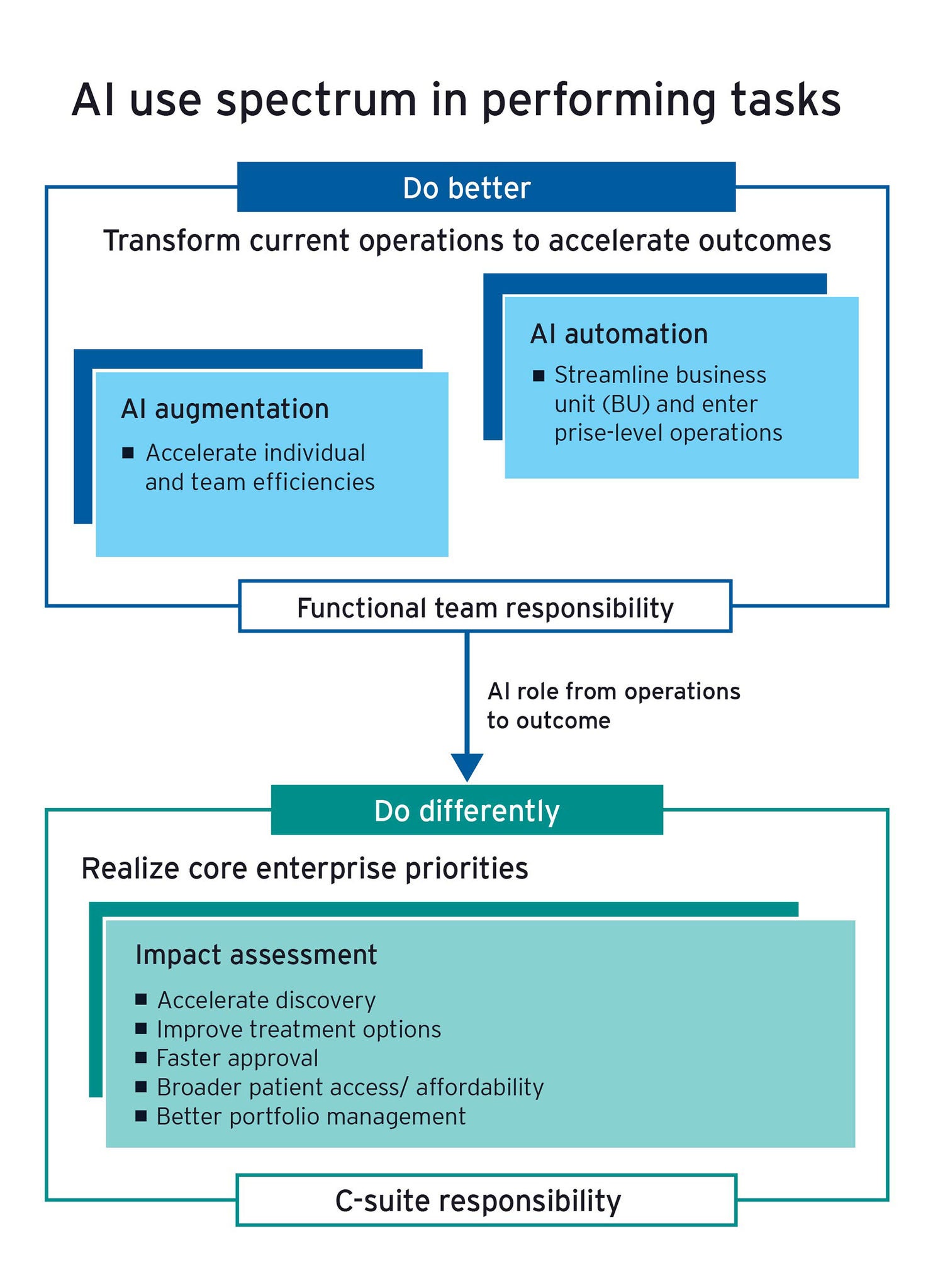
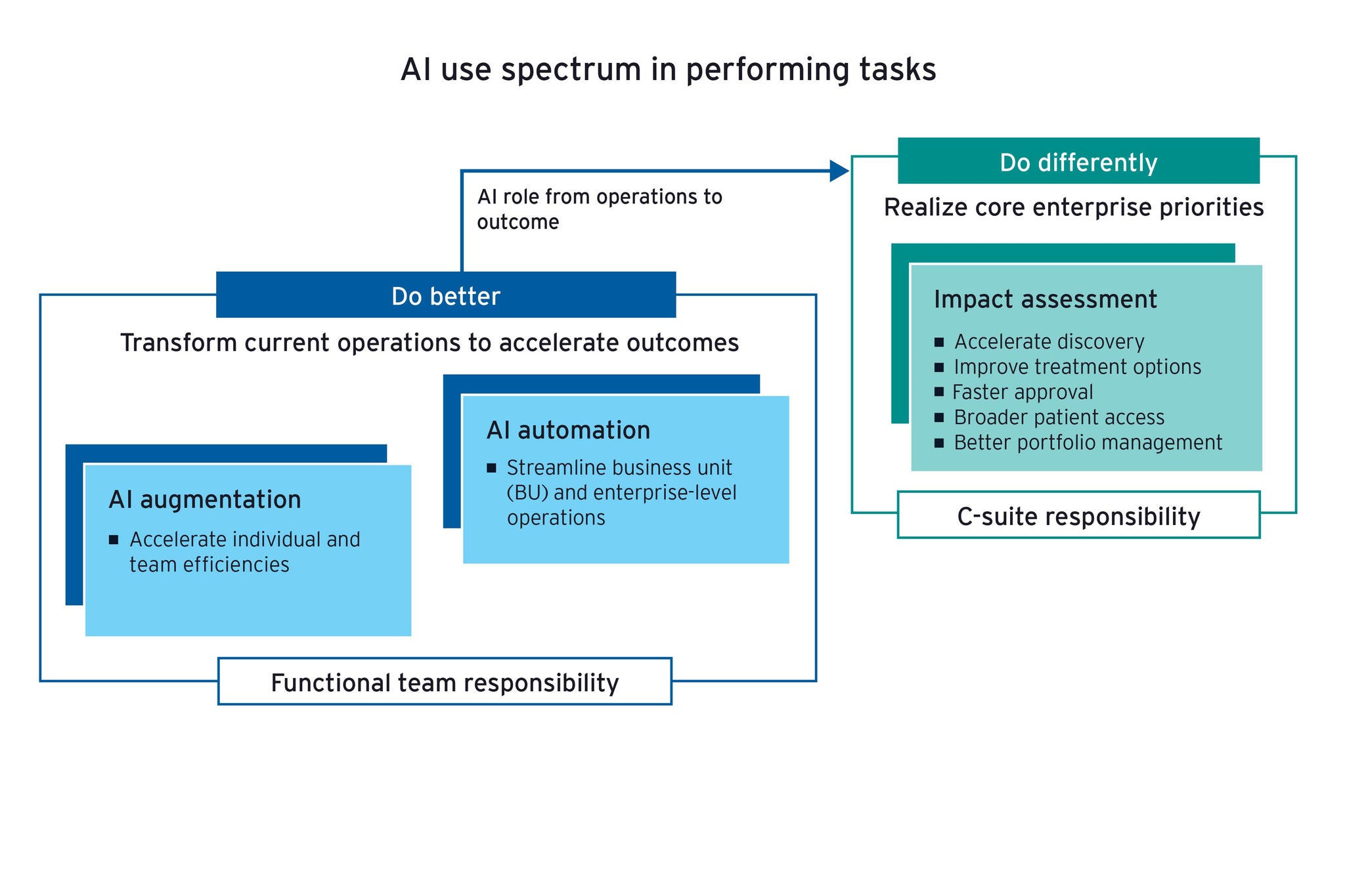
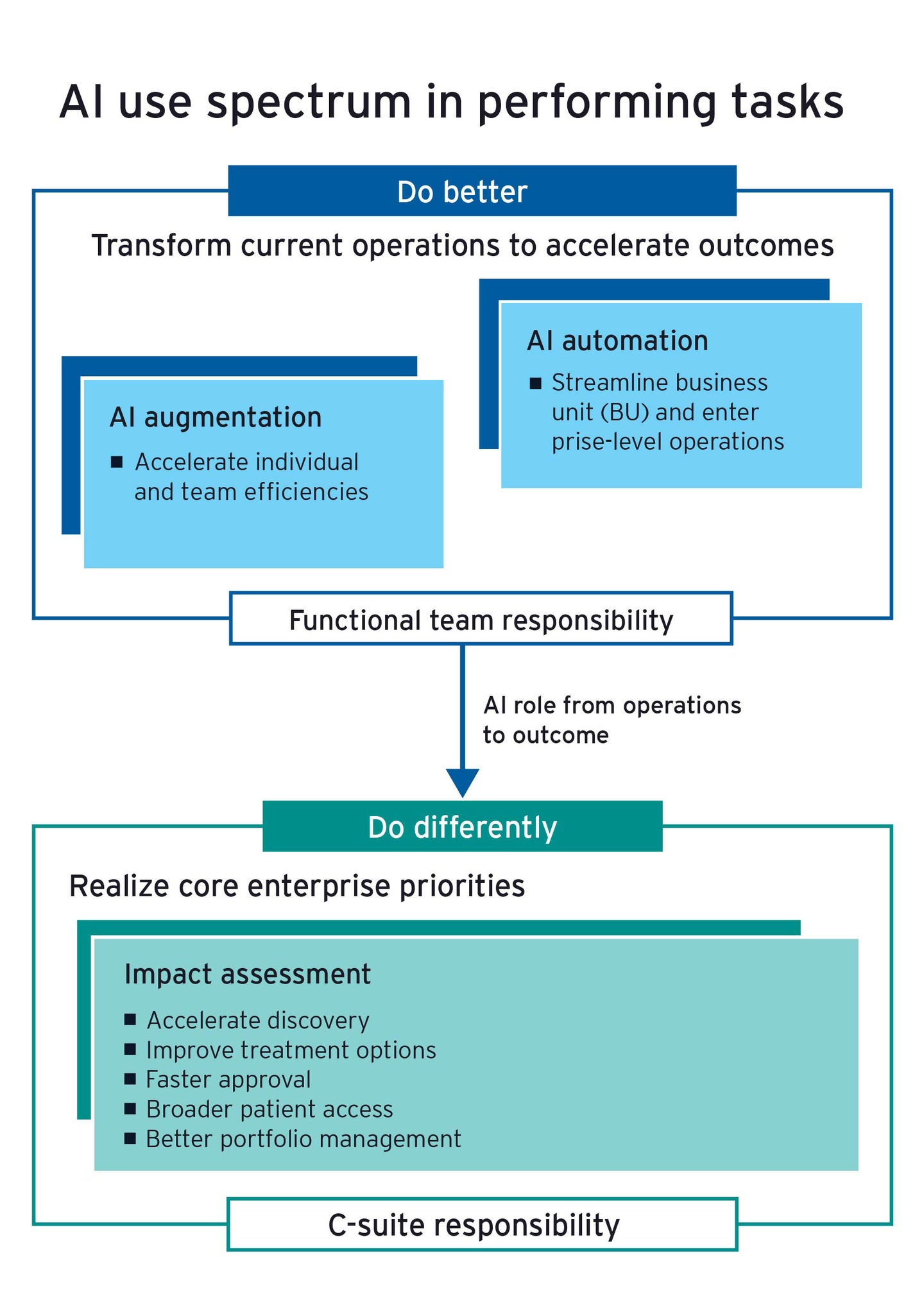
Between 2020 and 2025, biopharma companies poured billions into AI-focused ventures. In 2025 alone, pharmaceutical AI investment is expected to have been around $4 billion, with projections exceeding $25 billion annually by 2030.1 This surge reflects the industry’s belief in AI’s transformative promise - from speeding up R&D to personalizing patient care. Yet, most current initiatives still target streamlining operations and reducing costs, with some focus on accelerating drug discovery. Given this exponential growth in spending, operational efficiency alone cannot justify current biopharma AI investments. Efficiency gains and cost savings are valuable, but they should serve as a catalyst toward achieving biopharma’s “true north” objectives: discovering better drugs faster, developing them more efficiently and getting them to the broadest patient base (see Figure 1). In other words, AI must be pushed beyond back-office optimization to truly advance the core mission of improving patient outcomes.

Figure 1: Reaching true north: different stages of AI impact, from efficiency to reaching core priorities

Graphic 2512 10662 CS chart
ey-graphic-2512-10662-CS-chart-v4

Notably, investors are fueling this ambition. In the last year alone, venture capitalists have put over $3.2 billion into 135 AI-driven drug development deals, reflecting strong expectation that AI integration will drive greater R&D efficiency and success rates.2 Biopharma executives, similarly, must demand more from their AI investments. Early wins in cost reduction or process efficiencies should be leveraged as stepping stones toward larger mission-focused gains - such as accelerating drug candidate pipelines, enabling novel therapies and expanding patient access globally. This focus has even greater impetus in the wake of the announcement of the federal “Genesis Mission,” which includes biotechnology as an AI focus area. Only by aligning AI initiatives with these biopharma higher goals will the full value of AI be realized in biopharma’s pursuit of growth and innovation.


AI applications across the biopharma value chain


AI is increasingly being applied at virtually every stage of the biopharma value chain. From labs to logistics, companies are experimenting with AI tools to work smarter and faster. A few key domains illustrate how AI is making inroads across biopharma:


1. Enhancing drug discovery and preclinical research: AI is reshaping early-stage R&D, enabling breakthroughs in molecular design and target identification. Advanced machine learning models can predict protein structures with atomic-level accuracy - as demonstrated by recent innovations in protein folding3 - and can virtually screen vast libraries of compounds to prioritize which ones should be tested in the lab. These capabilities dramatically narrow down candidate molecules, potentially shaving months or years off discovery. In preclinical development, AI algorithms are used to predict safety and efficacy issues earlier by analyzing data from cell and animal studies. In short, AI-driven discovery platforms are not just doing things faster - they’re leaping to solutions that a human-driven process might miss.


2. Improving clinical trials and development: AI-powered platforms are tackling long-standing bottlenecks in clinical development. One of the biggest challenges in clinical trials - patient recruitment - is being revolutionized by AI. Natural language processing algorithms can comb through millions of electronic health records in seconds to match patients with complex trial criteria, dramatically speeding up recruitment while also improving the diversity of patient pools. Beyond recruitment, AI chatbots and automated data capture tools streamline trial management, ensuring studies maintain momentum and meet milestones. AI is also shortening the time from trial completion to regulatory submission. Generative AI tools, for example, can help draft clinical study reports and even assemble components of regulatory filings in a fraction of the usual time. Achieving such accelerated filings can get treatments to market faster and extend valuable patent exclusivity periods.


3. Optimizing manufacturing and supply chain: Beyond R&D, AI is transforming the operational backbone of biopharma - manufacturing, quality control and logistics. In production, AI systems analyze real-time sensor data to optimize manufacturing conditions, improving yields and reducing downtime. For instance, machine learning models can predict when equipment is likely to fail or when a batch is deviating from ideal conditions, enabling preventive maintenance or adjustments before problems occur. Across the supply chain, AI-driven demand forecasting looks at a multitude of data (prescription trends, epidemiological data, market dynamics) to predict where demand for a drug will spike or wane. These insights help companies adjust inventory levels and manufacturing schedules proactively. Collectively, such AI improvements reduce waste and operational costs while improving access to therapies by ensuring the right medicines are in the right place at the right time.


Through these examples, a pattern emerges: AI is contributing to incremental gains in speed, efficiency and decision-making quality across various functions of biopharma. Each improvement - faster candidate selection, quicker trials, smarter production - ultimately contributes to the larger mission of better serving patients. But realizing that mission impact consistently will require scaling AI beyond pilots and point solutions. It calls for rethinking how organizations adopt AI at a structural level to move from isolated wins to enterprise-wide transformation.


Patterns of current AI adoption in biopharma


As AI technologies permeate the industry, their impact is far from uniform. Every company - and each function within it - faces a unique landscape of opportunities and challenges from AI. Understanding these patterns is essential for leaders to prioritize where AI can drive the most value (see Figure 2).


Figure 2: Biopharma ecosystem stakeholders: differential levels of AI utilization and opportunities


 

Select red highlights for more info.


There is no one-size-fits-all approach to AI in biopharma

AI utilization varies significantly across different stakeholders, roles and domains. Research and scientific functions may experience an evolutionary change - AI acting as a smart assistant that augments scientists - whereas operational and administrative functions are poised for more revolutionary change through automation. Internal analysis indicates that in biopharma operations, up to 40%-50% of task hours could be automated with currently available AI technologies.4 Routine, repetitive tasks such as data processing, report generation or invoice handling are especially ripe for transformation by today’s AI and robotic process automation tools. Therefore, each department or function should set its own AI mandate aligned with its role: for example, an R&D division might aim to double its throughput of drug candidates using AI-driven tools, while the finance department might target automating half of all transactional processes. Significantly, domain-specific needs and resource profiles also vary across different types of biopharma organizations: distributors vs. pharma manufacturers or big pharma vs. biotech startups. Recognizing these realities ensures that AI investments are applied where they make the most sense and deliver measurable improvements.

  • Target the fat, empower the muscle. Across the life sciences industry, G&A and operations functions account for roughly 60% of total headcount in many companies (see Figure 3).

Figure 3: AI and biopharma domains: differential penetration of AI across biopharma domains

Select a domain for more information.


Not coincidentally, these areas also have the highest automation potential due to the volume of routine, repeatable tasks they handle. This alignment creates a major opportunity: by targeting these “fat” parts of the organization, such as the heavy administrative and operational layers, AI can trim inefficiencies and reduce costs where it matters most. The strategic focus for many companies should be on streamlining these middle- and back-office layers through AI - automating finance reporting, HR processes, procurement workflows and so on - to free up resources.

In contrast, the commercial and R&D functions represent the “muscle” of a biopharma company. Depending on the type of company, the proportion of staff in these areas varies widely. These core areas are where AI’s role is not to cut headcount but to amplify capability - for instance, helping a research team analyze data more deeply or enabling a sales force to target physicians more precisely. In essence, AI can help trim the organizational bloat and reinforce core strengths simultaneously: identify and automate the non-value-add tasks while enhancing the high-value work.

There is also significant variation in how AI is applied based on company size, portfolio maturity and therapeutic focus. A small pre-commercial biotech with a lean team and one or two assets in development will use AI very differently than a large pharma with hundreds of products or a generics firm operating at massive scale. The biotech might leverage AI tools as force multipliers - for example, using AI to design experiments or manage regulatory paperwork - enabling it to progress drug programs with a fraction of the usual staff. In contrast, a big generics manufacturer might focus AI on optimizing manufacturing efficiency or supply chain logistics to eke out margins in a volume-driven business. Even within large pharma organizations, a company heavily focused on oncology may deploy AI for complex genomic data analysis, whereas another focused on primary care products might prioritize AI in commercial analytics to navigate large patient populations and broad markets (see Figure 4). Each archetype - be it biotech startup, mid-size specialty pharma or pharma giant - must craft a tailored AI strategy that aligns with its unique mix of “fat and muscle.” The key is understanding where AI can have the greatest immediate impact (often in those heavy administrative areas) and where it can enable future growth (in the innovation and commercial arenas).

Figure 4: AI and biopharma archetypes: variations in AI utilization and opportunity across archetypes

Select red highlights for more info.


The future: AI-enhanced biopharma organizations

While AI’s current contributions often begin with efficiency and cost savings, the endgame is a shift toward a fundamentally different kind of biopharma organization (see Figure 5). For emerging, smaller companies, AI offers the chance to scale up without scaling out in headcount — enabling a lean organization to punch above its weight. Small biotech can progress from discovery to clinical trials with relatively few employees by relying on AI platforms and outsourced services for support functions. In effect, AI allows startups to remain streamlined and focused on science rather than building large support departments from scratch.

For large, established enterprises, the future with AI involves right-sizing and refocusing the workforce. AI can absorb growth in workload that outpaces growth in personnel, acting as a release valve that prevents the need for ever-expanding staff. In every case, a one-size-fits-all approach will not work - companies need to architect their AI journey in line with their specific strategy and makeup. A thoughtful, tailored AI roadmap is critical because even in scenarios where AI may not alter headcount, it will change how teams operate and the skills they require.

Figure 5: Biopharma organization structure evolution: right-sizing biopharma organizations with AI


Strategic steps for transforming biopharma with AI

Capturing AI’s full value requires more than technology deployment - it demands rethinking organizational design, talent and strategy. A well-designed AI program can reshape a biopharma company to fulfill both its business objectives and its broader societal mission. This means using AI to accelerate drug discovery, improve treatment options and broaden patient access in ways that were previously impossible. Efficiency gains are important, but they matter most when they lead to these tangible outcomes. AI should be viewed not just as a cost-cutting tool but as a catalyst for advancing the organization’s core mission and “true north” goals. How can leaders make that happen? The following seven steps outline essential strategies for harnessing AI to transform biopharma organizations:

  • Align AI initiatives with the strategic mission. Ensure every AI project is evaluated not only on immediate efficiency gains but also on its ability to accelerate the company’s mission - whether that’s scientific innovation, improving patient access or achieving market leadership. In practice, this means setting clear “true north” objectives for AI and measuring projects against those higher-order goals. An AI effort aimed at automating data entry, for example, should be justified by how it frees up scientists’ time for research or speeds up a patient support process, not just by hours saved.

  • Redesign organizational structures for an AI-driven world. Assess your organization’s current structure and be ready to reorganize for optimal AI integration. Large biopharma companies should identify duplicative functions and high-volume, routine tasks that are prime candidates for automation. By mapping out which processes AI can handle, leaders can create a roadmap to streamline departments and redeploy freed-up resources to more strategic areas. For smaller companies, the guiding principle is to structure your company for the future, not the past - a future where AI is embedded in core workflows from the start. All organizations, large or small, should pinpoint priority domains for AI based on their unique profile and benchmark themselves against peers and competitors to identify gaps.
  • Adopt an “AI-augmented everything” mindset. In the AI-enhanced model, every employee is supported by AI in some form. Routine tasks are increasingly automated, and higher-level work is augmented. This mindset means looking at every role and process and asking: how can AI help here? It requires cross-functional collaboration to integrate AI tools into daily workflows. The objective is to help the organization achieve more with the same or fewer people - not by overburdening employees but by elevating them to work on higher-value activities while AI handles the rote and analytical heavy lifting.

  • Invest in continuous learning and reskilling. As transactional roles shrink and new, data-centric roles expand, it’s crucial that organizations reskill their workforce at scale. HR policies should facilitate transitions from roles that AI will reduce or eliminate to new roles that AI will enable - for example, transforming report analysts into data interpreters or lab technicians into automation supervisors. This might involve large-scale training programs in data science, AI ethics or digital literacy. A culture of continuous learning will ensure employees adapt alongside AI rather than being displaced by it.

  • Embrace innovative collaborations and AI orchestration. AI can facilitate more seamless collaboration with contractors, partners and vendors, leading to more fluid organizational boundaries. Companies should be open to project-based teams that include AI systems and external experts working together. Organizational design may shift toward network- or ecosystem-based structures, with AI tools orchestrating work across internal and external contributors. Embracing this approach means thinking of the organization not just as a fixed hierarchy but as a dynamic network or “hub” that can expand or contract as needed. Ensure governance and security measures are in place so that, as AI connects more parts of the ecosystem, data and intellectual property (IP) remain protected.

  • Champion an AI-driven culture with clear accountability. Leadership must set the tone that AI is a priority and an opportunity, not a threat. This means promoting a culture of experimentation, rewarding learning, including learning from failures, and being transparent about how AI is being used and what its benefits are. Employees should hear consistent messaging, from the C-suite down, that AI will help them achieve more. At the same time, there must be clear ownership and accountability for AI-driven outcomes. Every level of the organization should have explicit expectations for AI adoption: from executives who champion and fund AI initiatives, to middle managers who implement and supervise AI in their departments, down to front-line teams who are encouraged to incorporate AI tools into their daily work.

  • Execute proactive change management and talent redeployment. Transformative changes to accelerate AI adoption need to be managed thoughtfully. Biopharma companies should anticipate that AI-driven shifts will cause uncertainty - even fear - among some employees, and plan robust change management accordingly. Communication is key: articulate a compelling vision of an AI-enabled future, emphasizing benefits for both the organization and employees’ day-to-day jobs. For roles that will likely shrink or disappear, have plans ready for how affected staff will be retrained or transitioned into new positions. The end state will likely be a workforce that is smaller in some traditional job categories and larger in new, more analytical and creative categories. Manage this shift humanely and smartly to retain trust and morale.

Conclusion

The emergence of AI is set to redefine how biopharma organizations are structured and how they operate. Even in scenarios where AI doesn’t directly reduce headcount, it will fundamentally change workflows, required skills and overall organizational design. The most successful companies will be those that proactively assess which parts of their business to automate vs augment, tailoring their AI strategy to their specific business model and workforce. Cost savings and operational improvements are valuable, but in biopharma they are a means to a greater end - patient impact. The true measure of a biopharma AI strategy’s success is how effectively it helps the company achieve its mission: discovering new drugs, developing life-saving therapies faster and delivering them to the patients who need them. The competitive edge will belong to organizations that design themselves around the complementary strengths of human talent and AI - leveraging AI for what it does best and empowering their people to focus on what humans do best. In doing so, AI in biopharma can drive mission-focused growth, not just operational efficiency.

Methodology


References

Reference title

Author(s)

Year

Source

1

$25B Potential in Accelerating AI’s Impact and Value in Pharma

Pete Foley

2025

Pharmaceutical Executive (https://www.pharmexec.com/view/25-b-potential-accelerating-ai-impact-value)

2

AI may be the key to reigniting VC interest in biotech: PitchBook

Gabrielle Masson

2025

Fierce Biotech (https://www.fiercebiotech.com/biotech/ai-may-be-key-reigniting-vc-interest-biotech-pitchbook)

3

AlphaFold is five years old – these charts show how it revolutionized science

Ewen Callaway

2025

Nature News (https://www.nature.com/articles/d41586-025-03886-9)

4

AI agents could shoulder 55% of biopharma work, Accenture/Wharton study finds

Brian Buntz

2025

Drug Discovery & Development (https://www.drugdiscoverytrends.com/ai-agents-could-shoulder-55-of-biopharma-work-accenture-wharton-study-finds/)

Osefame Ewaleifoh, EY-Parthenon contributed to this article.

Summary 

AI can transform biopharma—not just by boosting efficiency, but by driving bold innovation and mission-focused growth. From accelerating drug discovery to transforming clinical trials and streamlining operations, AI is poised to reshape the industry’s future. Aligning AI with strategic goals is key to unlocking better therapies, broader patient access, and a smarter, more agile workforce.

About this article

Related articles

How AI Can Enable a Continuous Biopharma Deal Radar

AI-powered deal radars help biopharma firms continuously spot, assess, and prioritize early-stage acquisition targets to strengthen R&D pipelines.

Neurosymbolic AI: A strategy for growth, not just a product

Neurosymbolic AI transforms growth strategy, uncovering hidden value and driving innovation with predictive, auditable, and scalable reasoning.