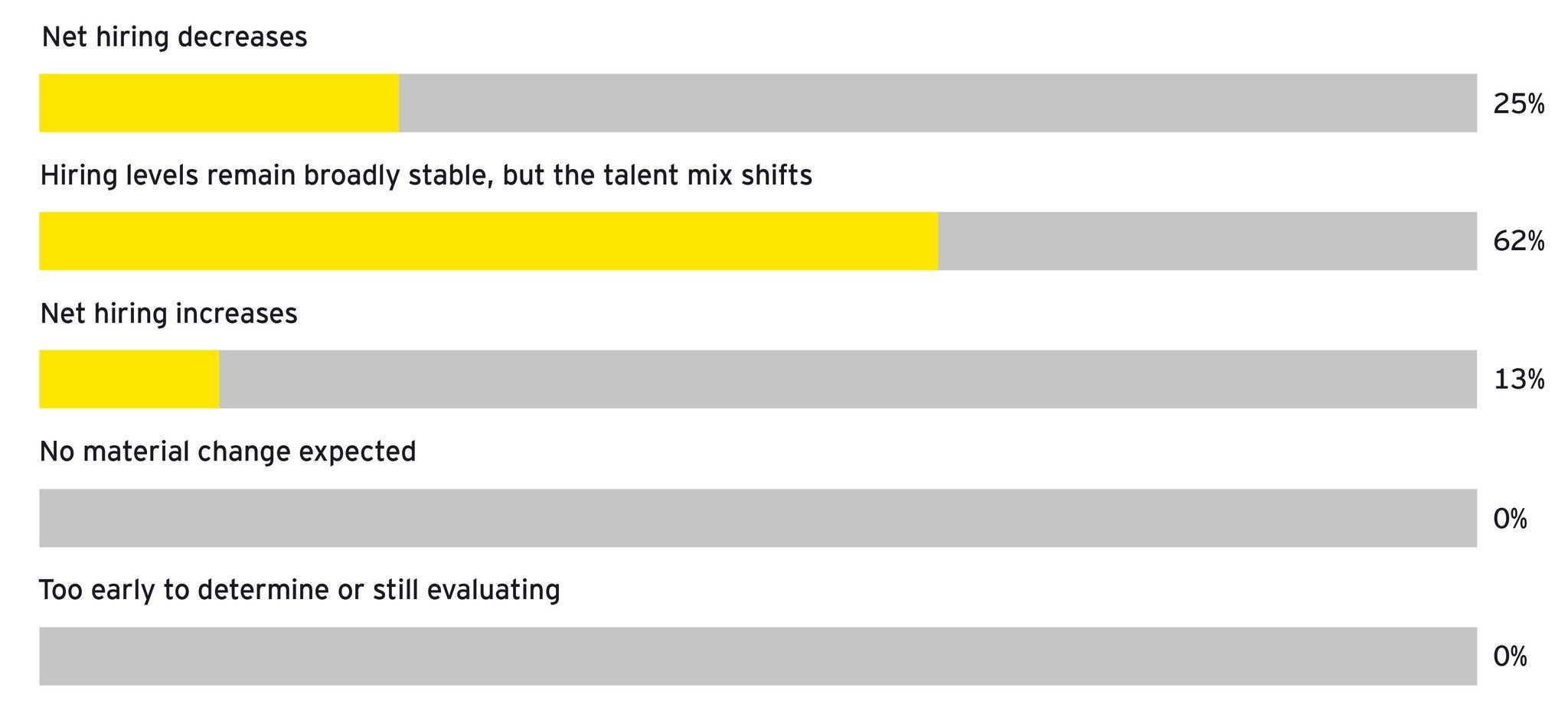
An informal poll of our participants shows a heavy tilt toward maintaining hiring levels, and attrition is being used to reassess what work is needed and whether agents can fill the gaps. A CIO in an economically sluggish sector is focused on upskilling to prepare for an upturn. “We’re setting ourselves up for not hiring people when the market turns around — that there will be growth that we’ll seize with our existing headcount,” she said. “We don’t need to add people, but we retain and reposition talent. It’s a great message instead of layoffs: we’re investing in people and their skills.”
Efforts to drive AI adoption are leading to a bifurcation of talent, others noted, showcasing a developing fault line in how executives are assessing the future and who will be part of it. “One office gets it and suddenly they’re doing X with Y amount of people, and another doesn’t get it,” another CIO said. “We’re measuring that more in this company.” Another agreed: “There are ways to train and educate. But there are individuals that don’t have the capacity or the interest.”
For one leader in an organization with hundreds of thousands of hourly workers, that has meant developing cohorts that study for 10 to 20 hours a week. “Sometimes we put them on big, impactful projects, and that filters through the organization. But it’s not enough. We’re thinking about scale: embedding more medium- to higher-end users to help train people out there.”
Kristin Valente, EY Americas Chief Client Officer, highlighted how much productivity is contingent upon the individual. “It’s helpful to think about people in terms of their mindset,” she said. “Can they embrace tech? And do they have the skillset and then the toolset to back up that mindset?”
Action item: Is this within the realm of the CIO to fix — if it can be fixed? It’s worthwhile to be part of the conversation and orient the discussion around doing new things with AI and not to do the same things differently, which is as much about talent as it is about technology. And that is closely tangled with cost and governance, two of the most prominent debates occurring in C-suites today.
2. Cost: will you pay a price for using too much AI or not enough?
You could spend $400 generating slides, or over $10,000 on a proposal, or similar amounts just on generating memes when your people get bored. Top executives down to interns are making agents, potentially even the same agents. “One normal regulating factor on bad ideas was that they took time and energy,” Malhotra said. “Now they’re a prompt away.”
This variable cost for democratized AI, dependent on the end user, never existed before, said Amr Ahmed, EY Americas Infrastructure, Cloud & Service Resiliency Practice Leader. He outlined the EY approach on scaling toolsets globally with an eye on prices:
- Building controls around evaluating and bringing in new tools, particularly to avoid duplication and limit the scope
- Working with practices to define personas and the type of tool that aligns with their needs and skillsets
- Exploring allocations based on those personas and tools, coupled with educating users on the tools through different communities
- Accounting for data access and security implications on copyright
- Driving that into the marketplace with self-servicing and different levels of governance for visibility on usage and utilization
CIO participants spoke about trying to thread the needle between encouraging AI use and throttling it. “We’re trying to avoid saying no,” one executive said. “That can’t go unfettered forever, though. People say, ‘I need this,’ and we say: ‘What do you need to accomplish?’ We’re closely monitoring use knowing that someone can run up a hefty bill for an insignificant task.”
Action item: Explore our deep dive on the total cost of ownership of AI. Informed by the business, CIOs should offer insights into what tasks can be scaled for impact with an eye on variables such as inference volume, model mix and retrieval load. Share what you can about tokens and application programming interface (API) calls, subscriptions and licenses, and platform infrastructure, while also noting that doing nothing may be free but comes with an incalculable cost.
3. Digital product development: is governance as big of a hurdle as it seems?
The emphasis on cost has not coincidentally climbed alongside the adoption of agentic coding, which promises to upend the buy-vs.-build paradigm and redefine entire businesses. “We’re handing every engineer a $100 million fighter plane — but who gets to fly it?” asked Malhotra, who has spent over 20 years building commercial software.