






Diverse group of people looking at a screen in a modern office.

How to redesign work around human skills in the age of AI

Empathy, creativity and ethical judgment amplify the power of intelligent machines, transforming offices into cognitive ecosystems.


In brief
  • Ambiguity about jobs, skill erosion and deepening anxiety all pose risks that are more complex than just the loss of work — and that leaders must address.
  • Organizations should shift from automation to augmentation, blending human and machine strengths in three stages: Augment, Adapt and Account. 

Artificial intelligence (AI) has entered the workforce faster than most organizations were prepared for. What began as backend automation has evolved into a powerful co-creator, reshaping productivity, purpose and the very meaning of work. Yet most enterprises still operate with pre-AI structures, rigid hierarchies, static job descriptions and fragmented learning systems that fail to capture AI’s collaborative and innovative potential.

The future of productivity lies not in automation but in augmentation: redesigning work so that human empathy, creativity and ethical judgment amplify the power of intelligent machines with co-creation and collaboration. Drawing from leading research by the World Economic Forum, the Organisation for Economic Co-operation and Development (OECD), Stanford HAI, Gallup, MIT Sloan and the EY Work Reimagined Survey 2025, we introduce the AAA Framework — Augment, Adapt and Account — for building a human-centered AI workforce.

AI has created a new class of challenges — what this article calls “good problems” — born from abundance, not absence. These are the right problems to have because they signal progress and invite reinvention.


This insight provides an actionable call for leaders to redesign their workspaces, both physical and digital, into cognitive ecosystems where humans and AI learn from each other. Leaders must measure success not by how much AI can do but by how much more human their people can become because of it.


When organizations balance technological intelligence with human values, the results are transformative. Productivity becomes sustainable rather than extractive. Engagement is rooted in purpose rather than fear. Innovation is driven by collaboration rather than compliance. Reputation is anchored in trust and equity.


By 2030, half of all employee interactions will involve an AI agent.3 The most successful organizations will be those where technology sets the rhythm, and humanity provides harmony.

1

Chapter 1

The problem: AI has outpaced workforce design

Headlines in the media are hyping the potential loss of jobs from AI. But the loss of purpose in work presents the real risk.

At a global pharmaceutical firm that EY professionals advised, AI now drafts compliance reports overnight, work that once took analysts three days. Productivity soared. But employees reported something unexpected: detachment. The task was faster, yet meaning was fading.

This paradox defines the modern workplace. AI has entered the workforce far faster than the structures, roles and cultures can absorb it. The World Economic Forum’s Future of Jobs Report 2023 finds that 75% of firms plan to adopt AI within five years, yet fewer than half have redesigned workflows or roles around it. The OECD’s Employment Outlook 2024 notes that most companies still operate with hierarchical, supervision-heavy and static systems that reward control more than creativity.

AI has solved one class of problems — speed, scale, cost — but created another: trust, inclusion and meaning. Employees face role ambiguity; leaders face skill erosion; HR faces rising anxiety over fairness, bias and surveillance. The risk is not job loss. It’s purpose loss.

Figure 1. The 3A Framework for Human/AI Synergy: Augment, Adapt and Account

2

Chapter 2

The solution: building a human-centered AI workforce

The future of productivity belongs to organizations that treat AI as a relationship, not a replacement. AI should handle scale and pattern; humans must provide empathy, ethics and strategic judgment.

To thrive, organizations must shift from automation to augmentation, blending human and machine strengths through three imperatives: Augment, Adapt and Account.


1) Augment: redesign work for partnership, not replacement


AI works best when humans stay in control, with systems that sharpen judgment instead of replacing it. According to Stanford’s Human-Centered AI Index (2024), employees who guide AI outputs see productivity gains of 30% to 35%, compared to far smaller gains when full automation replaces human oversight.

At a global bank, AI now flags compliance anomalies for analysts. Rather than eliminate roles, leadership retrained analysts to interpret and challenge the system’s insights. The result: 40% fewer errors and higher job satisfaction. AI made the work smarter, not smaller.


2) Adapt: invest in skills that machines cannot learn


Technical skills expire. Human skills endure. The World Economic Forum (2023) identifies some of the top skills for 2030 as human-centric creativity, adaptability, empathy, curiosity and critical thinking.


Training must shift from “how to use AI” to “how to think with AI.” Organizations should update their leadership training for empathy, creativity and collaboration for new AI era; evaluate performance on trust, inclusion and innovation — not just efficiency; and pair technical teams with communicators and behavioral experts to foster multidimensional problem-solving.


A Gallup (2025) study shows a highly engaged workforce enjoys 23% higher profitability and 18% higher productivity.


At an Asian manufacturing firm, predictive AI improved equipment uptime significantly, but the real transformation came from weekly “AI Huddles” where data scientists and technicians interpreted predictions together. Collaboration created insight; empathy sustained it.


3) Account: lead with governance, inclusion and transparency


Mistrust, rather than a malfunction, is the fault line for today’s AI systems. The EY Work Reimagined Survey 2025 found that 63% of employees are more likely to embrace AI when they understand how it’s used and retain override control.


To earn that trust, establish AI Ethics Councils with HR, IT, legal and DEI leaders; develop explainability dashboards that clarify how key algorithms make decisions; and adopt privacy-by-design-computing locally where possible and minimize intrusive tracking.


Human-centered AI must also be inclusively trained on diverse data, designed by multidisciplinary teams, and governed with fairness and accessibility in mind. MIT Sloan (2024) reports that companies tracking AI fairness metrics outperform peers in innovation by 27%.

3

Chapter 3

Design workspaces for the human–AI era

Our workplaces are still rooted in the 20th century when they can become cognitive ecosystems that enable humans and AI to perform optimally.

The future workplace will use AI to manage ambient conditions, scheduling and collaboration flows; integrate physical and virtual presence seamlessly; and reinforce privacy and human agency through adaptive controls. When space learns from people, not the other way around, innovation thrives. And according to the OECD’s Digital Economy Outlook 2024, AI-optimized environments can reduce workspace costs by 25% while improving comfort and focus.

Why it is essential to have human AI redesign

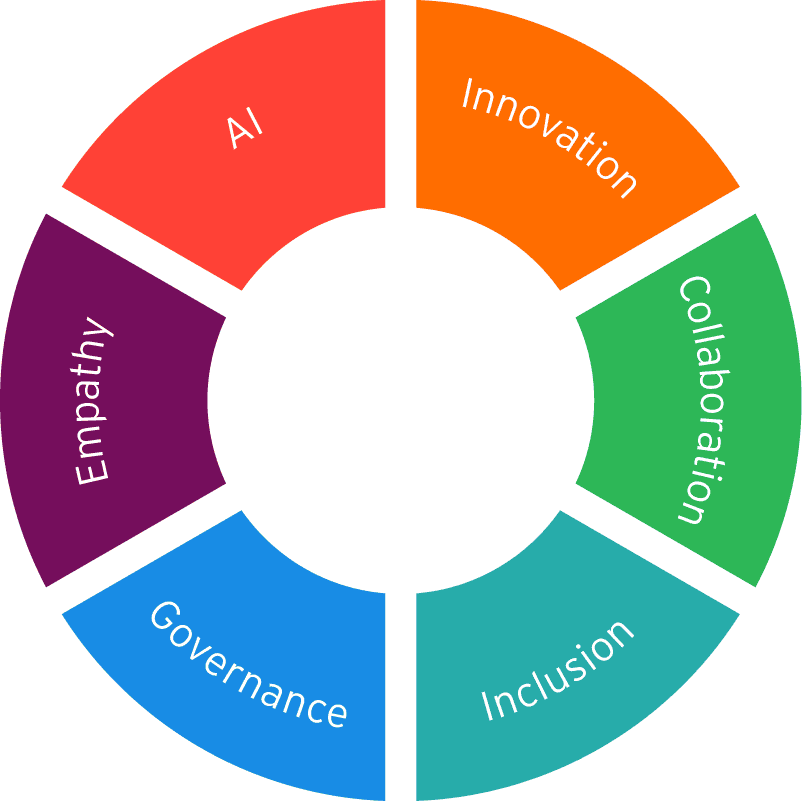
Figure 2. The Symbiotic Workplace 2030 Wheel: Balancing technology and humanity

Symbiotic Workplace 2030 Wheel

The next steps: turning insight into action

Transformation doesn’t need to be massive — but it must be intentional. These considerations provide ways to thrive in such an uncertain world:

  1. Audit the human-AI interface — Identify where algorithms and humans meet. Ask: does this tool empower or monitor?
  2. Reskill for human strengths — Prioritize adaptability, curiosity and moral reasoning. Partner with academia for AI-literacy curricula.
  3. Redefine success metrics — Measure trust, inclusion and creativity as rigorously as output.
  4. Communicate the “why” — Explain how AI supports both business outcomes and human growth.
  5. Pilot and iterate — Launch co-creation pilots. Collect feedback. Scale what enhances meaning, not just metrics.

The leadership imperative

For leaders, the challenge ahead is more than technological. We must redesign work as a partnership between empathy and intelligence; build cultures that reward curiosity, not compliance; and measure success not by how much AI can do, but by how much more human your people can become because of it. AI will not replace leaders. But leaders who learn to lead with AI — responsibly, inclusively and transparently — will define the next decade.

Special thanks to Chandra Shukla and Kay Youngstrom for contributing to this article.


Summary 

By 2030, half of all employee interactions will involve an AI agent — yet the most successful organizations will measure empathy, creativity and collaboration as core productivity indicators (OECD, 2024). Workspaces will reconfigure dynamically based on mood, engagement and wellbeing data. AI will remember what humans forget — but humans will question what AI assumes. Technology may set the rhythm, but humanity will always provide the harmony.

About this article

Related articles

Onshore, offshore, agent: welcome to the modern, three-pronged workforce

AI is becoming the third pillar of the workforce. Discover how to balance human and machine collaboration for long-term growth.

The four-collar workforce: leading blended human + AI teams

As AI agents join human teams, traditional white- and blue-collar distinctions are evolving into a four-collar framework: white, blue, green and gray.

Evolving the workforce to keep pace with rapid AI advancements

Discover how a combining awareness, training and hiring can help organizations evolve their workforce to fully leverage AI and create lasting value.