






Long pipeline system transporting energy across a vast, green landscape towards a setting sun in the mountains

How energy is cautiously entering the next stage of AI adoption

An EY survey shows that executives are evolving AI governance and strategies and pinpointing how investment translates into productivity.


In brief
  • In oil and gas, established processes should be reimagined for new ways of working through AI, and silos should be demolished in favor of greater integration.
  • Without as much profit motive, power and utilities companies are exploring how AI can deliver greater consumer reliability even as it further strains grids.
  • To build a better foundation for AI, particularly as agentic capabilities rapidly scale, executives need to emphasize cohesive data and integrated operations.

Across industries, organizations are increasingly focused on deriving results from their investments in artificial intelligence (AI), the topic that’s been on the minds of C-suite leaders for at least three years. And for many leaders in energy — more than any other sector — the reality of AI maturity is starting to come into focus: setting up the guardrails and governance as the technology handles more work, building upon the momentum for strategic transformation, and connecting investment to productivity gains.

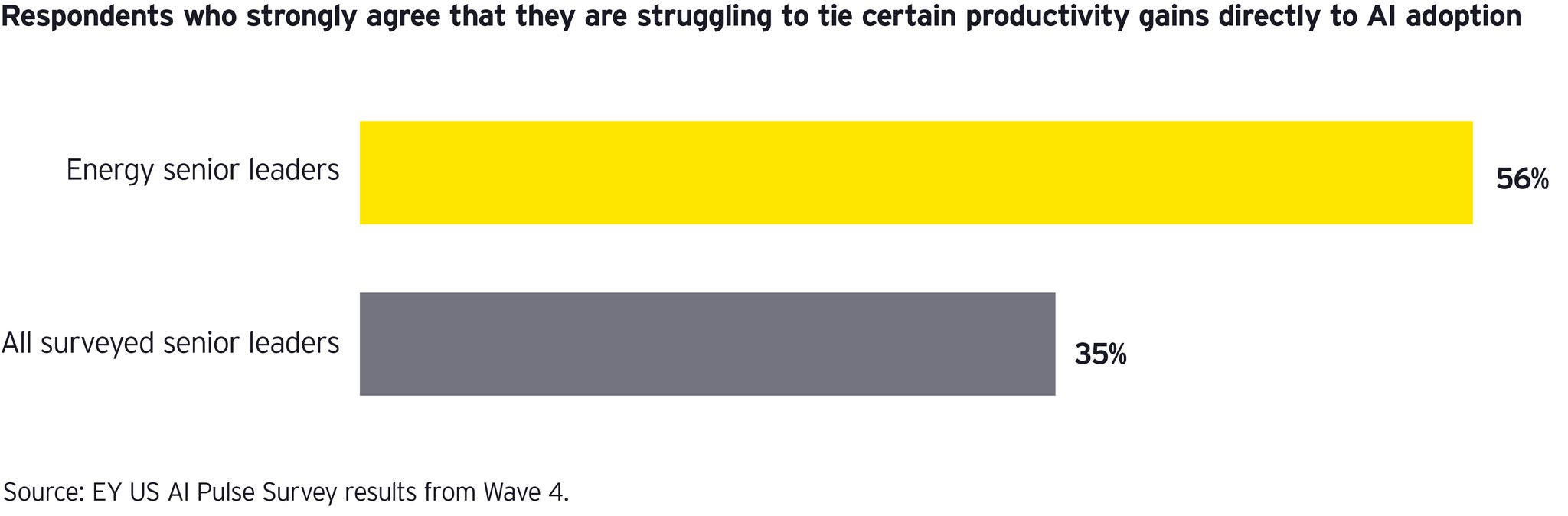
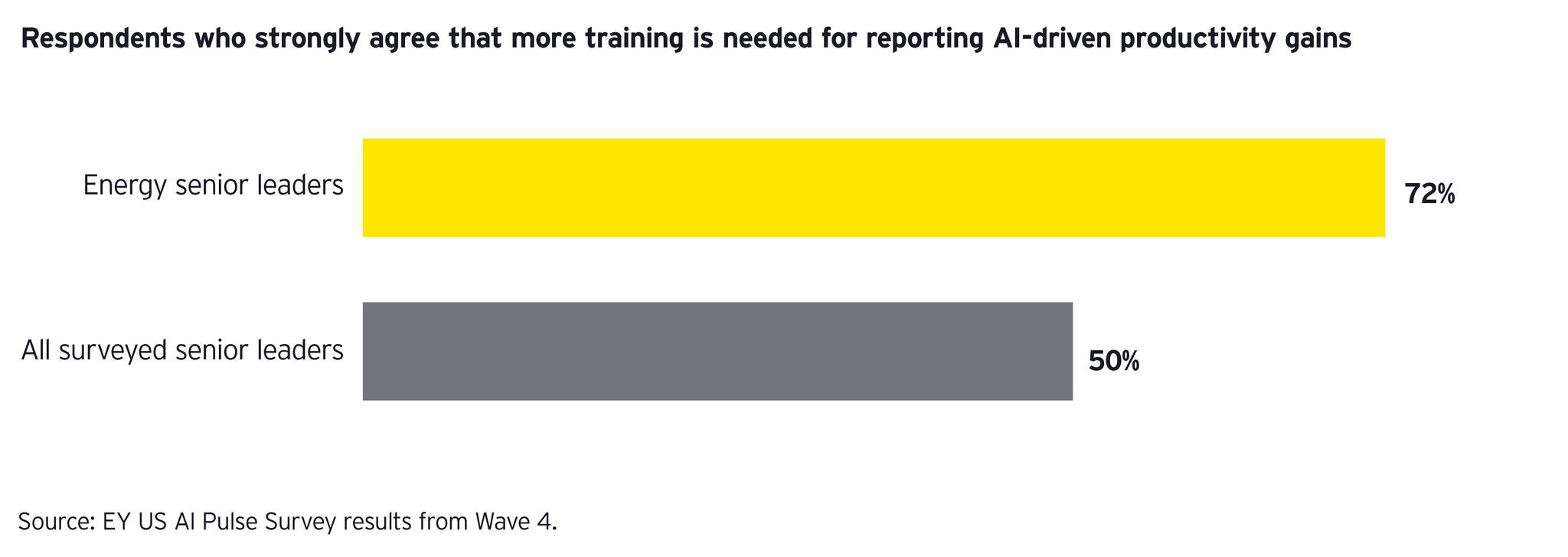
In sector-specific data from the December 2025 EY US AI Pulse Survey, 72% of energy senior leaders say their organization’s interest in responsible AI has increased over the past year — a jump of 25 percentage points since July 2024, the highest of any industry. Of those whose organizations are investing in AI and have seen productivity gains driven by AI, 78% strongly agree that those improvements are a catalyst for strategic transformation, while the average across industries is 55%. And there are other outliers in energy:


Certain productivity gains directly AI adoption


Reporting AI driven productivity gains


That said, the nature of subsectors within energy — whether in highly competitive oil and gas or in highly regulated power and utilities — tells different stories about adopting AI and building for the future with it. Here are snapshots of how they are thinking about AI, adding responsible AI and measuring impact.

Oil & gas and chemicals

Scaling AI drives ROI, but many companies continue to struggle with evolving proofs of concept into enterprise-level transformation. The EY Future of Energy Survey from March 2025 showed both a massive upswing in technology investment as well as, perhaps predictably, strong doubts that the resulting AI capabilities, chatbots and cloud computing have paid off so far. Many oil and gas companies do have the technology, such as AI models, digital twins and analytics — more so than many organizations in other sectors.


But to get the conversion effects from AI, it’s a matter of eliminating silos, not rebuilding from scratch, similar to efforts out in the field to squeeze more production out of traditional reserves. In many cases, “integrated oil companies” are anything but integrated: Insights into all the assets they need at each part of the lifecycle are instead siloed.


For example, field and process control networks are kept separate from the corporate environment at many companies, a security architecture originally designed for safety, reliability and uptime. Yet, because data cannot flow across the asset lifecycle, AI’s ability to deliver value is limited — and organizations are not protected by sacrificing value. The boundaries between IT and operational technology (OT) must be modernized, not collapsed: Executives can enable controlled, risk-based data access through new security, integration and monitoring capabilities so AI can optimize performance, predict failures and improve decision making without compromising safety.

By taking agentic AI seriously, leaders today must reassess and reimagine processes for synergies across the enterprise, setting the foundation for scale. Major oil and gas companies have been around for over 100 years, and employees do things because they always have, for reasons that may have become untethered from reality. The mantra should be to do new things with AI, not to do old things differently, and oftentimes that begins with finding and eliminating unnecessary churn in systems.

Executives also find themselves in an age-old quandary with technology: how to push for productivity gains while reassuring employees concerned about job security, which inhibit AI adoption and experimentation.

For oil and gas companies, responsible AI involves:

  • Know where AI is being used and tier models according to risk levels because limited resources require prioritization. Executives should be asking questions like: What data is feeding the model? What is the output?
  • See the organization in full to understand its patterns and behaviors, leveraging more tools than ever to address safety and risk without minimizing the upside of AI. Modernize infrastructure enough so that AI can be leveraged from end to end. Without cohesiveness from cross-functional data, for example, AI can be ineffective or even destructive, highlighting the perils of “garbage in, garbage out.”
  • Understand that “responsible AI” is what enables organizations to do more with AI, especially as regulation takes shape — much like brakes on a car provide the confidence to accelerate.

Power and utilities

In this sector, AI has been spoken about more in aspirational terms, as silos and different operating companies make it harder to achieve the end-to-end thinking that AI needs across enterprises. And power and utilities (P&U) is the only industry with three charts of accounts/ledgers: for Federal Energy Regulatory Commission reporting, tax reporting and SEC reporting. That’s a separate layer of systems and processes that a lot of other industries don’t have.

Now the conversation is beginning to shift as agentic AI becomes more of a reality and as more P&U organizations complete enterprise resource planning system upgrades or add more advanced smart meters. Companies are asking: Can I leverage AI to make our transformation faster and cheaper? And how can I make sure the future state has AI embedded in it?

Using AI to assist customer service representatives is one thing; automating it from end to end is more powerful, but it’s a huge risk if, say, customers follow improper advice from an agent and have their lights shut off. Responsible AI provides the solution for risks such as these and allows agentic AI to potentially flourish.

This is borne out by our work with clients, who are typically avoiding high-risk or high-reward use cases. “When I go to the executive committee, data and AI governance projects get signed immediately, but for the use case in operations or customer service, they ask more questions,” one EY client executive said. “When I’m bringing in the guardrails under responsible AI, those have a faster path to get approved.”

Today, productivity and efficiency gains are not expected to translate into headcount reductions. P&U companies are more concerned with reducing operations and maintenance costs while achieving public-facing metrics such as reliability, safety and customer satisfaction — goals that must also be affirmed in their rate-making cases. Yet the other side of AI is the demands it is expected to place on the grid, forcing executives to think in terms of long-term plays, not quick wins on labor costs.

Tactics for P&U executives to move the needle on AI include:

  • Capitalize AI as an asset up front and then deploy more operations and management use cases to lower costs. Insight readiness and preparedness in operations will be focus areas more than in other sectors, including workforce management and optimization and predictive maintenance, as a way to avoid outages and boost impressions with customers and commissions.
  • Get ahead of the curve on data maturity and controls. Invest in data as one would with any other enterprise asset. P&U organizations are good at protecting large data silos. But integrating disparate data is hard, as a common data model is often missing across fragmented systems and applications. The old mentality for P&U was, “You don’t want to be last but second-to-last.” The industry is shaking off that mindset, with more prodding from regulators, but it remains behind other sectors. Most P&U organizations also don’t have a high-ranking lead for data, showing how it’s not prioritized as much as it should be.
  • Appeal to talent with a disruptive mindset. The future workforce sees P&U as a bit stodgy as compared to pure tech companies, financial services or retail and consumer products. As a result, natural, tech-led cultures are not prevalent in the subsector, and people need more training. Pockets of progress are more likely to develop than functional disruption or enterprise transformation. Create a culture that embraces change, strengthened with responsible AI.

How energy organizations are realizing value from agentic AI

Summary

Successful AI implementation can be measured through operational efficiency and automation of routine tasks, yet that barely scratches the surface of how transformative this technology can be — from improving safety, to monitoring equipment and environmental conditions in real time, to driving environmental sustainability, and improving forecasting accuracy. The nature of how work is done, and how it is powered, can be reimagined for those who make strides today.

About this article

Authors

Related articles

The dividend age: How AI is turning promise into payoff

This AI survey shows how AI investments are turning into business productivity gains and significant financial performance.

How digital twin technology powers the future at Xcel Energy

Next-gen technology drives new strategies to surpass customer and stakeholder expectations. Learn more.

EY Future of Energy Survey

Explore how energy companies are evolving in technology adoption and workforce readiness, addressing challenges and bridging the investment-expectation gap.