




Vibrant Fingerprint Art

FinCEN’s focus on Mexican-based cartels and foreign nationals

How to protect your organization from regulatory, legal and headline risks


In brief
  • FinCEN reports rising coordination between Mexican cartels and Chinese laundering networks posing systemic financial crime risk.
  • Sophisticated laundering methods enable rapid movement of illicit funds across multiple jurisdictions.
  • Institutions should enhance monitoring and due diligence to mitigate regulatory, legal, and reputational exposure.

Introduction

On 28 August 2025, the Financial Crimes Enforcement Network (FinCEN) released an advisory, alongside a Financial Trend Analysis, on the integration of what it termed as “Chinese Money Laundering Networks (CMLN)1” with Mexico-based transnational criminal organizations (cartels) to facilitate the laundering of illicit funds.

According to US government reports, law enforcement advisories, and regulatory communications, this collaboration poses a significant challenge for global financial systems — including financial institutions, non-bank financial entities, digital asset organizations and money services businesses — and law enforcement agencies as these professional money launderers employ sophisticated tactics to obscure the origin of funds and quickly move across multiple international jurisdictions. US agencies such as the Department of the Treasury, the Drug Enforcement Administration (DEA), and FinCEN have highlighted these risks in recent public statements and advisories.

For example, cartels source chemicals essential for certain drug production from foreign suppliers, using funds laundered through CMLNs2. CMLNs facilitate this by employing informal value transfer systems and trade-based money laundering, allowing cartels to convert drug sale cash into usable funds while avoiding regulatory scrutiny. Additionally, recent designations of Mexican cartels as Foreign Terrorist Organizations (FTOs) have introduced new legal frameworks for combating their operations. This designation allows for the freezing of assets and enhanced surveillance to disrupt their financial networks supporting the cartels. As the cartels continue to adapt their strategies, understanding their financial mechanisms is essential for organizations to understand as they develop effective countermeasures. This article does not make any statements or judgments regarding the actions of any country or entity.

CMLNs role in cartel operations1

According to FinCEN analysis, this mutually beneficial relationship rose out of local currency controls in place in both Mexico for US dollar deposits and China for caps on annual foreign currency conversions.

The three overarching typologies for money laundering that CMLNs employ:

1. Mirror transactions

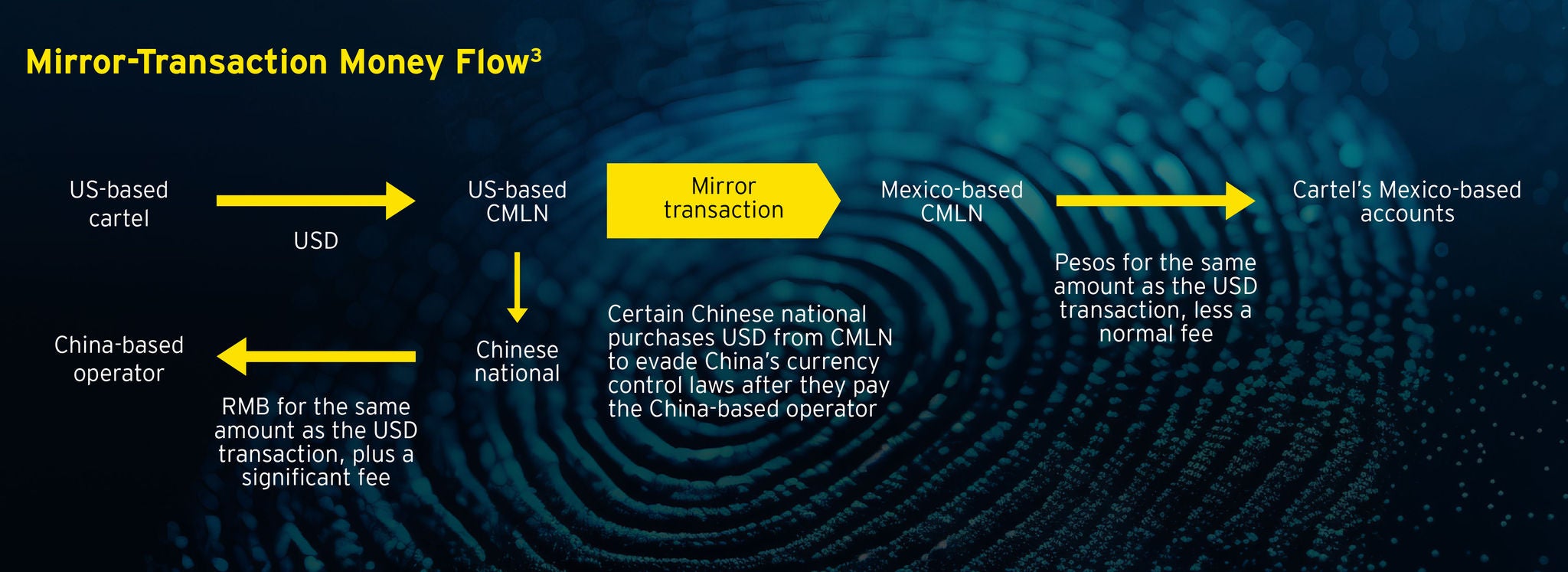
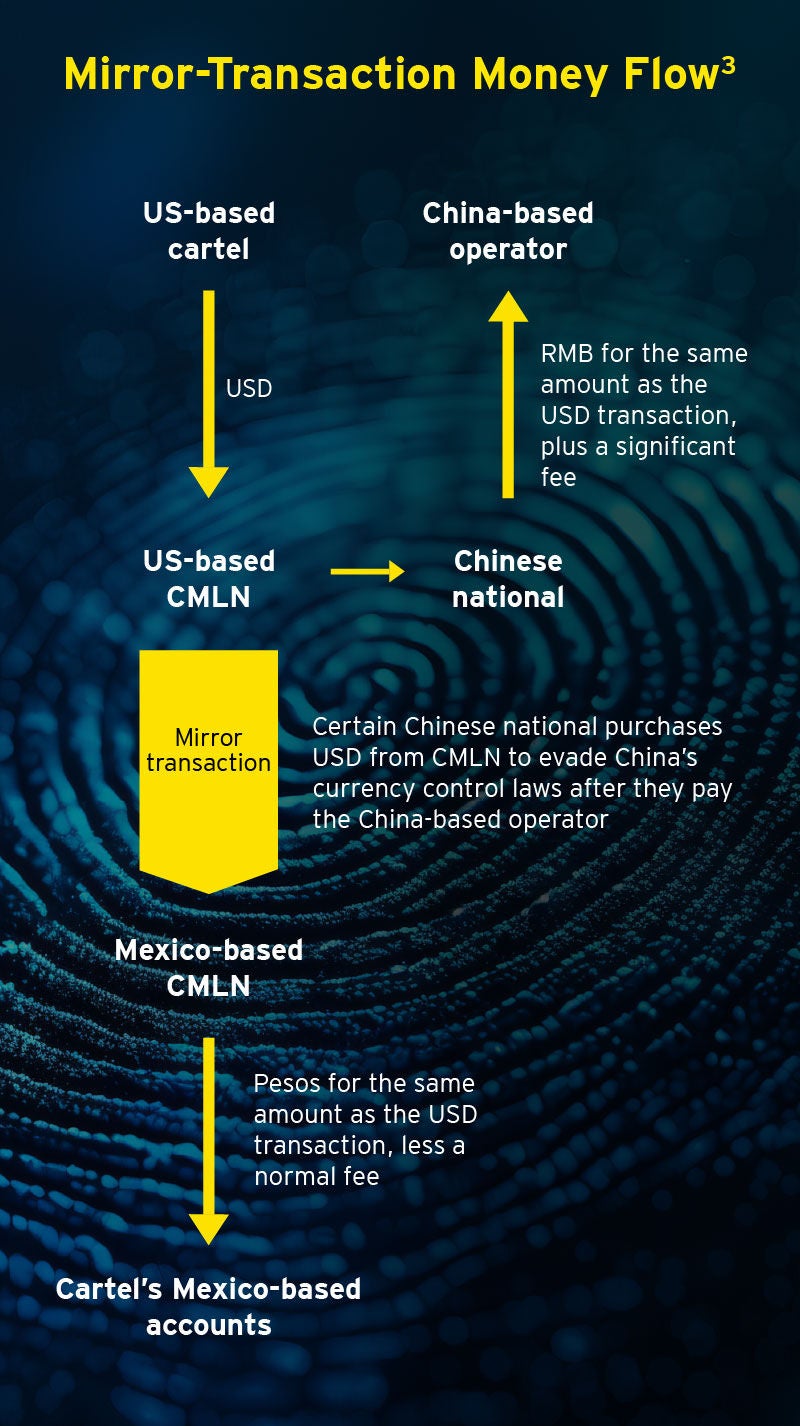
When a US-based CMLN receives US dollars (USD) from the cartel, it coordinates with Mexican counterparts to transfer an equivalent amount of pesos to the cartel’s accounts, circumventing bulk cash smuggling risks and deposit restrictions. CMLNs may also use convertible virtual currency (CVC) to sell USD to certain Chinese buyers, evading currency control laws and further obscuring the funds’ origins.

2. Money mules

CMLNs often recruit certain US-based Chinese nationals, including students, as money mules, who may be unaware of their illegal involvement and attracted by promises of easy income.1 These individuals frequently report low-income occupations and may present counterfeit Chinese passports, with CMLNs depositing funds into mule accounts and transferring them via wire, automated clearinghouse (ACH) or peer-to-peer (P2P).

3. Trade-based money laundering (TBML)

CMLNs employ TBML techniques to obscure the origins of illicit funds and generate revenue, making it an ever-evolving challenge. Goods purchased through money mules are funnelled through shell or front companies for resale or export, often leveraging online marketplaces or direct sales to cartel-owned companies in Mexico. Additionally, CMLNs collaborate with “daigou” buyers — individuals who purchase goods on behalf of others — further complicating the laundering process.

Advancing your compliance program to protect against CMLN and Mexican cartel activity

Organizations can proactively track and mitigate risks associated with CMLNs and cartel activities by enhancing their compliance programs. By recognizing specific red flags indicative of CMLN involvement and cartel financing, such as the examples below, organizations can better identify suspicious activities and strengthen their defenses against these illicit networks:

  • Account holders with low-income occupations (e.g., students, housewives, laborers) exhibiting unexplained wealth and engaging in high-value transactions inconsistent with their stated employment.
  • Payments made to businesses, such as real estate firms, using cashier’s checks or large wire transfers that do not align with typical transaction patterns. Large wire transfers could potentially be structured to remain below applicable suspicious activity report (SAR) reporting thresholds to obscure the true nature of the transactions and may indicate an attempt to evade detection by regulatory authorities.
  • Frequent deposits or withdrawals that are unrelated to the customers’ payroll, living expenses or expected financial activity. 
  • Customer reluctance or refusal to provide adequate documentation regarding the source of funds for significant purchases, such as real estate or tuition payments.
  • Incoming wire transfers from jurisdictions, such as Mexico, China Mainland, Hong Kong or the United Arab Emirates (UAE), directed to US-based small businesses in sectors like electronics or real estate that lack established ties to those regions.
  • Elevated levels of cash activity at branches and ATMs, particularly in high-risk areas, which may indicate money laundering operations. High-risk areas include geographic locations that are identified as having a higher likelihood of criminal activity, due to factors such as elevated crime rates, presence of organized crime or known associations with illicit activities.
  • Involvement with third-party entities that have potential connections to CMLNs or Mexican cartels, raising concerns about the legitimacy of transactions.

The graphic below illustrates a simplistic example of how funds flow between cartels and CMLNs.

Mirror transaction Money Flow

Essential practices for effective AML compliance

Ongoing vigilance, technological advancements, and international cooperation are essential to combat transnational crime. Review your compliance program to confirm you have the following:

About this article

Related articles

How cartels as foreign terrorist organizations create compliance risks

A new executive order designating drug cartels as foreign terrorist organizations presents compliance challenges for financial institutions. Learn more.