






circle panorama of city / 360 panorama of city

How AI operations and strong AI governance boost insurer confidence

With a unified approach to AI operations and governance, insurance firms can accelerate adoption with measurable results.


In brief
  • Insurance companies should establish strong governance frameworks and transparency to reduce the risks associated with AI models.
  • A centralized solution that maintains comprehensive visibility can enhance operational efficiency and foster trust with stakeholders.

Insurance companies are increasingly turning to data-driven artificial intelligence (AI) as a powerful ally to boost operational efficiency, improve risk assessment and build customer trust. However, the unpredictable nature of AI models introduces considerable risks that may threaten a company's reputation and undermine customer confidence. By establishing strong AI operations and robust governance frameworks, insurers can streamline their processes and actively manage the risks associated with AI. Transparent usage and well-defined governance structures, aligned with strategic objectives, empower insurers to effectively monitor progress and outcomes. What follows is a unified approach to AI that not only instills confidence in leadership but also simplifies the measurement of benefits and return on investment.

Discover why insurers need strong AI operations, governance and an AI control tower.


Establish risk management and AI governance practices

Responsible practices are essential for navigating the complexities of algorithmic decision-making. This involves focusing on model risk management, addressing privacy concerns, managing third-party AI usage and maintaining regulatory compliance. Organizations should adopt responsible AI principles that emphasize accountability, data protection, reliability, security, transparency, explainability, fairness, compliance and sustainability. Effective governance also must be established to identify risks and regularly update security processes, allowing oversight to evolve with the AI landscape.


Implement AI governance approvals and workflows

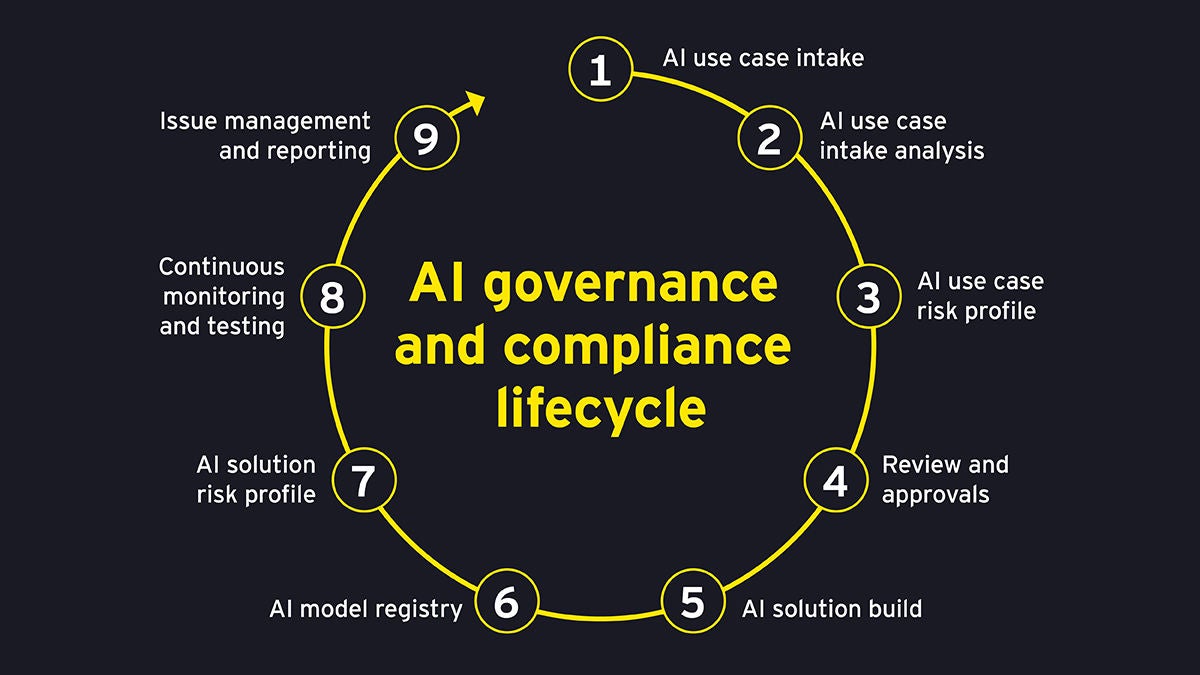
Effective AI governance involves a circular set of activities rather than a linear process. These nine steps form a leading practice for AI approvals and workflows:

2602-10653-CS_AI-ControlCenter_web-graphic

Operationalize AI execution

An AI Center of Excellence (AI CoE) is vital for promoting best practices. By consolidating knowledge and resources, the AI CoE ensures that AI projects align with the organization’s goals and adhere to established standards. Led by the chief AI officer (CAIO), the AI CoE builds accountability by setting up strong frameworks to reduce risks and improve compliance for AI initiatives. As companies deploy AI models, using smart automation and real-time risk checks is important for quick and large-scale implementation. Without automation, keeping pace with fast-changing AI technology becomes increasingly challenging.
 

For AI to work well, robust IT systems are needed to monitor various risks, including model drift, bias, fairness, unusual use and ROI. By using advanced monitoring tools, organizations can track model performance and usage, allowing for early identification of potential issues. This careful approach helps maintain the reliability and effectiveness of AI systems.
 

Using a standardized platform is also important for creating consistency in terminology and metrics, which fosters trust in AI outputs. Many organizations struggle with custom AI solutions, particularly if there is a variety of models from different vendors. Without standardization, comparing model performance becomes difficult. A unified platform allows organizations to adopt a consistent approach, facilitating meaningful comparisons and improving overall AI governance.

Unlock insights to track AI effectiveness

For effective oversight, executive teams in insurance organizations require comprehensive visibility into AI adoption, performance, governance and monitoring. Key requirements include clarity on deployed AI models, enhanced risk controls, minimal intervention for visibility into AI usage, tracking the business value generated by AI initiatives, calculating ROI, streamlining approval processes and ensuring consistent model availability. To meet these needs, organizations should implement a robust AI governance and operational controls system that includes tools for AI model management, risk management, monitoring and analytics, business intelligence, approval workflow management, model performance monitoring and data governance. 

Because AI systems are complex and impact nearly every aspect of an organization, there isn't a single ready-made tool that gives a complete and clear view of AI risks and operational monitoring across the enterprise. Our alliance partner ServiceNow, which handles 60 billion workflows each year for more than 90% of Fortune 500 companies, addresses this challenge with the AI Control Tower (AICT).   It creates a central way for teams to see and manage all AI projects while driving alignment, reducing risks and tracking value. AICT works with different company systems to connect all AI assets to monitoring tools, making it possible to clearly see the human risks tied to each asset. With this setup, insurers can quickly spot major risk areas and respond to changes in how AI is used or how models perform, allowing for quick and effective management of AI risks.

By prioritizing transparency, establishing strong governance frameworks and leveraging centralized oversight, insurance firms can navigate the complexities of AI implementation. This strategic approach enhances operational efficiency while building trust with stakeholders, positioning organizations for long-term success in the evolving landscape of AI technology.

Thank you to Nigel Walsh Global - Head of Insurance GTM, ServiceNow, Mark Bagley - Global Partner Leader - EY, ServiceNow, Gregory Kanevski - VP, Financial Services GTM, and Drew Federico - Senior Manager, EY, for contributing to this article.

Summary 

Insurers are turning to AI driven by data analytics to improve operations, enhance risk management and strengthen customer relationships. However, AI’s unpredictable behavior can challenge brand reputation and customer loyalty. To mitigate these risks, insurers should build robust AI operations and governance, including ethical standards, formal approval workflows and dedicated oversight teams like an AI Center of Excellence. Using centralized management platforms ensures transparency and visibility across AI projects, fostering openness and positioning insurers for success as the AI landscape continues to evolve.

About this article

Authors

Related articles

Why operational resilience is a strategic priority for insurance CROs

The second annual EY/IIF insurance risk management survey highlights the importance of resilience and how CROs aim to instill it. Learn more.

Stu Doyle + 1

AI and compliance analytics: driving value for insurance carriers

An EY survey shows how insurance compliance risk analytics and AI can drive value for insurance firms. Learn more.

The age of autonomous technologies in insurance: separating myth from reality

Discover how autonomous frontier technologies, like agentic AI, driverless vehicles, and humanoid robotics, are poised to transform the insurance industry.