Business woman, glasses and working on laptop in office for planning, reading email and internet research in law firm.

Merger Monthly series

US M&A activity insights: April 2026


US M&A activity strengthened in February to April 2026 driven by megadeals. Deal values rose sharply on fewer larger transactions.


In brief
  • Technology, life sciences, consumer products and retail led in mergers and acquisitions (M&A) value, driving the strongest gains in total deal value.
  • US M&A remains strong into 2026, though geopolitics could disrupt some of the momentum.
  • Consolidation deals build larger platforms to broaden offerings and improve margins and resiliency through scale.

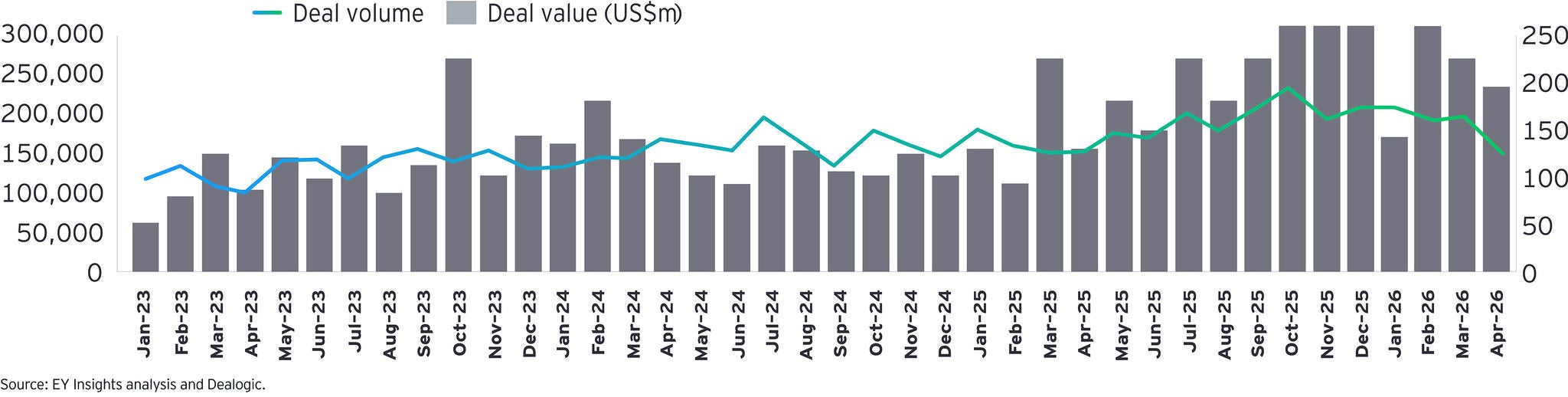
Corporate dealmaking accelerated over the last three months (February to April 2026), with transactions above US$100m rising 65% in value and 17% in volume compared with the same period in 2025. This heightened M&A activity was led by a resurgence in US$5b+ megadeals, where value surged 149% alongside a 94% swell in volume, reinforcing a clear prioritization of large deals. The regulatory environment and robust equity markets encouraged corporate boards to confidently pursue strategic acquisitions. Buyers remain highly motivated to secure AI-ready capabilities and maintain or grow their market positioning.

According to EY-Parthenon Chief Economist Gregory Daco, US economic activity remains on solid footing and US economic conditions remain broadly resilient, though rising geopolitical uncertainty and inflationary pressures continue to influence deal pricing and timing, particularly in sectors exposed to energy and supply chain volatility.

Monthly M&A trend (2023 onwards)

Deal value (US$100m+); deal volume (US$100m+)

Monthly M&A trends chart - April

Scaling and consolidating core business platforms for synergies

Recent deals increasingly aim to create scaled platforms through consolidation. These transactions have targeted significant cost synergies, broader category coverage and stronger cash flow generation, reflecting a strategic emphasis on operational efficiency, a portfolio focus and market leadership. Overall, this pattern highlights a focus on improving the margin potential and business resilience through scale, integration and streamlined operations.

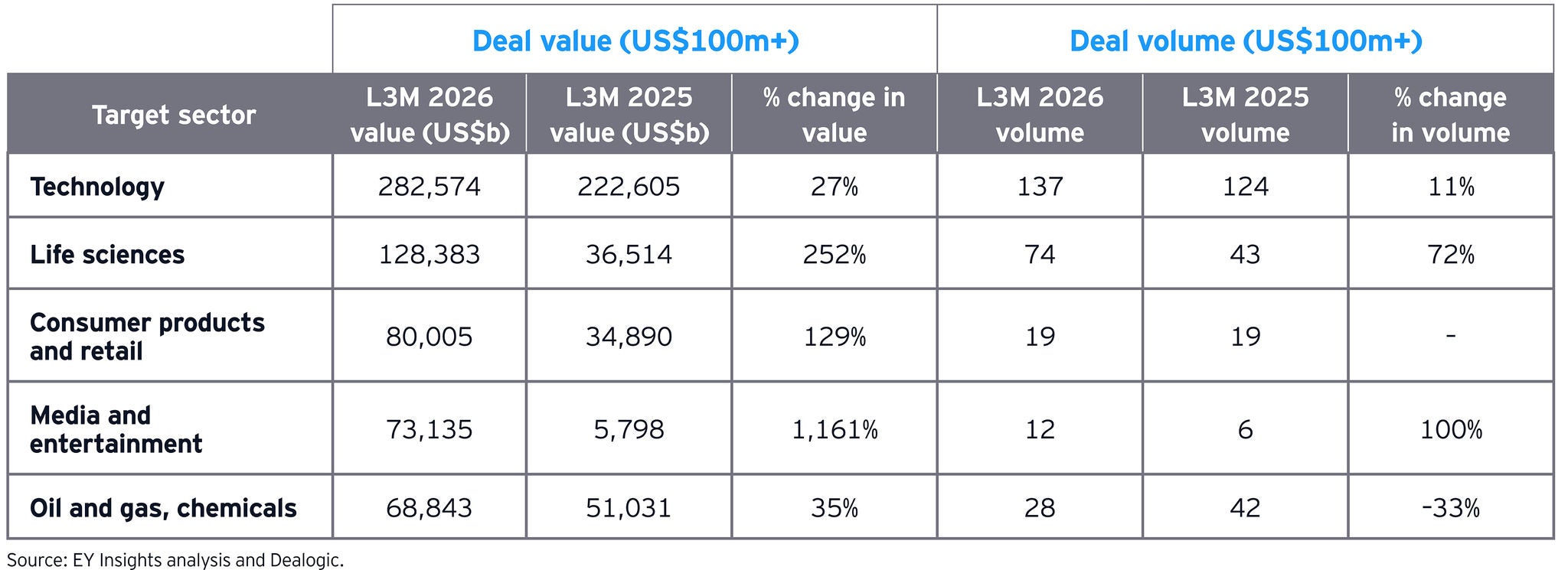
US sector breakdown for top deals (US$100m+) – last three months (L3M), February to April 2026

Sectors that fueled deal activity over L3M

US sector breakdown for top deals - Apr2026

Sector highlights

M&A activity over the last three months compared with the same period last year showed significant growth in the deal value across these sectors.

Technology

M&A activity strengthened over the period, with deal values up 27% and volumes rising 11%, reflecting continuous confidence in long-term digital infrastructure investments. Capital concentrated around frontier AI models, compute-intensive platforms and facilitating infrastructure as buyers prioritized securing capacity and scalability. Transactions highlighted a shift toward vertically integrated ecosystems.

Life sciences

M&A accelerated sharply, with deal values up 252% and volumes rising 72%, reflecting a decisive rebound in strategic activity. Buyers focused on scaling differentiated platforms across therapeutics, MedTech and biosimilars, prioritizing assets with clinically de-risked profiles. The momentum was driven by pipeline reinforcement ahead of patent cliffs, access to scalable manufacturing and delivery platforms, and the use of strategic partnerships to improve research and development (R&D) productivity and the speed to market.

Consumer products and retail

The sector saw deal values surge 129%, while volumes remained flat, indicating a concentration of capital into fewer deals that investors felt the most confident about. Activity focused on scale creation, category consolidation and premium brand platforms with strong unit economics. Strategic buyers targeted assets that expand margin accretive adjacencies, strengthen supply chain control and enhance the global distribution reach.

Media and entertainment

The sector registered a significant surge in deal value, increasing by 1,161%, with volumes doubling, reflecting a sharp reacceleration in dealmaking. Activity centered on scale creation in content and rights ownership, portfolio simplification and platforms with recurring cash flows. Buyers targeted assets that unlock valuation re-rating, strengthen the global reach, and improve monetization of high-quality catalogs through technology and data-driven distribution. 

Oil, gas and chemicals

M&A activity in the sector became more selective, with deal values up 35% despite a 33% decline in volumes, reflecting a focus on fewer larger consolidation plays. Activity centered on consolidation with the same production region fleet and infrastructure enhancement and selective portfolio pruning. Buyers focused on capital discipline, boosting shareholder returns, and positioning portfolios toward low-cost but high-return assets.

Looking ahead

The US M&A environment is expected to remain active, underpinned by a reopening of deal confidence, continued strategic urgency and ample capital seeking deployment. The global M&A value is estimated to reach ~US$3.8t¹ by the end of 2026, supported by corporate growth strategies and continued private equity exit needs.

However, geopolitical risk remains a defining headwind for 2026, with energy price volatility, trade friction and conflict-related uncertainty complicating underwriting assumptions and extending deal timelines, particularly in energy-intensive, industrial and cross-border transactions.

The EY-Parthenon CEO Outlook Survey reinforces this sentiment, highlighting that geopolitical risk has become the most significant near-term concern for global CEOs, with more than half (56%) identifying it as a key threat to their business. However, CEOs are not retreating from growth initiatives but are tightening their investment discipline, prioritizing profitability and financial resilience. Against this backdrop, 2026 is likely to be shaped by a combination of sustained large cap momentum, selective reopening of mid-market activity, and continued strength in technology (specifically AI, data and cybersecurity) and industrial sectors.



Summary

February to April 2026 corporate dealmaking accelerated, with US$100m+ transactions up 65% in value and 17% in volume year over year, driven by a rebound in US$5b+ megadeals. Easing rates and strong equity markets boosted board confidence, while buyers pursued AI-ready capabilities and sector consolidation to build scale, synergies and resilience — signaling sustained M&A activity.

Explore recent editions


US M&A Insights
March 2026


US M&A Insights
February 2026


US M&A Insights
January 2026


About this article

Authors


Contact our M&A advisory team
Get in touch to learn how EY can help with your M&A strategy. 

Related articles

Can disciplined ambition unlock growth in a volatile global economy?

Explore CEO 2026 priorities: disciplined growth that ties AI to ROI, embeds geopolitics into strategy and uses M&A to compete amid volatility.

Private Equity Pulse: key takeaways from Q1 2026

The PE Pulse is a quarterly report that provides data and insights on private equity market activity and trends. Read the latest report.

Macro Bites: PE deals increase as valuation gaps shrink, dry powder available

Private equity leaders should invest in AI, prepare for exits, and engage stakeholders to seize new market opportunities. Watch more on Macro Bites.

M&A outlook: stronger US deal market in 2026 despite mixed economic signals

The EY-Parthenon Deal Barometer, informed by our US economic outlook, predicts robust US deal volume growth through 2026.