


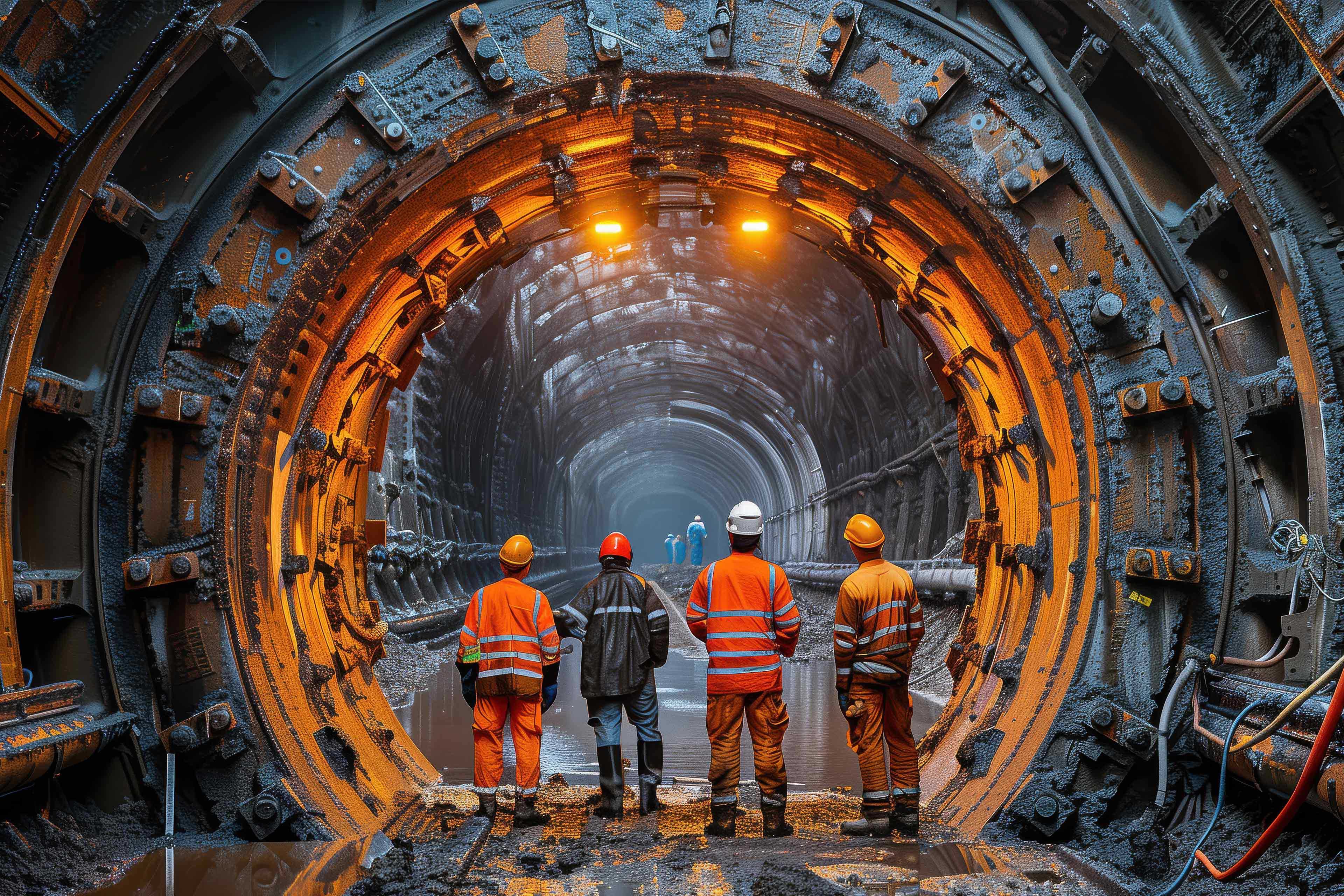



Engineers in control room overseeing operations at mining site

Under pressure: how evolving tariffs are reshaping metals and minerals

Related topics
This article is co-authored by:
  • Helen Byon, Partner, Global Trade, EY Law LLP (Canada)
  • Alicia Dominguez, EY Chile Mining and Energy Leader; Partner, EY Consultores Limitada
  • Rodrigo Ochoa, EY Mexico International Tax and Transaction Services Leader; Partner, Mancera, S.C.

In a geopolitically charged trade environment, metals and minerals must adopt new approaches to thrive amid continued tariff uncertainty.


In brief

  • Recent changes in tariff and trade policies are having a profound effect on the metals and minerals sector in the US, Canada and Latin America.
  • It will be essential for companies to stay informed of evolving tax and regulatory developments to manage regional risks effectively.
  • Proactive and innovative considerations and supply chain approaches will support leaders in navigating tomorrow’s complex environment and acting with purpose.

With global trade dynamics continuing their shift, metals and minerals organizations around the world are entering a period defined by tariff uncertainty and driven by geopolitical tensions, changing policies and the need for an economic recalibration.


Businesses can expect rising costs, continued supply chain disruption and shifting market conditions, demanding that companies remain alert, plan ahead and be ready to jump on change. EY recently hosted a tax webcast with metals and minerals sector leaders from across Canada, the US, Mexico and Chile to discuss the implications of uncertainty and how changing dynamics may impact future landscapes as businesses anticipate what comes next.


While not entirely unforeseen, the insights shared were compelling. When polled, many — if not most — attendees indicated plans were already underway to respond to volatility and limit risk exposure. But as governments around the world continue to deploy new policies, trade barriers and import taxes, it is clear that navigating continual change will require agility, foresight and a deep understanding of domestic and international trade frameworks.


Exactly where the webcast dialogue began. Moderated by EY Americas Metals and Mining Tax Leader Greg Matlock, the session kicked off a discussion focused on three topics: the current tariff and trade landscape and what EY leaders in the three regions have observed happening in recent months, the latest developments in trade and tariff policies and the potential impact that evolving and contributing factors taking place in these regions could have Americas-wide.

A global purview – setting the stage

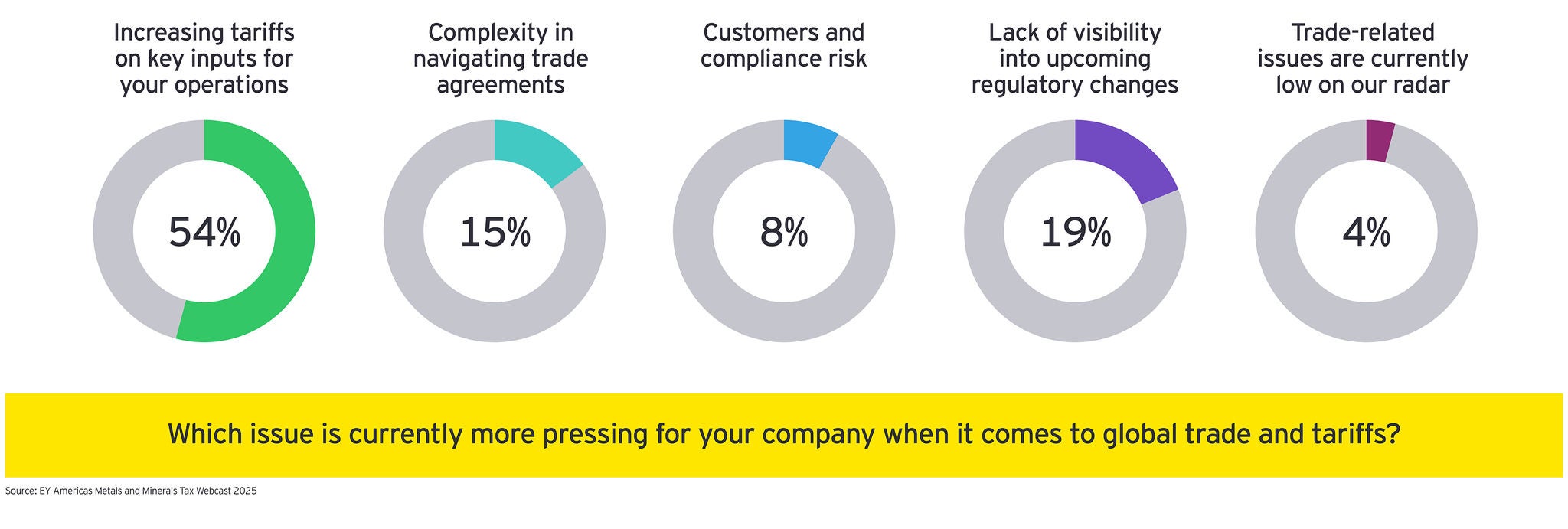
First item on the webcast agenda? Exploring trade landscapes and the potential impacts industry should be bracing for in each of the Americas regions represented. But before the conversation kicked off, a pulse-check poll of the 400-plus executives and specialists dialed in kicked off on the topic of tariffs, trade and transparency:

which issue is currently more pressing for your company when it comes to global trade and tariffs chart

Of those grappling with trade concerns, more than half claimed tariffs as their number one issue, followed by a lack of visibility into regulatory changes, accounting for 19% of responses. It was clear validation the landscape is reshaping the sector in myriad ways, calling for new methods, reinvented supply chains, operating and pricing models and the fresh thinking needed to bolster investment decisions.

The US

Starting with the biggest country, the US is a clear contender when it comes to impact, both at home and abroad. US metals and minerals continue its roller coaster ride when it comes to trade policy.

Following court proceedings potentially impacting presidential use of the International Emergency Economic Powers Act (IEEPA) to impose broad-based tariffs, the administration continues to use these powers to impose import tariffs for Canada and Mexico to 25% with current threats to impose a 35% tariff 1. Sectoral investigations — like the one on steel and aluminum, for example — impose tariffs on derivatives as high as 50% 2 , upping the obligations of importers. And with investigations underway on more than 200 other products, including critical minerals and copper (with a tariff of 50% to go into effect Aug. 1 3), the cost of goods is sure to influence investment decisions and inform opportunities.

Starting with customs classification and assessing the origin of goods, companies can determine the applicable tariff rates, evaluate if any steps apply and where necessary, evaluate sourcing to identify suppliers in regions with preferential duty rates. Where sourcing cannot be optimized, customs valuation planning can also be evaluated to reduce impact.

For example, by taking a closer look at intellectual property- where it resides and what it consists of — benefits can be structured to reduce customs value. This can be a significant lever when looking to reduce costs and positively impact revenue and profitability.

Canada

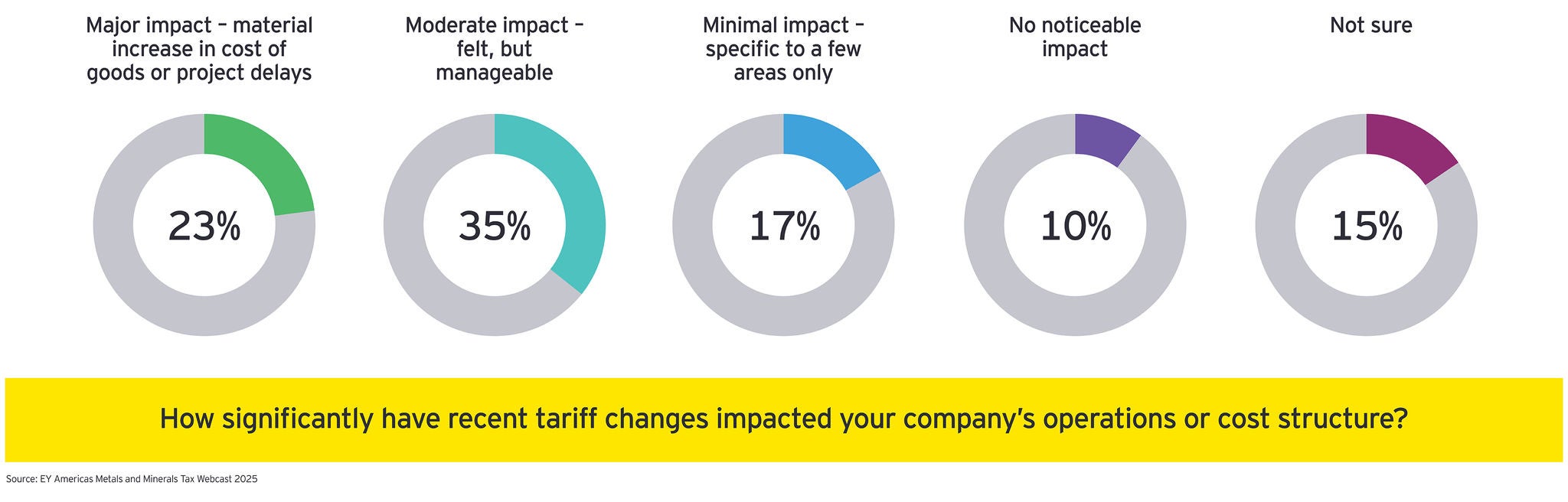
In response to pressure from the US, some of America’s closest trade partners remain in reaction mode, anticipating possible policy changes and preparing for potential impact. A challenge to many who attended the webcast, according to the second polling question:

how significantly have recent tariff changes impacted your company's operations or cost structure chart

Almost 58% of respondents anticipate that tariffs would have a major or moderate impact on operations or cost — and not only on exports to the US. Canadian counter tariff measures are contributing to the uncertainty metals and minerals organizations are facing.

In early March, the federal government introduced a 25% surtax worth a projected $155 billion on over 1,000 products coming to Canada from the US 4. A further 25% surtax on imported motor vehicles, steel and aluminum products followed shortly after, introducing new obstacles to overcome 5. To address the destabilizing effect these measures had on Canadian businesses, the government announced a relief remission process, initiating a deep-dive examination into the need for imports — from a lack of resources preventing goods from being produced in-country to down-the-line impacts on Canadian suppliers.

And while recent orders have been issued to automatically grant relief in select circumstances, they have raised questions around eligibility. Where metals and minerals producers often qualify for relief based on inputs entering the US for the purpose of manufacturing and processing, further investigation may be required to determine if imports are intended for the purpose outlined — a seemingly gray area that is prolonging the remission process.

And uncertainty doesn’t end there. In a sector dependent on heavy equipment, a 25% surtax on imported vehicles, engines and the parts needed to maintain equipment 6 used for haul trucking, for example, demands that businesses pay close attention and thoroughly think through how to manage capital and equipment needs for the future.

In addition to the outcomes of US investigations looming, concerns that such decisions may contribute to steel products being diverted into Canada are also being tabled. Governments are considering safeguards to prevent US steel from flooding Canadian markets, conducting investigations under Canada’s anti-dumping and countervailing duty laws and looking deeper at the Special Import Measures Act, which is being increasingly used as a trade remedy measure.

In Mexico

With the trade environment in such flux, it stands to reason that confusion and uncertainty at the national and international level will present similarly for sector leaders navigating the landscape with company interests in mind — those being tapped to come up with solutions, new approaches, a plan of action.

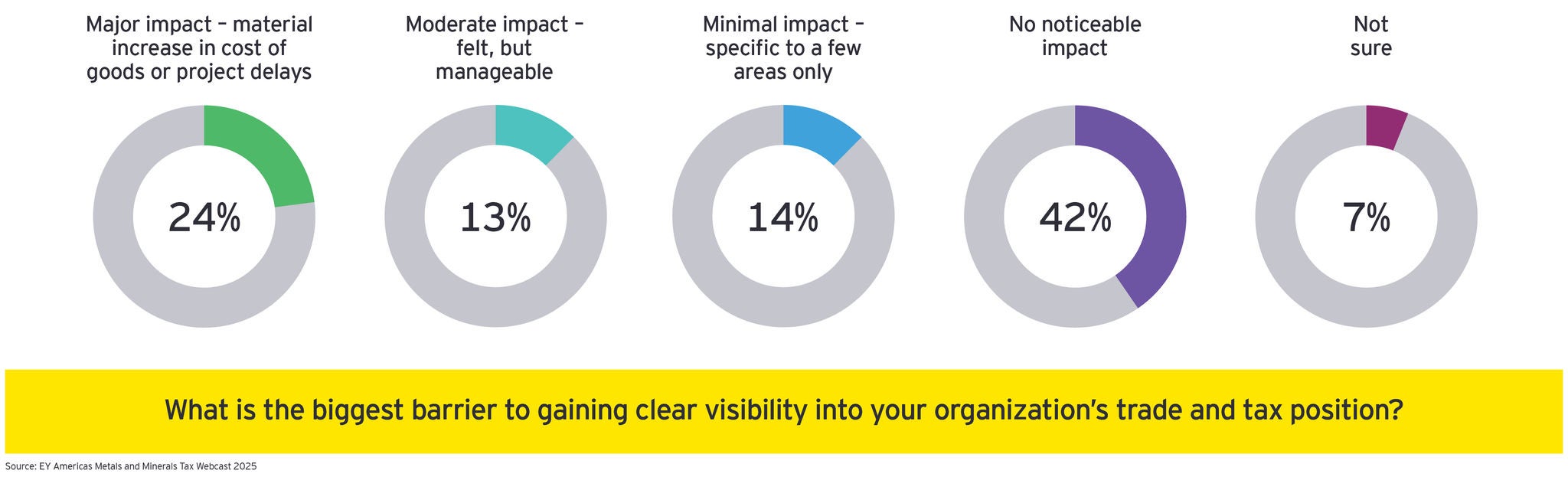
what is the biggest barrier to gaining clear visibility into your organization's trade and tax position chart

So, when asked about barriers defining their trade position, it’s not surprising that 42% of respondents directly dealing with the issue identified the challenges of forecasting policies and tariff changes as a top concern, followed by almost a quarter who listed silos across tax, trade and their supply chain as a key obstacle.

A primary culprit? Noise. And plenty of it. Similar to Canada, Mexico is facing fallout from changing US trade policies. A global leader in minerals mining — particularly silver, copper and gold — Mexico’s mining sector had previously shared low import tariffs under the United States-Mexico-Canada Agreement (USMCA). Coming regulations are expected to tip the scales.

A 25% import tariff and doubled foreign steel taxes 7 added to existing duties are sure to drive costs up. While Mexico has not imposed counter tariffs, its Ministry of Economy has released policies for industry and foreign trade that regulate the export of goods, maintain a record of foreign trade operations and strategically flag products. These policies require companies to notify authorities ten days in advance of flagged products being exported and to obtain approval before export.

In addition to restricting the movement of goods, mining royalty increases implemented in January have Special Mining Duties up a full percent — from 7.5% to 8.5% — on Earnings Before Interest, Taxes, Depreciation and Amortization (EBITDA) and duties on precious metals up from 0.5% to 1.0% of gross revenues 8. These changes potentially make Mexico less competitive on the global stage while cutting into profits.

Metals and minerals companies may already be evaluating regular tax assessments, identifying potential savings, looking for areas of improvement and regulatory compliance. Having advisors familiar with the global landscape and tax law can provide insights and identify beneficial actions across the business. And working together — in proximity and transparency — to review and strengthen current trade agreements, as US steelmakers are attempting to do with the USMCA, can help improve the environment as a whole.

In Chile

While not yet finalized and with the full impacts of these trade policy changes still unclear, there is no doubt that evolving regulations are having an impact on international trade, affecting a large number of countries and spurring anticipatory action — with the trickle-down effect impacting businesses from the top down or downstream.

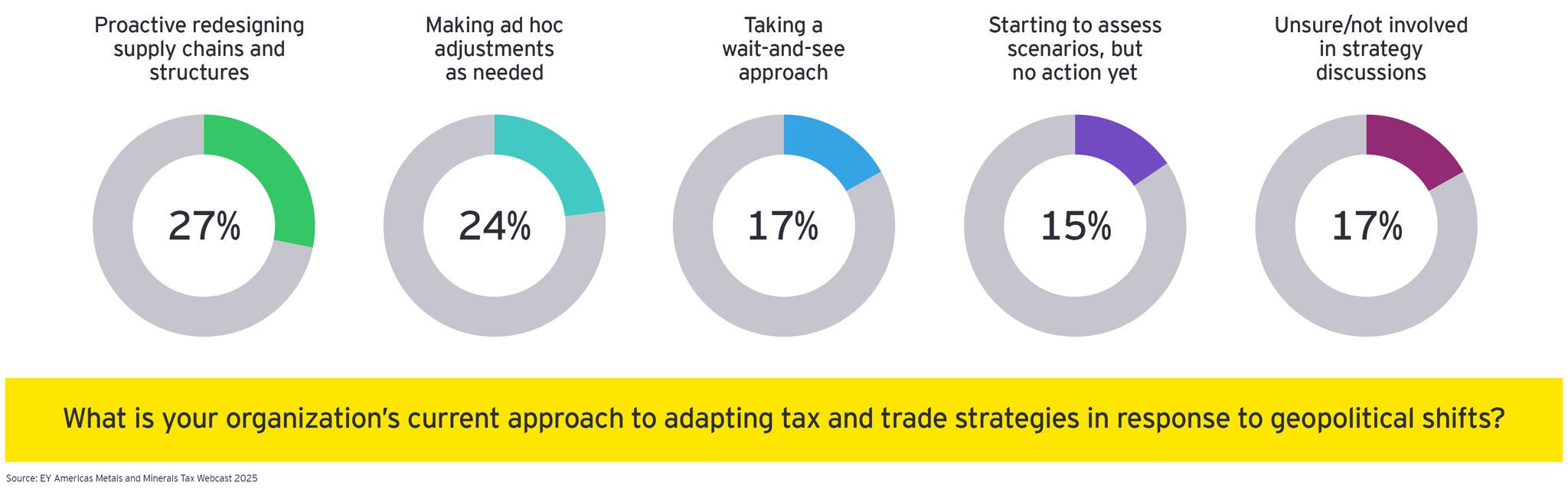
what is your organization's current approach to adapting tax and trade strategies in response to geopolitical shifts chart

Results of the final polling question focused on potential approaches to managing disruption and responses were divided. Almost half of respondents were split between redesigning supply chains (27%) and making ad hoc adjustments as they arose (24%) while the other half were taking a “wait and see” approach (17%), assessing but not acting on scenarios (15%) or admitting to being unsure or uninvolved in such strategy discussions (17%).

Firmly in the wait-and-see camp, Chilean metals and minerals companies have been adjusting to modest 10% tariffs imposed by the US 9, where the country had previously enjoyed free trade for decades. As the world’s largest producer of copper — supplying 25% of global production 10 — the in-demand mineral was initially exempted, but that decision is being investigated.

More than 600,000 tons of Chilean copper reached US shores in 2024 11 . But while it accounted for more than 70% of US copper imports 12 , it represented only a sliver of Chile’s total mining sector outputs and exports to the US. And with China having become Chile’s main trading partner — with sales doubling those to the US 13 – Chile is more vulnerable to a global recession than US-imposed tariffs.

To address this, the Chilean government has been working with private business to boost investments and diversify exports in new markets through alliances and establishing new trade agreements, while holding tight to US agreements. By generating trade relations in other countries, Chilean companies may be motivated to invest in innovation and efficiency, improve long-term competitiveness and drive export guidelines that adapt to changing market conditions in the years ahead.


Summary

While North American and Latin American regions may be preparing differently in response to local trade and tariff agendas, one truth is abundantly clear: change will be the new constant when it comes to trade policies and relations. Anticipating future policy shifts and preparing early will help metals and minerals companies build the resilience needed to maintain a competitive edge. Those that remain alert, plan ahead and equip themselves to jump on change quickly will be best positioned to convert challenge into opportunity as the trade and tariff landscape evolves in the coming years.

About this article

Authors

Related articles

A mining makeover: inspiring the next generation

The mining sector is evolving as it embraces technology, attracts young talent, and prepares for a major workforce shift to support a sustainable future.

Cybersecurity and metals and minerals: striking a delicate balance

Explore insights from EY's roundtable on cybersecurity in metals and minerals, focusing on AI risks, incident response, and strategies to combat human error.

Considerations for metals and minerals companies on tariffs, trade and transparency

In this webcast, leaders from the metals and minerals sector share insights on today’s complex and fast-changing trade and tariff landscape.

Leading Women in Mining: fostering change and igniting innovation

Cassie Boggs of Hecla highlights that recognizing strengths, adaptability, diverse skill sets and effective communication in mining for career success.

Mining, metals and aggregates: powering future development in the US

The US MMA sector is driving energy transition, boosting economic growth, creating jobs and fostering innovation for future competitiveness.