Implementation strategies in hospital capacity management will be unique and are influenced by system size, geography, technology adoption, staffing, governance and proactive change management. Attention to these factors can not only improve financial performance but also impact patient experience.
How do hospital capacity management efficiencies impact free cash flow and operating margins?
Hospital capacity management involves the measurement of patient demand, patient conditions, building and bed capacity and other data that enable staff to predict patient needs and place people in the appropriate setting of care. Better management of resources, using technology and dedicated teams, allows patient throughput to increase. In addition, net patient revenue and operating margins can improve with the assumption that variable costs remain steady or decrease and more patients fill beds. Improved margins create healthier free cash flow for systems, which is critical for systems facing financial constraints.
Just focusing on emergency room capacity can yield results. Of US health systems with a capacity management center that aimed to reduce emergency department boarding (holding admitted patients in need of inpatient beds), manage beds and handle transfers, 72% tracked a positive level of financial return on investment (ROI), according to the Hospital Capacity Management Consortium, an American Hospital Association (AHA) unit formed in 2020.2
Hospitals and health systems can focus on three areas — higher patient volume, lower variable costs and better patient experiences — to achieve positive ROI from capacity management.
How can hospital capacity management increase patient volume and improve patient placement?
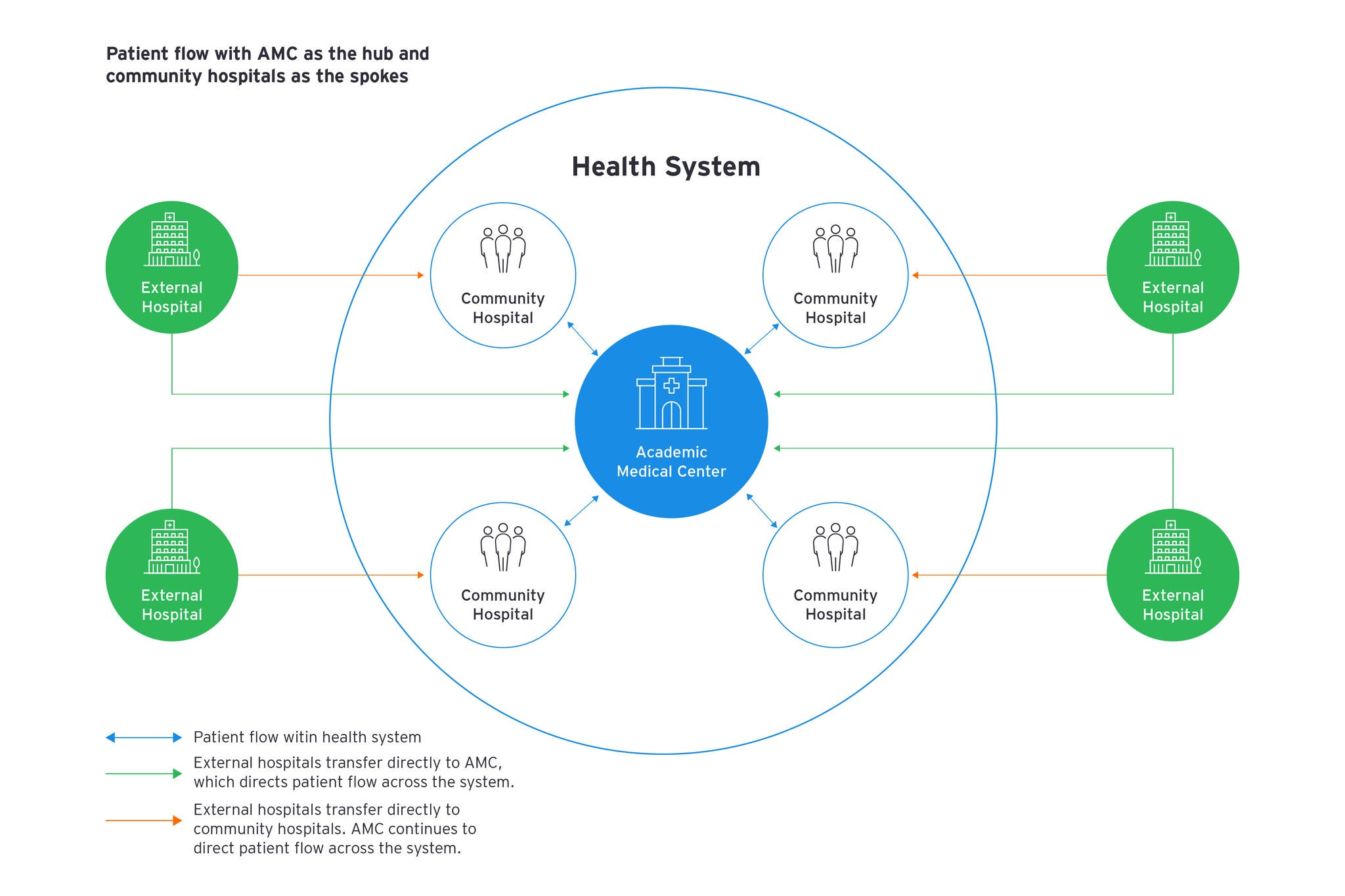
A proactive approach to patient placement based on need and appropriate setting, using real-time monitoring, allows health systems to load balance across the system and absorb additional patient volume. Capacity management can effectively improve patient volume and monitor capacity across hospitals by directing new patient volume into the system through the flagship hospital, community hospitals or external network, as well as through intra-network transfers for patients requiring different levels of care.
A) Flagship hospitals and academic medical centers (AMCs) can benefit from the ability to transfer lower acuity patients to community hospitals. This will unlock capacity at the AMC that can then be backfilled with patients requiring more complex care. Further, community hospitals can benefit from a streamlined source of higher-volume, in-network patient transfers to increase bed utilization peripheral to the system hub or hubs.
B) Community hospitals may also need to transfer patients to another facility for a higher level of care or due to capacity constraints. Retaining patients within the health system will offer enhanced continuity of care for the patient, reduce leakage and may financially benefit the system if filling an empty bed at one facility creates an opportunity to admit a new patient at the transferring facility.
C) Capacity management strategies can also direct patient transfers from external hospitals to the health system. These patients could either 1) be transferred directly to the flagship hospital or AMC, with this hospital serving as a hub for patients and community hospitals as the spokes; or 2) be transferred to the community hospitals, with the flagship hospital or AMC decants from the community hospitals. (See Figure 1)
In addition to assessing patient needs and hospital occupancy, capacity management strategies can improve patient flow based on factors such as the availability of specialty care and specific procedures. A center of excellence or the establishment of hospital specialties can direct greater relevant patient volume to the appropriate location. Additionally, staff at these locations can work with inbound referral sources to expedite and streamline referrals for high-margin service lines in which the hospital may excel, such as cardiology or orthopedics.
Figure 1: Patient flow with AMC hub, community hospital spokes