TBA

Margin resilience: The strategic architecture of the top 10%

In volatile markets, margin resilience defines winners. Analysis of 1,000 US firms reveals the strategic DNA of elite performers.


In brief
  • Volatility is the new baseline. Macro shifts and geopolitical tensions redefine value creation. Markets reward transparency and penalize ambiguity.
  • Among 1,000 US companies analyzed since 2010, only 10% consistently deliver top-quartile margins — treating resilience as structural, not cyclical.
  • Top performers share a common playbook: low capital intensity, recurring revenue, pricing power, and operational discipline. Their success is engineered, not incidental.

Market volatility is reshaping how businesses create and protect value. Inflation shocks, interest rate shifts, geopolitical risks and trade realignments are no longer episodic — they are embedded features of today’s market environment. These forces unsettle asset valuations, disrupt capital flows and create strategic ambiguity for business leaders.
 

For executives navigating this environment, strategic resilience and structural robustness — grounded in a well-designed strategic architecture — are more than risk management; they are differentiators that enhance enterprise value and transaction readiness. By combining empirical analysis with proven strategic levers, we offer a roadmap to manage valuation risk, sharpen competitive positioning and future-proof business models in a world defined by uncertainty.

Bridges. Winter panorama from under the bridge. The construction of bridges. Winter city landscape. Concept - bridge maintenance. Bridge supports. City architecture. Frozen river Frozen channel. Snow
1

Section 1

How markets reprice macroeconomic and geopolitical risks

Equity markets price uncertainty in real time

Equity markets price uncertainty in real time — nowhere is that clearer than during macroeconomic and geopolitical inflection points. To assess how US investors systematically reprice risk during these episodes, we analyzed nearly 45 years of daily S&P 500 returns (September 1981 – October 2025), measuring the equity risk premium as the excess return over the three-month Treasury bill.

We categorize events into three key drivers of market repricing:

Not all events carry the same weight — or elicit the same investor response. Some events provide clarity that stabilizes valuations, while others inject deep uncertainty, driving risk aversion and sharp declines in equity value. Our analysis reveals how different categories of events consistently influence equity risk premia — the additional return investors demand to hold equities over safer assets. 

Federal Reserve policy decisions tend to boost equity returns, with markets pricing an average 19-basis points (bps) increase in realized equity returns in excess of the three-month Treasury bill rate. These events bring clarity on monetary conditions, which helps investors reassess financing costs and future growth trajectories. For business leaders, Fed communications influence everything from capital strategy to M&A timing. 

Macroeconomic announcements, such as employment, GDP or inflation reports, carry a smaller but still meaningful impact lifting realized equity returns by about 5bps on average. Importantly, the market’s reaction often hinges more on how these data points compare to expectations, greatly influencing forward earnings guidance and valuation multiples. Executives should remain attuned not only to the data itself but to the narrative it shapes in the market.


Geoeconomic shocks are the most destabilizing, triggering an average 143bps decline in equity market returns in a single day as risk aversion surges. These events prompt immediate risk-off behavior, as investors reassess macroeconomic stability, supply chains, energy costs and regulatory risks. For corporates, this underscores the need for strategic flexibility and scenario-based risk management — valuation can erode quickly in the absence of resilience.

In essence, markets reward transparency and penalize ambiguity. Executives who understand how equity risk premia shift in response to key events are better positioned to manage investor sentiment, protect valuations and make strategic decisions that enhance long-term enterprise value.

2

Section 2

The top 10%: what margin leaders do differently

Consistency is the ultimate mark of strategic excellence

In today’s volatile environment, consistency is the ultimate mark of strategic excellence. While most companies swing with the cycle – expanding margins in good years and retrenching in bad – a small group stands apart.

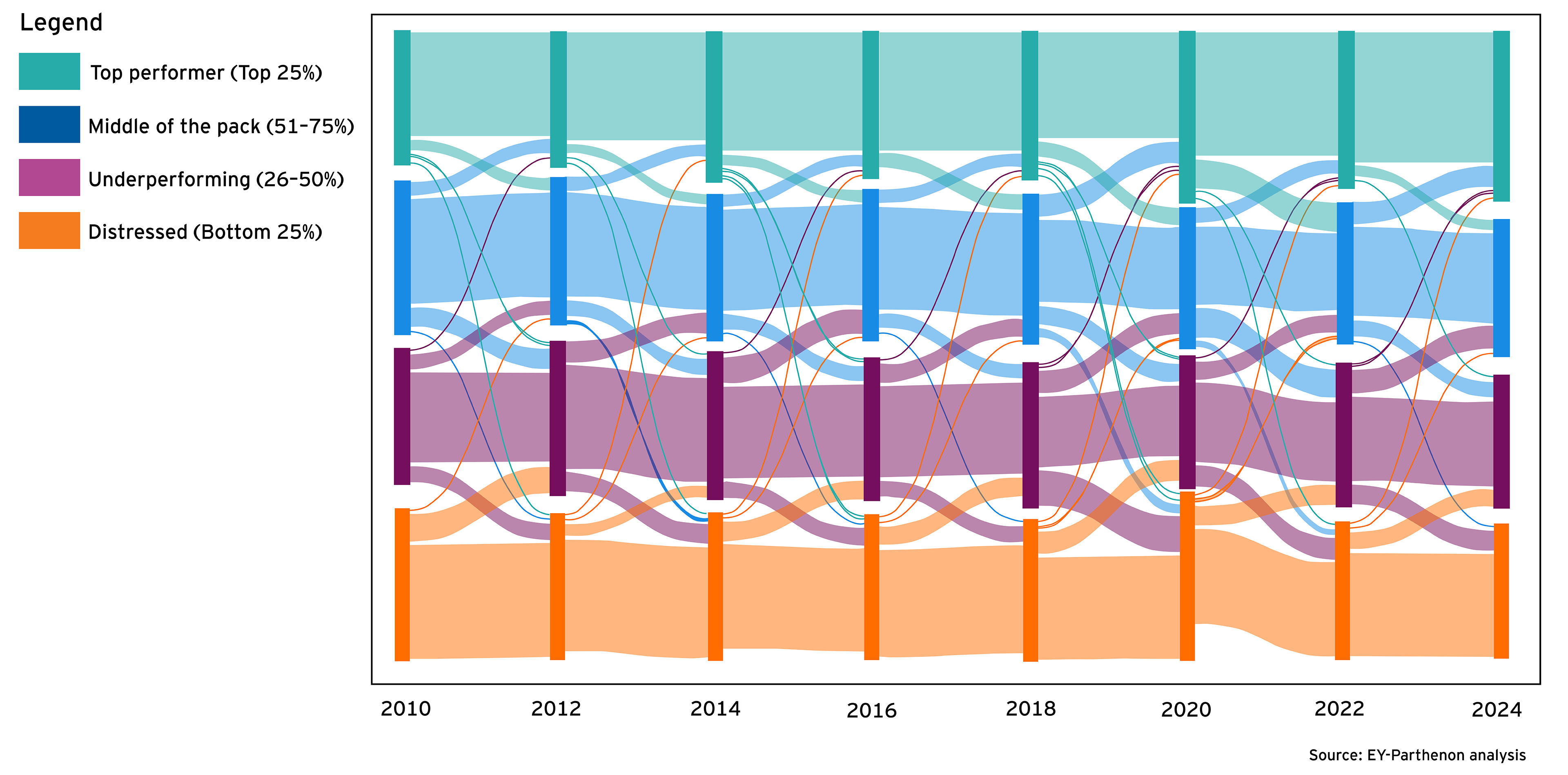
Among US companies with revenues of at least $500m in 2010, nearly 1,000, a subset of nearly 100, or roughly the top 10%, have consistently delivered EBITDA margins that outperform their industry peers over the observation horizon.

These companies are the corporate equivalent of elite athletes. Their sustained performance isn’t driven by a lucky product or a one-time market advantage. It’s the result of discipline — strategic, operational and financial. They are built to outperform in all seasons.

To understand what underpins this resilience, we leveraged EY insights and Microsoft Copilot to analyze 10-K filings from these top 10% companies going back to 2010. The goal is to “decode” the architecture of long-term margin leadership across industries. We found that these top performers share a common strategic DNA: their success is engineered, not incidental.

EBITDA margin evolution for assessed cohort of US public companies 2010 - 2024


Despite operating in different sectors with distinct market dynamics, the top 10% we analyzed rely on a shared set of structural levers. These are not isolated tactics but interconnected choices that reinforce one another over time. Together, they form a blueprint for earning “the right to grow” through disciplined growth and sustained profitability:

What sets this top 10% group apart is not just the playbook — it’s the consistent application of it. They execute with a long-term view, resist the temptation to chase short-term wins and adapt with agility as conditions evolve. For business leaders, the implication is clear: margin leadership isn’t a function of luck or market timing. It is the outcome of repeatable choices, embedded discipline and a structural commitment to performance.

Looking ahead, artificial intelligence (AI) is becoming an increasingly important enabler of margin resilience — but not a standalone lever. Its impact on margins depends less on the technology itself than on where and how it is deployed. Firms distinguished by their margin performance within their industry are incorporating AI selectively into portfolio decisions, scaling it in businesses with repeatable processes, rich data and operating leverage, while exiting or deprioritizing areas where returns to automation are structurally limited.

In this way, AI is less about lifting margins across the enterprise and more about reinforcing strategic focus — widening the gap between high-return and low-return activities and accelerating margin expansion where structural advantages already exist.

View of the majestic bridge spanning the river with a scenic landscape, South Queensferry, Great Britain.
3

Section 3

Outlook: margin leadership in a polarized macroeconomic environment

Supportive of margin leaders but increasingly unforgiving for the rest

Looking ahead, the macroeconomic environment is likely to remain supportive of margin leaders — but increasingly unforgiving for the rest. We expect global GDP growth to slow modestly in 2026 as structural headwinds — shifting trade alignments, demographic pressures and policy fragmentation — intersect with persistent market volatility. Inflation should continue declining overall, but disinflation will be patchy and subject to episodic repricing around shocks and policy shifts. 

Tailwinds for structurally resilient firms include moderating goods inflation and supply chain frictions, and the prospect of productivity gains as firms scale digital and AI-enabled capabilities. Where operating models and governance are disciplined, these forces can reinforce margins and competitive positioning. 

Headwinds remain meaningful. Geopolitical fragmentation and trade realignments will continue to inject uncertainty and episodic cost pressures, while labor constraints and regulatory dynamics may cap demand and pricing power in several sectors. Policy divergence across major economies — from cautious central banks to constrained fiscal space — will add complexity to investment and cost forecasts. 

In this environment, margin dispersion is likely to widen. Firms with structural cost discipline, pricing power, recurring revenue and portfolio agility are best positioned to convert modest growth into durable profitability. Margin leadership will be defined less by broad macroeconomic outcomes and more by how effectively companies are positioned to navigate these crosscurrents.

skateboard; activity; adult; autumn; bag; balance; beijing; bridge; business; chinese; city; clear; confidence; confident; day; fashion; fun; handsome; leather; male; man; millennial; motion; one; outdoors; pavement; people; portrait; shoulder bag; skate; skill; sky; sport; street; sunny; sunshine; teenager; winter; young; youth; east asian; boy; person; teenagers; young person; young people; adolescent; adolescents; youths; minor; minors; juvenile; juveniles; teen; teens; youngster; youngsters
4

Section 4

Sector deep dive: translating strategy into sustained margin performance

Top-performing firms apply strategic discipline

Top-performing firms don’t just operate efficiently — they apply strategic discipline tailored to the realities of their sector. While the structural levers are consistent across industries, their expression is sector-specific, with margin leaders outperforming peers by optimizing capital intensity, pricing power and cost structure within the constraints of their business model. Across industries, margin leaders demonstrate how consistent application of high-impact levers — low capital intensity and high asset productivity, pricing power, cost efficiency and portfolio agility — translates into outperformance. Here’s how that plays out across key sectors:

Image of green ground cover
5

Section 5

Margin resilience: from defensive posture to strategic edge

Margin resilience as a defining trait of corporate outperformance

In today’s environment shaped by macroeconomic uncertainty, policy pivots and geopolitical disruption, margin resilience has emerged as a defining trait of corporate outperformance. While monetary policy and macro releases influence investor sentiment, our analysis shows that geopolitical shocks deliver the most immediate and severe hits to equity risk premia. Companies that consistently outperform don’t just react — they are structurally prepared.

The top-performing 10% of US public companies demonstrate that sustained margin leadership is not the result of short-term gains, but of embedded strategic choices. Their success is anchored in a coherent and disciplined approach that integrates five core levers:

  1. Low capital intensity and high asset productivity models that rationalize fixed costs and enable scalable growth.
  2. Recurring revenue and customer lock-in that create predictability and pricing leverage.
  3. Pricing power through market differentiation, brand equity or control of scarce assets.
  4. Operational discipline and scale efficiency that translate growth into margin.
  5. Active portfolio management and strategic agility, including environmental, social and governance (ESG) and digital acceleration.

These levers don’t operate in isolation — they form a mutually reinforcing system that helps businesses navigate complexity, absorb shocks and compound returns over time.

For executives, the message is clear: stress-test your operating model, benchmark against top margin performers and double down on strategic transformation. Embedding structural resilience isn’t just about protecting margins in downturns — it’s about positioning for long-term value creation.

In a world where volatility is the norm, margin resilience is no longer a defensive metric. It is a durable source of competitive advantage — and a cornerstone of sustainable growth.


Summary 

Among nearly 1,000 publicly listed US companies with revenues of at least $500m in 2010, only 10% consistently deliver top-quartile EBITDA margins. These leaders engineer resilience through five strategic levers: low capital intensity and high asset productivity models, recurring revenue, pricing power, operational efficiency and portfolio management, all underpinned by a robust strategic architecture. Our analysis reveals how markets reprice risk during macro events and provides a sector-by-sector blueprint for building margin resilience as a durable competitive advantage.

About this article

Authors

Related articles

2026 Global Economic Outlook: growth slows amid supply shocks

2026 Global Economic Outlook: global growth will slow as supply shocks, trade tensions and policy uncertainty intensify. Explore our latest outlook.

How do CEOs reimagine enterprises for a future that keeps rewriting itself?

EY-Parthenon CEO Outlook 2026 explores how leaders use AI, transformation and portfolio strategy to navigate uncertainty and drive sustainable growth.

How neurosymbolic AI finds growth that others cannot see

Artificial intelligence should help companies grow, not just be efficient. Neurosymbolic AI is the AI platform for a company’s growth strategy.