1. Predictive operations as margin expansion
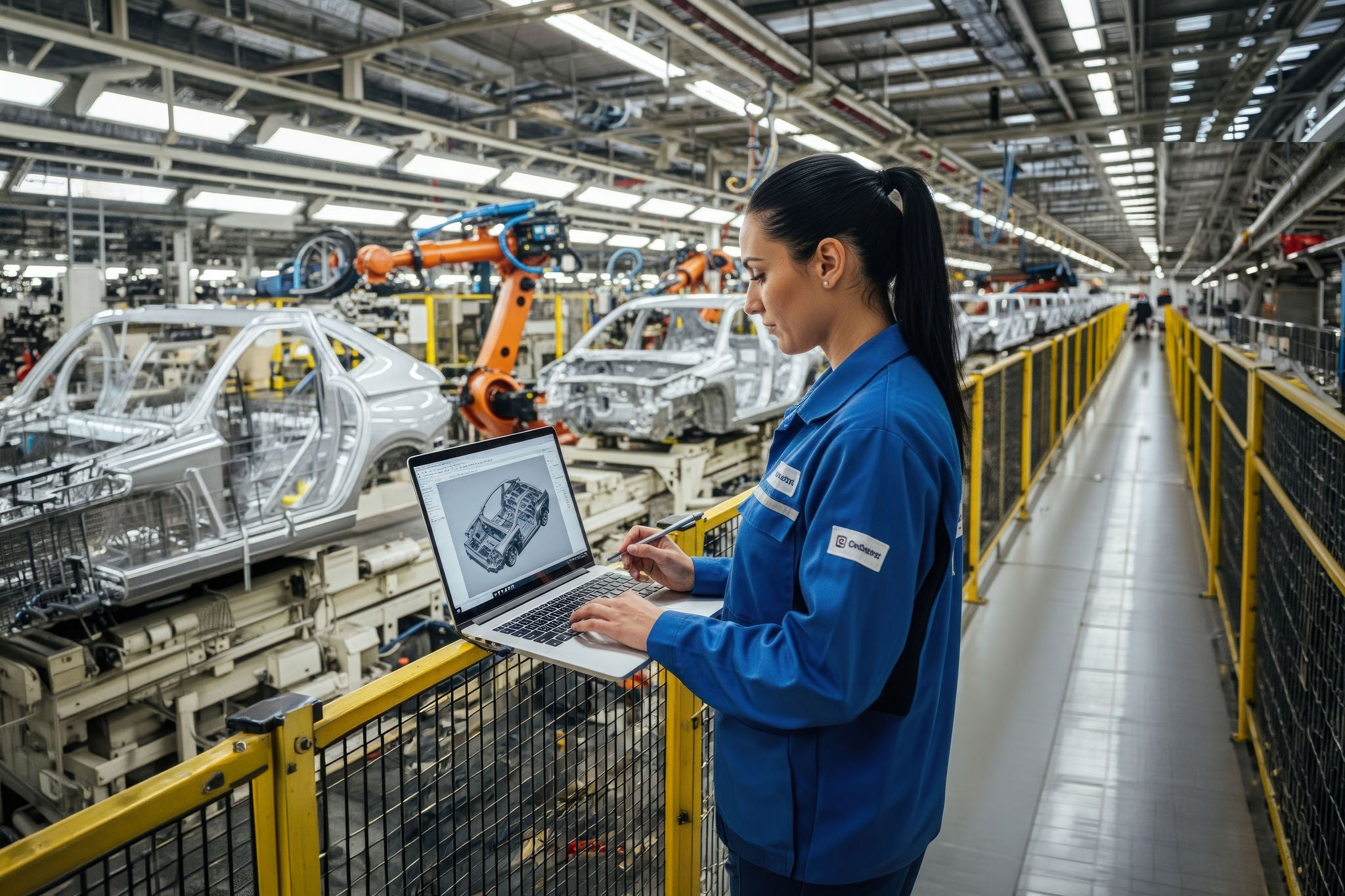
The U.S. Department of Energy’s Federal Energy Management Program documents that a properly functioning predictive maintenance program delivers a 25% to 30% reduction in maintenance costs, 70% to 75% fewer breakdowns, 35% to 45% less downtime, and a tenfold ROI. Predictive maintenance targeting energy efficiency yields up to 20% annual energy savings.
Industry analysis shows that unplanned downtime now costs the Fortune Global 500 roughly $1.4 trillion each year — about 11% of total revenues — with automotive plants incurring losses of up to $2.3 million per hour. Major manufacturers suffer an average of 25 downtime incidents per month per facility. While average downtime hours have declined by nearly a third since 2019, per-hour costs have risen dramatically due to inflation, energy prices and supply chain complexity.
The EBITDA impact is easy to translate. A facility with 400 hours of annual unplanned downtime at $6,700 per hour loses $2.7 million annually. A 35% to 45% reduction saves $950,000 to $1.2 million per plant — before maintenance cost savings and equipment life extension. Leading manufacturers are already operating at this scale: a major automaker saved $20 million annually deploying AI monitoring on assembly robots. A major automotive OEM predicted 22% of component failures 10 days in advance, saving 122,000 hours of downtime and $7 million on a single component type. For acquirers, this is all EBITDA and value creation opportunity — not a technology story.
2. AI-enabled products and revenue durability
AI is enabling industrials to shift from selling equipment to selling outcomes, fundamentally altering revenue profiles and the multiples they command. Industrial OEMs historically traded at 8x-12x EBITDA — well below the 15x-25x multiples in software and recurring-revenue businesses. AI-powered connectivity is converging and blurring the lines in how these industries are valued.
By embedding sensors, real-time monitoring and AI analytics into products, manufacturers are creating outcome-based revenue streams. Instead of selling an HVAC system, a manufacturer sells “comfort-as-a-service.” Instead of selling a water pump, an industrial company will sell volume moved. Instead of selling a compressor, they will sell guaranteed uptime per hour. Top-quartile manufacturers now derive up to 40% of sales from innovative products, services and software. IoT Analytics reports 63% of industrial providers with recurring models achieved 29% CAGR in service income over three years.
The EY CEO Outlook confirms the demand side: 49% of US CEOs cite accelerated AI adoption as the single biggest growth factor for 2026. Industrial targets that have converted AI capability into recurring revenue are precisely the assets these CEOs are pursuing — and the blended multiples will reflect it. As more manufacturers embed AI-powered monitoring into their installed base, the line between “industrial company” and “industrial technology company” is blurring — and the M&A market is beginning to price that convergence.
3. Supply chain intelligence as risk reduction
AI-driven demand sensing, supplier risk scoring and logistics optimization systematically reduce earnings volatility — which directly lowers the discount rate acquirers apply. Machine learning algorithms analyze historical sales data, macroeconomic indicators, weather patterns and real-time consumption signals to improve forecast accuracy. Supplier risk models continuously monitor financial health, geopolitical exposure and quality metrics across the supply base.
The valuation impact is material. The difference between a 10.0% and 8.5% WACC on a $2 billion industrial target translates to $200 million to $300 million in additional enterprise value. With GDP growth forecasted to moderate to 1.7% in 2026 amid tariff uncertainty, companies demonstrating AI-enabled supply chain resilience will command structurally higher valuations. Companies that can improve their supply chain intelligence will reduce the impact of trade disruptions — rather than simply weathering them — and present a fundamentally different risk profile that is directly reflected in deal pricing and financing terms.
4. Data assets as hidden balance-sheet value
Decades of proprietary operational data — vibration signatures, thermal profiles, quality inspection records and field service logs — collected for compliance or operations have never been valued as a strategic asset. That is changing. AI models are only as valuable as the data they train on, and domain-specific industrial data is nearly impossible to replicate. A sensor dataset from 15 years across 200 installations can become a real competitive moat.
Acquirers now evaluate data architecture quality alongside more traditional intangible assets such as patents and customer lists. Clean, cloud-connected data lakes are an asset; fragmented data trapped in siloed historians and disconnected legacy systems is a liability that buyers deduct as post-close remediation cost. For industrial CEOs, the implication is clear: data governance, architecture modernization and OT/IT integration are not infrastructure projects. They are enterprise value creation initiatives that directly affect how a future acquirer will price the business.
5. The AI gap discount
The NAM’s Manufacturing Leadership Council reports that while 51% of manufacturers use AI, 82% lack AI-ready skills and 65% lack AI-ready data. Only 28% describe operations as “smart,” though 76% expect to be there within two years. The Stanford HAI AI Index confirms that only a small single-digit percentage of companies achieve AI maturity at scale. While there are certain companies that are extracting selling, general and administrative (SG&A) savings by leveraging AI use cases (less impactful) or through full-scale reimagination (more impactful), many more have made limited or no progress. Sophisticated acquirers are pricing this aspiration-execution gap — underwriting post-close digital remediation as a direct deduction from enterprise value. The AI gap discount is not theoretical; it is reshaping deal outcomes today.