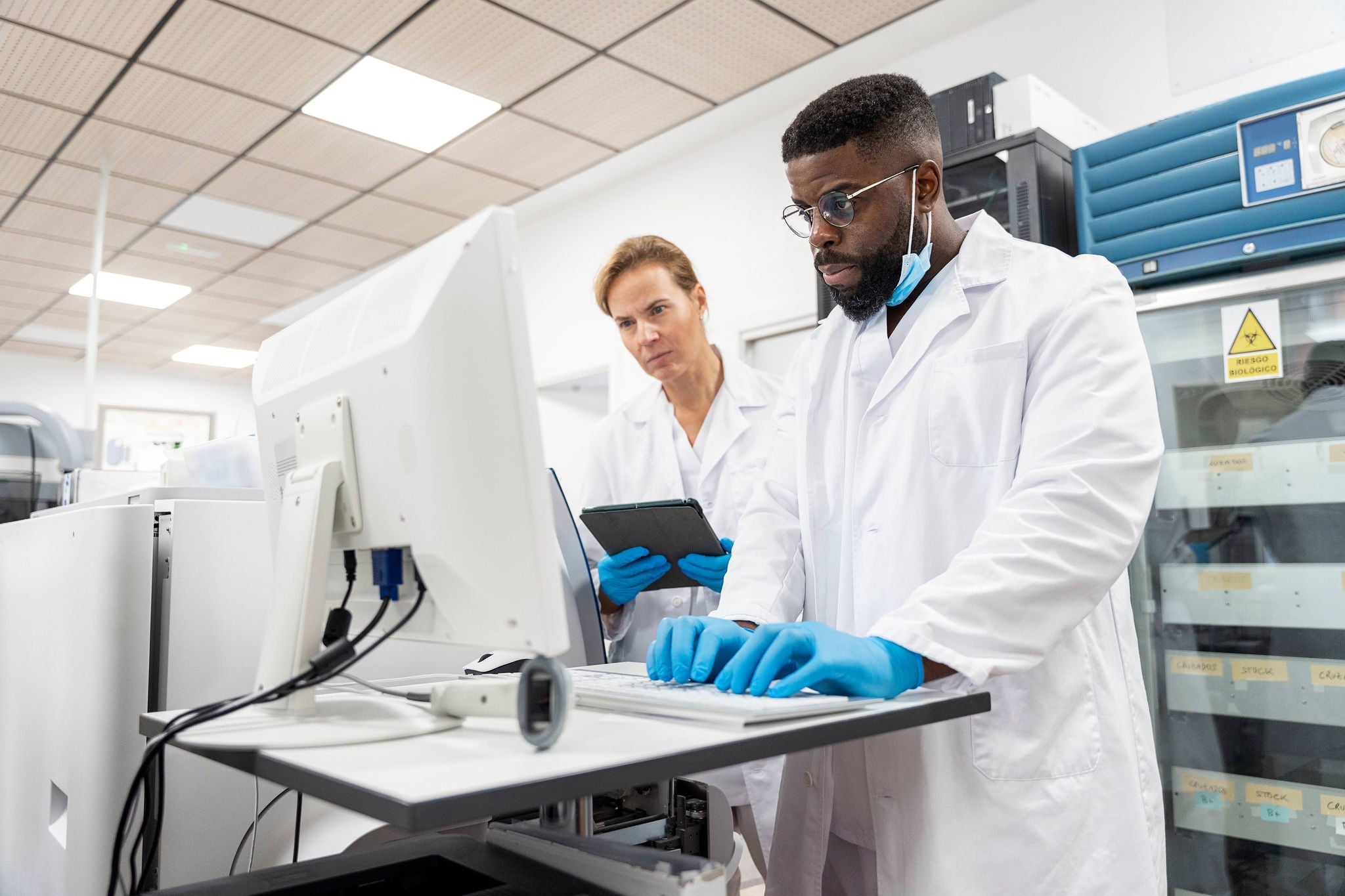
Perhaps the most critical, and most overlooked, element of successful AI deployment is building the right talent ecosystem. Organizations cannot simply hire technologists and expect them to ask the pivotal questions in drug development, nor can traditional scientists immediately adopt AI-native mindsets. Success requires a deliberate, multifaceted talent strategy.
Cross-training and upskilling programs
Scientists and data fluency: Research scientists need foundational training in data science principles, statistical thinking, AI model capabilities and limitations, and how to critically evaluate AI predictions. They should understand how models learn, what makes training data high quality, how to apply AI tools to their own research questions, and when to trust or question predictions. Models make predictions based on previously observed trends and known chemical rules, so it is up to the scientists to interpret these predictions and translate them into actionable, informative experiments.
Technologists and domain expertise: Data scientists and AI engineers need deep immersion in biology, chemistry and drug development. They should understand disease biology, medicinal chemistry principles, what makes a good drug candidate, regulatory requirements and the clinical development process. Organizations achieve this through both rotational programs where AI engineers embed with discovery teams and joint projects pairing data scientists with therapeutic area experts. This knowledge will allow them to build better models by understanding what kinds of inputs and biological trends are valuable and therefore should be more heavily weighted in an algorithm. Ultimately, training technologists on the science will enable them to build more informative and scientifically sound models.
Hybrid role creation: The most successful organizations create new hybrid roles that bridge the gap. One emerging role is that of an AI product manager: an individual who understands both the technology and the science, serving as a translator and prioritizing AI initiatives based on scientific and business value.
Strategic talent sourcing
Building this hybrid workforce requires a multi-pronged approach to talent acquisition and development.
Leveraging global talent ecosystems: Establish centers of excellence in locations with strong concentrations of both life sciences and AI talent. Build distributed teams where domain-heavy roles (medicinal chemists, clinical scientists) concentrate in biopharma hubs, while AI and data-heavy roles (ML engineers, data engineers, platform developers) leverage cost-effective talent markets with deep technical expertise. This approach allows organizations to scale AI capabilities without proportionally scaling costs.
Offshore and nearshore talent for specialized functions: For specific AI operations functions (such as model training and optimization, data engineering pipelines, MLOps infrastructure, quality assurance for AI systems) leverage offshore technical talent in India, Eastern Europe and Latin America. This enables 24/7 development cycles and provides cost advantages for computationally intensive but less domain-dependent work. However, maintain strategic domain-AI integration roles on-site with R&D teams so AI solutions remain grounded in scientific reality and translatable to the bench.
Communities of practice
Create cross-functional communities where scientists and technologists learn from each other:
- Regular seminars where scientists present challenging problems and technologists propose AI approaches
- Showcases where successful AI applications are demonstrated and lessons shared
- Internal conferences bringing together AI practitioners across therapeutic areas to share methodologies
Incentive alignment
Adjust performance metrics and incentives to reward cross-functional collaboration and AI adoption:
- Recognize scientists for proposing and implementing AI solutions, not just traditional experimental work
- Evaluate data scientists on scientific impact and adoption, not just model performance metrics
- Reward teams for sharing learnings and enabling others to succeed with AI
- Encourage rapid translation of AI output to lab experiments
The talent challenge cannot be overstated. Even the most sophisticated AI infrastructure will fail without people who can bridge the gap between what AI can do and what drug development needs. Organizations that invest as heavily in talent development as they do in technology infrastructure position themselves to capture sustained competitive advantage.