Surgeons and nurse discussing reports

Cash management is key for hospitals facing Medicaid eligibility changes

In the face of recent legislation, healthcare organizations should prepare for disruption by improving balance sheet health and liquidity.


In brief
  • Healthcare organizations are facing big financial challenges from changes to Medicaid eligibility rules and other disruptive trends
  • Many healthcare organizations focus on profitability, missing opportunities to improve liquidity through a more focused approach to cash management.
  • An approach that improves working capital to increase free cash flow is a powerful way to strengthen resilience in the face of disruption.

Disruptive trends, from changing patient demands to industry consolidation, are putting new financial pressures on the US healthcare industry, increasing the need for funds and forcing healthcare organizations to level up their cash management game.

The recent passage of federal bill HR1 (the One Big Beautiful Bill Act) is likely to add to financial headaches for hospitals and health systems. The sweeping legislation contains directives that bring new compliance requirements as well as economic consequences for healthcare organizations. For example, it imposes stricter Medicaid eligibility criteria through work requirements and redeterminations, which are expected to significantly increase the number of uninsured visits to hospitals and healthcare systems, elevating bad debt risk and impacting provider revenue and working capital.


As a result of this and other changes, the bill is prompting a renewed focus on operational efficiency and effective cash management for healthcare organizations. For many, the imperative is more critical than ever as rising costs, shifting patient preferences and persistent reimbursement challenges are also straining margins and liquidity. While hospital systems tend to concentrate management attention and performance incentives on the profit and loss statement (P&L), a stronger focus on balance sheet health can unlock liquidity to fund growth initiatives, improve agility and promote long-term sustainability.

A confluence of trends is destabilizing hospitals’ operations and finances:

    Given these types of disruptive trends, profitability initiatives may prove more complex and slower to implement than working capital improvements. A powerful way for hospitals to address these challenges is to free up liquidity through better cash management techniques. Effective cash management is essential for maintaining financial health, enabling investments in technology and infrastructure, and ensuring long-term sustainability.

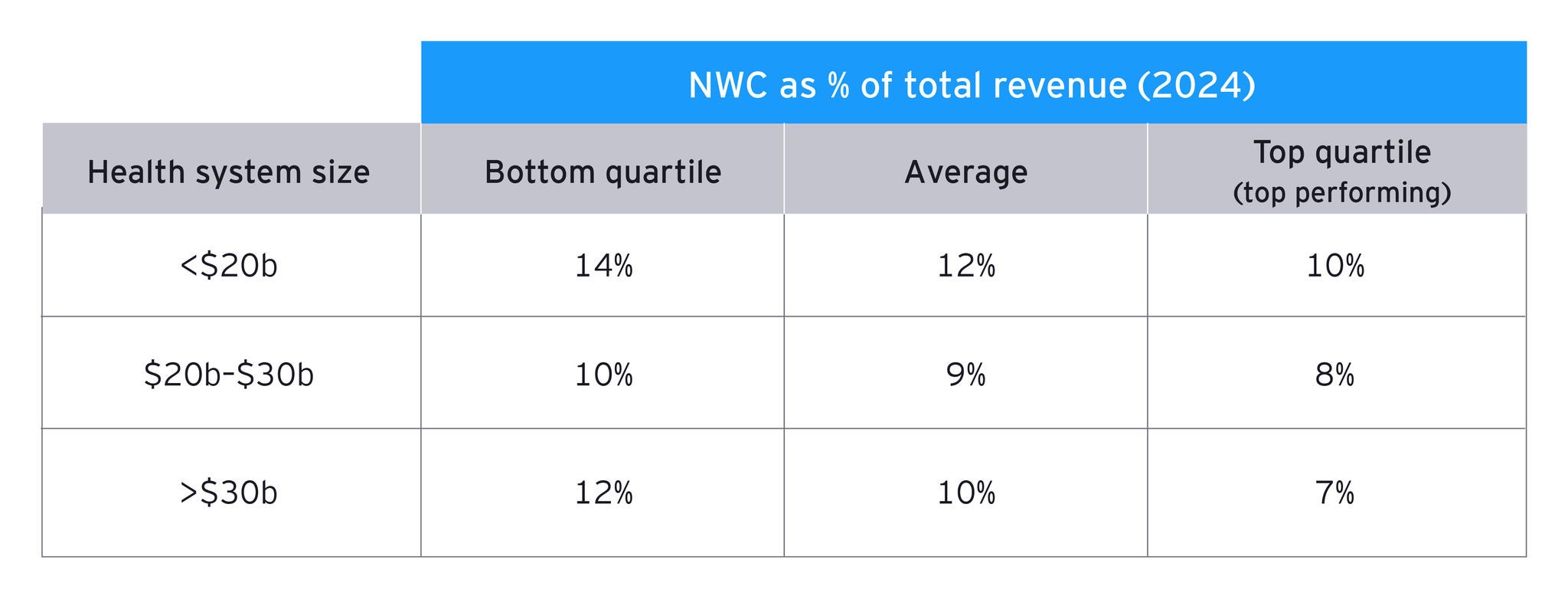
    Net working capital (NWC) represents an area with untapped potential. A recent EY-Parthenon analysis indicated that NWC among hospital systems ranges greatly, from 5% to 20% of total revenues, with some organizations exceeding 25%. Over the past five to seven years, there has been a steady trend of 1% to 3% annual increases in NWC among these systems. Private healthcare institutions often exhibit even greater disparities, with estimates suggesting that over 30% of total revenues may be tied up due to higher operational costs, delayed reimbursements, and the need for substantial investments in technology and infrastructure. While optimal NWC targets vary by organizational size, type and location, the healthiest of systems have less than 10% of their total revenue tied to NWC and have clear visibility of cash inflows and outflows.

    The following table (Figure 1) depicts the top public hospital systems and their NWC as a percentage of total revenue. The top performers, on average, are 1%–3% better than the average hospital system, equating to freeing up $500 million to $1 billion of cash tied up in working capital.

    Figure 1: Net working capital as % of total revenue - 2024 view

    ey-figure-1-obbba-3840x2170

    Hospital systems can enhance liquidity and free up cash by managing working capital drivers across the balance sheet:

    Revenue cycle management (RCM)

    • Back office: Process claims denials promptly and generate reports to identify root causes of chronic delays or nonpayment. This allows the organization to focus limited resources on areas that significantly impact the revenue cycle.
    • Midstream: Assess claims submission processes and required documentation to determine when specific procedures are necessary. Diligent alignment of procedure coding with reimbursement rates can expose improvement areas. Automation and AI can enhance efficiency with proper setup.
    • Payer contracts: Compare current contracts with actual reimbursement rates to identify revenue leakage. Organizations can track reimbursement timing and denial trends relative to negotiated terms, improving payer compliance. Insights gained can inform future payer contract negotiations.

    Supplier payment management

    • Accounts payable: Analyze the cycle times of the accounts payable process (receipt, routing, approval, payment) to identify constraints and resource allocation. Often, supply chain organizations negotiate complex terms that the accounts payable department struggles to execute, diminishing the negotiated value (for example, organizations may miss early pay discounts due to lengthy invoice processing times). For one health system, an EY-Parthenon team helped deliver more than $13 million of cash benefits from back-office payment processing efficiencies and an additional $2 million by clawing back duplicate supplier payments.
    • Supplier management: Review suppliers by category to understand their relationship with the system. Hospital systems often have a significant portion of their supply under individual vendor contracts but lack effective management processes, leading to expense and cash leakage from poor pricing, suboptimal terms and complications from physician-preferred items that may not align with contracts. By using group purchasing organizations (GPOs), organizations can enhance pricing and terms through collective buying power; however, many healthcare systems miss opportunities to leverage the full potential of GPOs due to inadequate engagement or weak purchasing process management.

    Unlocking near-term liquidity

    An EY-Parthenon team helped a long-term acute care hospital identify $80 million (4% of net patient revenue) in RCM through improvements in collections and reduction in unbilled claims. 

    Supply chain and inventory optimization

    • Inventory rebalancing and optimization: Unlock cash by strategically rebalancing inventory. Organizations can analyze current levels across departments and locations to identify redistribution opportunities, reducing overstocking and preventing stockouts.
    • Management of physician preference items (PPIs): Limit PPIs to reduce variability, which can control costs throughout the system. The healthcare sector’s high supplier count — upwards of 2,000 suppliers for every billion dollars spent — limits pricing leverage and working capital flexibility, complicating procurement.
    • Streamlining supplier relationships: Optimize inventory by streamlining supplier relationships, standardizing PPI usage and regularly reviewing pharmaceutical formularies. This approach also aims to reduce administrative burdens related to supplier management and compliance.

    Enhanced working capital

    EY-Parthenon specialists worked with a large health system to deliver over $50 million in cash benefits by optimizing supplier payment terms: $25 million in realized benefits with another $25 million through future negotiations.

    Optimized supply chains

    An EY-Parthenon team helped a large health system identify a $5 million net inventory reduction through enhanced replenishment parameters and disposition of slow-moving and obsolete inventory (SLOBs).

    Mitch Slack, Andrew Bae, Josh Gracey, Lucy Berry, Hannah Lee and Tyler Sherper from EY-Parthenon contributed to this article.


    Summary 

    Working capital management can be a vital component of healthcare providers’ financial strategies. By recognizing the significance of working capital in the context of industry trends and challenges, hospital systems can enhance liquidity, support self-funding mechanisms for transformation and drive sustainable growth. This strategic focus on cash management not only strengthens financial stability but also empowers hospitals to invest in the innovations and efficiencies necessary for long-term success.

    About this article

    Authors

    Related articles

    How proactive hospital capacity management can create financial value

    Better hospital capacity management strategy can result in financial and patient care improvements and health care transformation. Learn more

    Four areas of innovation can shape the future of health care value

    Health care payers are thriving by tackling common operational challenges. Discover how.

    Why you need a better antitrust approach in health care M&A diligence

    Blending business strategy and antitrust economics in health care M&A due diligence can uncover dealbreakers and create value amid complex regulation.