EY helps clients create long-term value for all stakeholders. Enabled by data and technology, our services and solutions provide trust through assurance and help clients transform, grow and operate.
At EY, our purpose is building a better working world. The insights and services we provide help to create long-term value for clients, people and society, and to build trust in the capital markets.
Healthcare leaders have key growth opportunities in 2026 despite the mounting pressures that are reshaping the industry.
In brief
A changing healthcare landscape is shifting economic returns, leading organizations to rethink their value chain position.
Expansion in lower-acuity care and opportunistic mergers and acquisitions can accelerate long-term growth.
Implementing new benefit cost containment strategies and investing in innovative AI solutions can elevate efficiency and performance.
Healthcare utilization remained elevated in 2025, driving growth while organizations navigated challenges across the sector. Further, industry forces continue to reshape strategic opportunities: volume migration to lower-cost care settings, maturity in value-based care, advances in artificial intelligence (AI) and therapeutics, and rising consumer expectations. Organizations across the ecosystem have been positioning themselves to capitalize on trends. Looking forward, our healthcare sector outlook provides insights into how these organizations can effectively navigate key headwinds that are expected to create increased complexity in 2026:
Our Healthcare Strategy Consulting teams help organizations develop digital, transaction and value strategies to build resilience and drive future growth.
Government program enrollment and funding declines
Elevated cost of capital
Wage and supply cost inflation
Persistent workforce shortages
Consumer transparency and value expectations
Sustained federal and state regulatory scrutiny
The One Big Beautiful Bill Act (OBBBA), passed in 2025, will play a notable role in driving complexities for health sector organizations in 2026:
Figure 1. One Big Beautiful Bill Act projected economic impacts on healthcare sector businesses
Source: KFF; Urban Institute; Commonwealth Fund; EY-Parthenon analysis
ADA description: The chart illustrates the broad economic impacts of the One Big Beautiful Bill Act (OBBBA) on various healthcare sector entities. It shows how the OBBBA affects health systems, hospitals, providers, government plans (Medicare and Medicaid), pharmacies and pharmacy benefit managers (PBMs), private equity investors, and ACA/commercial coverage providers. The visual highlights the interconnectedness and complexity introduced by the OBBBA, emphasizing increased regulatory and financial pressures across these groups.
The changing landscape is shifting economic returns and cash flows for operating healthcare assets, forcing leaders to rethink their position in the value chain for improving care in their communities.
Healthcare sector executives can unlock growth and transformation amid these headwinds by pursuing the following strategic opportunities in 2026:
To jump to a specific section, click one of the links below.
1) Profitable expansion in lower-acuity care for payers, providers and other strategic players
Ambulatory and post-acute services are expected to drive healthcare sector volume growth in 2026, fueled by cost pressures, an aging population, advances in therapy and value-based care. Industry forecasts provide further support, with outpatient and post-acute care expected to outpace population growth over the next decade.1 Services such as behavioral health, post-acute care, physician practices and ambulatory surgery centers (ASCs) are all poised for patient volume expansion.
Chart 1. 10-year volume growth forecast by care setting (2025-2035)
Source: Sg2: 2025 Impact of Change Forecast
ADA description: This chart compares projected population growth for inpatient and outpatient care settings over the next decade. It breaks down growth into categories such as emergency department visits, outpatient care, outpatient surgery, post-acute care, and inpatient days. The data demonstrates that outpatient and post-acute care settings are expected to experience higher growth rates than inpatient categories, reflecting a shift toward lower-cost, ambulatory healthcare services.
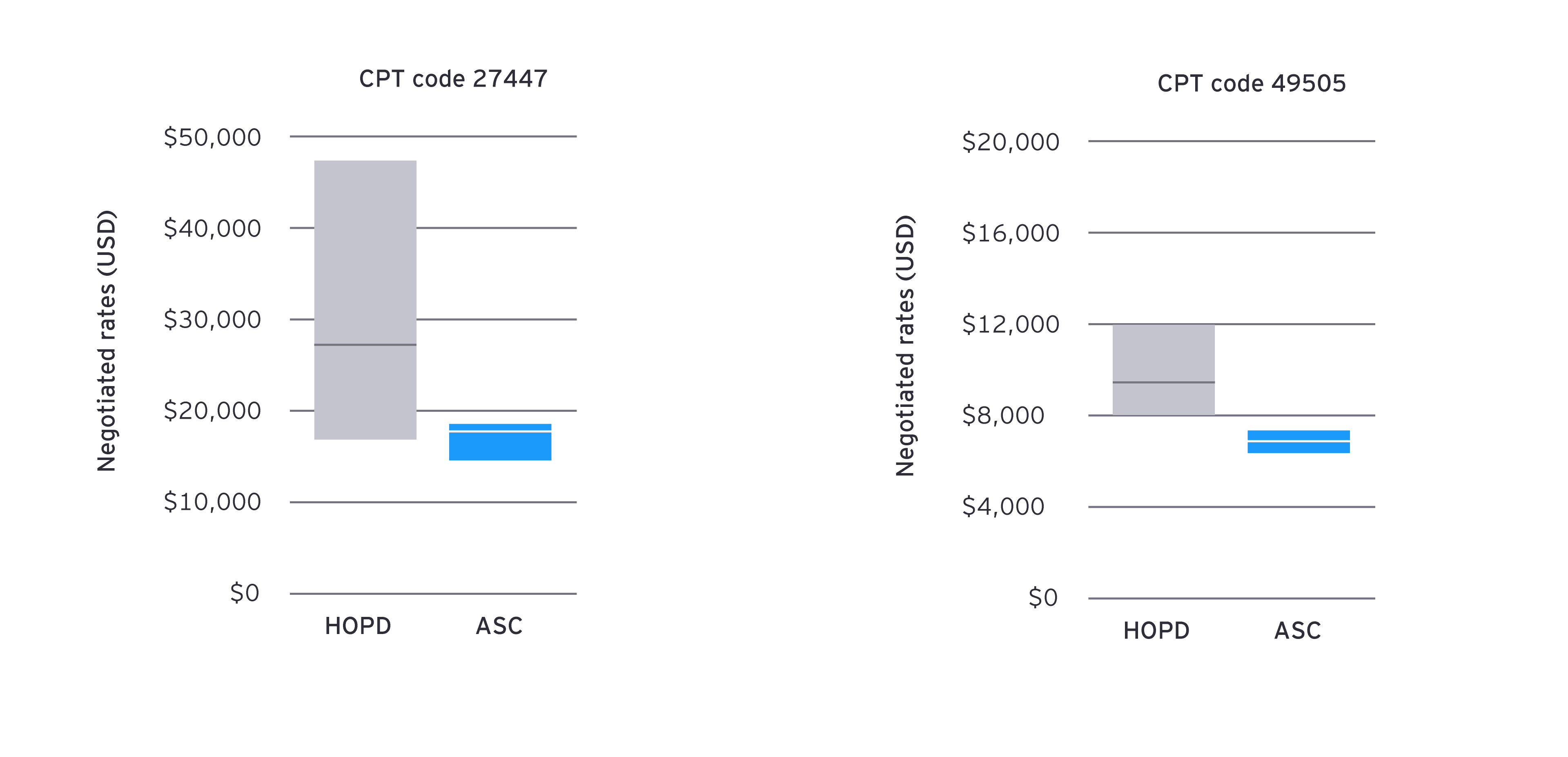
However, lower-acuity care may present economic challenges for certain health organizations, particularly in fee-for-service arrangements. ASC procedural rates, for example, can be 40% to 60% lower than hospital outpatient departments (HOPD) based on Centers for Medicare & Medicaid Services CMS rates. Furthermore, ASC rates can have far less variability, signaling reduced opportunity for price flexibility. Profitability, therefore, requires a fit-for-purpose, efficient operating model.
Chart 2. Commercial negotiated rates for hospital outpatient vs. ambulatory surgery centers for targeted CPTs, Chicago MSA
Source: Trilliant: 2025 Trends Shaping the Health Economy
ADA description: Bar chart comparing hospital outpatient department and ambulatory surgery center commercially negotiated rates for selected CPT codes within the Chicago metropolitan area.
Executing sustainably in ambulatory will therefore be a strategic opportunity and differentiator for payer, provider and non-traditional businesses. Organizations should consider the following effective strategies and investment opportunities for 2026:
Strategic acquisitions. Given the potentially lower capital commitments and regulatory scrutiny, ambulatory transactions can be expected to maintain momentum in 2026. Acquisitions have become a key tool for both incumbent and strategic buyers alike in 2025 as several have compressed, with non-traditional players such as payers and even life sciences companies looking to create their own patient network flywheels via physician practice management and post-acute care deals.
Service line programming. Service line-oriented approaches to ambulatory growth can deliver differentiated results. Mature ambulatory-oriented procedural service lines and programs such as gastroenterology, ophthalmology, plastic surgery and general surgery continue to offer sound returns. However, musculoskeletal and now cardiovascular procedures are seeing an increased push out of the hospital into ASCs, presenting unique opportunities to capitalize on the trends. Progressive organizations are reprogramming ASCs to focus on synergistic specialties to maximize margin.
Insourcing and performance improvement. Mature provider organizations are building enhanced ambulatory and post-acute capabilities in-house, no longer relying on outside operators to support their networks. Entities accomplish this by strengthening organizational leadership around ambulatory and executing targeted performance improvement programs. Organizations are also executing a range of initiatives to elevate financial returns. These include expanding the role of advanced practitioners, strategically managing implant and supply expenses, infusing technology into access and workflows and re-evaluating staffing models.
Value-based care investment. Primary care remains a strategic opportunity, especially as the US continues to deliver lower-value care and lag peer countries in primary care access and utilization.2 Given the more challenging fee-for-service economics, payers and providers continue to evaluate risk-bearing reimbursement models to drive success. Organizations have succeeded through market density, technology- and analytically-enabled workflows, patient engagement and cultural fit among provider practices.
Partnerships and joint ventures (JVs). While several post-acute JVs dissolved in 2025, partnerships remain a well-used growth option at a time when capital remains costly. Operating partnerships in urgent care, ambulatory surgery, freestanding imaging, home health, micro-hospitals, rehab and behavioral health continue to present opportunities for traditional and non-traditional provider organizations.
2) Novel benefit cost containment strategies for employers across the sector
Managing benefit costs proactively will be a key opportunity in the healthcare sector in 2026, as surging costs continue to erode the capital available for strategic investment. Healthcare premiums are projected to rise at an unprecedented rate in 2026. Employers are facing an average premium increase between 6% - 9%,2 marking the largest rise in over a decade. Small businesses are expected to see an even steeper increase of 11%.3 Many employers are absorbing rising premium costs, rather than passing these costs onto their employees. Small and mid-sized employers (those with fewer than 1,000 workers) are particularly affected by these rising costs.3 Regardless of the cost increases, employers remain focused on providing competitive benefits to attract and retain top talent.
Chart 3. Average worker and employer premium contributions for family coverage (2019-2025)
Sources: KFF; BLS; Take Command Health; EY-Parthenon analysis
ADA description: A bar chart displaying the average premium contributions for family health coverage by both workers and employers from 2019 to 2025. It highlights a steady rise in benefits costs, with employers' share increasing more rapidly than employees.
Benefits costs have risen at 5% compound annual growth rate (CAGR) since 2019, with employers’ contribution outpacing employees’ significantly (6% vs. 2%, respectively). Employers’ contribution averages $20,000k in 2025, up 33% since 2019. Over the same period, employees’ contributions have only risen $1,000k to $7,000k on average in 2025.
Employers have innovative health cost containment opportunities in 2026 to drive margin growth and free cash flow:
Alternative funding models. Level-funded options that blend fully insured and self-funded models present opportunities to improve cost predictability for employers, especially when coupled with measures such as stop-loss protection and surplus refunds. Self-funding arrangements can also help employers better manage their healthcare expenses more directly.
Individual coverage health reimbursement arrangements (ICHRAs). ICHRAs are on the rise, with a growth rate of around 20% from 2024 to 20253 and notably high adoption among small employers. This trend is likely to persist due to unstable costs in fully funded employer plans and a new workforce generation seeking more customized benefits. Barriers to adopting this model remain, including employee abrasion, broker acceptance and regulatory volatility.
Technology-driven platforms and services. Technologies that facilitate cost containment and offer clear, data-backed return on investment (ROI) are a strategic opportunity to manage benefit costs. Scalable solutions that streamline administration and empower employers to manage healthcare expenses more proactively have notable potential for impact. Platforms focused on containing costs within targeted areas, such as disease states or out of network claims, are showing promise in generating quantifiable return on investment.
3) Strategic AI investments to drive access and efficiency for payers and providers
AI is continuing to grow across industries; in the health sector, its adoption is over double the blended rate across the rest of the US economy.4 AI is proving to be a powerful tool to address challenges across the health value chain: administrative burdens, operational inefficiencies, convoluted revenue cycle processes, persistent workforce shortages, heightened demand for personalized care, and provider burnout.
Chart 4. Share of US businesses with paid commercial licenses for AI applications (2023 – 25)
Source: Menlo Ventures: The State of AI in Healthcare (2025)
ADA description: Line chart showing the percentage of US businesses with paid commercial licences for AI applications from 2023 to 2025. The chart highlights that healthcare sector organizations have a higher adoption rate compared to the wider economy, with health systems reaching 27% and payers at 14% over the past two years. The data illustrates a sharp increase in uptake within the health sector, which has grown roughly three times faster than other industries since September 2023.
US healthcare sector organizations outpace the broader economy in adoption rates of AI applications. This trend has been accelerating since September 2023, with health sector uptake growing at approximately three times the rate of the broader economy. Health systems in particular show a very high adoption rate (27%), with payers at the lowest rate (14%) over the past two years.
Payers have significant opportunity in 2026 to use AI to improve their financial performance and free cash flow across key applications:
Administrative process automation. Generative AI (GenAI) can automate routine tasks such as claims processing, billing and coding, converting data into actionable information and mitigating manual intervention. This automation not only accelerates workflows and reduces administrative overhead, but also lowers the risk of errors and denials, leading to more efficient revenue cycle management. This can help enhance resource allocation, improve accuracy in documentation and ultimately drive down operational expenses while improving overall productivity.
Personalization in benefits design and member engagement. By analyzing large volumes of existing member data, AI can identify individual member needs and preferences, allowing insurers to tailor benefits, send targeted wellness reminders and provide proactive outreach through virtual assistants and personalized communication, ultimately improving satisfaction and health outcomes.
Providers have key opportunities to consider in 2026 to infuse AI across the patient journey to drive access, growth and improved margins:
Clinical workflows. AI can assist providers in tracking, assessing, diagnosing and recommending treatments based on unstructured medical data and images. This includes applications in clinical documentation, medical imaging and diagnostic processes.
Patient engagement. AI can enhance interactions through virtual assistants, symptom checkers and educational resources, improving access as well as the overall patient experience.
Revenue cycle management. AI can significantly reduce administrative burdens by converting unstructured data into usable information, streamlining processes such as prior authorization, billing, coding and denial management.
4) Opportunistic regional network M&A to enhance scale for providers
While regional health system mergers and acquisitions (M&A) scaled back in 2025, academic medical centers (AMCs) have sustained transaction activity. They have faced mounting pressures, which are expected to persist in 2026. Reimbursement, labor shortage and cost inflation headwinds are compounded by the need to invest in leading clinical programs, recruit outstanding provider faculty, and sustain research and educational missions. Expanding acute care networks has been effective in alleviating AMCs’ inpatient capacity constraints, which have persisted due to the increasing acuity of the patient populations they serve. M&A has unlocked patient volume growth and enabled strategic bed management while also preserving complex care at flagship hospitals.
Chart 5. Bed utilization for top 20 academic medical centers by staffed bed size (2025)
Sources: Definitive Healthcare, JAMA, EY-Parthenon analysis
ADA description: This chart displays bed utilization rates for the 20 largest US academic medical centers by staffed bed size in 2025. It demonstrates that these AMCs have maintained high bed utilization, with many exceeding the 80%-85% threshold commonly used for strategic planning. While inpatient volume growth has been modest, the chart shows that higher patient acuity has led to sustained utilization levels, underscoring ongoing capacity challenges and the need for strategic management of inpatient resources.
The largest US AMCs have continued to see high bed utilization. While inpatient volume growth has been modest, higher acuity has resulted in sustained utilization. Many large AMCs have exceeded the 80%–85% bed utilization threshold commonly used for strategic planning.
M&A initiatives will continue to enable regional health systems and AMCs to enhance scale, reduce costs to serve patients and manage capacity strategically in 2026:
Targeted hospital network acquisitions. By expanding their brand “halo” to acquired community hospitals, AMCs can amplify the number of patients served while continuing to fuel utilization of their higher-end tertiary and quaternary services. While health system M&A has stalled in the current capital and regulatory environment, AMCs have been able to persist given their structural, financial and strategic differences with their community health system counterparts.
“Hub and spoke” operating model development. M&A can fuel transformative operating model shifts for AMCs that help them better serve their patients and communities. By augmenting flagship AMCs with community hospitals, health systems can deliver inpatient care in more cost-effective sites. Furthermore, community hospitals gain an opportunity to transfer higher-acuity patients to leading AMCs in a way that is seamless and prevents patient leakage. Successful execution of these models requires reevaluation of organizational structure and operating mode, but improves margins and unlocks free cash flow.
Program and service reallocation. Realizing the full benefit of regional health system M&A requires strategically repositioning services across campuses. One illustrative example is repositioning general medicine capacity to a community campus and backfilling at the AMC with higher-end services such as bone marrow transplant (BMT) or cardiothoracic surgery services. Success in these efforts requires physician sponsorship and directives, care pathway realignment, technology and infrastructure facilitation, and clear execution governance.
Conclusion
The healthcare sector outlook for 2026 is shaped by both persistent challenges and compelling opportunities. As organizations continue to navigate headwinds, strategic adaptation will be crucial to optimize economic returns and free cash flow. The ongoing migration to lower-cost care settings, investments in value-based and AI-driven solutions, proactive benefit cost management, and targeted regional M&A activity represent key levers for growth and transformation. Leaders who embrace these trends and implement agile, sustainable operating models will be best positioned to unlock value and resilience in the evolving healthcare landscape.
Andy Bechtel, Barry L Lambert, Alex Moss and Ashley Arigoni from EY-Parthenon contributed to this article.
The healthcare sector outlook for the US heading into 2026 remains dynamic, as organizations navigate high utilization and a complex mix of financial, operational and regulatory challenges. Leaders in the healthcare sector can promote growth by expanding lower-acuity care, managing benefit costs, and pursuing targeted AI investment and M&A strategies.