Innovative medical research on cancer treatment in personalized medicine healthcare lab scientific exploration

How biopharmas can better integrate pre-commercial acquisitions

Acquiring pre-commercial assets is critical to fill biopharma development pipelines. The deals require a tailored integration approach.


In brief
  • Patent expirations and new emerging therapies have increased the need for biopharma companies to acquire pre-commercial assets to fill their R&D pipelines.
  • Most of these acquisitions fail to meet expectations, underscoring the need for a bespoke integration playbook for pre-commercial M&A.
  • EY-Parthenon teams have identified and helped companies focus on several areas in the M&A process to help make acquisitions of these assets more successful.

Biopharma companies are increasingly looking to M&A for the next potential blockbuster treatments, and pre-commercial treatments are increasingly the asset of choice. However, according to EY-Parthenon analysis, about 70% of acquired early-stage assets analyzed did not meet deal expectations, either because they failed or were abandoned in clinical trials or fell short of sales targets post-launch.

One reason is that the “standard” integration playbook is not fit for pre-commercial acquisitions. Missteps can include either fully integrating, which can stifle the target company, or leaving the acquisition fully standing alone, which can lead to gaps in capabilities, a lack of funding, and unmitigated operational and development issues.
 

To help improve the success of pre-commercial acquisitions, corporate development and integration teams need to rewrite their playbooks to consider the unique elements of these deals. Particular emphasis should be placed on the functional operating models and where the acquirer’s capabilities will support the needs of the newly acquired in-development assets and teams. This can help increase opportunities for a successful approval and launch.

The growth of pre-commercial M&A in biopharma

By 2030, inorganic growth strategies — including acquisitions, joint ventures and licensing agreements — are projected to account for about 67% of revenue for the top 25 biopharma companies, according to EY-Parthenon analysis. 

A key reason is that companies need to restock development pipelines in the face of the “patent cliff.” Blockbuster drugs worth an estimated $230 billion in annual sales are set to lose exclusivity by 2026 to 2029, creating enormous revenue gaps.1

Pre-commercial companies also drive growth in new modalities. For example, pre-commercial companies are the largest drivers of pipeline growth in both cell and gene therapies (CGT) and custom therapies. Larger pharma companies interested in entering these spaces are expected to acquire much of their pipeline as external assets reach clinical validation. 

Biopharma has seen an increase in pre-commercial acquisitions. Over the past three years, these deals have accounted for more than 60% of deal volume as companies look to replenish pipelines, achieve speed to market and gain early access to emerging therapeutics across a wider spectrum of modalities and therapeutic area capabilities.

Unfortunately, the vast majority of these acquisitions fail to meet expectations. (See Figure 1.)

Figure 1

Source: EY-Parthenon analysis of Capital IQ and Evaluate Pharma data.


The reasons for failure can vary, but EY-Parthenon teams have seen clients struggle with a spectrum of issues. Some are biopharma specific, while others are common in any deal but potentially more detrimental in biopharma deals. Some of the most common challenges we’ve seen fall under six categories, ranging from diligence and clinical trial design to scalability and oversight. (See Figure 2.)

Figure 2


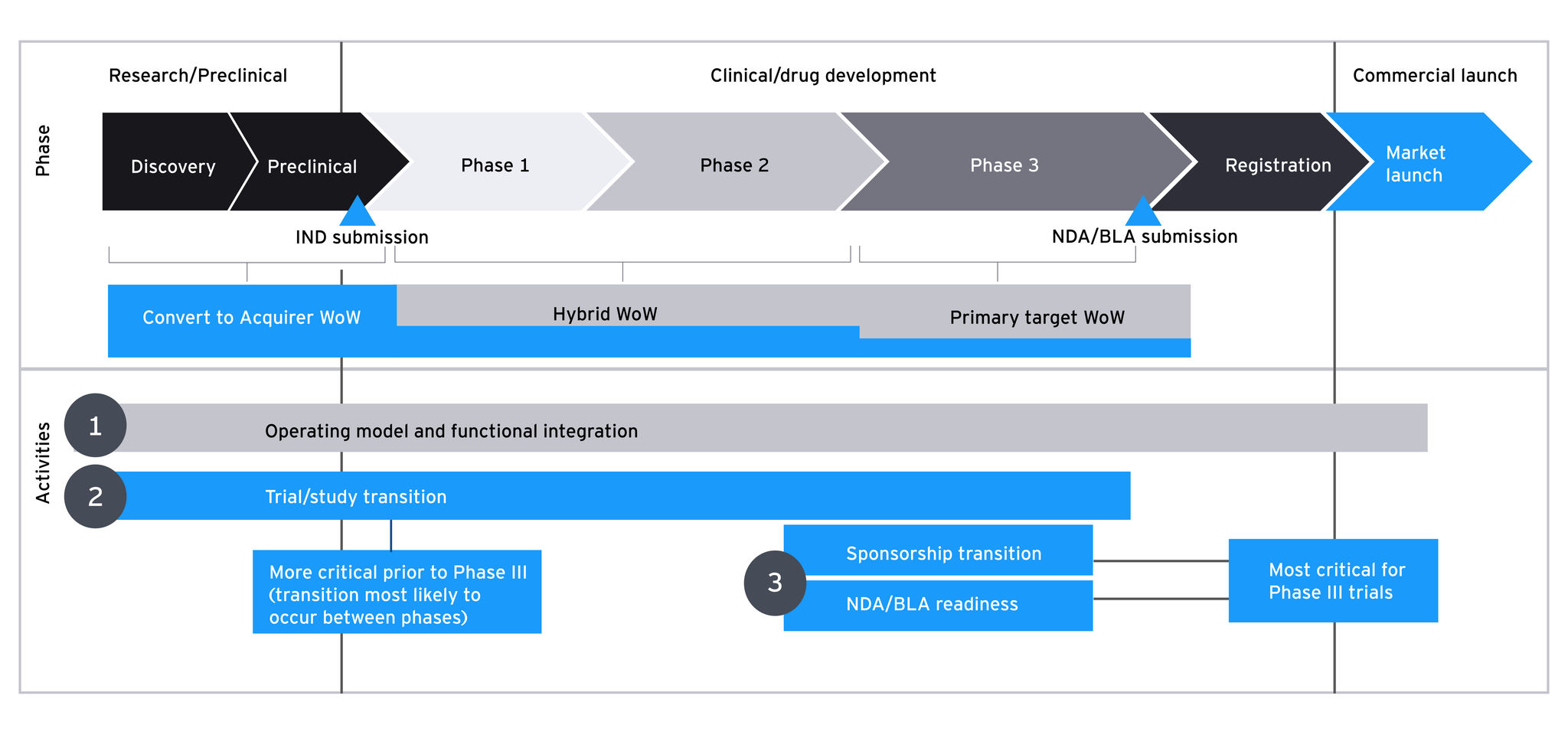
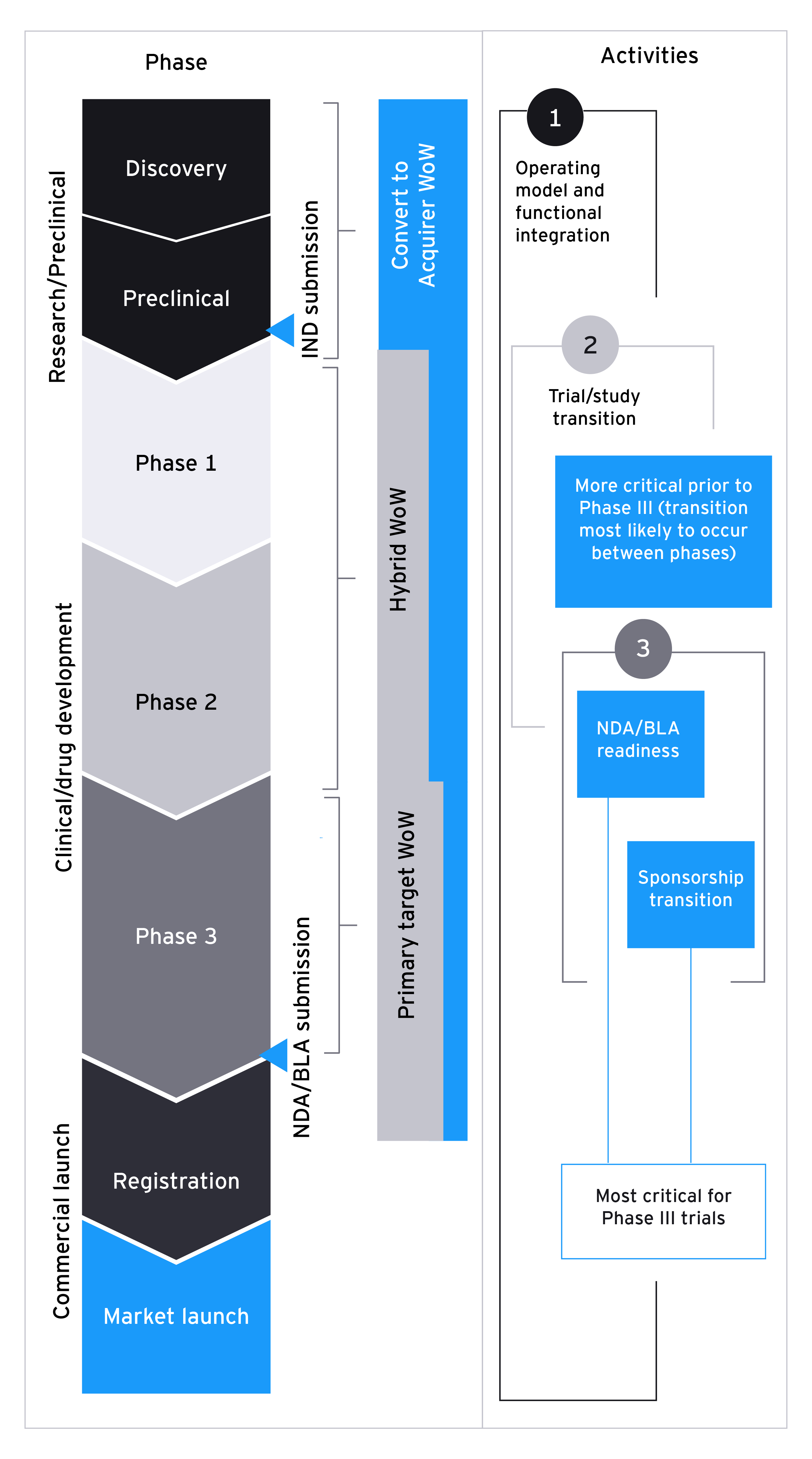
Addressing these issues requires a tailored approach, with a particular focus on functional operating models, trial and sponsorship transition, and new drug application or biologics license application readiness. How these three areas are addressed will depend on the phase of the assets being acquired. (See Figure 3.)

Figure 3


Functional operating model

For pre-commercial assets, it’s essential for acquirers to determine the functional operating models to understand what will remain unchanged and what will be reinforced with the acquirer’s capabilities to support the R&D process. A leading practice is to have an operating model hypothesis developed during the pre-sign and sign-to-close phases. More detailed transition state and end state operating models are often developed post-close when there is more access to the target. This understanding of each function’s target operating model becomes the blueprint for planning trial and sponsorship transition. Iterative in nature, the operating models can expect updates to reflect findings from the trial and sponsorship transition strategies. Done well, trial and sponsorship transition work validates that the planned operating model will not hinder the trials. 

Defining the functional operating model involves determining the ways of working that the combined company will use by function for its people, processes, systems and data, and vendors and third-party contracts. EY-Parthenon teams typically approach this process by first mapping out the current state, then deciding what the end state should be, and finally, working backward to understand what interim states are necessary.
 

Many companies attempt either stand-alone or fully integrated models for their end state. For pre-commercial assets, we now see companies increasingly leveraging hybrid operating model approaches, which entail a mixture of target and acquirer ways of working. Still, some functions should experience a higher degree of integration than others. For example, quality and certain back-office functions, such as finance, HR and IT, tend to be integrated more quickly and fully into acquirer ways of working than R&D functions, such as development. This approach reflects the compliance, standardization and synergistic benefits of consolidating where possible while preserving the target’s unique knowledge in the R&D process and mitigating risks to business continuity. Functions such as clinical development, operations and regulatory require a nuanced approach that assesses capabilities and the integration strategy. To address strategic decision-making and resolution of issues, such as an anticipated shortage and clinical trial supply, we recommend a joint governance structure in areas where the target remains unintegrated. 

Overall, there is no fixed standard approach, and each acquisition will have nuances. Some examples:

  • Even slower integration within R&D may occur for an acquirer entering a new therapeutic area or modality. 
  • Faster integration of the people and organization, including knowledge transfer, may need to occur if it is decided that quick consolidation at the leadership level or other roles within the target should occur to support synergies. 
  • Acquisitions of new therapies that the buyer lacks expertise in will also require a more thoughtful approach, where enhanced capabilities, such as manufacturing, come through a specialized CMO if the buyer does not have the knowledge and capabilities. 

Trial transition

The acquirer should make sure that each trial is successfully transitioned, leveraging its scale and resources to support and fill the target’s operational gaps where applicable and protecting original target infrastructure elsewhere. This does not mean that significant changes need to occur in every trial transition. In fact, particularly with in-flight trials in Phase 2 or Phase 3, acquirers need to be mindful of the changes they make so that no trial disruptions occur from the acquisition. Where possible, it is ideal to transition between phases to reduce this risk, focusing integration activities around developing interim governance structures, enhancing knowledge transfer and supplementing interactions with health authorities or opinion leaders. Each trial is different, and thus, each should receive its own tailored trial transition plan. 

Factors that often drive how clients transition trial ways of working include the following:

  • Protocol accuracy and quality – Verify that protocols deliver sufficient data packages and address any dosing or design gaps proactively.
  • Quality standards and Good Clinical Practice (GCP) – Prepare to integrate into the acquirer’s quality management system (QMS), including supplier management, policies and procedures, and oversight, while establishing access to data, applications and transition of key databases, such as the safety database. Review processes for recording and reporting of trials to verify that ethical practices and scientific quality standards are being met. 
  • Capabilities and capacity – Identify areas that would benefit from reinforcement available through the acquirer’s vendors, HCP network or functional capabilities in order to achieve new trial and launch ambitions. Establish sufficient communication to sites, investigators and patients of any changes while driving knowledge transfer to mitigate risks.
  • Attrition risk – Evaluate potential resource attrition risks across critical roles; implement contingency plans to maintain continuity and avoid delays. 
  • Governance and decision-making – Establish processes that give the acquirer visibility and input into key decisions around the trial, particularly if the entity remains a largely stand-alone organization.

Preparing for regulatory submission

Clinical trial sponsorship transition and new drug application (NDA)/biologics license application (BLA) readiness are among the tasks that need to be addressed to prepare for regulatory submission.

Acquirers should determine if their choice of acquirer branding, target branding or co-branding will drive a need to transition sponsorship. For Phase 3 assets, the timing of any sponsorship transition should be carefully planned around NDA/BLA submission and launch activities. 

There are several factors that biopharma companies should consider when planning sponsorship transition prior to market approval submission:

  • Legal entities (LEs) and existing sponsors – Understand from a tax perspective which target LEs will be dissolved, which LE will own the intellectual property (IP) and how that will affect the LE’s availability for sponsorship by country.
  • Clinical data and evidence – Plan for resulting impacts on scientific and ethical reviews, such as institutional review boards (IRBs), and their approvals. Consider the timing for updates needed to documentation, such as informed consent forms (ICFs), trial master files (TMFs), Investigational Medicinal Product Dossiers (IMPDs) and required database transitions. Evaluate and refine clinical data and real-world evidence generation plans to confirm that there is consistency, relevance and compliance. Prioritize protocol amendments and build them into sponsorship timelines.
  • Labeling and supply – Manage sponsorship name change impacts, including verifying that all clinical supply is properly labeled with the correct sponsor by trial and country.
  • Health authority (HA) engagement – Maintain clear communication with HAs so that guidance is integrated; for sponsorship transitions, build approval timelines by trial and country to capture nuances. If the acquirer will interact with the HA to support the NDA/BLA submission, the acquirer will require significant knowledge transfer in preparation, including a structured approach to:
    • Develop a comprehensive understanding of previous submissions, such as the investigational new drug (IND), and identify and disposition all data (structured, unstructured and physical) as this is the catalyst for knowledge transfer.
    • Define a joint quality and regulatory plan to understand roles, responsibilities and decision-making rights while operating in a hybrid model, including co-owned plans for an audit and U.S. Food and Drug Administration (FDA) inspection.
    • Perform a gap analysis on document-level gaps, risks and limitations. Document reviews should be expansive, including the Investigator’s Brochure (IB), clinical study report (CSR), TMF, standard operating procedures (SOPs), monitoring visit reports, IT systems, third-party contracts and delegated accountabilities.
    • Transfer the knowledge on the documentation, how decisions were made, and what deviations were experienced to the acquirer and pressure test understanding with target colleagues.
    • Leverage the acquirer’s quality function, with close collaboration with regulatory, to confirm the knowledge transfer is sufficient to prepare for inspections and requests.

Case study: Integrating a pre-commercial rare disease asset 

A biopharma company, focused on rare diseases, was acquiring pre-commercial assets to fill its pipeline. The acquirer, which had limited integration experience, was focused on continuity of clinical trials, regulatory compliance and trial sponsorship transition planning prior to a rapidly approaching FDA submission deadline for the Phase 3 asset. It also had organizational synergy targets to meet while still hitting the proposed market launch date.

EY-Parthenon teams helped the client set integration priorities, develop day one readiness plans, establish a consolidated integration work plan and support knowledge transfer. They also developed a timeline and work plan for sponsorship transition, including four trials in more than eight countries, protocol amendments that increased dosages and required additional inventory, and legal entity structure and supply chain considerations. Lastly, they led synergy validation, creating a forecast based on financial statements and executive interviews, and incorporated the results into the client’s annual operating plan process.

Despite several challenges, such as data migration, system access delays and resource constraints, the client was ready for day one, as it had established a repeatable integration governance model, successfully developed a sponsorship transition timeline for BLA filing and commercial launch, and identified a 36% reduction in pre-acquisition OpEx, exceeding synergy targets.


Adam Berman, Frank Schropfer, and Kathy Harcourt from EY-Parthenon contributed to this article.


Summary 

Acquiring pre-commercial assets is an increasingly important objective for biopharmas looking to augment their R&D pipelines. But these assets require a different integration process than typical M&A. Avoiding a fixed standard approach and taking bespoke steps to integrate these assets can help improve the chances of a successful acquisition.

About this article

Authors

Related articles

How AI in biopharma drives mission‑focused growth

AI accelerates biopharma innovation and growth.

How AI Can Enable a Continuous Biopharma Deal Radar

AI-powered deal radars help biopharma firms continuously spot, assess, and prioritize early-stage acquisition targets to strengthen R&D pipelines.

Macro Bites: Life sciences adapt to a new economic paradigm  

Macro Bites: Tariffs on active pharmaceutical ingredients spark transformation in life sciences. Learn more.